
Bunion exercises and physiotherapy
What is a bunion?
A bunion is a hard, bony lump on the inside of the foot at the base of the big toe. Behind it is a slow drift of the big toe in toward the smaller toes, which doctors call hallux valgus. OrthoInfo, the patient site of the American Academy of Orthopaedic Surgeons, calls it a progressive condition. In plain terms, it tends to change slowly over the years rather than settle by itself.
According to the NHS, the lump is usually the first thing you notice, often with the big toe pointing toward the others. The skin over it can be hard or swollen and look red or darker than the skin around it. Pain tends to be worse in shoes and when you walk. OrthoInfo also mentions calluses, and a stiff big toe that does not move as far as it should, which can make walking harder.
The cause is not always clear. The NHS links bunions with shoes that do not fit properly. OrthoInfo notes that they often run in families and are more common in women, and that inflammatory conditions such as rheumatoid arthritis make them more likely.
What exercise can and cannot do for bunions
Exercise is unlikely to straighten a bunion, and the same goes for splints and toe spacers. In 2022, Hurn and colleagues reviewed 18 studies of nonsurgical treatment. Where they could pool the results, for foot orthoses, splints, manual therapy or taping added to foot exercises, none made a clear difference to pain or to the angle of the big toe. They rated the certainty of the evidence as low, and concluded that less pain is more likely than a straighter toe.
Some single studies in the review did report less pain, for example with foot exercises plus taping, or with a physio program that combined several treatments. A few also found a smaller big toe angle after night splints, foot exercises or physio programs, but the evidence is too weak to promise that. This program sets more modest goals: a big toe that bends more easily, stronger small muscles in the foot, a more flexible calf and steadier balance. Give it several weeks before you judge whether your pain has changed.
Shoes, pads, toe spacers and splints
Start with your shoes. Choose wide ones with a soft sole and a low heel, as the NHS suggests, and skip high heels and tight, pointy shoes. The NHS also lists bunion pads, an ice pack wrapped in a towel held on the bunion for up to 5 minutes at a time, painkillers, and losing weight if you are overweight. If you are unsure whether a painkiller is safe for you, check with a pharmacist.
Think of toe spacers, splints or insoles as comfort aids. A podiatrist can help you choose, and the NHS says you may be able to refer yourself to one without seeing a GP. Braces and splints have not been shown to fix a bunion for good, according to OrthoInfo. If one rubs or leaves the joint sorer, stop using it.
How to use this program
Choose the stage that fits how your foot is now. If you cannot decide, begin at stage 1, and move up once the stage you are on feels easy and the big toe feels no worse the morning after. If most of your pain is under the heel, the plantar fasciitis program may be a better fit. For an arch that aches or seems to be dropping, see the flat feet program.
Stage 1 should not hurt at all. In stages 2 and 3, a little discomfort while you exercise is usually fine, as long as it fades soon afterwards and the foot is no worse by the next morning. A bunion that is clearly sorer the next day tells you the load was too much. Drop back a step rather than stopping everything.
A typical calf stretch is a hold of around 30 seconds, repeated 2 to 3 times per leg, once or twice a day. For the foot strength work, many programs begin with 1 to 3 sets of 10 to 15, or 2 to 3 lengths of the towel. Calf raises often start at 2 to 3 sets of 10 to 15. You will find a typical starting dose on each exercise page, and your physio will adjust the numbers to your foot and your goals.
If you have diabetes or numb feet, look closely at the skin on both feet once each session is over. Get the go-ahead from your doctor, podiatrist or physio before you try anything that presses or rolls on the sole. If your balance feels shaky, hold on to a counter or wall for the standing exercises.
The exercise program
Stage 1: Loosen the big toe and calf
Use this stage if the big toe joint is sore or stiff, and for the first weeks of the program. The plantar fascia stretch pulls the big toe back along with the other toes. That is the bend the joint makes every time you push off that foot to take a step, so ease into it and stop short of any pain at the bunion itself. Toe curls move all the toes without putting weight through the foot. Stretch the calf with the back knee straight, then with it bent for the soleus stretch, and keep this whole stage pain free.
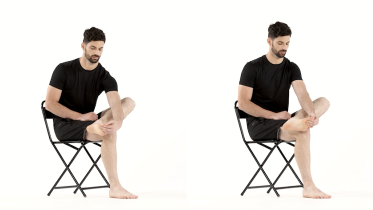 Plantar fascia stretch
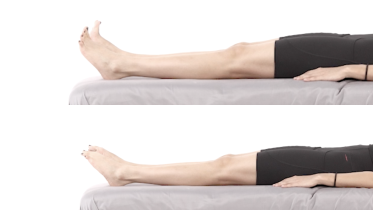 Toe curls
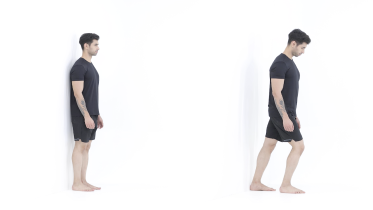 Calf stretch
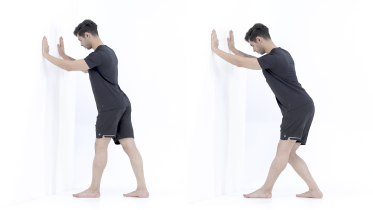 Soleus stretch
Stage 2: Build strength in the foot and calf
Move on once stage 1 is easy and the big toe feels no worse the morning after. Towel scrunches and towel sweeps, done sitting, train the small muscles in the sole of the foot. The toe spread needs no equipment: sit with your feet flat, lift all your toes and spread them as wide as they go, then put them down still spread and try to ease the big toe away from the second toe. Hold for a few seconds and relax; many programs start with about 10 slow repetitions, once or twice a day, and your physio will adjust this. Then add calf raises, rising only as high as the big toe joint allows without sharp pain, with your weight over the big toe and second toe rather than rolling out toward the little toes.
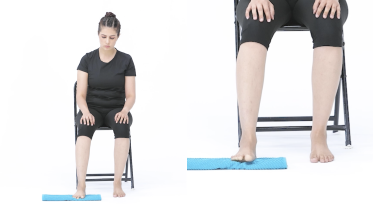 Towel scrunches
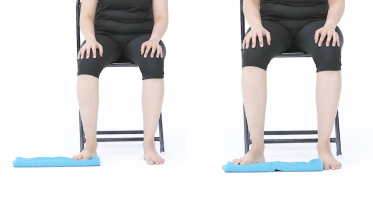 Foot towel sweeps
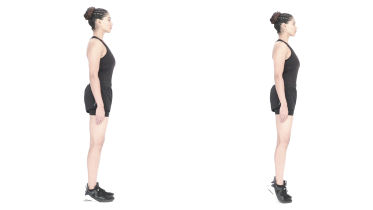 Calf raises
Stage 3: Balance for longer walks
Start balance work when 2 to 3 sets of calf raises on both feet feel easy and walking is more comfortable. Standing on one leg (single leg stance) and standing heel to toe (tandem stance) train the small balance corrections your foot and ankle make on rough or uneven ground. Hold a counter or the back of a chair until you feel steady. Wear flat shoes that fit well and grip the floor, not socks, tights or bare feet. With a bunion, pick a pair with a wide toe box that does not press on the lump.
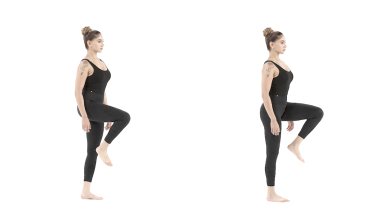 Single leg stance
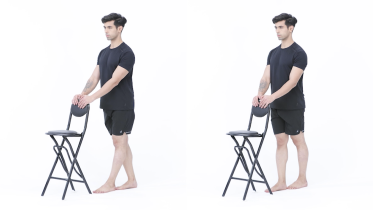 Tandem stance
When to see a physio or doctor
The NHS suggests seeing a doctor if a few weeks of home treatment have not eased the pain, if the pain stops you doing your normal activities, or if the bunion is getting worse. If you have diabetes, see a doctor about your bunion anyway, because foot problems can be more serious with diabetes. A physio or podiatrist can test how far the big toe bends, tell you which stage to start at, and help with shoes and padding.
Surgery is for bunions that are very painful and have a big effect on your life. The most common operation, the NHS explains, removes the bony lump, straightens the toe bone and fixes it with metal screws or staples. Recovery is slow. The NHS mentions no driving for 6 to 8 weeks, 2 to 12 weeks off work and no sport for 3 to 6 months. After bunion surgery, follow the rehab plan from your surgeon's team instead of this page.
Not every pain near the big toe is a bunion. Gout usually comes on suddenly: the joint, most often the big toe, becomes very painful and swollen, and the skin over it is hot and red. A big toe joint that stiffens and hurts without the toe drifting over may be hallux rigidus, which is a different problem. Burning or tingling in the ball of the foot or between the toes suggests something else again, such as Morton's neuroma. Each of these needs its own assessment.
For physiotherapists
This is a conservative starting program for symptomatic hallux valgus. It tells patients early that the goals are comfort, first metatarsophalangeal (MTP) joint mobility, intrinsic foot strength and balance, not correction of the deformity. If the presentation does not fit, screen for inflammatory arthritis, a hot, swollen first MTP joint (gout or septic arthritis), hallux rigidus and interdigital neuroma. Refer on for a surgical opinion when pain limits daily life despite footwear changes and exercise.
Hurn and colleagues (2022) included 18 studies of nonsurgical care. Five meta-analyses (foot orthoses, splints, manual therapy, taping added to foot exercises) showed no significant effect on pain or HV angle. In 8 individual studies pain fell with orthoses, night splints, dynamic splints, manual therapy, taping added to foot exercises, a multifaceted physical therapy program or botulinum toxin, and 4 reported a clinically meaningful reduction in HV angle with night splints, foot exercises, multifaceted physical therapy or botulinum toxin. The authors rated certainty as low.
Intrinsic work such as the toe spread in stage 2, or short foot work if you teach it in person, can be progressed from sitting to standing and then single leg stance. Let the 24-hour response at the first MTP joint guide progression, not a fixed sheet. With diabetes or neuropathy, exclude active Charcot foot and skin breakdown before loading, and look at the skin over the medial eminence, where shoes rub.
See a doctor promptly if
- You have diabetes or numb feet, and one foot becomes hot, swollen or red, or changes color or shape, with or without pain. Take your weight off that foot straight away and get advice the same day from your doctor or your diabetes foot team. This can be Charcot foot, where the bones and joints of the foot are damaged and the foot can collapse. Do not exercise that foot until it has been checked. If you also have a fever or feel very unwell, or redness is spreading up your foot or leg, go to an emergency department.
- You have diabetes or numb feet and find a new blister, cut or sore on your foot, especially one you did not feel, a wound that smells or is leaking, or new pain in your foot that you cannot explain. Get it seen by your doctor or foot team the same day. If you also have a fever or feel very unwell, redness is spreading up your foot or leg, or part of your foot or a toe turns black, go to an emergency department.
- Part of your foot or a toe turns cold, pale, blue or black. Call emergency services or go to an emergency department straight away, and do not drive yourself, as the blood supply to the foot may be blocked.
- The big toe joint suddenly becomes hot, red, swollen and very painful, the skin over the bunion breaks and the area around it turns red, warm or starts to leak, or you have a fever or feel unwell. Get medical help the same day, go to an emergency department if you feel very unwell, and do not exercise that foot until it has been checked. A hot, swollen big toe joint can be gout or an infection, which is different from bunion pain. If you have a very high or very low temperature, shivering you cannot control, you are breathing very fast or finding it hard to breathe, you are confused or your speech is slurred, your skin, lips or tongue look blue, gray, pale or blotchy (on brown or black skin this can be easier to see on the palms of the hands or soles of the feet), or you have a rash that does not fade when you press it, call emergency services, as this can be sepsis.
- The pain started with a fall, a knock or a stubbed toe, and the toe is swollen, bruised or a different shape, or you cannot put weight on the foot. Get it checked the same day.
- A calf or thigh that is newly swollen, warm, tender, red or darker than usual, has swollen veins that are sore to touch, or has a throbbing or cramping pain that does not fit your injury or condition, or that feels different from normal muscle soreness after exercise. This can be a sign of a blood clot (deep vein thrombosis), especially after surgery, an injury, time in a cast or boot, a long trip or a spell of being much less mobile than usual. Get medical advice the same day. If you are also short of breath or have chest pain, call emergency services.
- The pain is there at night or at rest as well as when you stand and walk, and it is getting worse. See your doctor within a few days. If you have had cancer, now or in the past, or are losing weight without trying, see your doctor sooner, within a day or two, and mention it. This applies even if the pain is not getting worse. If you are being treated for cancer now, contact your cancer team the same day.
- You have new numbness, tingling, burning or loss of feeling in the foot or toes. Get medical advice the same day.
Common questions
Can exercises fix bunions?
Not if fixing means a straight toe for good. A 2022 systematic review of nonsurgical treatments found only a low level of certainty for any of them, and concluded that less pain is more likely than a change in the angle of the big toe (Hurn and colleagues, 2022). Exercise is still worth doing for a stiff, sore big toe and a weak foot, and some individual studies in that review reported benefits from foot exercises or physio programs. The realistic hope is a more comfortable foot. Its shape will probably stay much the same.
Do toe spacers and bunion splints work?
They can make a bunion more comfortable for some people, but they do not fix it. The NHS lists toe spacers and toe supports (splints) among the things that may ease pain. OrthoInfo, from the American Academy of Orthopaedic Surgeons, says braces and splints have not been shown to permanently fix bunions. If you try one, stop if it rubs or makes the joint more sore.
What shoes are best for bunions?
The NHS suggests wide shoes with a low heel and a soft sole, and advises avoiding high heels and tight, pointy shoes. OrthoInfo also advises shoes with a wide toe box. Bunion pads, soft pads that stop the shoe rubbing on the lump, can help too.
When should you have bunion surgery?
Surgery is for a bunion that is very painful and has a big effect on your life, according to the NHS. OrthoInfo says surgery is considered when pain limits your daily activities despite nonsurgical treatment, and not for the look of the foot alone. The NHS also notes that after surgery the toe can be weaker or stiffer than before and may not be perfectly straight, and that bunions sometimes come back.
References
- NHS. Bunions. Page last reviewed 12 June 2023. https://www.nhs.uk/conditions/bunions/
- American Academy of Orthopaedic Surgeons. Bunions. OrthoInfo. https://www.orthoinfo.org/en/diseases--conditions/bunions/
- Hurn SE, Matthews BG, Munteanu SE, Menz HB. Effectiveness of nonsurgical interventions for hallux valgus: a systematic review and meta-analysis. Arthritis Care and Research. 2022;74(10):1676-1688. https://doi.org/10.1002/acr.24603
- NHS. Gout. https://www.nhs.uk/conditions/gout/
- Diabetes UK. Charcot foot and diabetes. Last reviewed 8 November 2024. https://www.diabetes.org.uk/about-diabetes/looking-after-diabetes/complications/feet/charcot-foot
- Diabetes UK. Serious foot problems and diabetes. Last reviewed 24 December 2024. https://www.diabetes.org.uk/about-diabetes/looking-after-diabetes/complications/feet/serious-foot-problem
Written and checked by the PocketPhysio editorial team. Last updated 2026-09-28.
This page is general education, not a diagnosis or a personal treatment plan. See a physiotherapist or doctor for advice about your own situation.