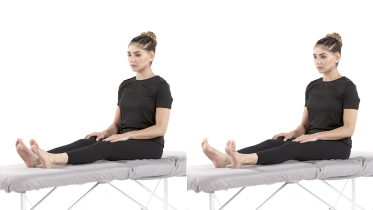
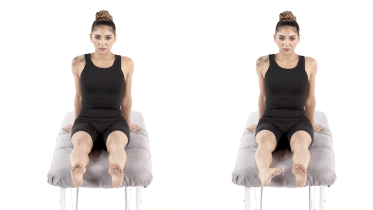
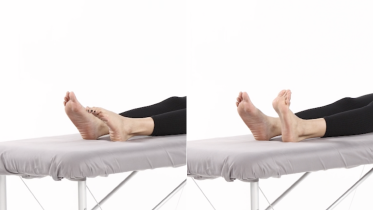
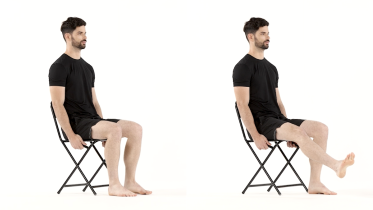
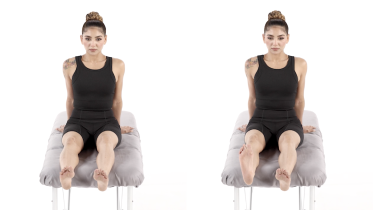
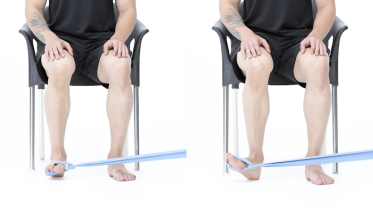
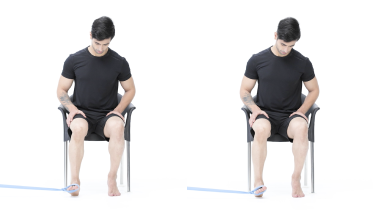
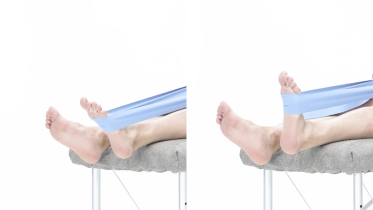
Foot towel sweeps
Foot towel sweeps train the muscles that turn your foot in and out at the ankle, along with the small muscles that grip with your toes. Sitting on a chair, you rest one foot on a towel, keep your heel planted and drag the towel sideways a bit at a time by pivoting the front of the foot. Physios use it in foot and ankle programs, for example after a sprain, as a gentle seated option.
How to do the foot towel sweeps
- Sit up straight on a chair, feet planted hip width apart. Lay a towel flat on a smooth floor, stretched out to the little toe side of the foot you are working.
- Rest the front of that foot on the near end of the towel. Your heel stays on the floor and your knee stays still for the whole exercise.
- Grip the towel with your toes and pivot the front of your foot inward, dragging the towel toward your other foot.
- Let go, swing the front of the foot back out, grip a new section and pull it in again. Carry on until the whole towel is gathered in the space between your feet.
- Then work the other way, as the second half of the video shows: start with the towel on the big toe side and sweep it outward, away from your other foot.
What you should feel
Work along the inside of the shin and ankle as you pull the towel in, and along the outside of the lower leg as you push it out. Your toes and arch work too, from the gripping.
Common mistakes
- Swinging the knee or turning the whole leg from the hip. The movement comes from the ankle and foot.
- Lifting the heel off the floor to reach further.
- Sliding the foot over the towel without gripping it, so the toes do no work.
- Working on carpet, where the towel catches and barely slides.
How often
A usual amount is 2 or 3 passes of the whole towel in each direction, once or twice a day. Your physio will adjust this.
Stop and check with your physio if
- Sharp pain on the inside or outside of the ankle, or in the arch.
- Pins and needles, burning or numbness in the foot or toes.
- Your calf or thigh becomes swollen, warm, tender, red or darker than usual, or has a throbbing or cramping pain that feels different from normal muscle ache. Stop and get medical advice the same day, as this can be a blood clot. If you are also short of breath or have chest pain, call emergency services.
From the clinic
A thin hand towel on tiles or wood is easiest to control. Pulling the towel in works the same direction as ankle inversion with a band, and pushing it out matches ankle eversion with a band, so physios often use the towel version before adding a band. Towel scrunches use the same setup but pull the towel straight back under the foot.
After a recent ankle sprain, keep the inward sweep short and pain free, since that inward turn is the way the ankle usually rolls in a sprain. After an ankle fracture or foot surgery, ask your physio when to start. Diabetes or numb feet? Look at your toes and sole for red marks or rubbing when you finish.
Written and checked by the PocketPhysio editorial team. Last updated 2026-09-26.
This page is general education, not a diagnosis or a personal treatment plan. If you have pain, an injury or a health condition, see a physiotherapist or doctor before starting new exercises.