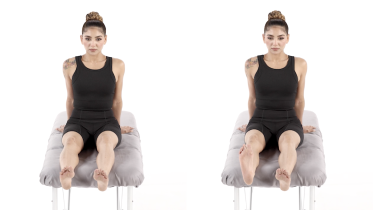
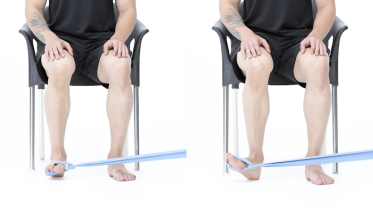
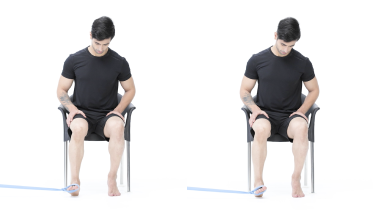
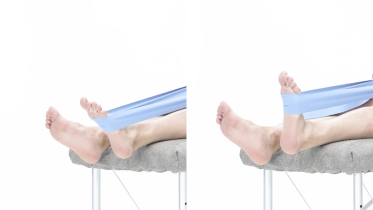
Plantar fascia stretch
The plantar fascia stretch lengthens the thick band of tissue that runs along the sole from your heel to your toes (the plantar fascia). You sit with the ankle of the sore foot resting across your other knee, hold your toes and draw them upward until the arch feels a gentle pull. Physios often give it for heel pain (plantar fasciitis), and many people do it before their first steps in the morning.
How to do the plantar fascia stretch
- Sit up straight near the front of a steady chair, both feet resting on the floor.
- Lift the foot you are stretching and rest that ankle across the knee of your other leg, so the sole turns partly toward you.
- With one hand, take hold of your toes across their base. Your other hand can steady the ankle, as in the video.
- Ease the toes, and the front of the foot with them, up and back in the direction of your shin. Stop when the sole of your foot feels a clear stretch.
- Hold the stretch, breathing normally, then let the toes go and rest before the next one.
What you should feel
A pulling stretch along the arch and into the heel, sometimes with a slight stretch under the toes. If you run a thumb along the arch while you hold, you may feel the band standing out tight.
Common mistakes
- Pulling only on the tips of the toes, which bends them but barely stretches the arch. Hold across the base of the toes.
- Yanking or bouncing instead of a steady pull.
- Slumping or twisting to reach the foot. Sit tall and bring the foot to you.
- Pulling so hard that the stretch turns into pain.
How often
Many programs hold the stretch for 10 to 30 seconds and repeat it 3 to 10 times, up to 3 times a day, with the first round before you stand up in the morning. Your physio will adjust this.
Stop and check with your physio if
- Sharp or tearing pain under the foot or heel, or a pop followed by bruising.
- Tingling, burning or numbness spreading into the sole or toes.
- Your calf or thigh becomes swollen, warm, tender, red or darker than usual, or has a throbbing or cramping pain that feels different from normal muscle ache. Stop and get medical advice the same day, as this can be a blood clot. If you are also short of breath or have chest pain, call emergency services.
From the clinic
If resting your ankle on the other knee is awkward, some physios suggest sitting with the leg out straight and looping a towel or strap around the ball of the foot and toes to draw them back. The stretch is often paired with a calf stretch or a water bottle foot roll, and the plantar fasciitis program shows the order. People with diabetes or numb feet should check the skin of both feet every day, and get advice from their doctor, podiatrist or physio before rolling or pressing on the sole. After surgery on the foot, ankle or Achilles tendon, ask your physio before you start, because drawing the toes and foot back also stretches the calf and the Achilles tendon.
If you have had a hip replacement, get the go-ahead from your surgeon or physio before you try this exercise. Lifting your foot onto the opposite knee bends that hip and turns it outward, and many surgeons ask you to avoid that for the first months after some operations.
Written and checked by the PocketPhysio editorial team. Last updated 2026-09-26.
This page is general education, not a diagnosis or a personal treatment plan. If you have pain, an injury or a health condition, see a physiotherapist or doctor before starting new exercises.