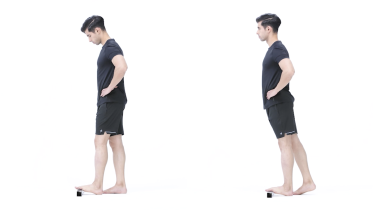
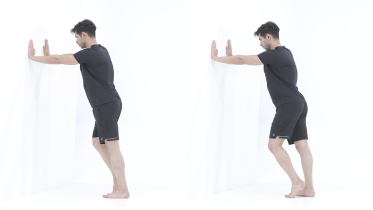
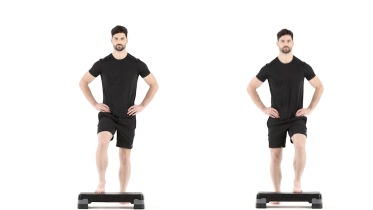
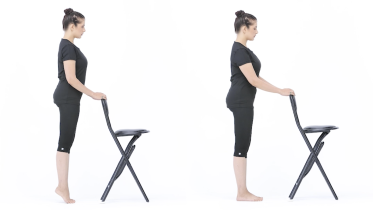
Heel raise with towel under toes
This is a heel raise on one leg, standing on a step with a rolled towel under your toes and your heel hanging off the edge. The towel lifts your toes, so the band of tissue along the sole (plantar fascia) is drawn tight as you rise, while the calf does the lifting. It is a heavy exercise, and some programs for heel pain (plantar fasciitis) bring it in once heel raises on both feet feel easy.
How to do the heel raise with towel under toes
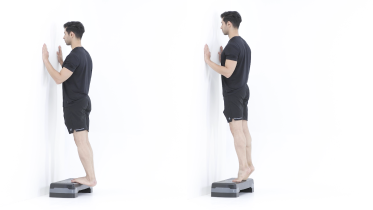
- Roll a small towel into a tube. Place a sturdy step close to a wall and lay the towel across the step, on the side nearest the wall.
- Step up facing the wall, both hands resting on it. Shuffle backward so your heels overhang the rear edge of the step, with the toes of the working foot propped up on the rolled towel.
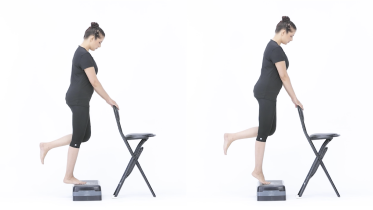
- Bend the other knee to lift that foot behind you. Your weight is now on the working leg, and its knee stays straight.
- Lift your heel and push up through the front of the foot, only as far as you can go smoothly, then hold the top briefly.
- Lower the heel slowly back down over the edge of the step, knee still straight, then rise again.
What you should feel
Hard work in the calf of the standing leg, and a stretch along the sole as your toes are lifted. The calf often burns by the last few repetitions. Mild discomfort under the heel can happen, but it should not be sharp and should settle soon after you finish.
Common mistakes
- Letting the standing knee bend as you rise, which takes the work away from the calf.
- Rushing. Each repetition should take several seconds up and several seconds down.
- Letting the toes slide off the towel, so they are no longer lifted.
- Pushing hard through your hands, so the arms carry the weight instead of the leg.
How often
A common approach for heel pain is a slow tempo: about 3 seconds up, a 2 second hold at the top and about 3 seconds down. Many programs start with 3 sets of 8 to 12 every second day rather than daily, and add weight, such as a backpack, as it gets easier. A two-footed version on the towel is sometimes used first. Your physio will adjust this.
From the clinic
The towel is the only thing separating this from an ordinary single leg heel raise, and it changes what you are loading. Propping the toes up draws the plantar fascia tight before the calf even starts to lift, so the arch stays under tension through the whole repetition rather than only at the top. That is why it belongs to heel pain programs rather than calf strength programs, and why toes that slip off the roll turn it straight back into a plain heel raise. Glance down every few repetitions and check they are still up there.
Use a step that cannot slide, keep both hands on the wall or a rail for the whole set, and work barefoot or in shoes that grip the towel. Had a fall this past year, or feel wobbly standing on one leg? Hold on firmly and ask your physio whether you are ready for the single leg version. Earlier stages are usually calf raises on both feet and the eccentric calf raise, and the plantar fasciitis program shows where this one fits. If your feet are numb or you have diabetes, get advice from your doctor or physio before you start, because the step edge presses on the sole, and check the skin of your toes and sole after each session.
Heel pain that is clearly worse the next morning is a sign to ease back and tell your physio. If your heel is very sore when squeezed from both sides, or the pain began after a sudden jump in how much you run or walk, get it checked before you load it, as this can be a stress fracture of the heel bone. If your pain is where the Achilles tendon attaches to the heel bone, letting the heel sink below the step can aggravate it, so ask your physio how far to lower.
Before you start
- Following surgery to repair the Achilles tendon, wait until your surgical team and physio clear you for single leg heel raises, and again for letting the heel drop over the edge.
When to stop and get help
- Sharp pain under the heel, in the arch or in the Achilles tendon, or heel pain that keeps building through the set.
- A sudden pop or tearing feeling under the foot. Step down and get it checked the same day.
- A sudden pop or snap at the back of your ankle or heel, a feeling that someone kicked you there, or sudden pain there after which you cannot push off or rise onto your toes on that leg. Stop, take the weight off that leg carefully and go to an urgent care center or emergency department the same day, even if you can still walk, as this can be a torn Achilles tendon.
- Your calf or thigh becomes swollen, warm, tender, red or darker than usual, or has a throbbing or cramping pain that feels different from normal muscle ache. Stop and get medical advice the same day, as this can be a blood clot. If you are also short of breath or have chest pain, call emergency services.
- You feel dizzy, lightheaded, faint or sick, or the room seems to spin. Hold your support, sit down and get medical advice the same day before you practice again. If you faint, it does not settle within a few minutes of sitting still, your vision suddenly blurs or goes double, or you cannot stand or walk steadily, call emergency services.
Written and checked by the PocketPhysio editorial team. Last updated 2026-10-11.
This page is general education, not a diagnosis or a personal treatment plan. If you have pain, an injury or a health condition, see a physiotherapist or doctor before starting new exercises.