Side stretch over a ball
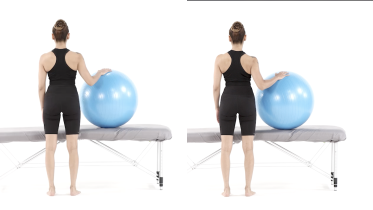
The side stretch over a ball is a standing stretch for the muscles that pull the arm down toward your body, mainly the broad muscle down the side of your back (latissimus dorsi). You stand side on to a table with a gym ball on it, lay your arm over the ball, then lean toward it so your arm slides out over the ball while your hips move the other way. The ball takes the weight of your arm, so you can ease into the stretch and hold it.
How to do the side stretch over a ball
- Put a gym ball on a sturdy table or counter and stand side on to it, close enough to rest your arm on the ball. Place your feet about hip width apart, or a little wider if that feels steadier.
- Lay the arm nearest the table straight over the top of the ball, palm down, with your hand past its far side.
- Slowly lean your upper body toward the ball and let your hips shift gently the opposite way. Your arm slides out over the ball, which may roll a little away from you.
- Go until you feel a stretch under your armpit and down the side of your back. Let your head tilt with your trunk rather than holding it upright.
- Hold the stretch and breathe steadily, then roll the ball back toward you and stand up straight.
What you should feel
A stretch under the armpit and along the side of your back and ribs, on the side of the arm that rests on the ball. Your shoulder should not pinch.
Common mistakes
- Pressing down on the ball, so it shoots away across the table.
- Turning the chest toward the floor instead of leaning straight to the side.
- Letting the stretched shoulder creep up by your ear. Keep it low and relaxed.
- Bracing and holding your breath instead of letting each breath out slowly into the stretch.
How often
Many programs hold the stretch for 10 to 30 seconds and repeat it 2 to 4 times, once or twice a day. The holds in the video are shorter, to show the movement. Your physio will adjust this.
Stop and check with your physio if
- A sharp pain or pinch in your shoulder, or pain that stays after you stop.
- Tingling, numbness or pins and needles in your arm or hand while you stretch.
- You feel dizzy, faint or unsteady. Stop and get medical advice the same day. If you faint, it does not settle within a few minutes of sitting still, or you cannot stand or walk steadily, call emergency services.
- Things look double, your vision suddenly blurs or goes, your speech slurs or becomes muddled, swallowing becomes hard, your face or lips go numb, one side of your face droops or one side of your body goes weak or numb, you suddenly become so dizzy or unsteady that you fall or cannot stand or walk, your legs suddenly give way but you do not black out (a drop attack), or you get a sudden severe headache. Stop and call emergency services, even if it goes away.
From the clinic
Set the ball on a table or counter that is solid and will not slide, and check there is enough surface past the ball for it to roll without dropping off the edge. Keep your weight in your feet rather than resting your body on the ball, because it can roll further than you expect. Stand on a floor that does not slip. Wear flat shoes that fit well and grip the floor, not socks, tights or bare feet. If your balance is unsteady or you have fallen in the past year, stand close to a wall you can touch with your free hand, or ask your physio about the standing side bend stretch, which needs no ball.
The voice guide calls the arm on the ball your affected side, so this stretch is often given for one shoulder. If you are stretching for general stiffness rather than one sore shoulder, do both sides. If lifting the arm is painful, start with it lower on the ball and let the range come with time. After shoulder surgery, check with your surgeon or physio before stretching the arm up and out like this.
With low bone density (osteoporosis), keep the lean gentle and ask your physio how far to go, as bending the spine sideways to the end of its range is often limited. If you have had a fracture in your spine, check with your physio before you begin. If you have had surgery on your spine, chest or heart in recent months, get the go-ahead from your surgical team or physio first. The seated side bend moves the trunk sideways from a chair if standing is not comfortable.
Written and checked by the PocketPhysio editorial team. Last updated 2026-09-26.
This page is general education, not a diagnosis or a personal treatment plan. If you have pain, an injury or a health condition, see a physiotherapist or doctor before starting new exercises.