Standing ball bounce balance
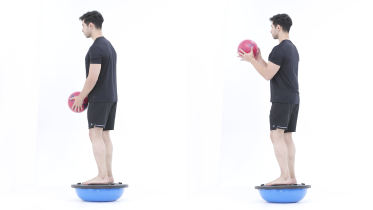
Standing ball bounce balance means standing with your feet about shoulder width apart and bouncing a medium-sized ball on the floor, then catching it as it comes back up. Watching the ball and reaching for the catch shift your weight, so your feet and trunk keep adjusting while you stay in one place. Both feet stay down the whole time, which makes it gentler than the ball drills done on one leg.
How to do the standing ball bounce balance
- Stand on a firm floor that does not slip, with a wall or kitchen counter at your side and clear space in front of you. Hold a medium-sized ball at chest height in both hands.
- Place your feet shoulder width apart, stand tall with your knees soft and keep your eyes on the ball.
- Let go with one hand and push the ball down with the other, so it hits the floor just in front of your feet and bounces back up to about chest height.
- Catch it as it rises, bring it back into both hands at your chest and settle for a moment before the next bounce.
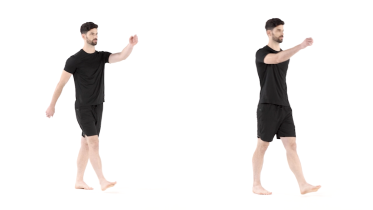
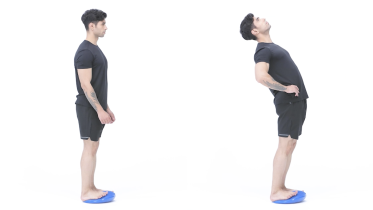
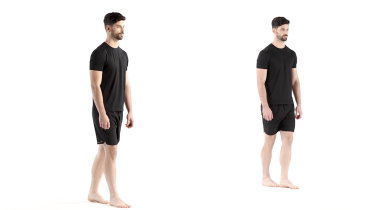
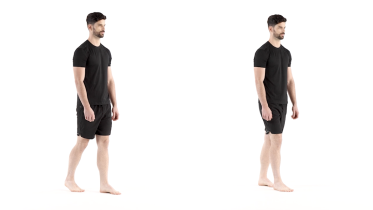
- He uses one hand in the video. Pushing down and catching with both hands is fine too, and if one arm is weak, use your stronger arm.
What you should feel
Small shifts of weight through your feet and ankles as you push the ball down and reach to catch it, with a little work in your arms and shoulders.
Common mistakes
- Bouncing too hard, so the ball flies up past your hands or away from you.
- Folding forward to chase the ball instead of letting it come back to you.
- Stepping or shuffling your feet to make the catch.
- Forgetting to breathe as you focus on the ball.
How often
Many programs begin with 10 to 20 bounces, repeated 2 or 3 times with a rest in between, once a day. Your physio will adjust this.
Stop and check with your physio if
- You feel dizzy, lightheaded, faint or sick, or the room seems to spin. Hold your support, sit down and get medical advice the same day before you practice again. If you faint, it does not settle within a few minutes of sitting still, your vision suddenly blurs or goes double, or you cannot stand or walk steadily, call emergency services.
- You have to step, lunge or grab your support to keep your balance when you catch the ball.
- Pain in your shoulder, elbow or wrist when you bounce or catch.
From the clinic
Your hands are busy with the ball, so stand close to a wall or counter where a quick hand can steady you. Keep a chair nearby too, in case you need to sit. Clear the floor around you so a missed ball cannot end up under your feet, and let a dropped catch roll away rather than chasing it. Wear flat shoes that fit well and grip the floor, not socks, tights or bare feet. He is barefoot in the video, but at home shoes that grip are the safer choice.
If you have fallen within the past year, feel unsteady standing still, or take tablets that can leave you drowsy or lightheaded, practice with another adult nearby and check with your physio whether a falls assessment is needed before you begin. If one side of your body is weaker after a stroke or another condition, check with your physio first that this drill suits you. If you have been told your bones are thin (osteoporosis), pick up a dropped ball by bending your hips and knees with your back straight and a hand on your support, or ask someone to pass it back.
A sudden loss of balance is different. Call emergency services straight away for any sign of a stroke, even if it goes away: sudden dizziness with unsteadiness or falling over, a face that droops on one side, an arm you cannot lift or keep up, slurred or muddled speech, weakness or numbness on one side of your body or face, sudden blurred vision, double vision or loss of sight, or a sudden severe headache. If one side is already weak or numb from an earlier stroke, new or suddenly worse weakness or numbness is a sign, and every other sign in this list still counts.
Once bouncing and catching feel steady, your physio may narrow your stance, as in semi-tandem stance. Single leg balance with ball pass is a harder ball drill, done on one leg.
Written and checked by the PocketPhysio editorial team. Last updated 2026-09-26.
This page is general education, not a diagnosis or a personal treatment plan. If you have pain, an injury or a health condition, see a physiotherapist or doctor before starting new exercises.