Towel stroking for sensory re-education
Towel stroking is a sensory exercise for an arm and hand where feeling has changed, most often after a stroke or a nerve injury. You sit with your bare arm resting palm up on a pillow while a helper strokes the arm with a soft towel, moving between the hand and above the elbow. There is no muscle work. Your job is to pay attention to the touch. Physios and occupational therapists use it as part of sensory re-education, the practice of relearning to read touch through the skin.
How to do the towel stroking for sensory re-education
- Sit upright in a steady chair with a backrest, or in a wheelchair with the brakes on. Roll the sleeve up so the arm is bare from above the elbow to the fingers.
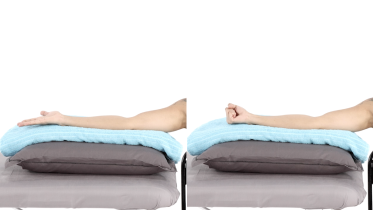
- Lay a pillow across your lap, or two stacked pillows as in the video, and rest the arm you are working on it, palm facing up and the wrist straight.
- Your helper sits facing you with a small folded towel and supports your hand with their other hand. In the video they stroke the inner side of the arm gently and slowly, from the hand up the forearm to just above the elbow, lift the towel off and start again at the hand.
- Keep your attention on each stroke: where you feel it, how firm it seems, and whether it feels the same all the way along. Tell your helper what you notice.
- The voice guide also describes strokes the other way, from just above the elbow down to the palm. Your physio will tell you which direction to start with and when to add the other one.
What you should feel
Only the touch of the towel. It may feel faint, patchy, tingly or oddly strong in places, and that can change from one session to the next.
Common mistakes
- Pressing hard or rubbing fast, which can mark numb skin without you noticing.
- Letting the wrist bend or the arm slip off the pillow partway through.
- Chatting about other things instead of paying attention to what the arm feels.
- Using a rough or damp towel. Start with a soft, dry one.
How often
Sessions are often short, about 5 to 10 minutes, once or twice a day. Your physio will adjust this.
Stop and check with your physio if
- The stroking feels painful, burning or unbearable, or the skin stays sore or tingling for more than a few minutes afterward. Stop and tell your physio before the next session.
- Redness, a scrape or broken skin where the towel moved. Leave that area alone until it heals, and tell your physio.
- Pain in the shoulder of the arm on the pillow. Stop, support the arm so the shoulder is comfortable, and tell your physio.
- Since the stroke or nerve injury, the hand is getting more painful rather than less, the skin becomes very sensitive to light touch, or the hand changes color, temperature, swelling or sweating compared with the other one, or looks shiny. See your doctor or physio as soon as you can, within a few days at most, as this can be complex regional pain syndrome (CRPS) and early treatment may help.
- Call emergency services straight away for any sign of a stroke, even if it goes away: sudden dizziness with unsteadiness or falling over, a face that droops on one side, an arm you cannot lift or keep up, slurred or muddled speech, weakness or numbness on one side of your body or face, sudden blurred vision, double vision or loss of sight, or a sudden severe headache. If one side is already weak or numb from an earlier stroke, new or suddenly worse weakness or numbness is a sign, and every other sign in this list still counts.
From the clinic
The voice guide starts with strokes from above the elbow toward the palm and reverses them once that feels comfortable. The video shows the strokes going from the hand up the arm, with the woman seated in a wheelchair, her arm on two pillows and the helper sitting in front of her. She watches the towel as it moves. Your physio may later ask you to close your eyes, say where you feel the touch, then look to check. Follow the plan you have been given.
When feeling is reduced, skin can be hurt without you noticing, so look over the arm for red marks after each session. Some people have the opposite problem, where even a light touch feels unpleasant or too strong. That needs a slower start, so tell your physio if your arm feels like this.
This page explains the general technique, not a stroke rehab program. After a stroke, a nerve injury or surgery to repair a nerve, your physio, occupational therapist or hand therapist decides whether and when to start, and can show your helper the pressure and pace to use. A weak arm after a stroke needs its shoulder supported, so make sure the whole forearm and elbow rest on the pillow, not just the hand.
Written and checked by the PocketPhysio editorial team. Last updated 2026-09-29.
This page is general education, not a diagnosis or a personal treatment plan. If you have pain, an injury or a health condition, see a physiotherapist or doctor before starting new exercises.