
Part of Cricket injuries: what the game asks of your body
Side strain in cricket: the tear a bowler feels in one delivery
Warning signs, and when to get help
What is a side strain, and what actually tears?
It is a tear in the muscles of the side wall of the trunk, low down, close to where they anchor onto the ribs. The original description came from 10 cases in first class pace bowlers. MRI in 70 percent of them showed injury to the internal oblique, the external oblique or the transversalis at or near their attachments to one or more of the lowest four ribs (Humphries and Jamison, 2004). The internal oblique is the one named most often, which is why you will hear this called an oblique strain.
The attachment is not always the rib end. A small radiology series of four cricketers described tears and impact injuries at the other end of the same muscles, where they attach to the rim of the pelvis (Mehta and colleagues, 2021). Four cases proves nothing about how often that happens. It is here for the reader whose pain sits lower down than this page describes.
The history is the most recognizable thing about it. It comes on in a single delivery, the pain is considerable, and it stops the bowler continuing (Humphries and Jamison, 2004). Nobody describes a side strain that crept up over a fortnight, which is one of the ways it differs from the bowler's other trunk problem, the slow bone stress injury in the lower back covered on the fast bowler back pain page.
How common is it in cricket at large? There is no clean figure. The nearest surveillance number is regional rather than diagnostic. In English and Welsh domestic cricket, when players were bowling, the abdomen was the most injured body region in white ball cricket at 13.4 injuries per 1000 days of play, with a confidence interval of 10.3 to 17.4 (Goggins and colleagues, 2024). That covers the whole abdominal wall and not this one diagnosis, so it describes a neighborhood rather than a street.
Which side does it happen on, and how is it recognized?
The non-bowling arm side, in every one of the original 10 cases (Humphries and Jamison, 2004). A right arm bowler tears the left side. The action explains it well enough: the trunk side bends away from the bowling arm as the arm comes through, so the muscles on the opposite side are long and loaded at the same moment.
Two clinical findings were the most consistent in that series, and both are things a clinician reproduces in about a minute. One is tenderness in a single spot when the area is pressed. The other is pain when you side bend toward the painful side against resistance. The authors add one more line: the biomechanics of the injury are not yet understood.
That is also why guessing is a poor plan. Pain low in the side of the trunk can come from a rib, from the back, from the muscles between the ribs, and occasionally from something that has nothing to do with sport at all. The warning list at the foot of this page sets out the versions that need the same day, including anything that started with a blow from the ball or that hurts when you breathe in.
How long does a side strain take to heal?
The one measured distribution comes from 80 MRI scans of side strain in 57 first class fast bowlers across Australia and England. Mean time to return to play was 39 days, with a standard deviation of 14 days, and 44 percent of bowlers took more than six weeks (Nealon and colleagues, 2019). Of six MRI parameters the researchers tested, only one was associated with the time it took: whether a muscle tear was present. Those with a tear were 8 times more likely to need more than six weeks.
The study's own limitation is the part that makes it honest. Its multifactorial model predicted recovery time in just 53 percent of the cohort, which leaves about half the variation between one bowler and the next unexplained by anything that was measured, scan included. So plan around six weeks, prepare for longer, and accept that nothing at the start reliably tells you which half you are in.
That is a professional group with daily access to a medical team and no job other than being fit to play. A club bowler fitting rehab around work will not automatically be slower, but the 39 days is not a promise to anybody.
Will it come back?
It does for a substantial minority, and the figures matter before you plan a return. Among 207 fast bowlers contracted at first class level in Australia and England in 2011, more than half had sustained at least one side strain in their career, recurrence happened in 30 percent of them, and over 30 percent of those had at least one further recurrence. Nearly half of all recurrences came within 2 years and another quarter in the following year, and 77 percent of first injuries occurred in bowlers aged 24 or under (Nealon and Cook, 2018). In the original 10 case series, 6 were recurrences rather than first injuries (Humphries and Jamison, 2004).
Both of those are retrospective and rely on players remembering their own careers, so hold the exact percentages loosely. The direction is consistent enough to act on: this is an injury that repeats, and the months after the first one are when it repeats.
The same study is also the reason this page does not hand you a prevention routine. Side strain was not associated with bowling arm, player height, active trunk side bending range, side bridge endurance or the volume of first class cricket played (Nealon and Cook, 2018). Every one of those is something a program might reasonably have targeted, and none of them separated the bowlers who tore from the bowlers who did not.
What is the treatment based on?
Clinical practice, and it is better to say so. The narrative review that gathered the whole field found only nine papers dedicated to side strain in the literature up to October 2015. It states that there has been no research on the management of side strain, and none on the relationship between clinical or imaging findings and either time to return to play or risk of recurrence (Nealon, Kountouris and Cook, 2017). The MRI study above has since supplied part of the second half of that, which is progress, but the first half still stands: no trial has compared one program with another, or with doing nothing.
What clinicians typically do, labeled as practice rather than evidence, follows the shape of any muscle tear. Settle the painful phase and let the tissue knit, with the loading that hurts taken out rather than the person being put to bed. Reintroduce side bending and rotation gently, then load the side wall progressively, which is what the exercises below are for. Then rebuild bowling itself in graded steps, at controlled intensity, since bowling is the thing that tore it and the only way to prove it is ready is to do some. If an injection or an operation has been raised with you, follow your own surgeon's or clinician's plan, because this page offers no post-operative program and no timeline of its own.
Pain low in the side that is not this injury has other homes on this site. An ordinary pulled muscle in the back is covered by pulled back muscle, one-sided pain lower down by lower back pain on one side, and the general program for a sore lower back by low back pain. The sport as a whole, and where this injury sits in it, is on the cricket injuries hub.
Trunk exercises used in a side strain program
These are the graded side and trunk exercises a program tends to work through once the painful phase has settled, and they are clinical practice rather than tested treatment: no trial has compared any program for this injury. Nothing here is a reason to start before an assessment, and none of it has been shown to prevent a side strain. Usual starting points are a 10 to 30 second hold 3 to 5 times on each side for the kneeling side plank, a hold of 10 to 30 seconds 2 to 5 times on each side for the full side plank, 2 to 3 sets of 5 to 8 turns on each side for the side plank with rotation, stopping the set as soon as the hips start to drop, and 10 to 15 slow rolls to each side with a 3 to 5 second hold at the end of each roll for lower trunk rotation. Where this paragraph and an exercise page differ, the exercise page wins. Your physio will adjust this.
The exercises below carry their own stop signs and precautions. Open the line under an exercise and read them before you try it.
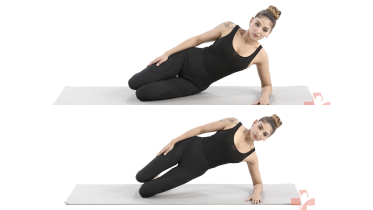 Kneeling side plank
Stop signs and precautions for the kneeling side plank
Before you start
- Holding your hips up also works the muscles at the side of the bottom hip, much like a side leg lift. If you have had a hip replacement or other hip surgery, get the go-ahead from your surgeon or physio before you try the kneeling side plank. Some operations limit this kind of work for the first months, so the timing depends on your surgery.
- If your shoulder is painful, or you have had shoulder surgery or a dislocation, check with your physio before putting your weight through that arm. After a wrist fracture or wrist surgery, stay on the forearm version until your physio says the hand can take your weight.
- After recent heart or chest surgery, get your surgeon's or surgical team's okay first, because even on your knees, the side plank balances on one hand, so that weight goes through one arm and shears across the healing breastbone. If the breastbone clicks, grinds, shifts or feels as if it is moving while you do it, stop, and contact your surgical team the same day.
When to stop and get help
- Pain in the shoulder, elbow or wrist you are leaning on.
- Sharp pain in the lower back or the side of the hip.
- Pain or tingling spreads down the arm.
- Pins and needles in your arm or hand that do not go away after you stop, or part of your arm or hand goes numb. Get medical advice the same day. If one side of your face or body suddenly goes numb or weak, or your speech becomes slurred or muddled, call emergency services, even if it goes away.
- Chest pain or pressure, dizziness or feeling faint, a racing or irregular heartbeat, or being far more out of breath than the effort should cause.
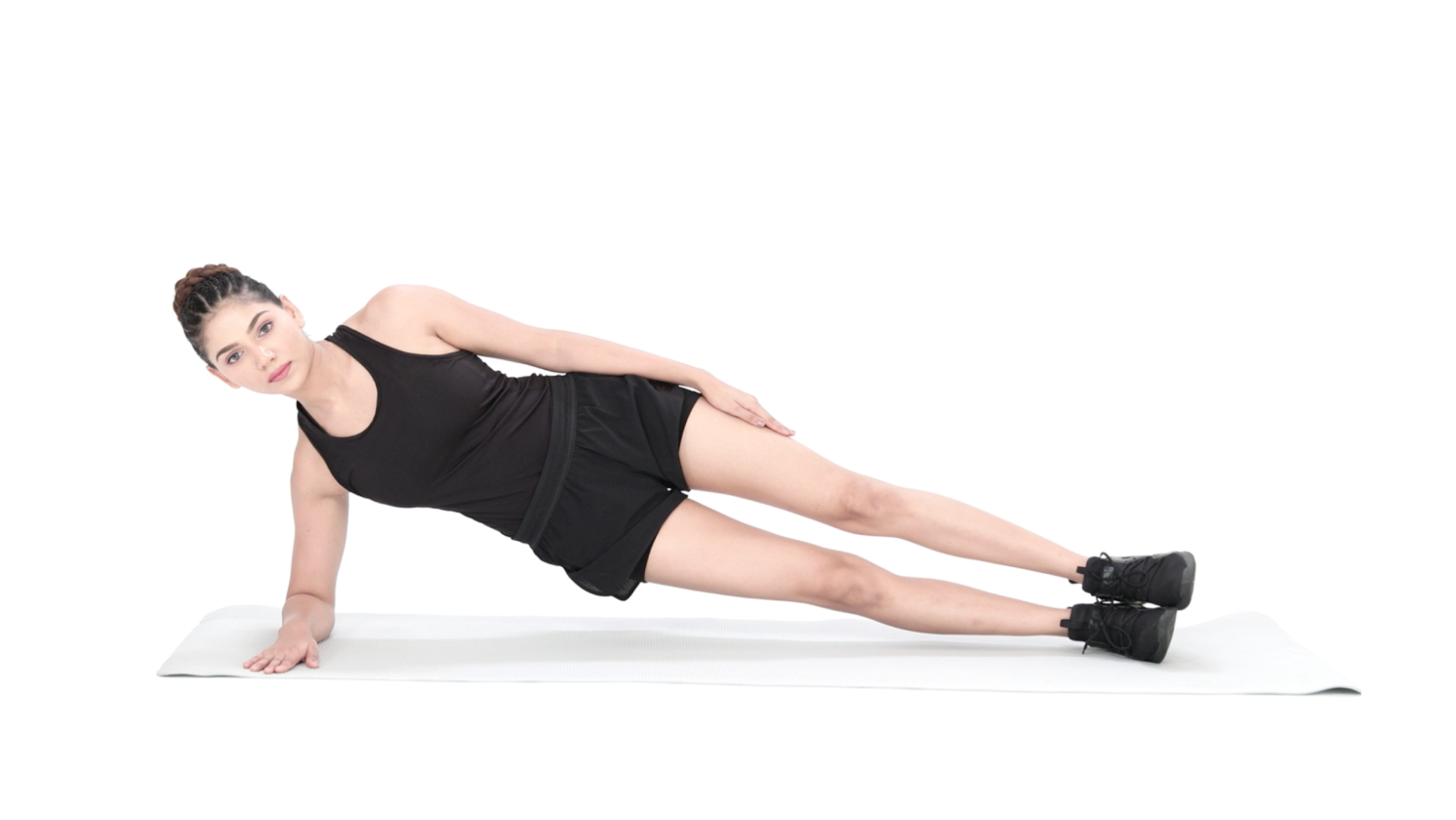 Side plank
Stop signs and precautions for the side plank
Before you start
- Holding your hips up also works the muscles at the side of the bottom hip, much like a side leg lift. If you have had a hip replacement or other hip surgery, get the go-ahead from your surgeon or physio before you try the side plank. Some operations limit this kind of work for the first months, so the timing depends on your surgery.
- With a painful shoulder, or after shoulder surgery or a dislocation, check with your physio before putting your full weight through one arm.
- After recent heart or chest surgery, get your surgeon's or surgical team's okay first, because the whole side plank balances on one hand, so all that weight goes through one arm and shears across the healing breastbone. If the breastbone clicks, grinds, shifts or feels as if it is moving while you do it, stop, and contact your surgical team the same day.
- If you have high blood pressure, keep the holds short and breathe steadily the whole time.
When to stop and get help
- Pain in the wrist, elbow or shoulder you are leaning on.
- Sharp pain in the lower back or the side of the hip.
- Pain or tingling spreads down the arm.
- Pins and needles in your arm or hand that do not go away after you stop, or part of your arm or hand goes numb. Get medical advice the same day. If one side of your face or body suddenly goes numb or weak, or your speech becomes slurred or muddled, call emergency services, even if it goes away.
- Chest pain or pressure, dizziness or feeling faint, a racing or irregular heartbeat, or being far more out of breath than the effort should cause.
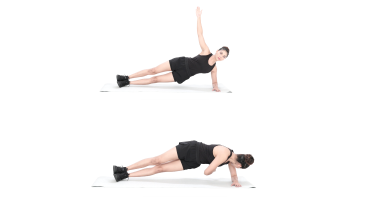 Side plank with rotation
Stop signs and precautions for the side plank with rotation
Before you start
- Holding your hips up also works the muscles at the side of the bottom hip, much like a side leg lift. If you have had a hip replacement or other hip surgery, get the go-ahead from your surgeon or physio before you try the side plank with rotation. Some operations limit this kind of work for the first months, so the timing depends on your surgery.
- If you have had shoulder surgery, a dislocation or a broken arm, check with your physio before you take your weight on one hand.
- After recent heart or chest surgery, get your surgeon's or surgical team's okay first, because balancing on one hand loads the healing breastbone through one arm, and turning the top arm under your body twists across it. If the breastbone clicks, grinds, shifts or feels as if it is moving while you do it, stop, and contact your surgical team the same day.
- If you are pregnant, have recently given birth, have had abdominal surgery or have a hernia, ask your physio or doctor before you plank.
- With high blood pressure, breathe steadily all the way through each hold and never hold your breath.
- The reach under your body twists and rounds the spine while it carries your weight. With low bone density (osteoporosis) or a past fracture in the spine, leave the turn out unless your physio has cleared it. A plain side plank is usually the better choice.
When to stop and get help
- Chest pain or pressure, dizziness or feeling faint, a racing or irregular heartbeat, or being far more out of breath than the effort should cause.
- Pain in the wrist or shoulder you are leaning on, or that shoulder feels like it could slip out.
- Sharp pain in your lower back, or back pain that builds as you go.
- The shoulder feels as if it has slipped out of place, looks a different shape or suddenly locks so you cannot move the arm, or your hand turns cold, pale or blue. Go to an emergency department straight away, without driving yourself, and do not try to put the shoulder back in yourself.
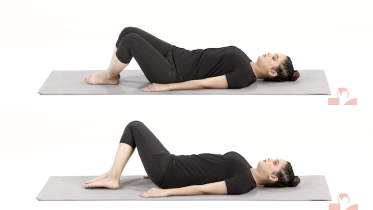 Lower trunk rotation
Stop signs and precautions for the lower trunk rotation
Before you start
- If you have had a hip replacement, get the go-ahead from your surgeon or physio before you try this exercise. As the knees roll to one side, the upper knee turns that hip inward and across the middle of your body, and many surgeons ask you to avoid that for the first months after some operations. If you are pregnant, ask your physio whether to keep doing these flat on your back once you are past the first trimester.
- If you have had surgery on your spine in recent months, get the go-ahead from your surgical team or physio first.
- With low bone density (osteoporosis), keep the rolls small and gentle. Twisting right to the end of the range is usually avoided.
When to stop and get help
- Pain spreads down the leg or you get numbness or tingling.
- You feel sharp or catching pain in the back at any point. Make the movement smaller, and stop if it keeps happening.
- Numbness around your genitals or bottom, new trouble with your bladder or bowels, pain, tingling, numbness or weakness in both legs, or loss of feeling in one leg. Call emergency services or go to an emergency department straight away, and do not drive yourself.
- Your leg or foot gets weaker, for example your foot drags, catches on the ground or slaps down when you walk (foot drop). Get medical advice the same day. If the weakness is getting worse by the hour, go to an emergency department.
Each exercise page carries its own precautions and stop signs, and those come before anything written here. Read the line under an exercise before you try it. Start at the easiest version your side tolerates, which for most people is the kneeling side plank with a short hold, and only move to the full side plank when the short holds cause no pain during or afterward.
Side planks put weight through the arm and shoulder, so after a broken wrist, hand or forearm, or surgery on any of them, start them only when your doctor, surgeon, physio or hand therapist says the arm is ready to take weight. After a hip replacement, get the go-ahead from your surgeon or physio before side-lying work and lower trunk rotation, because lying on your side lets the top leg drop across the lower one, and rolling the knees over turns the upper hip inward and across the middle of your body. If you have osteoporosis, low bone density or a past fracture in the spine or the ribs, check with your physio before the side planks as well as the rotation work, because a side plank asks the trunk to hold your own weight sideways, and keep the trunk rolls small.
If you are pregnant or have had a baby recently, check with your physio before loaded trunk and side exercises, which covers all four of these. If you have high blood pressure, breathe steadily through every hold and never hold your breath. Stop and get advice if any of these reproduces the sharp pain you came here with, rather than working through it.
When to see a physio
Straight away, or at least before the next time you bowl. This injury is usually obvious at the moment it happens. What goes wrong afterward is not the first fortnight but the return: a bowler who feels better at three weeks and goes straight back to a full spell is the one most likely to be reading the recurrence figures above with personal interest.
Expect the assessment to be mostly hands and history. Where exactly it is tender, what resisted side bending does, what the delivery was that did it, where you were in the spell, and what your bowling week looked like beforehand. Imaging is a clinical decision rather than a routine step, and in the one study that looked, the only scan feature that changed the timeline was whether there was a tear.
Then the useful part, which is the graded return. Ask for the criteria rather than a date: what has to be pain free, at what intensity, off what length of run-up, before the next step. That is the conversation that decides whether this is six weeks once or six weeks three times. The warning signs below come first, at whatever speed each line sets.
Related exercise programs
Warning signs
Get emergency help now
- Emergency: if chest pain, pressure or tightness does not ease quickly when you rest, spreads to your arm, neck, jaw, stomach or back, or comes with sweating, feeling sick, feeling light-headed or being short of breath, call emergency services straight away, as this can be a heart attack. If it eases quickly and none of these happen, get medical advice the same day, and do not exercise again until you have been checked.
- Emergency: a sudden sharp or stabbing pain in one side of your chest or shoulder that is worse when you breathe in. Stop and call emergency services, and say what you were doing. This can be a collapsed lung (pneumothorax) or a blood clot in the lungs, and both need treating quickly.
- Emergency: you suddenly become short of breath, you get chest pain or pain in your upper back that may be worse when you breathe in, you cough up blood, your heart is beating very fast, or you faint. Call emergency services straight away, even if your leg looks normal. These can be signs of a blood clot in the lungs (pulmonary embolism).
Get help today
- Same day: pain in your ribs or the side of your chest that started with a fall, a blow, a crush, or a seatbelt in a car accident, rather than coming on by itself. Get medical advice the same day, and do not start these exercises until your chest has been checked, because the same knock can crack a rib and the sore spot sits right where an ordinary strain would be. Call emergency services or go to an emergency department straight away if the injury was a serious accident such as a car accident, your breathlessness is getting worse, your chest pain is getting worse, you have pain in your tummy or your shoulder, or you cough up blood, as a broken rib can damage something else such as a lung, the liver or the spleen. Do not drive yourself to hospital: ask someone else to drive you, or call an ambulance (NHS).
- Same day: new pain in one spot on your ribs or your breastbone after a minor fall, a knock, a cough, a sneeze, a lift or a bend, or pain in one spot that keeps getting worse with no injury at all, if you are older, have low bone density (osteoporosis) or have taken steroid tablets for a long time. Get medical advice the same day. A thin rib can break under very little force, and the NHS says a cough or a sneeze can be enough to break a rib or to partly collapse one of the bones of the spine. Until it has been checked, leave out the side planks and the trunk rolls, because those load a rib that may be broken.
- Same day: sharp pain in your upper back or around your ribs that has been coming and going when you breathe in or cough, or back pain with a cough, a high temperature or yellow or green mucus. Get medical advice the same day. These can be signs of inflammation of the lining of the lungs (pleurisy) or a chest infection. If the pain came on suddenly, or you find it hard to breathe, call emergency services straight away.
- Same day: sharp pain in your chest, ribs or upper back that has not got better after a few days, or you are feeling short of breath regularly. Get medical advice the same day. The NHS puts both of these at the urgent level for pleurisy.
- Same day: back or leg pain with a fever, or you feel hot, cold, shivery or generally unwell. Get medical advice the same day, and go to an emergency department if you feel very unwell.
- Same day: severe pain that comes on suddenly or is getting worse quickly. Get medical advice the same day.
- Same day: you have back pain and have lost weight without trying. Get medical advice the same day and mention the weight loss.
- Same day: new back pain and you have had cancer, now or in the past. Get medical advice the same day and mention your cancer history. If you are being treated for cancer now, contact your cancer team the same day.
- Same day: pain that is worse at night, or does not ease at all when you rest. If you have had cancer, now or in the past, or you have lost weight without trying, get medical advice the same day.
Book an appointment
- Within a few days: a sudden pain low in the side of your trunk that arrived in one delivery and stopped you bowling. Stop bowling, and do not bowl again until it has been assessed, rather than warming up for another spell, because that history is exactly what the published case series describes, and those bowlers needed weeks rather than days. If you cannot take a deep breath, the pain is severe, or it followed a blow from the ball, follow the same-day lines above instead.
- Within a few days: pain that is worse at night, or does not ease at all when you rest. See your doctor within a few days.
Common questions
How long does a side strain take to heal?
The best measured answer comes from 80 MRI scans of side strain in 57 first class fast bowlers in Australia and England: the mean time to return to play was 39 days with a standard deviation of 14 days, and 44 percent of those bowlers needed more than six weeks (Nealon and colleagues, 2019). One thing on the scan mattered for timing, and only one of the six things the researchers measured: whether a muscle tear was present. Bowlers with one were 8 times more likely to take more than six weeks. The part that deserves as much attention as the average is that the model built from all of those measures predicted recovery time in only 53 percent of the cohort, so nearly half the variation between bowlers was not explained by anything measured. Six weeks is a fair expectation to plan around, with a real chance of longer, and the only way to narrow that down for you is an assessment and the response of the tissue over the first fortnight.
Which side does a side strain happen on?
The non-bowling arm side. In the original series of 10 cases in first class pace bowlers, the injury was on the side opposite the bowling arm in every case, so a right arm bowler tears the left side (Humphries and Jamison, 2004). It makes sense from the action: at the top of the delivery the trunk side bends away from the bowling arm and then whips over, which lengthens the muscles of the opposite side wall under load. The same series found the two most consistent clinical findings were focal tenderness on palpation and pain on resisted side flexion toward the painful side. It is 10 cases, and the authors say plainly that the biomechanics of the injury are not yet understood, so treat the side as a useful clue rather than a diagnostic test.
Can I bowl through a side strain?
In practice almost nobody can, and that is part of the description of the injury rather than advice. In the original case series the pain was considerable and it prevented the bowler from continuing in the over (Humphries and Jamison, 2004). The injury that announces itself that loudly is not one you negotiate with on the day. Stop bowling, get it looked at, and expect the plan to be a staged return to bowling built on how the tissue responds rather than on a date, because nobody has published a tested protocol to follow. Batting, fielding and running are a separate question for whoever assesses you, since a throw and a hard pull shot both load the same side wall.
Will a side strain come back?
Often enough that it should change how you build your bowling back up. Among 207 fast bowlers contracted at first class level in Australia and England in 2011, over half had sustained at least one side strain during their career, recurrence occurred in 30 percent of them, and more than 30 percent of those had at least one further recurrence; nearly half of all recurrences happened within 2 years, with another quarter in the following year (Nealon and Cook, 2018). The same study found 77 percent of first injuries happened at age 24 or under. That is career recall collected retrospectively, so the exact percentages are soft. The earlier case series tells a similar story, with 6 of its 10 cases being recurrences rather than first injuries (Humphries and Jamison, 2004).
What can I do to stop it happening again?
Nothing has been shown to prevent it, and one study cuts against the usual advice. Among those 207 first class bowlers, side strain was not associated with the bowling arm, the player's height, active trunk side bending range, side bridge endurance or the volume of first class cricket they had played (Nealon and Cook, 2018). So a page promising that a stretch or a plank will keep you clear of it has gone past the evidence. What is left is sensible and unproven: build bowling volume in steps rather than jumps, treat the first twinge in the side as a reason to stop that spell, and finish a graded return before you go back to full pace rather than in the middle of it. The return to sport test battery sets out how clinicians judge readiness in general, and your physio will set the criteria for this injury.
References
- Humphries D, Jamison M. Clinical and magnetic resonance imaging features of cricket bowler's side strain. British Journal of Sports Medicine. 2004;38(5):e21. https://doi.org/10.1136/bjsm.2003.005272
- Nealon AR, Kountouris A, Cook JL. Side strain in sport: a narrative review of pathomechanics, diagnosis, imaging and management for the clinician. Journal of Science and Medicine in Sport. 2017;20(3):261-266. https://doi.org/10.1016/j.jsams.2016.08.016
- Nealon AR, Cook JL. Trunk Side Strain Has a High Incidence in First-Class Cricket Fast Bowlers in Australia and England. Clinical Journal of Sport Medicine. 2018;28(3):284-288. https://doi.org/10.1097/JSM.0000000000000450
- Nealon AR, Docking SI, Lucas PE, Connell DA, Koh ES, Cook JL. MRI findings are associated with time to return to play in first class cricket fast bowlers with side strain in Australia and England. Journal of Science and Medicine in Sport. 2019;22(9):992-996. https://doi.org/10.1016/j.jsams.2019.05.020
- Mehta CP, Daftary A, Lawande M. Side Strain and Impact Injuries at the Iliac Crest Attachment of Lateral Abdominal Wall Musculature in Cricketers: An Uncommon Injury Pattern. Indian Journal of Radiology and Imaging. 2021;31(2):373-377. https://doi.org/10.1055/s-0041-1734345
- Goggins L, Williams S, Griffin S, Langley B, Newman D, Peirce N. English and Welsh men's domestic cricket injury risk by activity and cricket type: A retrospective cohort study from 2010 to 2019. Journal of Science and Medicine in Sport. 2024;27(1):25-29. https://doi.org/10.1016/j.jsams.2023.07.013
- England and Wales Cricket Board. ECB Recreational Cricket Safety Guidelines, December 2025 update. https://resources.ecb.co.uk/ecb/document/2025/12/16/28c76edf-7e04-4193-933d-cb2866010440/Recreational-Cricket-Safety-Guidelines-Dec-2025-Update.pdf
- NHS. Broken or bruised ribs. Page last reviewed 10 January 2024. https://www.nhs.uk/conditions/broken-or-bruised-ribs/
- NHS. Pleurisy. https://www.nhs.uk/conditions/pleurisy/
- NHS. Pulmonary embolism. https://www.nhs.uk/conditions/pulmonary-embolism/
- NHS. Osteoporosis. Page last reviewed 13 October 2022. https://www.nhs.uk/conditions/osteoporosis/
- NHS. Chest pain. Page last reviewed 8 August 2023. https://www.nhs.uk/symptoms/chest-pain/
- NHS. Sprains and strains. Page last reviewed 23 April 2024. https://www.nhs.uk/conditions/sprains-and-strains/
- NHS. Back pain. Page last reviewed 5 March 2026. https://www.nhs.uk/conditions/back-pain/
Written and checked by the PocketPhysio editorial team. Last updated 2026-11-06.
This page is general education, not a diagnosis or a personal treatment plan. See a physiotherapist or doctor for advice about your own situation.