
Part of Cricket injuries: what the game asks of your body
Cricket shoulder pain: bowling, throwing and the dive in the deep
Warning signs, and when to get help
Two kinds of cricket shoulder, and why the difference matters
Nearly every page you will find on this subject treats the cricket shoulder as one thing. The surveillance data says it is two, with different mechanisms and different urgency, and getting yours into the right half changes what you do next.
The largest of the cricket datasets behind this page is eight seasons of elite Australian female cricket, covering 409 shoulder injuries that received medical attention between July 2015 and June 2023, at an average incidence of 12.9 per 100 players a season. Gradual onset injuries were most commonly in pace bowlers, 51 percent of them, while sudden onset injuries were most commonly sustained while fielding, 69 percent of them (Pritchard and colleagues, 2026). Every figure in that study comes from women's cricket, and the authors did the work as part of their employment with Cricket Australia or an Australian cricket association, both of which are worth knowing before the numbers get borrowed for a men's team.
So two routes. If your shoulder has been getting sorer over weeks of bowling or throwing, you are in the gradual group and the rest of this page is about you. If it hurt in one moment, going for a catch, landing on it in the outfield or taking a hard ball on it, that is the sudden group. The first question there is whether something is broken, torn or out of place, and the warning list at the foot of this page is where to start rather than the exercises. A shoulder that felt as if it slipped out, or that you cannot move properly after a fall, goes to an emergency department, and shoulder dislocation covers what follows one.
Why does my shoulder hurt when I bowl?
The cuff is doing the quiet half of the work. Four muscles wrap the top of the arm bone, and their job is not to swing the arm: it is to keep the ball of the joint sitting where it should in a shallow socket while the big muscles do the swinging. That is hardest in two places, at the top of the backswing where the arm is turned out and the joint has least mechanical advantage, and immediately after release, where the cuff has to slow a fast arm down while lengthening.
Bowling adds a second demand that throwing does not. The arm goes through a vertical arc with the elbow straight, while the trunk side flexes away and then whips over, and the shoulder blade has to rotate up and tilt back across the ribcage to give the arm somewhere to go. Muscles that hold the blade run out of stamina during a long spell like everything else, which is one reason the last two overs feel different from the first two. How much blade control matters to a painful shoulder is less settled than the internet suggests, and scapular dyskinesis sets out what is and is not known about it.
The tissue underneath all this is usually the rotator cuff tendon, and the program for it is not cricket-specific. Rotator cuff tendinopathy is the staged version with dose, rotator cuff tear or tendinopathy explains the difference between the two labels, and swimmer's shoulder is the site's other page for an overhead athlete whose sport does the same thing hundreds of times a week.
Why does it hurt to throw and not to bowl?
Because throwing is a different movement with a different end range. The elbow bends, the shoulder goes further into external rotation at the top of the cocking phase, and the arm finishes by decelerating hard across the body. Clinicians have a name for the pattern that develops in the people who do it most, a thrower's shoulder, and almost all of the research behind that term comes from baseball rather than cricket.
What cricket adds is the context. A fielder in the deep throws at close to maximum effort from a standing start, perhaps once or twice an hour, with no warm-up between the last one and the next. Bowling is high volume and rhythmical. Throwing is low volume and explosive, and a shoulder can tolerate one and object to the other, which is why the useful question at an assessment is which action hurts rather than how much cricket you play.
Fielding position is a real variable here, not a cosmetic one. In the England and Wales survey, 58 percent of the shoulder-injured professionals had taken to fielding in a specific position to avoid the problem (Ranson and Gregory, 2008). Deciding that deliberately with your captain for a few weeks is load management; doing it quietly for three seasons is how a shoulder gets to be a long story.
Can I keep playing with a sore shoulder?
Cricketers mostly do, and the two best datasets agree about it across 18 years and two hemispheres. In the 2005 England and Wales first class season, 23 percent of the 158 professionals who returned both questionnaires described a shoulder injury, while only 1.7 percent of players were actually unavailable for selection with one. Of those injured players, 64 percent often or always had problems fielding (Ranson and Gregory, 2008). That was a 42 percent response rate from 378 players, so it describes the players who answered. In the Australian women's data, four in five shoulder injuries cost no playing time at all, and yet the modified activity those players needed typically ran between two weeks and six months (Pritchard and colleagues, 2026).
Put those together and the honest message is not that playing on is forbidden. It is that playing on unchanged is what turns a six week problem into a six month one. The deal most physiotherapists will offer is a swap: keep batting and keep playing, cut the long throws right back for a few weeks, agree a fielding position that does not punish you, and start the strength work now rather than in October. That deal is for the shoulder that came on gradually. A shoulder that went in one moment, or an arm that has been weak since an injury, gets checked first, at the speed the warning list below sets.
One finding should push a borderline shoulder toward an appointment. Thirty-two provincial and club cricketers were followed through the first three months of a season, and 9 of them sustained a dominant shoulder injury. Baseline shoulder pain that was not limiting participation was associated with going on to a time-loss shoulder injury, with a p value of 0.007, and the authors concluded that non-time-loss shoulder pain in actively participating cricketers seems to come before the injuries that do cost time (Olivier, Lala and Gillion, 2020). Nine injuries in 32 players is a small study and not a prediction about you. In a sport whose culture is to ignore a niggle, it is still the most useful sentence in the literature.
How long will a cricket shoulder take?
Expect months rather than weeks for the gradual kind. In the Australian women's dataset, return to full unrestricted match play typically took between 1 and 8.5 months, and recurrent injuries took longer (Pritchard and colleagues, 2026). Tendon problems change slowly, and the first sign of progress is usually doing more rather than hurting less, which is why a review date in the calendar beats checking it every morning; how long rotator cuff recovery takes sets out the general timeframes and what moves them. Night pain is common with shoulder problems and is not by itself a sign that something has gone wrong, though the warning list sets out the version of it that needs checking. Shoulder pain at night deals with sleeping positions, and sleeping with a painful shoulder goes further into it.
If you have had an operation, a stabilization after a dislocation or a cuff repair, your surgeon's or physiotherapist's protocol decides what you do and when, and this page sets no timeline of its own against it. Take any new sharp pain, weakness or sudden loss of movement after surgery to your surgical team the same day.
Two more pages may help if your shoulder is the reason you are here. Shoulder pain when lifting your arm explains what an arc of pain is telling you, and exercises to avoid with a rotator cuff problem covers the gym work that tends to aggravate a cricket shoulder. The hub page, cricket injuries, puts the shoulder alongside the rest of the sport, including the bowler's back.
Exercises for a cricket shoulder
Two for the rotator cuff, two for the muscles that hold and turn the shoulder blade, and one stretch for the back of the shoulder. They are for the shoulder that came on gradually. If yours arrived in one moment, with a dive, a fall or a ball, or the arm has been weak since, read the warning signs at the foot of this page and get it checked before you start any of them. Usual starting points are 2 to 3 sets of 10 to 15 slow repetitions once a day with no weight in the hand for side-lying external rotation, 2 to 3 sets of 8 to 12 with a 3 to 5 second hold at the top for the prone T raise and the prone Y raise, a light band with 2 to 3 sets of 8 to 12 slow repetitions on 3 or 4 days a week for the band row with external rotation, and a 20 to 30 second hold 2 to 3 times on each side, once or twice a day, for the cross body stretch. Where this paragraph and an exercise page differ, the exercise page wins. Your physio will adjust this.
The exercises below carry their own stop signs and precautions. Open the line under an exercise and read them before you try it.
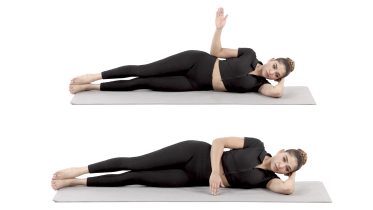 Side-lying external rotation
Stop signs and precautions for the side-lying external rotation
Before you start
- After shoulder surgery, including a rotator cuff repair, or after a shoulder fracture or dislocation, follow your surgeon's or physio's plan, and do only the movements and range they have cleared. Many plans allow only passive movement at first, where the arm is moved for you and its muscles stay relaxed.
- If you have been told you have a large or long-standing rotator cuff tear, or cuff tear arthropathy, have it looked at before you add this exercise. Lying on your side is what makes the cuff lift the weight of the arm against gravity, and that is the part a large or long-standing tear may not manage. Most people have never been told what their cuff looks like, so do this check sitting or standing, before you lie down, because you cannot watch a shoulder you are lying on. Bring the sore arm out to the side with your good arm, to about shoulder height or as high as it goes comfortably, let go, and try to hold it there for a few seconds, catching it with the good arm as it comes down. An arm that drops as soon as you let go is not holding its own weight, so leave this exercise out until the shoulder has been examined. An arm that will not reach shoulder height even with help is stiff rather than weak, which says nothing about the cuff, so the check does not rule you out and your range of motion work still stands. Once you start the exercise, the shrug is the sign to go by, and on your side you feel it rather than see it: the top of the shoulder and your neck tighten and the shoulder rides toward your ear. Leave it for now if that is what it takes to turn the arm up. The isometric hold and the standing band turn are the gentler way in.
- If you have had a hip replacement, get the go-ahead from your surgeon or physio before you try side-lying external rotation. Lying on your side lets the top leg slide forward or drop across the lower one, and many surgeons ask you to avoid that for the first months after some operations. A pillow between your knees helps keep the legs apart.
- Turning the arm out against any resistance, even the weight of your forearm, is often held off for several weeks, and the range may be limited at first. Has your shoulder dislocated before? Check with your physio first, and stop if it feels like it might slip out.
When to stop and get help
- You feel a sharp pain or a catch in the shoulder as the forearm turns up.
- Pain or tingling spreads down the arm.
- Pins and needles in your arm or hand that do not go away after you stop, or part of your arm or hand goes numb. Get medical advice the same day. If one side of your face or body suddenly goes numb or weak, or your speech becomes slurred or muddled, call emergency services, even if it goes away.
- The shoulder feels loose, as if it might slip out, as the forearm turns up.
- A sudden pop or tearing feeling in the shoulder that brings sharp pain, new weakness or trouble lifting the arm. Stop and contact your surgical team the same day, or get medical advice the same day if you have not had surgery.
- The shoulder feels as if it has slipped out of place, looks a different shape or suddenly locks so you cannot move the arm, or your hand turns cold, pale or blue. Go to an emergency department straight away, without driving yourself, and do not try to put the shoulder back in yourself.
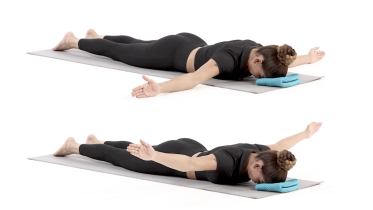 Prone T raise
Stop signs and precautions for the prone t raise
Before you start
- After shoulder surgery, including a rotator cuff repair, or after a shoulder fracture or dislocation, follow your surgeon's or physio's plan, and do only the movements and range they have cleared. Many plans allow only passive movement at first, where the arm is moved for you and its muscles stay relaxed. Lifting the arms against gravity like this usually comes later in rehab.
- After recent heart or chest surgery, get your surgeon's or surgical team's okay first, because lifting both straight arms out to the sides pulls across the healing breastbone while your chest rests on the mat. If the breastbone clicks, grinds, shifts or feels as if it is moving while you do it, stop, and contact your surgical team the same day.
When to stop and get help
- The shoulder catches or hurts sharply as your arms rise.
- Your arm starts to tingle, or pain spreads down it.
- Pins and needles in your arm or hand that do not go away after you stop, or part of your arm or hand goes numb. Get medical advice the same day. If one side of your face or body suddenly goes numb or weak, or your speech becomes slurred or muddled, call emergency services, even if it goes away.
- Your neck gets more painful as the set goes on.
- A sudden pop or tearing feeling in the shoulder that brings sharp pain, new weakness or trouble lifting the arm. Stop and contact your surgical team the same day, or get medical advice the same day if you have not had surgery.
- The shoulder feels as if it has slipped out of place, looks a different shape or suddenly locks so you cannot move the arm, or your hand turns cold, pale or blue. Go to an emergency department straight away, without driving yourself, and do not try to put the shoulder back in yourself.
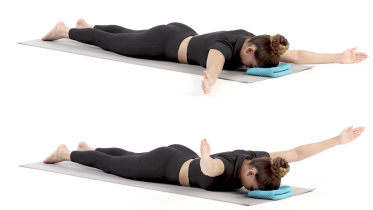 Prone Y raise
Stop signs and precautions for the prone y raise
Before you start
- After shoulder surgery, including a rotator cuff repair, or after a shoulder fracture or dislocation, follow your surgeon's or physio's plan, and do only the movements and range they have cleared. Many plans allow only passive movement at first, where the arm is moved for you and its muscles stay relaxed. An overhead lift against gravity like this is usually kept for later in rehab.
- After recent heart or chest surgery, get your surgeon's or surgical team's okay first, because lifting both straight arms overhead off the mat pulls across the healing breastbone. If the breastbone clicks, grinds, shifts or feels as if it is moving while you do it, stop, and contact your surgical team the same day.
When to stop and get help
- Lifting brings on a sharp pain or a catch in the shoulder.
- You get tingling or pain down an arm.
- Pins and needles in your arm or hand that do not go away after you stop, or part of your arm or hand goes numb. Get medical advice the same day. If one side of your face or body suddenly goes numb or weak, or your speech becomes slurred or muddled, call emergency services, even if it goes away.
- Lying face down brings on neck or lower back pain that does not ease when you rest.
- A sudden pop or tearing feeling in the shoulder that brings sharp pain, new weakness or trouble lifting the arm. Stop and contact your surgical team the same day, or get medical advice the same day if you have not had surgery.
- The shoulder feels as if it has slipped out of place, looks a different shape or suddenly locks so you cannot move the arm, or your hand turns cold, pale or blue. Go to an emergency department straight away, without driving yourself, and do not try to put the shoulder back in yourself.
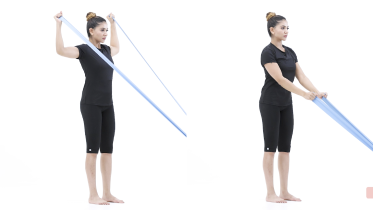 Band row with external rotation
Stop signs and precautions for the band row with external rotation
Before you start
- If you have ever fractured a bone in your spine, get your physio's go-ahead first.
- If your shoulder has dislocated or you have had shoulder surgery, check with your surgeon or physio before you try this exercise. Before you start, inspect the band for small splits and tug on the anchor, because a band that snaps or pulls loose can whip back at you.
- In the first months after heart or chest surgery, check with your surgeon or surgical team before you add band work for the arms, because the breastbone needs time to heal and only they can clear loaded pulling. If the breastbone clicks, grinds, shifts or feels as if it is moving while you do it, stop, and contact your surgical team the same day.
- If you have high blood pressure, breathe steadily through every repetition and never hold your breath.
When to stop and get help
- A sharp pain, a catch, or a feeling that the shoulder might slip out as your hands turn up.
- Pain, numbness or tingling travels down an arm.
- Pins and needles in your arm or hand that do not go away after you stop, or part of your arm or hand goes numb. Get medical advice the same day. If one side of your face or body suddenly goes numb or weak, or your speech becomes slurred or muddled, call emergency services, even if it goes away.
- Your shoulder aches more than usual after the set and has not settled by the next day.
- A sudden pop or snap at the front of your elbow, sudden sharp pain there, or the muscle at the front of your upper arm bunches up or changes shape. Stop and go to an urgent care center or emergency department the same day, even if you can still bend the elbow, as this can be a torn biceps tendon.
- The shoulder feels as if it has slipped out of place, looks a different shape or suddenly locks so you cannot move the arm, or your hand turns cold, pale or blue. Go to an emergency department straight away, without driving yourself, and do not try to put the shoulder back in yourself.
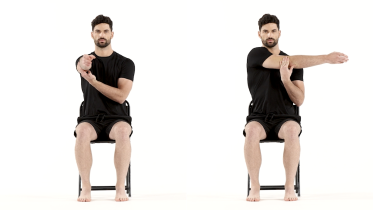 Cross body shoulder stretch
Stop signs and precautions for the cross body shoulder stretch
Before you start
- After shoulder surgery, including a rotator cuff repair, or after a shoulder fracture or dislocation, follow your surgeon's or physio's plan, and do only the movements and range they have cleared. Many plans allow only passive movement at first, where the arm is moved for you and its muscles stay relaxed.
When to stop and get help
- The shoulder pinches, catches or gives a sharp pain, most often at the front or top.
- You get pain or tingling running down the arm.
- Pins and needles in your arm or hand that do not go away after you stop, or part of your arm or hand goes numb. Get medical advice the same day. If one side of your face or body suddenly goes numb or weak, or your speech becomes slurred or muddled, call emergency services, even if it goes away.
- A sudden pop or tearing feeling in the shoulder that brings sharp pain, new weakness or trouble lifting the arm. Stop and contact your surgical team the same day, or get medical advice the same day if you have not had surgery.
- The shoulder feels as if it has slipped out of place, looks a different shape or suddenly locks so you cannot move the arm, or your hand turns cold, pale or blue. Go to an emergency department straight away, without driving yourself, and do not try to put the shoulder back in yourself.
Each exercise page carries its own precautions and stop signs, and those come first. Read the line under an exercise before you try it. Work below the height that pinches to begin with and raise that ceiling across weeks rather than inside one session. Aching during the work is acceptable if the shoulder is quiet again within a few hours and your sleep is no worse; a sharp catch, or an ache that climbs from the first repetition to the last, means that exercise stops for the day.
After shoulder surgery, including a rotator cuff repair, or after a shoulder fracture or dislocation, follow your surgeon's or physio's plan and do only the movements and range they have cleared. Turning the arm out against resistance is often held back for several weeks, and lifting both arms against gravity in the prone T and prone Y usually comes later still, so ask your surgical team when each one may start. If you have had a hip replacement, get the go-ahead from your surgeon or physio before side-lying external rotation, because lying on your side lets the top leg drop across the lower one.
Keep the cross body stretch light, because the pulling hand is far stronger than the shoulder it is pulling on, and speak to your physio first if that shoulder has slipped out before or feels loose. If you are pregnant, lying on your stomach usually stops being comfortable in the middle months, and your physio can give you a seated or leaning version of the prone raises. If you have high blood pressure, breathe steadily through every repetition and never hold your breath.
When to see a physio
Two weeks of the same shoulder is the usual trigger, and three things should bring that forward: nights that are worse than they were, a throw you have started avoiding, and any weakness in the arm after a fall or a dive. Weakness after an injury is the one that does not wait at all, because a cuff tear caused by an injury is referred urgently in UK shoulder pathways, and the warning list below carries that line in full.
Most of a first appointment is spent watching you move rather than talking. A physiotherapist will compare rotation on both sides, see what the blade does as the arm goes up, test the cuff at the positions your action uses, and ask what you throw, how far and how often. Nothing in cricket is measured as reliably as a bowling workload, so bring the detail you do have: overs and throws in a normal week, what changed in the fortnight before it started, and what the shoulder does between midnight and six.
Where you have had surgery, your surgical team decides when a new exercise starts. The warning signs below come first, at whatever speed each line sets.
Related exercise programs
- Rotator cuff tendinopathy
- Shoulder impingement
- Scapular dyskinesis
- Swimmer's shoulder
- Shoulder dislocation
Warning signs
Get emergency help now
- Emergency: if chest pain, pressure or tightness does not ease quickly when you rest, spreads to your arm, neck, jaw, stomach or back, or comes with sweating, feeling sick, feeling light-headed or being short of breath, call emergency services straight away, as this can be a heart attack. If it eases quickly and none of these happen, get medical advice the same day, and do not exercise again until you have been checked.
- Emergency: chest pain or tightness, which may spread to your arm, neck or jaw, or shoulder or arm pain that comes with shortness of breath, sweating or feeling sick. This can be a heart attack. Call emergency services straight away.
- Emergency: any sign of a stroke, even if it goes away. That means a face that droops on one side, an arm you cannot lift or keep up, slurred or muddled speech, weakness or numbness on one side of your body or face, sudden blurred vision, double vision or loss of sight, trouble swallowing, sudden dizziness with unsteadiness or falling over, a sudden severe headache, or a sudden fall where your legs give way but you do not black out (a drop attack). Call emergency services straight away.
- Emergency: the shoulder feels as if it has slipped out of place, looks a different shape or suddenly locks so you cannot move the arm, or the pain is severe after a fall or an injury. Go to an emergency department straight away, without driving yourself, and do not try to put the shoulder back in yourself.
- Emergency: your arm, hand or fingers turn cold, pale, blue or gray compared with the other side. Call emergency services or go to an emergency department straight away, and do not drive yourself. The blood supply to the arm may be blocked.
- Emergency: after a fall or a blow to the shoulder or collarbone, bone is sticking out through the skin, the shoulder swells up very quickly, you are bleeding heavily, or you find it hard to breathe, have chest pain or cough up blood. Call emergency services straight away.
Get help today
- Same day: after a fall or a blow to the shoulder, the shoulder is very swollen or bruised, or you cannot use your arm normally. Get it checked the same day, as the collarbone or the top of the arm may be broken.
- Same day: the shoulder is hot, red and swollen, or you have a fever or feel unwell. This can be a joint infection, which needs treatment quickly. Go to an emergency department the same day, and call emergency services if you feel very unwell.
- Same day: sudden, very bad shoulder pain, or you suddenly cannot lift or move your arm at all. Get medical help the same day.
- Same day: a sudden pop or tearing feeling in the shoulder that brings sharp pain, new weakness or trouble lifting the arm. Stop and contact your surgical team the same day, or get medical advice the same day if you have not had surgery.
- Same day: the pain started after a fall, a pull or another injury, especially if the arm has been weak since, for example you cannot lift it out to the side or hold it up. This can be a broken bone or a torn tendon. Get medical advice the same day, and say how it happened and that the arm has been weak since, because UK shoulder surgeons advise urgent referral for a rotator cuff tear caused by an injury.
- Same day: pins and needles or numbness in the arm that does not go away, no feeling in part of the arm, or weakness that is getting worse. Get medical advice the same day. For pain spreading down the arm from your neck, ask for an urgent appointment with your doctor. If one side of your face or body suddenly goes numb or weak, or your speech becomes slurred or muddled, call emergency services, even if it goes away.
- Same day: you feel dizzy, faint or unsteady. Stop and get medical advice the same day. If you faint, it does not settle within a few minutes of sitting still, or you cannot stand or walk steadily, call emergency services.
- Same day: severe pain that comes on suddenly or is getting worse quickly. Get medical advice the same day.
- Same day: severe pain in both shoulders that has come on recently. Get medical advice the same day.
- Same day: you are over 50 and have aching and stiffness in both shoulders, often in the neck or hips too, that is worst in the morning and lasts more than 45 minutes after you get up. This can be an inflammatory condition (polymyalgia rheumatica) rather than a rotator cuff problem. If you also get a new headache, pain or tenderness at your temples or on your scalp, or jaw pain when you eat or talk, get medical advice the same day, and if your vision changes, call emergency services. Even without those extra signs, see your doctor within a few days about the aching and stiffness.
Book an appointment
- Within a day or two: new shoulder pain and you have had cancer, now or in the past, or you are losing weight without trying. See your doctor within a day or two and mention it.
- Within a day or two: pain at night or at rest that is constant, that no rest or change of position eases at all, and that keeps getting worse. If you have had cancer, now or in the past, or are losing weight without trying, see your doctor sooner, within a day or two, and mention it. This applies even if the pain is not getting worse.
- Within a few days: night pain is common with shoulder problems, but get checked within a few days if the pain is constant, no rest or change of position eases it at all, and it keeps getting worse.
Common questions
Is cricket shoulder pain the rotator cuff?
Often, and it is the usual first assumption with a gradual cricket shoulder, but the label is not something a page can settle. The cuff is the four muscles that hold the ball of the shoulder in its shallow socket and steer the arm while the big muscles swing it, and it is the tissue that complains most in overhead sport. Other things produce much the same picture: the joint at the top of the shoulder, the long tendon at the front of the upper arm, the neck referring pain down into the shoulder, and in a shoulder that has been forced out of place before, the stability of the joint itself. The staged program for the commonest of them is rotator cuff tendinopathy, and rotator cuff tear or tendinopathy explains how the two labels differ and why it matters less than most people expect. What a page cannot do is examine you, and weakness after an injury is the one pattern that needs same-day advice rather than a program.
Should I field somewhere else for a while?
It is a reasonable short-term plan, and the professionals already do it: 58 percent of the shoulder-injured players in the England and Wales survey said they fielded in a specific position to avoid their shoulder problem (Ranson and Gregory, 2008). Moving in from the boundary cuts out the long, maximum-effort throw, which is the single heaviest demand a fielding position places on a shoulder. Do it deliberately, tell your captain it is for a few weeks, and put a date on it, because the version that goes wrong is the one where a player quietly rearranges their cricket around a shoulder for three seasons and never has it looked at. Pair it with the strength work rather than using it instead of the strength work.
Why does my shoulder hurt after batting?
No published cricket dataset separates shoulder injuries by batting, so anything specific would be invention: the surveillance work splits them into the gradual ones, mostly in pace bowlers, and the sudden ones, mostly in fielders (Pritchard and colleagues, 2026). What can be said is that a shoulder which only objects to batting is worth examining properly rather than guessing at, because the pull and the cut take the top arm across and above the body at speed, and because the neck refers pain into the shoulder in a way that a page cannot sort out. If the pain started when a ball hit you on the shoulder, treat that as its own thing: a cricket ball weighs between 140 and 166 g (0.31 to 0.37 lb, 0.14 to 0.17 kg) and arrives fast, and the warning list below sets out what needs checking the same day after a blow.
Will a screening test spot a cricket shoulder before it hurts?
There is no cricket evidence that it will, and one study is a reason not to assume it. Twenty-six elite Australian female fast bowlers, 12 of them with a history of shoulder pain, were tested for rotation range and shoulder strength: there were no differences between the bowling and non-bowling shoulders in strength or strength ratios, and no differences in range, strength or ratios in the bowling shoulder between those with and without a history of shoulder pain (Stuelcken and colleagues, 2008). What did predict trouble, in 32 provincial and club cricketers followed through the first three months of a season, was pain that was already there: a shoulder that hurt but did not stop the player participating was associated with a later time-loss shoulder injury, with 9 injuries in those 32 players (Olivier, Lala and Gillion, 2020). That is a small study, so hold it lightly, but it points the same way as the surveys. The niggle you have already is better information than a test result.
References
- Pritchard G, Deshmukh P, Saw AE, Beerworth K, Sims K. Shoulder injuries in elite female cricket players: Insights from eight seasons. Shoulder and Elbow. 2026;18(3):497-505. https://doi.org/10.1177/17585732251344257
- Ranson C, Gregory PL. Shoulder injury in professional cricketers. Physical Therapy in Sport. 2008;9(1):34-39. https://doi.org/10.1016/j.ptsp.2007.08.001
- Olivier B, Lala B, Gillion N. The cricketer's shoulder and injury: Asymmetries in range of movement and muscle length. South African Journal of Physiotherapy. 2020;76(1):754. https://doi.org/10.4102/sajp.v76i1.754
- Stuelcken MC, Ginn KA, Sinclair PJ. Shoulder strength and range of motion in elite female cricket fast bowlers with and without a history of shoulder pain. Journal of Science and Medicine in Sport. 2008;11(6):575-580. https://doi.org/10.1016/j.jsams.2007.06.007
- Goggins L, Williams S, Griffin S, Langley B, Newman D, Peirce N. English and Welsh men's domestic cricket injury risk by activity and cricket type: A retrospective cohort study from 2010 to 2019. Journal of Science and Medicine in Sport. 2024;27(1):25-29. https://doi.org/10.1016/j.jsams.2023.07.013
- Nawabi O, Pandya N. Injuries in Cricket: A Review. Current Reviews in Musculoskeletal Medicine. 2026;19(1):35. https://doi.org/10.1007/s12178-026-10029-8
- England and Wales Cricket Board. ECB Recreational Cricket Safety Guidelines, December 2025 update. https://resources.ecb.co.uk/ecb/document/2025/12/16/28c76edf-7e04-4193-933d-cb2866010440/Recreational-Cricket-Safety-Guidelines-Dec-2025-Update.pdf
- Kulkarni R, Gibson J, Brownson P, Thomas M, Rangan A, Carr AJ, Rees JL. Subacromial shoulder pain. BESS/BOA Patient Care Pathways. Shoulder and Elbow. 2015;7(2):135-143. https://doi.org/10.1177/1758573215576456
- NHS. Shoulder pain. Page last reviewed 22 May 2023. https://www.nhs.uk/symptoms/shoulder-pain/
- NHS. Dislocated shoulder. Page last reviewed 16 September 2026. https://www.nhs.uk/conditions/dislocated-shoulder/
- NHS. Broken collarbone. Page last reviewed 2 August 2023. https://www.nhs.uk/conditions/broken-collarbone/
- NHS. Septic arthritis. Page last reviewed 3 September 2026. https://www.nhs.uk/conditions/septic-arthritis/
- NHS. Polymyalgia rheumatica. Page last reviewed 23 April 2023. https://www.nhs.uk/conditions/polymyalgia-rheumatica/
- NHS. Temporal arteritis. Page last reviewed 14 August 2023. https://www.nhs.uk/conditions/temporal-arteritis/
- NHS. Chest pain. Page last reviewed 8 August 2023. https://www.nhs.uk/symptoms/chest-pain/
- NHS. Heart attack. Page last reviewed 31 March 2026. https://www.nhs.uk/conditions/heart-attack/
- NHS. Symptoms of a stroke. Page last reviewed 12 September 2024. https://www.nhs.uk/conditions/stroke/symptoms/
Written and checked by the PocketPhysio editorial team. Last updated 2026-11-06.
This page is general education, not a diagnosis or a personal treatment plan. See a physiotherapist or doctor for advice about your own situation.