
Cricket injuries: what the game asks of your body
Warning signs, and when to get help
What the game asks of your body
Cricket is three sports sharing one kit bag, and what hurts depends on which of the three fills your day. Bowling is the loudest of them. The England and Wales Cricket Board's own 2025 safety guidelines put the force through a fast bowler's lower back at approximately three times bodyweight on every delivery, and describe the lumbar spine extending, flexing, side flexing and rotating inside a single action. Batting is sprinting in pads, turning at the crease and stopping hard. Fielding is where the ball itself gets involved, along with the dives, the long throws and the occasional collision in the deep.
The ball matters more than players expect. A cricket ball weighs between 140 and 166 g (0.31 to 0.37 lb, 0.14 to 0.17 kg), a range taken from that same ECB document, and it does not deform when it meets a finger, a cheekbone or a rib. That is why the warning list at the foot of this page opens with the emergency lines for the head, the eye and the hand rather than with anything about a sore muscle.
A clinical review of cricket injury puts bowling at 41.3 percent of injuries and fielding and wicketkeeping together at 28.6 percent (Pardiwala and colleagues, 2018). Hold those loosely. It is a narrative review at level 4 evidence, not a surveillance study, and the numbers below come from systems that counted every injury in a squad for a decade.
What are the most common injuries in cricket?
Two answers, and the sport reports both because they measure different things. The commonest injury is the one that happens most often. The most prevalent is the one that keeps the most players out on any given day, and in cricket those are rarely the same injury.
In ten seasons of elite senior men's cricket in Australia, hamstring strain was the commonest injury while lumbar stress fracture was the most prevalent, affecting 1.9 percent of players and accounting for 15 percent of all missed playing time (Orchard, Kountouris and Sims, 2016). All three authors were employed by Cricket Australia to provide medical services to players, which they state in the paper. In England and Wales across nine seasons, the lumbar spine was likewise the most prevalent injury, with 1.3 percent of players unavailable on an average day (Goggins and colleagues, 2020). In New Zealand, the lumbar spine lost more match days than any other region in domestic cricket, at 417 days (Dovbysh, Reid and Shackel, 2021). The most recent overview of the field says the same thing in one line: fast bowlers tend to carry the highest injury rate, most specifically lumbar stress injuries and hamstring strains (Nawabi and Pandya, 2026).
So three surveillance systems in three countries, using three different units, point at the same two tissues. That is about as consistent as sports injury data gets.
The abdomen belongs on that list too, because it is what plenty of readers arrive looking for. In England and Wales, bowling in white ball cricket sent more injuries to the abdomen than to any other region: 13.4 injuries per 1000 days of play, confidence interval 10.3 to 17.4 (Goggins and colleagues, 2024). That is a regional figure covering the whole abdominal wall rather than a count of one diagnosis, and the injury most bowlers mean when they describe it has its own page: side strain in cricket.
How often do cricketers get hurt, and what do the units mean?
This is where cricket makes life hard for its own readers. The sport reports injury in at least four units, and two numbers in different units cannot be compared, however similar they look.
Cricket was the first sport to publish recommended injury surveillance methods, in 2005, and the 2016 international consensus update added the units match injuries per 1000 player days and annual injuries per 100 players per year precisely so that studies could be set beside each other (Orchard and colleagues, 2016). It also added definitions for general time-loss, medical presentation, player-reported and imaging-abnormality injuries, which is the other half of the problem. A study counting every reported niggle will always find more injuries than a study counting only players who missed a match.
With the units in hand, start with England and Wales, where elite men's domestic cricket averaged 102 injuries per 1000 days of play across nine seasons. That ran from 68 in First-Class cricket up to 254 in One-Day cricket, with bowling the commonest activity behind those injuries at 41.6 per 1000 days of play (Goggins and colleagues, 2020). Elite senior men's cricket in Australia recorded 155 match injuries per 1000 days of play, an annual incidence of 64 injuries per 100 players per season, and an average annual prevalence of 12.5 percent overall that rose to 20.6 percent for fast bowlers (Orchard, Kountouris and Sims, 2016). Elite New Zealand cricket recorded 37.0 new match injuries per 10,000 player hours domestically and 58.0 internationally, with prevalence of 7.6 and 10.0 percent (Dovbysh, Reid and Shackel, 2021). Read 102 against 155 as two different systems describing their own competitions, not as England being safer than Australia.
Two numbers on this page are worth separating while the units are in front of you, because they look like each other and are not the same kind of thing. The 41.3 percent further up is a share of all injuries in a narrative review. The 41.6 per 1000 days of play just above is a rate counted in a surveillance system. A share says how much of the total; a rate says how often, per unit of cricket played.
Every one of those studies counted professionals with daily access to a medical team. For ordinary club cricket there is one whole-population dataset in these three markets, and it is from New Zealand. Between 2008 and 2018 it logged 62,776 accident insurance claims for cricket injury at a place of sport or recreation, 91.4 percent of them in males and most in the 15 to 19 age group. Annual claim incidence ran between 258.8 and 304.8 per 100,000 population for males and between 22.6 and 28.3 for females (McLeod and colleagues, 2023). Those are counts of insurance claims across a whole country, not a measure of your own risk, and no study anywhere gives a cricketer their individual odds per hour or per over.
Can you lower the risk of a cricket injury?
Only one randomized trial has tried in this sport, and reading it honestly matters more than quoting it. Eight community cricket organizations and 65 male adolescent pace bowlers aged 14 to 17 were randomized to an eight week exercise-based program or to usual activity. The program improved shoulder strength at 90 degrees per second, hamstring strength at 60 degrees per second, hip adductor strength on both sides, Star Excursion Balance Test reach on both sides and back endurance. It made no difference to shoulder or hamstring strength at 180 degrees per second, to lumbopelvic stability or to knee position in a single leg squat (Forrest and colleagues, 2020).
What that trial moved was a set of risk factors. It did not show fewer injuries, and its authors say so plainly. The earlier rationale paper from the same group sets out what such a program contains: eccentric work for the back of the shoulder, the hip adductors and the hamstrings, dynamic neuromuscular control, and trunk extensor endurance (Forrest and colleagues, 2018). That is the thinking behind the four exercises on this page.
The one piece of load advice with real weight behind it is about junior fast bowling, and all three governing bodies have written it down. The ECB's over limits for players aged 19 and under in hardball cricket are mandatory regulation with umpire enforcement, dated December 2025. Cricket Australia's are recommendations, dated March 2026. New Zealand Cricket's are recommendations, dated November 2021. The numbers are not the same in all three, which is worth knowing before you quote any of them, and they are set out side by side with the body and the year attached on the fast bowler back pain page.
Where do I start if something already hurts?
Match the complaint to the program. A hamstring that let go in a sprint between the wickets belongs with hamstring strain, and a groin that complained after a long session in the field with groin strain or, if nothing has been named yet, with groin pain. A rolled ankle on a soft outfield goes to ankle sprain. A shoulder that objects to bowling or to throwing from the boundary has its own page here, cricket shoulder pain, and the tendon program behind it is rotator cuff tendinopathy.
The back splits in two, and the split is the most important routing decision on this page. Back pain that is not from fast bowling, the kind that follows a long day keeping wicket or a week of driving to away matches, is usually ordinary low back pain, where staying active is the advice and scans are not. Back pain that comes on while bowling fast, particularly in a teenager, is the exception on this whole site: that one goes to fast bowler back pain and to an assessment rather than to a rest week. A pain low in the side of the trunk that arrived in a single delivery is likely side strain in cricket.
When you are ready to go back, the return to sport test battery sets out the tests clinicians use to decide, which is a better guide than how the injury feels on a Thursday night.
Exercises that can help
Four exercises, one each for four of the things the only randomized injury prevention trial in this sport trained in adolescent pace bowlers: the hamstring, the hip adductors, the back of the shoulder and trunk endurance. None of them treats an injury you already have, so if something hurts now, use the routing above and the warning signs at the foot of this page before you start here. Usual starting points are 2 to 3 sets of 6 to 10 slow lowers on each leg a few days a week with a rest day between sessions for the eccentric hamstring exercise, 2 to 3 sets of 10 to 15 on each side once a day with a short pause at the top for side lying hip adduction, a light band and 2 to 3 sets of 10 to 15 slow repetitions once a day for band external rotation, and 1 to 2 sets of 6 to 10 reps on each side for the bird dog, holding each reach for a few seconds and building toward 8 to 10. Where this paragraph and an exercise page disagree, the exercise page wins. Your physio will adjust this.
The exercises below carry their own stop signs and precautions. Open the line under an exercise and read them before you try it.
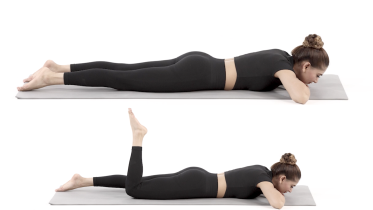 Eccentric hamstring exercise
Stop signs and precautions for the eccentric hamstring exercise
Before you start
- After a knee fracture or knee surgery, including a knee replacement, follow your surgeon's or physio's plan, and start this exercise only when they have cleared you. After a recent hamstring strain begin this only when your physio or surgeon says the muscle is ready for it, and keep to the slow lower until they clear you for the quick drop. The same applies after any ligament reconstruction that used a hamstring tendon as the graft, not only an ACL reconstruction: the tendon taken is usually the semitendinosus, sometimes with the gracilis, and the same tendons are used for MCL, PCL, posterolateral corner and kneecap ligament reconstructions, so your operation notes are what tell you whether this applies to you. Ask which leg the graft was taken from as well, because some surgeons take it from the uninjured leg, and it is that leg this applies to.
- If you are still growing, or you are a coach or parent setting this for somebody who is, ask a physiotherapist or a qualified strength coach to set it up and to look at the young person first. The hamstring attaches at a growth area at the bone you sit on, and the dose on this page is an adult figure that has not been tested in growing athletes.
- If you have had recent heart or chest surgery, do not lie face down on a healing chest wound. The weight of your chest presses on the wound for as long as you are down there, and pushing up through your arms to get off the bed pulls across the breastbone. Ask your surgeon or surgical team when lying on your front is allowed, and until then ask your physio for another way to do this while you lie on your side, sit or stand. If the breastbone clicks, grinds, shifts or feels as if it is moving while you do it, stop, and contact your surgical team the same day.
When to stop and get help
- A sudden sharp pain, pop or snap at the back of your thigh. Stop straight away. If you then get large bruising spreading down the back of the thigh, a gap or dip you can feel, a stiff-legged walk, or clear weakness when you bend the knee, get assessed the same day at urgent care or an emergency department, as the tendon may have pulled away from the bone near the buttock.
- Pain that catches behind the knee or up near the bone you sit on.
- Your lower back aches or pinches while you lie on your front or lower the leg.
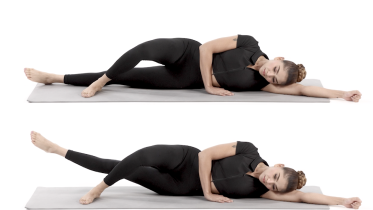 Side lying hip adduction
Stop signs and precautions for the side lying hip adduction
Before you start
- If you have had a hip replacement, get the go-ahead from your surgeon or physio before you try side-lying hip adduction. Here the top leg crosses over in front of you and the bottom leg lifts past the middle of your body, and many surgeons ask you to avoid that for the first months after some operations.
When to stop and get help
- You feel sharp pain in the groin or at the pubic bone at the front of the pelvis.
- Pain in the lower back, or pain that spreads down the leg.
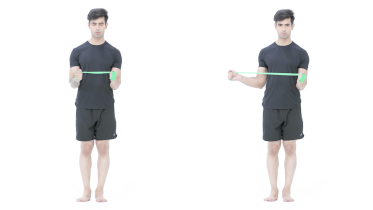 Shoulder external rotation with band
Stop signs and precautions for the shoulder external rotation with band
Before you start
- After shoulder surgery, including a rotator cuff repair, or after a shoulder fracture or dislocation, follow your surgeon's or physio's plan, and do only the movements and range they have cleared. Many plans allow only passive movement at first, where the arm is moved for you and its muscles stay relaxed. Resisted rotation usually starts later, and the range may be limited at first, so check with your physio before adding a band.
When to stop and get help
- You feel a sharp pain or a catch in the shoulder as the forearm turns out.
- Pain or tingling spreads down the arm.
- Pins and needles in your arm or hand that do not go away after you stop, or part of your arm or hand goes numb. Get medical advice the same day. If one side of your face or body suddenly goes numb or weak, or your speech becomes slurred or muddled, call emergency services, even if it goes away.
- A sudden pop or tearing feeling in the shoulder that brings sharp pain, new weakness or trouble lifting the arm. Stop and contact your surgical team the same day, or get medical advice the same day if you have not had surgery.
- The shoulder feels as if it has slipped out of place, looks a different shape or suddenly locks so you cannot move the arm, or your hand turns cold, pale or blue. Go to an emergency department straight away, without driving yourself, and do not try to put the shoulder back in yourself.
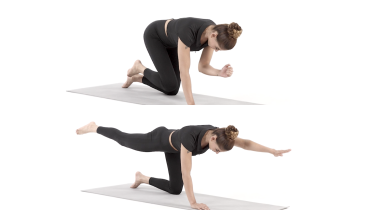 Bird dog
Stop signs and precautions for the bird dog
Before you start
- If you have had a hip replacement or other hip surgery, get the go-ahead from your surgeon or physio before you try bird dog. Lifting the leg takes the hip back behind the line of your body and drawing the knee in toward your elbow bends it well past a right angle, and many surgeons ask you to avoid that for the first months after some operations. After a hip or knee replacement, kneeling may not be comfortable yet either.
- After back surgery, keep to it until your surgeon and physio say bending the spine is fine.
- After a broken wrist, hand or forearm, or surgery on any of them such as a tendon repair, start only when your doctor, surgeon, physio or hand therapist says the bone or repair is ready to take weight through the arms, and follow their plan for how much to do.
- After recent heart or chest surgery, get your surgeon's or surgical team's okay first, because with one arm lifted, your whole upper body weight goes through the other hand, which shears across the healing breastbone. If the breastbone clicks, grinds, shifts or feels as if it is moving while you do it, stop, and contact your surgical team the same day.
When to stop and get help
- Your back hurts more during or after the exercise and it does not settle.
- You get pain running down your leg, or numbness or tingling.
- Your knees or wrists hurt from taking your weight. Ask your physio about padding under you or another position.
Every exercise page carries its own precautions and stop signs, and those come before anything written here. Read the line under each exercise before you try it. If you are pregnant and past the first three months, check with your physio before exercising flat on your back, and ask for a standing or seated version of the eccentric hamstring exercise, which is done lying face down and usually stops being comfortable in the middle months. After a recent hamstring strain, or an ACL reconstruction that used a hamstring graft, start the eccentric hamstring exercise only when your physio or surgeon says the hamstring is ready for it, since the whole point of the exercise is to load the muscle while it lengthens.
After a hip replacement, get the go-ahead from your surgeon or physio before side lying hip adduction, because lying on your side lets the top leg drop across the lower one. After shoulder surgery, a shoulder fracture or a dislocation, follow your surgeon's or physio's plan and do only the movements and range they have cleared.
Bird dog puts your weight through your arms, so after a broken wrist, hand or forearm, or surgery on any of them, start it only when your doctor, surgeon, physio or hand therapist says the bone or the repair is ready to take weight through the arms. If you have high blood pressure, breathe steadily through every repetition and never hold your breath. If chest pain, pressure or tightness does not ease quickly when you rest, spreads to your arm, neck, jaw, stomach or back, or comes with sweating, feeling sick, feeling light-headed or being short of breath, call emergency services straight away, as this can be a heart attack. If it eases quickly and none of these happen, get medical advice the same day, and do not exercise again until you have been checked.
When to see a physio
Two weeks of the same complaint is the usual trigger. So is a problem that turns up reliably on the second day of a weekend double header, and so is noticing that you have quietly changed how you bowl, throw or run to keep away from it. A shoulder that has started waking you up, an ankle that has given way twice, or a hamstring that grabs every time you sprint should move that appointment forward.
Two situations do not follow the two week rule at all. Back pain in a fast bowler, above all a teenage one, is a reason to stop bowling, get advice the same day and be assessed before bowling again, for reasons the bowler's back page sets out in full. And a hard ball to the head, the eye or the hand is assessed on the day, whatever the helmet or the glove did, with the head and eye lines in the warning list below going faster than that. Getting back to cricket after a concussion is its own process, with a staged return and a clinician signing off the last steps rather than a date doing it, and it is set out at concussion recovery and return to play.
Expect a first appointment to be mostly watching you move. A physiotherapist will look at what your hip and shoulder do at the end of your run-up, how your trunk behaves when you side flex, what your hamstring can hold at length, and how your week has been built. Take the details that explain it: your overs, your training days, and what changed in the fortnight before the pain started. The warning signs below come first, at whatever speed each line sets.
In this topic
- Fast bowler back pain: why it is not ordinary back pain
Why back pain in a fast bowler is read differently from other back pain, what the ECB, Cricket Australia and New Zealand Cricket limits say.
- Cricket shoulder pain: bowling, throwing and the dive in the deep
The two kinds of cricket shoulder pain, the gradual bowling one and the sudden fielding one, how to tell them apart and how long each takes.
- Side strain in cricket: the tear a bowler feels in one delivery
What tears in a side strain, why cricket bowlers feel it on the non-bowling side, the measured return to play times and what recovery involves.
Related exercise programs
- Hamstring strain
- Groin strain
- Low back pain
- Rotator cuff tendinopathy
- Ankle sprain
- Concussion recovery and return to activity
Warning signs
Get emergency help now
- Emergency: if chest pain, pressure or tightness does not ease quickly when you rest, spreads to your arm, neck, jaw, stomach or back, or comes with sweating, feeling sick, feeling light-headed or being short of breath, call emergency services straight away, as this can be a heart attack. If it eases quickly and none of these happen, get medical advice the same day, and do not exercise again until you have been checked.
- Emergency: if you faint while exercising, call emergency services, even if you feel fine again quickly.
- Emergency: any sign of a stroke, even if it goes away. That means a face that droops on one side, an arm you cannot lift or keep up, slurred or muddled speech, weakness or numbness on one side of your body or face, sudden blurred vision, double vision or loss of sight, trouble swallowing, sudden dizziness with unsteadiness or falling over, a sudden severe headache, or a sudden fall where your legs give way but you do not black out (a drop attack). Call emergency services straight away.
- Emergency: after a ball, a bat, a collision or a fall to the face, any change to your sight, severe pain in the eye, a headache or finding light hard to bear, feeling sick or being sick, an eye you cannot move or keep open, or blood or pus coming from the eye. The same applies if something has pierced the eye or hit it at high speed, or if a strong chemical has gone into it. Go to an emergency department or call emergency services straight away, and do not drive yourself.
- Emergency: after a knock to the head, being very drowsy or finding it hard to keep your eyes open, confusion, a fit (seizure), new weakness or numbness anywhere in your body, new trouble understanding, speaking, walking or keeping your balance, new problems seeing or hearing, clear fluid coming from your ears or nose, bleeding from your ears or bruising behind them, a black eye when your eye was not hit, a dent in your head or a wound with something stuck in it, or a change in behavior. Call emergency services straight away. These can be signs of an injury to the brain.
- Emergency: after a knock to the head, you were knocked out, even for a moment, you cannot remember what happened just before or after, you have had a headache ever since, or you are being sick (vomiting). The same applies, even if you feel fine, if you take medicine that thins your blood, other than aspirin on its own, have a bleeding or clotting condition, have had brain surgery in the past, or had been drinking alcohol or taking drugs when it happened. Go to an emergency department straight away, and do not drive yourself.
- Emergency: severe neck pain after a knock to the head, whatever the fall or the knock was like. Keep still and call emergency services, and do not let anyone move you until someone trained has checked your neck. If the neck pain only starts later and nobody has checked your neck since, go to an emergency department straight away, and do not drive yourself.
- Emergency: after a knock to the head, swelling, a deep cut or severe pain at the exact spot that was hit. Call emergency services or go to an emergency department straight away, and do not drive yourself. These can be signs of a broken skull.
- Emergency: the shoulder feels as if it has slipped out of place, looks a different shape or suddenly locks so you cannot move the arm, or the pain is severe after a fall or an injury. Go to an emergency department straight away, without driving yourself, and do not try to put the shoulder back in yourself.
- Emergency: your arm, hand or fingers turn cold, pale, blue or gray compared with the other side. Call emergency services or go to an emergency department straight away, and do not drive yourself. The blood supply to the arm may be blocked.
- Emergency: after an injury, a finger or thumb that points at an odd angle, looks blue or feels numb, or has a cut with bone showing or poking out. Go to an emergency department straight away, and do not drive yourself. The finger may be broken.
- Emergency: numbness, tingling or altered feeling around or under your genitals, between your inner thighs, or around your bottom (anus), for example it feels different when you wipe after using the toilet. Call emergency services or go to an emergency department straight away, and do not drive yourself. This can be a sign of pressure on the bundle of nerves at the base of the spine (cauda equina syndrome), which needs emergency treatment.
- Emergency: you find it hard to start peeing, cannot pee, cannot feel yourself peeing or cannot control when you pee, or you do not notice when you need to poo or cannot control when you poo, and this is not normal for you. The same applies to a new change in how your genitals feel during sex, new trouble getting or keeping an erection, new trouble ejaculating, or new trouble reaching orgasm. Call emergency services or go to an emergency department straight away, and do not drive yourself. These can also be signs of cauda equina syndrome.
- Emergency: sciatica in both legs, or pain, tingling, numbness or weakness in both legs. The same applies if you lose feeling in one leg. Call emergency services or go to an emergency department straight away, and do not drive yourself.
- Emergency: back or leg pain that started after a serious accident, such as a car crash or a fall from a height, or back pain with chest pain. Call emergency services. If the pain started straight after the accident, keep still while you wait.
- Emergency: the knee became very swollen very quickly, within a few hours of a twist, fall or blow, or you felt a pop or snap. Go to an emergency department straight away. Do not drive yourself: ask someone to drive you or call an ambulance. A knee that fills up that fast has usually bled inside the joint, which can come from a torn ligament, a kneecap that slipped out or a break, so it needs checking before you play again.
- Emergency: the ankle or foot looks deformed or out of place, you heard a crack when you were injured, or the foot is numb, tingling, cold, pale or blue. Go to an emergency department straight away, and do not drive yourself.
Get help today
- Same day: you have had a knock to the head and you take aspirin on its own, without any of the emergency signs above. Get medical advice the same day. Aspirin on its own is the only blood thinning medicine left out of the emergency line above, and the NHS still asks anybody taking a medicine that thins the blood to get urgent advice after a head injury.
- Same day: lower back pain that comes on while you are bowling fast, at any age and above all under 20. Stop bowling now, get medical advice the same day, and do not bowl again until a sports doctor or a physiotherapist who manages bone stress injuries has assessed you, which is what Cricket Australia's junior pace bowling guidelines tell a junior bowler to do. Keep walking and keep up your usual daily activities while you wait, because it is the bowling that comes out, not your life.
- Same day: lower back pain in a bowler under 20 that turns up after a spell rather than during it, or that comes back every time they bowl even if it settles in between. Stop bowling now, get medical advice the same day, and do not bowl again until a sports doctor or a physiotherapist who manages bone stress injuries has assessed you. Pain that waits until the spell is over is still bowling pain, and in a growing bowler it is read the same way.
- Same day: a sudden pop or snap at the back of your ankle or heel, a feeling that someone kicked you there, or sudden pain there after which you cannot push off or rise onto your toes on that leg. Stop, take the weight off that leg carefully and go to an urgent care center or emergency department the same day, even if you can still walk, as this can be a torn Achilles tendon.
- Same day: you cannot walk or put weight on the leg, whether or not there was a fall or injury, or you have very bad knee pain after a fall or injury, or very bad knee pain that came on suddenly with no injury at all. Get medical advice the same day.
- Same day: a finger or thumb that became painful, swollen, bruised, stiff or hard to move after an injury, rather than slowly over weeks. Get medical advice the same day, and have it checked before you start these exercises.
- Same day: a calf or thigh that is newly swollen or getting more swollen, warm, tender, red or darker than usual, has swollen veins that are sore to touch, or has a throbbing or cramping pain that does not fit your injury or condition, or that feels different from normal muscle soreness after exercise. This can be a sign of a blood clot (deep vein thrombosis), especially after surgery, an injury, time in a cast or boot, a long trip or a spell of being much less mobile than usual. Get medical advice the same day. If you are also short of breath or have chest pain, call emergency services.
- Same day: the pain is there at night or at rest and keeps getting worse. If you are being treated for cancer now, contact your cancer team the same day.
Book an appointment
- Within a day or two: the pain is there at night or at rest and keeps getting worse. If you have had cancer, now or in the past, or are losing weight without trying, see your doctor sooner, within a day or two, and mention it. This applies even if the pain is not getting worse.
- Within a few days: the pain is there at night or at rest and keeps getting worse. See your doctor within a few days.
Common questions
Do bowlers, batters and fielders get injured in different places?
Yes, and the surveillance work is clear enough about it to be useful. In nine seasons of elite men's domestic cricket in England and Wales, bowling was the activity behind the most injuries, at 41.6 per 1000 days of play (Goggins and colleagues, 2020). In the companion study of the same system, covering 2010 to 2019, bowling also produced the most days lost in a season, a mean of 1942 days with a confidence interval of 1799 to 2096, and the highest average severity at 30 days per injury; within bowling, the lumbar spine lost the most days, a mean of 432 a season (Goggins and colleagues, 2024). Fielding is a different problem rather than a smaller one, because it supplies the sudden injuries, and one clinical review of the sport puts fielding and wicketkeeping together at 28.6 percent of injuries, a rough share from a narrative review rather than a measured rate (Pardiwala and colleagues, 2018). Batting sits between the two, and the running between the wickets is what tends to find a hamstring or a groin.
How long do cricket injuries keep you out?
It depends entirely on the tissue, and the published numbers are wide. Across ten years of English and Welsh domestic cricket the average injury from bowling cost 30 days, with a confidence interval of 28 to 33 (Goggins and colleagues, 2024). A side strain in professional fast bowlers cost a mean of 39 days, standard deviation 14, and 44 percent of them were out for more than six weeks (Nealon and colleagues, 2019). At the slow end, the England and Wales Cricket Board tells its own players that a bowler with a spinal stress fracture may be unable to compete for up to 8 months, or in some cases longer, and of 31 fractures in 20 elite Australian bowlers, the 25 that reached healing took a median of 203 days from the scan that found the fracture to the scan that showed it healed, with a range across the middle half of 141 to 301 days (ECB Recreational Cricket Safety Guidelines, December 2025; Singh and colleagues, 2021). Those are elite squads with daily medical access, so treat them as the shape of the thing rather than as your own timetable.
Does a cricket warm-up prevent injuries?
Nobody has tested a cricket warm-up against no warm-up and counted injuries, so there is no honest yes. What has been tested in this sport, once, is an eight week exercise program: eight community cricket organizations and 65 male adolescent pace bowlers aged 14 to 17 were randomized to the program or to usual activity, and the program improved shoulder strength at 90 degrees per second, hamstring strength at 60 degrees per second, hip adductor strength on both sides, balance reach on both sides and back endurance (Forrest and colleagues, 2020). It changed nothing in shoulder or hamstring strength at the faster test speed, in lumbopelvic stability or in knee position during a single leg squat, and the authors say themselves that moving those measures is not the same as preventing an injury. So warm up because it gets you ready to bowl or bat properly, and build your week up in steps rather than in jumps, which is the part of load management the cricket evidence does support.
Is cricket safe for children?
It is exercise, and nothing in the datasets behind this page says children should not play, but junior fast bowling is the one part of cricket where the governing bodies set numbers rather than offering advice. In England and Wales the over limits for players aged 19 and under in hardball cricket are regulation, enforced by the umpire, with 5 penalty runs for a breach (ECB Recreational Cricket Safety Regulations, December 2025). Cricket Australia and New Zealand Cricket publish their own age-banded limits as recommendations, dated March 2026 and November 2021, and the three sets of numbers are not identical. The reason behind all of them is bone stress in the lower back, which is an injury of adolescence, and Cricket Australia's own guidelines tell parents and coaches that these injuries often develop before pain is felt. The fast bowler back pain page sets out each country's numbers with the body and the year attached, and what to do about back pain in a young bowler.
References
- Goggins L, Peirce N, Ranson C, McCaig S, Newman D, Langley B, Griffin S, Young M, McKay C, Stokes K, Williams S. Injuries in England and Wales elite men's domestic cricket: A nine season review from 2010 to 2018. Journal of Science and Medicine in Sport. 2020;23(9):836-840. https://doi.org/10.1016/j.jsams.2020.03.009
- Goggins L, Williams S, Griffin S, Langley B, Newman D, Peirce N. English and Welsh men's domestic cricket injury risk by activity and cricket type: A retrospective cohort study from 2010 to 2019. Journal of Science and Medicine in Sport. 2024;27(1):25-29. https://doi.org/10.1016/j.jsams.2023.07.013
- Orchard JW, Kountouris A, Sims K. Incidence and prevalence of elite male cricket injuries using updated consensus definitions. Open Access Journal of Sports Medicine. 2016;7:187-194. https://doi.org/10.2147/OAJSM.S117497
- Dovbysh T, Reid D, Shackel D. Injury incidence within male elite New Zealand cricket from the early T20 era: 2009-2015. BMJ Open Sport and Exercise Medicine. 2021;7(4):e001168. https://doi.org/10.1136/bmjsem-2021-001168
- Orchard JW, Ranson C, Olivier B, Dhillon M, Gray J, Langley B, Mansingh A, Moore IS, Murphy I, Patricios J, and colleagues. International consensus statement on injury surveillance in cricket: a 2016 update. British Journal of Sports Medicine. 2016;50(20):1245-1251. https://doi.org/10.1136/bjsports-2016-096125
- McLeod G, Murphy M, Gianotti S, Orchard JW, Fortington LV. Cricket injury in New Zealand: a study of injury insurance claims from 2008 to 2018. Journal of Science and Medicine in Sport. 2023;26(2):109-113. https://doi.org/10.1016/j.jsams.2022.12.001
- Pardiwala DN, Rao NN, Varshney AV. Injuries in Cricket. Sports Health. 2018;10(3):217-222. https://doi.org/10.1177/1941738117732318
- Nawabi O, Pandya N. Injuries in Cricket: A Review. Current Reviews in Musculoskeletal Medicine. 2026;19(1):35. https://doi.org/10.1007/s12178-026-10029-8
- Forrest MRL, Hebert JJ, Scott BR, Dempsey AR. Exercise-based injury prevention for community-level adolescent cricket pace bowlers: A cluster-randomised controlled trial. Journal of Science and Medicine in Sport. 2020;23(5):475-480. https://doi.org/10.1016/j.jsams.2019.12.009
- Forrest MRL, Scott BR, Hebert JJ, Dempsey AR. Injury Prevention Strategies for Adolescent Cricket Pace Bowlers. Sports Medicine. 2018;48(11):2449-2461. https://doi.org/10.1007/s40279-018-0981-6
- Nealon AR, Docking SI, Lucas PE, Connell DA, Koh ES, Cook JL. MRI findings are associated with time to return to play in first class cricket fast bowlers with side strain in Australia and England. Journal of Science and Medicine in Sport. 2019;22(9):992-996. https://doi.org/10.1016/j.jsams.2019.05.020
- Singh SP, Rotstein AH, Saw AE, Saw R, Kountouris A, James T. Radiological healing of lumbar spine stress fractures in elite cricket fast bowlers. Journal of Science and Medicine in Sport. 2021;24(2):112-115. https://doi.org/10.1016/j.jsams.2020.06.018
- England and Wales Cricket Board. ECB Recreational Cricket Safety Regulations, December 2025 update. https://resources.ecb.co.uk/ecb/document/2025/12/16/79efc12c-b0a0-4aeb-9774-347c138e00c0/Recreational-Cricket-Safety-Regulations-Dec-2025-Update.pdf
- England and Wales Cricket Board. ECB Recreational Cricket Safety Guidelines, December 2025 update. https://resources.ecb.co.uk/ecb/document/2025/12/16/28c76edf-7e04-4193-933d-cb2866010440/Recreational-Cricket-Safety-Guidelines-Dec-2025-Update.pdf
- Cricket Australia. Community Cricket Junior Pace Bowling Workload Guidelines. March 2026. https://resources.playcommunity.pulselive.com/playcommunity/document/2026/04/16/c6ec26ff-62b0-43fe-bd74-18f58c8e8e1e/Junior-Bowling-Guidelines.pdf
- New Zealand Cricket. Youth Pace Bowling Recommendations. November 2021. https://www.nzc.nz/media/18857/youth-pace-bowling-recommendations.pdf
- NHS. Chest pain. Page last reviewed 8 August 2023. https://www.nhs.uk/symptoms/chest-pain/
- NHS. Symptoms of a stroke. Page last reviewed 12 September 2024. https://www.nhs.uk/conditions/stroke/symptoms/
- NHS. Eye injuries. Page last reviewed 12 March 2026. https://www.nhs.uk/conditions/eye-injuries/
- NHS. Head injury and concussion. Page last reviewed 29 May 2025. https://www.nhs.uk/conditions/head-injury-and-concussion/
- Sport and Recreation Alliance and UK Government. UK concussion guidelines for non-elite (grassroots) sport. Published 2023, updated November 2024. https://sportandrecreation.org.uk/campaigns-and-policy/concussion/concussion-guidelines-for-grassroots-sport-html-version
- NHS. Dislocated shoulder. Page last reviewed 16 September 2026. https://www.nhs.uk/conditions/dislocated-shoulder/
- NHS. Broken finger. Page last reviewed 20 November 2025. https://www.nhs.uk/conditions/broken-finger/
- NHS. Back pain. Page last reviewed 5 March 2026. https://www.nhs.uk/conditions/back-pain/
- NHS. Sciatica. Page last reviewed 3 December 2024. https://www.nhs.uk/conditions/sciatica/
- NHS. Knee pain. Page last reviewed 21 December 2023. https://www.nhs.uk/symptoms/knee-pain/
- NHS. Sprains and strains. Page last reviewed 23 April 2024. https://www.nhs.uk/conditions/sprains-and-strains/
- NHS. DVT (deep vein thrombosis). Page last reviewed 30 April 2026. https://www.nhs.uk/conditions/deep-vein-thrombosis-dvt/
Written and checked by the PocketPhysio editorial team. Last updated 2026-11-06.
This page is general education, not a diagnosis or a personal treatment plan. See a physiotherapist or doctor for advice about your own situation.