Eccentric hamstring exercise
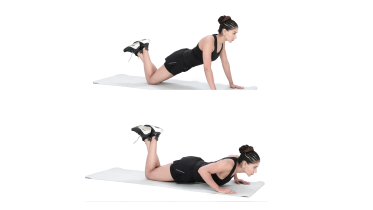
This eccentric hamstring exercise trains the muscles at the back of your thigh (hamstrings) to brake a falling lower leg. You lie face down, bend one knee until the shin points at the ceiling, then lower the foot back toward the mat and stop it just before it touches. Stopping the leg makes the hamstring work while it lengthens, which is what eccentric means.
How to do the eccentric hamstring exercise
- Lie face down on a mat with your legs straight and your forehead resting on your folded hands, as in the video.
- Bend one knee until your shin points straight up at the ceiling, a right angle at the knee.
- Lower the foot back toward the mat and brake so it stops just above the mat without touching. Start with a steady lower that takes 2 to 3 seconds.
- Pause for a moment, then bend the knee to bring the foot back up to the start.
- Keep the front of your hips on the mat throughout, and finish all the repetitions on one leg before changing sides.
What you should feel
Work at the back of the thigh on the moving leg, strongest at the moment you stop the foot above the mat.
Common mistakes
- Letting the foot land on the mat instead of stopping it.
- Lifting the hips or arching the lower back as the leg lowers.
- Swinging the leg back up with momentum rather than bending the knee with control.
- Going straight to the quick drop in the video before the slow lower is easy and pain free.
How often
Many programs start with 2 to 3 sets of 6 to 10 slow lowers on each leg, a few days a week, with a rest day between sessions, then speed up the lower over a week or two once it is easy and pain free. Your physio will adjust this.
Stop and check with your physio if
- A sudden sharp pain, pop or snap at the back of your thigh. Stop straight away. If you then get large bruising spreading down the back of the thigh, a gap or dip you can feel, a stiff-legged walk, or clear weakness when you bend the knee, get assessed the same day at urgent care or an emergency department, as the tendon may have pulled away from the bone near the buttock.
- Pain that catches behind the knee or up near the bone you sit on.
- Your lower back aches or pinches while you lie on your front or lower the leg.
From the clinic
The video and the voice guide show the faster version: a quick drop, with the hamstring stopping the leg suddenly just above the mat. That sudden stop is harder on the muscle than a slow lower, so start slow and add speed only once the slow version feels easy and does not hurt. The eccentric hamstring curl is a slower version in the same position, with the other leg helping on the way up, and the prone hamstring curl adds a band.
When you first start, braking work like this often leaves the back of the thigh a little sore for a day or two. Soreness the next day is expected, but pain during the drop means stop. After a knee fracture or knee surgery, including a knee replacement, follow your surgeon's or physio's plan, and start this exercise only when they have cleared you. After a recent hamstring strain, or an ACL reconstruction that used a hamstring graft, begin this only when your physio or surgeon says the muscle is ready for it, and keep to the slow lower until they clear you for the quick drop.
Written and checked by the PocketPhysio editorial team. Last updated 2026-09-28.
This page is general education, not a diagnosis or a personal treatment plan. If you have pain, an injury or a health condition, see a physiotherapist or doctor before starting new exercises.