
Pec strain: a physio guide to a pulled chest muscle
Warning signs, and when to get help
Is it a pulled chest muscle or my heart?
Read this part even if you are sure it is the muscle.
You cannot settle that question at home, and neither can this page. If chest pain, pressure or tightness does not ease quickly when you rest, spreads to your arm, neck, jaw, stomach or back, or comes with sweating, feeling sick, feeling light-headed or being short of breath, call emergency services straight away, as this can be a heart attack. If it eases quickly and none of these happen, get medical advice the same day, and do not exercise again until you have been checked.
Three things make the question harder than it sounds. The first is that a chest wall you can press and hurt is not proof of anything.
Among 122 consecutive people who arrived at one emergency department with chest pain, after injury, fever and cancer had been screened out, 36 turned out to have costochondritis, a painful condition of the joints beside the breastbone. Within that group the acute heart attack rate was 6%, against 28% in everyone else (Disla and colleagues, 1994). Tenderness lowered the odds. It did not clear anybody.
The second is that a pec strain almost always has a moment attached to it. You were at the bottom of a heavy press, or a dip, or you grabbed a rail as you fell, and the pain started there and then. Pain that turns up while you are sitting still, or builds through a day with nothing behind it, has no such moment, and that is unexplained chest pain rather than a pulled chest muscle. The NHS puts sudden chest pain that does not go away, pain spreading into an arm, the neck, the jaw, the stomach or the back, and chest pain with sweating, sickness, light-headedness or breathlessness on its emergency list, and asks you to see a doctor about chest pain that comes and goes.
Having a moment attached to it does not settle the question the other way, and this is the part lifters get wrong most often. NICE calls chest pain anginal when it has three features: a constricting discomfort at the front of the chest, or in the neck, shoulders, jaw or arms, brought on by physical exertion, and eased by rest within about 5 minutes. All three present is what NICE calls typical angina, and two of the three is what it calls atypical angina, which goes down the same assessment route rather than out of it (NICE CG95, 1.3.3.1).
So counting your own features and coming up one short is not an exit, and "it came on at the bottom of the set and it went when I stopped" is not evidence for the muscle. It is the pattern a doctor is taught to treat as angina until it has been assessed. The same guideline tells clinicians not to read these symptoms differently in men and women, or in different ethnic groups, and says that not every acute coronary syndrome arrives with central chest pain as its main feature. Those categories belong to a clinician working with an examination and an ECG, which is the one thing that makes them useful, and it is also why none of them is a test you can run on yourself.
The third is the one both lifters and physios lean on hardest, and it is the weakest of the three. A pain you can bring on with a movement, and find again the same way, feels mechanical, so it feels settled. Look at what those movements are. Pulling a car door, pushing up out of a bath, carrying a bag on one side: every one of them is effort, and effort is the middle feature of the three above.
In a clinic, resisted adduction and internal rotation tell a physio which structure is painful. They do not tell either of us that nothing else is going on at the same time. Pain you can reproduce is a finding, never a rule-out, which is the tenderness research saying the same thing in a different way.
So this page does not offer you a test. There is no breathing pattern, no press of a thumb and no stretch that rules your heart out, and anything that claims otherwise is selling you reassurance. If your chest wall hurts and no lifting injury explains it, costochondritis covers that ground, and red flags in physiotherapy sets out the symptoms that get checked before any exercise program starts.
What is a pec strain?
The pectoralis major is the broad fan of muscle across the front of your chest. It runs from the breastbone, the collarbone and the upper ribs out to the front of the upper arm bone, where it twists into a tendon that is narrower than most people picture. Its jobs are bringing the arm in toward your body and turning it inward, which is why a chest muscle strain shows up when you push a heavy door, hug someone, reach across yourself for a seatbelt or roll over in bed.
A strain means that load has outrun what the muscle or its tendon could take, and some fibers have given way. That runs from a few fibers at the mild end to the whole tendon coming off the arm bone at the other, and the mechanism is usually the same at both ends. The muscle is pulling hard while something stretches it, with the arm out to the side and turned outward. A systematic review of 365 published cases found 83% came from that kind of indirect load rather than a blow, and 48% of them happened during weight training (ElMaraghy and Devereaux, 2012).
Read those percentages for what they are. They describe published cases, which are weighted toward the injuries bad enough to write up, and in the earlier meta-analysis of 112 reported ruptures every single patient was a man (Bak and colleagues, 2000). They tell you how these injuries happen. They do not tell you how common a mild strain is in the general population, because nobody counts those.
There is a consequence to that, and it needs saying out loud if you are not a young man who lifts. The systematic review of repairs pooled 536 patients, of whom exactly 1 was a woman, and their average age was 28 (Yu and colleagues, 2019). So everything this page can tell you about how the injury behaves, what it does next and how long it takes was measured almost entirely in young men. A woman or an older reader can certainly tear a pec, but the reassurance on offer here is thinner for her, because almost none of it was measured in anyone like her.
Age counts the other way too: NICE lists age among the factors that make angina more likely, along with being male and the usual cardiovascular risk factors (NICE CG95, 1.3.3.4), and the same guideline tells clinicians not to read chest pain symptoms differently in men and women. Both of those push the same-day check up rather than down.
One more thing about the word strain. When an international group of sports medicine clinicians looked at how muscle injury terms are used, strain was the term they disagreed about most, which is why one clinician's strain is another's low grade tear (Mueller-Wohlfahrt and colleagues, 2013). If two people have told you two different things about your chest, that is part of the reason.
What does a pec strain feel like?
A pulled, grabbing soreness at the front of the chest or in the fold at the front of the armpit, sore to press, sorer to push against, and worst when the arm travels out to the side and back. Everyday things find it before the gym does: pulling a car door shut, pushing up out of a bath, carrying a bag across the body on that side. Most people can still use the arm, and that is the point worth holding on to. What none of this does is tell a chest muscle from a heart, because every item on that list is effort through the arm, which is why the first section of this page comes before this one.
The strain end of this injury has never been described in a study, so what you have just read is clinical experience and nothing stronger. The tear end has published signs, and they are different enough that you do not need to be a clinician to notice them: a pop or a tearing feeling at the moment of injury, then swelling and bruising that spread into the armpit and down the upper arm, a fold at the front of the armpit that looks wrong next to the other side, and genuine weakness bringing the arm in and turning it inward (Long and colleagues, 2022).
Two patterns catch people out. Bruising can take a day or two to come out, so an injury that looked mild at the time can look much less mild on Thursday. And pain is a poor guide to size here, because a tendon that has come fully off can hurt less at rest than a muscle that is partly torn and still pulling.
Pec strain vs tear: what is different
This is the question most people have under the one they typed, and it has a short answer and a longer one. The short answer: a strain is an overloaded muscle that still works, and a tear is a structural failure that often needs a surgeon's opinion within weeks rather than months.
The longer answer is in how the injuries are classified. The accepted system sorts them by where the failure is, at the origin or in the muscle belly, anywhere from the junction of muscle and tendon out to the insertion, or a piece of bone pulled off, and then by how much of the thickness and width has gone (ElMaraghy and Devereaux, 2012). Where the failure sits and how much of it has gone are what decide the plan, and they are what an examination and usually an MRI are for (Butt and colleagues, 2015).
The reason to settle this quickly is the timing of surgery. The meta-analysis that first put a window on it concluded that repair gave significantly better results than conservative care or late surgery, preferably inside the first 8 weeks after the injury (Bak and colleagues, 2000). Read that as a surgeon's outside limit and not as your own allowance. The clock starts on the day of the injury rather than on the day you decide to act, and inside the window earlier still beats later, which is what the acute against chronic comparison measures.
A later meta-analysis of 384 injuries found that repairs done acutely beat repairs done once the injury was chronic, both on function and on appearance (Bodendorfer and colleagues, 2020). Neither paper gives you a date to hold anyone to. Bak's 8 weeks is written as a preference and not as a cut-off, Bodendorfer's report never says in weeks what it counted as acute, and the accepted classification sorts these injuries into acute and chronic without putting a number on where one becomes the other (ElMaraghy and Devereaux, 2012). Which side of it you are on is a judgement about your own tendon, made by somebody who has examined it and usually seen a scan of it.
The strength difference is the part patients tend to feel: in a small series of complete tears at the tendon end, the repaired group got back to 99% of the uninjured side's peak torque, and the group managed without surgery to 56% (Hanna and colleagues, 2001). Twenty two tears in twenty one patients is a small study, and it is still the clearest direct comparison there is.
Being past the window is not the same as being past help, and reading it that way does its own damage. A review of current management says it plainly: early surgery is preferable, good outcomes in the chronic setting are still achievable, direct repair to the bone is possible in acute and in most chronic cases, and where it is not, reconstruction using a graft is considered (Butt and colleagues, 2015). That same review's first point is that the diagnosis gets recognized and the patient gets referred to a surgeon who deals with these injuries. So if this happened to you months or years ago, nobody examined it, and the arm has never pushed properly since, the next step is a surgical opinion rather than a decision at home that the chance has gone.
None of that means a strain needs an operation. It means the same injury name covers two situations with different clocks, and the slow one has a cost. The warning signs at the foot of this page give the route for a suspected tear, and it is the same day, not next week.
How long does a pec strain take to heal?
Nobody has published a figure for the mild end, and anyone quoting you a confident number for a grade one pec strain is quoting their own practice, not a study. Saying so plainly is better than printing a timetable that has nothing behind it.
The wider muscle injury literature only takes you so far. Most muscle injuries recover well without surgery, the treatments used for them have rarely been tested in clinical trials, and a recovery that is managed badly can delay a return to sport by weeks or months (Jarvinen and colleagues, 2005). That last point is the one that matters for a pec, because the usual way this injury drags on is a return to full depth pressing two weeks too early, twice.
The published numbers that do exist are about surgery, and they are not your timeline unless you have had an operation. A systematic review pooled 536 patients who had a torn tendon repaired, and of the ones whose return was reported, 90% got back to sport at an average of about 6 months and 74% got back to their previous level (Yu and colleagues, 2019).
So judge progress by the chest rather than by the calendar. Mild soreness during a set that settles soon after you stop and leaves you no worse the next morning is the level to work at.
Soreness that builds through a set, sharp pain, or a chest that is clearly worse the next day means the last step was too big, so drop back a stage for a few days and try a smaller one. One pattern is not a load error and does not get a smaller step. If chest pain, pressure or tightness is arriving at lower effort than it did at first, or coming back more often, that is the pattern a clinician assesses as a possible heart problem rather than a healing muscle (NICE CG95, 1.2.1.3), and it goes to the warning signs at the foot of this page instead of into the next session. A sore spot that only complains when you press or push it is a different thing from a chest that now tightens at an effort it used to manage.
The pain monitoring model is the same idea with numbers attached, which some people find easier to hold to than a feeling.
How to use this program
One step comes before stage 1. The first warning sign at the foot of this page is written for everybody who arrives here with chest pain, including the reader who matches none of the emergency signs inside it, and its second half says to get medical advice the same day and not to exercise again until you have been checked. If that has not happened yet, that is the step, and the program waits.
Then start at stage 1, even if the injury feels minor, and move up when the current stage is comfortable and your chest is no worse the morning after it. Each stage replaces the one before it rather than being added to it, so when you move up, the earlier holds or push-ups come out of the session. The pendulum is the one part worth keeping on for as long as it helps. Two stages stacked into one session is how a chest that was ready for the next step ends up loaded twice in a day. This is education rather than a plan for your particular chest, and if a clinician has given you one, theirs comes first.
Each exercise page gives a typical starting dose, and the stage notes above repeat them. The holds in stage 1 suit most days, while the pushing work in stages 2 and 3 is usually done 2 or 3 days a week so the muscle can recover between sessions. Your physio will set the range and the numbers for you, and swap an exercise that does not suit your chest. Pendulums and the isometric adduction hold are the two to get right first, because everything later is built on a chest that can take a quiet contraction without flaring.
Three situations this page cannot see, and what to do in each. If you cannot get an appointment, keep the two errands apart: being checked for chest pain is urgent care or emergency services and it does not wait for a referral, while finding a physiotherapist can wait, and the first one is not satisfied by doing the second. If there is nobody to clear you for the next stage, that is not a reason to stay still and it is not permission to skip ahead, so stay at the stage that is comfortable, give each new stage a week before you judge it, and keep using the morning-after rule.
If the injury was months or years ago, do not use stage 3 as a test of whether you have recovered: start at stage 1 like everybody else, because a chest that has pressed nothing for a year is out of condition as well as mended, and a full push-up is a poor way to find that out. One version of an old injury is not mended at all, so check it against the signs first. A pop at the time, bruising that spread into the armpit, a fold at the front of the armpit that still looks different from the other side, or pushing strength that never came back, any of those and the step before stage 1 is a surgical opinion rather than a program, however long ago it was.
If you have high blood pressure, breathe steadily through every repetition and never hold your breath. With a heart condition or high blood pressure, check with your doctor before you start.
Stop at once for any of these: chest pain or pressure, dizziness or feeling faint, a racing or irregular heartbeat, or being far more out of breath than the effort should cause. Stopping is the right call even if it turns out to have been the same pain you came with, because nothing you can do at home separates one from the other, and a session missed costs you nothing. Then follow the chest pain warning signs at the foot of this page, which say what to do next and how fast. If you faint while exercising, call emergency services, even if you feel fine again quickly. If you live alone, keep a phone within reach while you exercise, and call emergency services yourself rather than waiting for somebody to reach you.
If you are pregnant, check with your midwife, doctor or physio first. That is not a formality on this page, because stages 2 and 3 are pressing work and the knee and full push-ups hold a plank position, which loads the wall of your tummy at the same time as the chest. If you are pregnant or have had a baby in the last few months, plan those two stages with your midwife, doctor or physio rather than working up to them alone, breathe out as you push instead of holding your breath, and stop and ask before going further if a ridge or dome appears down the middle of your tummy, if you leak, or if you feel heaviness or bulging in your vagina. The wall push-up and the band press, done standing, are the pressing work to stay with meanwhile, and diastasis recti covers the tummy wall side of this properly. After surgery to repair the tendon, after any chest, heart or lung operation, or after shoulder surgery, follow the program from your surgical team and physio rather than this one, and read the section below before you touch a push-up.
The exercise program
The exercises below carry their own stop signs and precautions. Open the line under an exercise and read them before you try it.
Stage 1: Settle it down and keep the shoulder moving
For the first days to weeks, while the chest is sore to press on and sore to stretch. The pendulum keeps the shoulder joint moving without asking the chest muscle to pull, and the two holds ask the pec to work without changing length, which a sore muscle usually tolerates earlier than movement under load. Keep every hold pain free: press lightly against your own hand, build the pressure over days rather than minutes, and work at the level where you feel effort and no pain. For the adduction hold, keep the elbow in front of your chest with the forearm pointing upward, and not out to the side, because an arm held wide and turned outward is the position this injury happens in. The exercise page for that hold leaves the height to your physio, so if nobody has given you one, in front of the chest is the version this stage means. If any of the warning signs for a torn chest muscle fit you, the holds are not where you start: get examined first, and until then the pendulum is the only part of stage 1 that is for you. Resisted adduction and internal rotation are the two movements an examination uses to find a torn tendon, so there is nothing to gain from testing it yourself at home. Common starting points are 30 to 60 seconds of pendulum in each direction a few times a day, and 5 to 10 holds of 5 to 10 seconds for each of the two isometrics, once or twice a day. Both holds work the same chest muscle, so count them as one lot of work rather than two: in the first days that means the lower end of each range and once a day, and what you build first is the pressure, not the count. Your physio will adjust this.
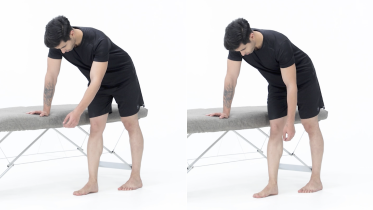 Pendulum exercise for the shoulder
Stop signs and precautions for the pendulum exercise for the shoulder
Before you start
- It is common for frozen shoulder and in the first weeks after some shoulder operations. Do it only if your own team has said it is right for you.
- After shoulder surgery, including a rotator cuff repair, or after a shoulder fracture or dislocation, follow your surgeon's or physio's plan, and do only the movements and range they have cleared. Many plans allow only passive movement at first, where the arm is moved for you and its muscles stay relaxed.
- After a repair of the biceps tendon at the elbow, or another repair, break or operation at the elbow or forearm, leave this one out until your surgeon or physio has cleared the elbow to straighten fully. There is no smaller version of it. The arm hangs fully straight and relaxed, so the elbow goes to its full straight position under the weight of the arm and the hand, which puts a tendon repaired at the elbow in its longest position with nothing of yours holding it back. If your team has set a limit on how far the elbow may straighten, or you are wearing a sling, brace, cast or splint after an operation or a break at the elbow or forearm, this exercise is not yet for you, and taking the arm out of it, or changing a brace setting to let the arm hang, is not the way round that limit. Teams differ on when full straightening is allowed after these operations, so the go-ahead comes from yours.
When to stop and get help
- Shoulder pain gets sharper or keeps building while you swing.
- You feel dizzy when leaning forward. Stand up slowly and sit down. If you faint while exercising, call emergency services, even if you feel fine again quickly.
- Your arm or hand goes numb, tingles or gets pins and needles.
- Pins and needles in your arm or hand that do not go away after you stop, or part of your arm or hand goes numb. Get medical advice the same day. If one side of your face or body suddenly goes numb or weak, or your speech becomes slurred or muddled, call emergency services, even if it goes away.
- A sudden pop or tearing feeling in the shoulder that brings sharp pain, new weakness or trouble lifting the arm. Stop and contact your surgical team the same day, or get medical advice the same day if you have not had surgery.
- The shoulder feels as if it has slipped out of place, looks a different shape or suddenly locks so you cannot move the arm, or your hand turns cold, pale or blue. Go to an emergency department straight away, without driving yourself, and do not try to put the shoulder back in yourself.
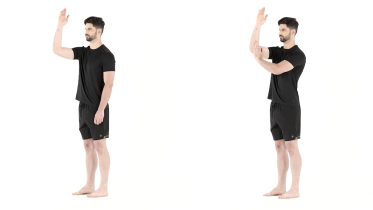 Isometric shoulder adduction
Stop signs and precautions for the isometric shoulder adduction
Before you start
- After shoulder surgery, including a rotator cuff repair, or after a shoulder fracture or dislocation, follow your surgeon's or physio's plan, and do only the movements and range they have cleared. Many plans allow only passive movement at first, where the arm is moved for you and its muscles stay relaxed. Raising the arm and pressing against your hand are both active work, so ask whether resisted holds are on your plan yet.
- If you have high blood pressure, breathe steadily through every hold and never hold your breath.
When to stop and get help
- A sharp pain or a catch in the shoulder or near the armpit as you press.
- Pain, pins and needles or numbness spreading down your arm or into your hand.
- Pins and needles in your arm or hand that do not go away after you stop, or part of your arm or hand goes numb. Get medical advice the same day. If one side of your face or body suddenly goes numb or weak, or your speech becomes slurred or muddled, call emergency services, even if it goes away.
- A sudden pop or tearing feeling in the shoulder that brings sharp pain, new weakness or trouble lifting the arm. Stop and contact your surgical team the same day, or get medical advice the same day if you have not had surgery.
- The shoulder feels as if it has slipped out of place, looks a different shape or suddenly locks so you cannot move the arm, or your hand turns cold, pale or blue. Go to an emergency department straight away, without driving yourself, and do not try to put the shoulder back in yourself.
 Isometric shoulder internal rotation
Stop signs and precautions for the isometric shoulder internal rotation
Before you start
- After shoulder surgery, including a rotator cuff repair, or after a shoulder fracture or dislocation, follow your surgeon's or physio's plan, and do only the movements and range they have cleared. Many plans allow only passive movement at first, where the arm is moved for you and its muscles stay relaxed. Many shoulder replacements and some stabilization operations go through the tendon at the front of the shoulder (subscapularis), and so does a repair of that tendon. After these, pushing inward against resistance is usually held off for several weeks, and your surgeon and physio will tell you when to start.
- Do not hold your breath while you push, especially if you have high blood pressure.
When to stop and get help
- Pushing gives you a sharp pain or a catch in the shoulder.
- You feel pain or tingling spread down the arm.
- Pins and needles in your arm or hand that do not go away after you stop, or part of your arm or hand goes numb. Get medical advice the same day. If one side of your face or body suddenly goes numb or weak, or your speech becomes slurred or muddled, call emergency services, even if it goes away.
- The shoulder aches more after the holds and is still sore a few minutes later.
- A sudden pop or tearing feeling in the shoulder that brings sharp pain, new weakness or trouble lifting the arm. Stop and contact your surgical team the same day, or get medical advice the same day if you have not had surgery.
- The shoulder feels as if it has slipped out of place, looks a different shape or suddenly locks so you cannot move the arm, or your hand turns cold, pale or blue. Go to an emergency department straight away, without driving yourself, and do not try to put the shoulder back in yourself.
Stage 2: Get the range back and add a light push
When the stage 1 holds are pain free and everyday reaching no longer catches the front of the chest, often after one to three weeks. The stick lift brings back overhead reach without stretching across the front of the chest, the wall push-up is the lightest push you can measure and change, and the band row keeps the back of the shoulder working while pressing is cut back. Add the band chest press last of the four, and set it up narrow: hands no wider than your shoulders, elbows kept in rather than flared, and stop the hands at the front of the chest on the way back instead of letting the band draw them further back than that. Wide and travelling backward is the direction this injury happens in, and the slow return is the part of a band press that goes there. If the chest objects, let more band out so it pulls less, or stand closer to the wall for the push-up, rather than pushing through it. Shortening your grip on the band makes it harder, not easier. Programs often use 10 to 15 slow stick lifts 1 to 3 times a day, 2 to 3 sets of 10 to 15 for the wall push-up and the row, and 2 sets of 10 to 15 building to 3 for the band press. The wall push-up and the band press are the same pressing work for the chest, so on a day you do both, keep each at the lower end rather than adding the two top ends together. Both pressing exercises go on the 2 or 3 days a week this page sets, even where the exercise page's own note suggests doing it more often, because those notes are written for people without a healing chest. The row is the exception, since it is back work rather than chest work: keep it on the same 2 or 3 days if the chest is sore afterward, and otherwise its own page's schedule is fine, judged the same way as everything else here, by how the chest is the next morning. Your physio will adjust this.
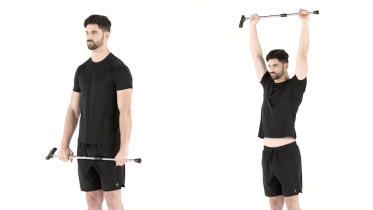 Shoulder flexion with a stick
Stop signs and precautions for the shoulder flexion with a stick
Before you start
- After shoulder surgery, including a rotator cuff repair, or after a shoulder fracture or dislocation, follow your surgeon's or physio's plan, and do only the movements and range they have cleared. Many plans allow only passive movement at first, where the arm is moved for you and its muscles stay relaxed. How high you may lift is often limited for a while.
- After a repair of the biceps tendon at the elbow, or another repair, break or operation at the elbow or forearm, leave this one out until your surgeon or physio has cleared the elbow to straighten fully, and cleared you to hold it straight with the palm turned down and a stick in your hand. There is no smaller version of it. Both elbows stay straight and both palms turn down, and the easier arm supplies the push, so the repaired side is held straight and palm down by a stick it is also gripping and carrying overhead. The biceps turns the palm up as well as bending the elbow, so a straight elbow with the palm turned down is the position that pulls hardest on a tendon repaired there, and the force holding the arm in it comes from your other arm through the stick. Early plans after this repair usually allow gentle bending and straightening, and turning the palm up and down with the elbow bent in at your side, and they keep those two movements apart from each other and from anything held in the hand, which is what this exercise puts together. If your team has set a limit on how far the elbow may straighten or how far the forearm may turn, or you are wearing a sling, brace, cast or splint after an operation or a break at the elbow or forearm, this exercise is not yet for you, and taking the arm out of it, or changing a brace setting, is not the way round that limit. A cast or clinic limit on the wrist or hand does not change that, and leaving the stick out is not a way round it either, because the arm still has to travel overhead. Teams differ on when these movements can be put together, so the go-ahead comes from yours.
- After a broken wrist, hand or forearm, or surgery on any of them, keep the shoulder moving, and do this one only as far as your cast, splint or fracture clinic allows. Both elbows stay straight and both palms turn down, so the injured side has to grip the stick, hold the forearm palm down and carry the stick overhead. Where your fracture clinic, surgeon or hand therapist has limited turning the palm, gripping or taking load through the wrist, that limit comes first. Hold the stick lightly with your fingers. If the cast, or a thumb held still inside it, stops you holding the stick securely, leave the stick out and lift that arm forward and overhead on its own.
- While your hand is in a cast or splint, do not lift it above your head if the hand is painful, tight, more swollen or numb. Rest it at about the level of your heart instead and contact your fracture clinic, as the stop signs for a tight cast describe.
When to stop and get help
- Emergency: while you are in a cast or splint, your fingers turn blue, white or pale, or feel cold. Do not wait to see if raising your hand helps. Go to an emergency department straight away, and do not drive yourself. The cast or splint may be cutting off the blood supply, or pressure may be building up inside the forearm (compartment syndrome), and both need checking quickly.
- In a cast or splint, the pain gets worse, your fingers feel numb or tingle or look more swollen, or the cast feels too tight. Stop, rest your hand at about the level of your heart, keep moving your fingers and contact your fracture clinic or get medical advice straight away. Do not lift the hand higher than your heart and do not put ice on it, because if pressure is building up inside the forearm both of those cut down the blood reaching it. If you cannot move your fingers, the pain is severe even after painkillers, or the numbness, tingling or swelling has not settled within 30 minutes, go to your fracture clinic or an emergency department straight away, and do not drive yourself.
- You get a sharp pain or a catch in the shoulder as the stick goes up.
- Pain or pins and needles spread down the arm.
- Pins and needles in your arm or hand that do not go away after you stop, or part of your arm or hand goes numb. Get medical advice the same day. If one side of your face or body suddenly goes numb or weak, or your speech becomes slurred or muddled, call emergency services, even if it goes away.
- The shoulder stays more painful for hours afterward.
- A sudden pop or tearing feeling in the shoulder that brings sharp pain, new weakness or trouble lifting the arm. Stop and contact your surgical team the same day, or get medical advice the same day if you have not had surgery.
- The shoulder feels as if it has slipped out of place, looks a different shape or suddenly locks so you cannot move the arm, or your hand turns cold, pale or blue. Go to an emergency department straight away, without driving yourself, and do not try to put the shoulder back in yourself.
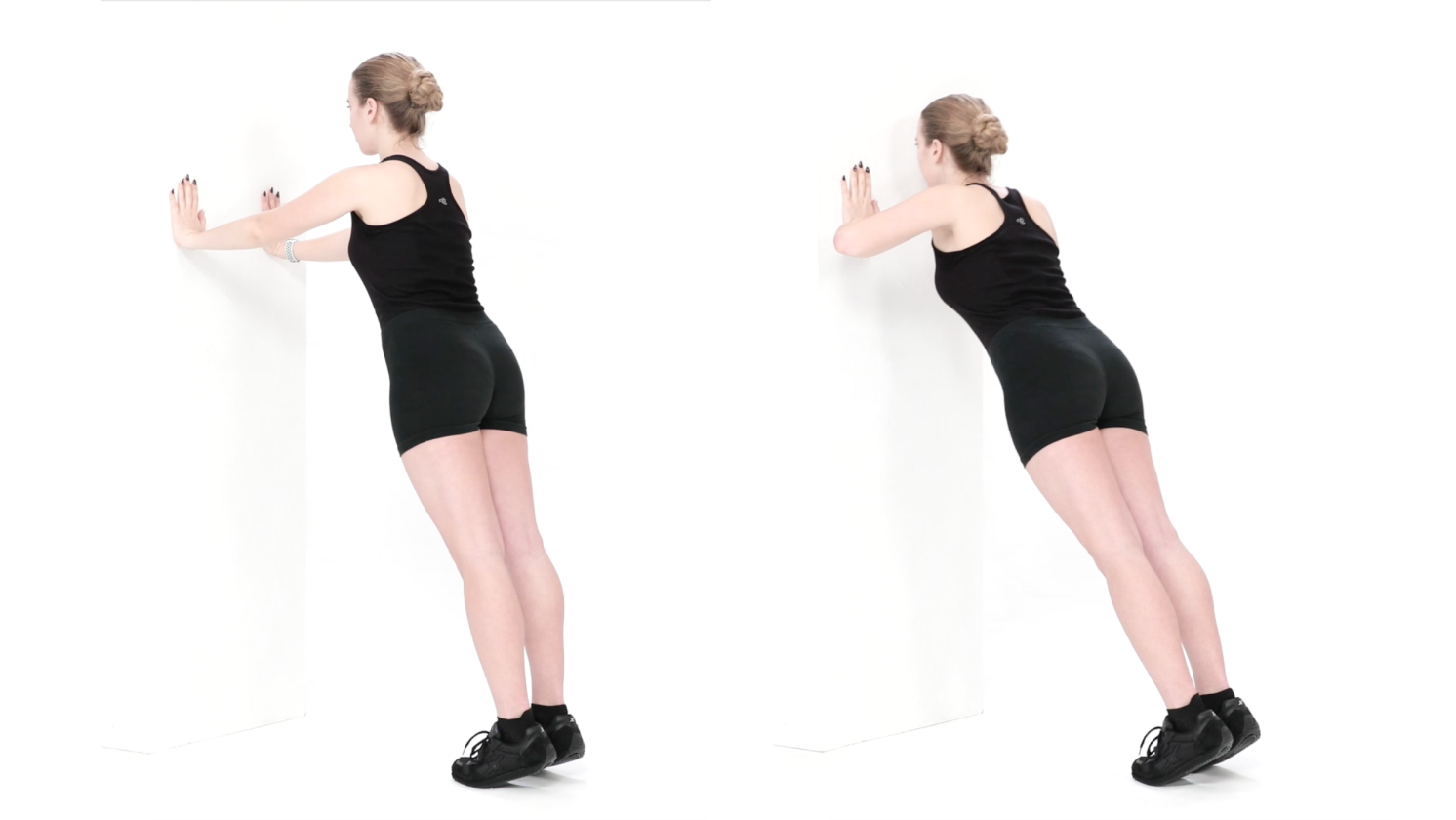 Wall push-ups
Stop signs and precautions for the wall push-ups
Before you start
- After a broken or dislocated elbow, or elbow surgery such as a tendon repair, follow your surgeon's or physio's plan, and start this exercise only when they have cleared you. If you have just hurt your arm and have severe pain or cannot move the elbow, do not exercise it. Go to an urgent care center or emergency department the same day. If you heard a snap or a crack at the moment of the injury, the arm looks a different shape or sits at an odd angle, a bone is showing, or your arm or hand tingles, feels numb or turns cold, pale or blue, go to an emergency department straight away or call emergency services, and do not drive yourself.
- After shoulder surgery, including a rotator cuff repair, or after a shoulder fracture or dislocation, follow your surgeon's or physio's plan, and do only the movements and range they have cleared. Many plans allow only passive movement at first, where the arm is moved for you and its muscles stay relaxed. Putting weight through your arms usually comes later, so check with your physio first.
- After recent heart or chest surgery, get your surgeon's or surgical team's okay first, because leaning your weight into your hands and pressing back off the wall loads the healing breastbone and the front of the chest. If the breastbone clicks, grinds, shifts or feels as if it is moving while you do it, stop, and contact your surgical team the same day.
When to stop and get help
- Sharp pain in the shoulder, elbow or wrist.
- Pain, numbness or tingling spreads down the arm.
- Pins and needles in your arm or hand that do not go away after you stop, or part of your arm or hand goes numb. Get medical advice the same day. If one side of your face or body suddenly goes numb or weak, or your speech becomes slurred or muddled, call emergency services, even if it goes away.
- Your feet start to slip on the floor.
- A sudden pop or tearing feeling in the shoulder that brings sharp pain, new weakness or trouble lifting the arm. Stop and contact your surgical team the same day, or get medical advice the same day if you have not had surgery.
- The shoulder feels as if it has slipped out of place, looks a different shape or suddenly locks so you cannot move the arm, or your hand turns cold, pale or blue. Go to an emergency department straight away, without driving yourself, and do not try to put the shoulder back in yourself.
- Chest pain or pressure, dizziness or feeling faint, a racing or irregular heartbeat, or being far more out of breath than the effort should cause.
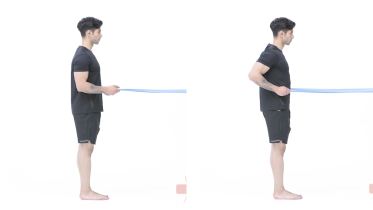 Resistance band row
Stop signs and precautions for the resistance band row
Before you start
- After a broken or dislocated elbow, or elbow surgery such as a tendon repair, follow your surgeon's or physio's plan, and start this exercise only when they have cleared you. If you have just hurt your arm and have severe pain or cannot move the elbow, do not exercise it. Go to an urgent care center or emergency department the same day. If you heard a snap or a crack at the moment of the injury, the arm looks a different shape or sits at an odd angle, a bone is showing, or your arm or hand tingles, feels numb or turns cold, pale or blue, go to an emergency department straight away or call emergency services, and do not drive yourself.
- After shoulder surgery, including a rotator cuff repair, or after a shoulder fracture or dislocation, follow your surgeon's or physio's plan, and do only the movements and range they have cleared. Many plans allow only passive movement at first, where the arm is moved for you and its muscles stay relaxed. Banded rows are not usually an early exercise after shoulder surgery, so ask when you can add them.
- After recent heart or chest surgery, get your surgeon's or surgical team's okay first, because pulling a band back and squeezing the shoulder blades together pulls across the healing breastbone. If the breastbone clicks, grinds, shifts or feels as if it is moving while you do it, stop, and contact your surgical team the same day.
When to stop and get help
- Pulling gives you a sharp pain or a catching feeling in the shoulder.
- You notice tingling or pain spreading down an arm.
- Pins and needles in your arm or hand that do not go away after you stop, or part of your arm or hand goes numb. Get medical advice the same day. If one side of your face or body suddenly goes numb or weak, or your speech becomes slurred or muddled, call emergency services, even if it goes away.
- A sudden pop or tearing feeling in the shoulder that brings sharp pain, new weakness or trouble lifting the arm. Stop and contact your surgical team the same day, or get medical advice the same day if you have not had surgery.
- The shoulder feels as if it has slipped out of place, looks a different shape or suddenly locks so you cannot move the arm, or your hand turns cold, pale or blue. Go to an emergency department straight away, without driving yourself, and do not try to put the shoulder back in yourself.
- Chest pain or pressure, dizziness or feeling faint, a racing or irregular heartbeat, or being far more out of breath than the effort should cause.
- A sudden pop or snap at the front of your elbow, sudden sharp pain there, or the muscle at the front of your upper arm bunches up or changes shape. Stop and go to an urgent care center or emergency department the same day, even if you can still bend the elbow, as this can be a torn biceps tendon.
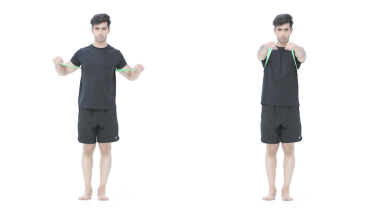 Chest press with band
Stop signs and precautions for the chest press with band
Before you start
- If your shoulder has dislocated before, or you have had shoulder surgery, check with your surgeon or physio before you add pressing exercises.
- After recent heart or chest surgery, get your surgeon's or surgical team's okay first, because pressing a band forward works the chest muscles that attach to the breastbone, and the band itself runs across your back and under your arms. If the breastbone clicks, grinds, shifts or feels as if it is moving while you do it, stop, and contact your surgical team the same day.
- If you have high blood pressure, breathe steadily through every repetition and never hold your breath.
When to stop and get help
- A sharp pain, a painful click or a catch at the front of the shoulder.
- Pins and needles, numbness or pain passing down an arm into your hand.
- Pins and needles in your arm or hand that do not go away after you stop, or part of your arm or hand goes numb. Get medical advice the same day. If one side of your face or body suddenly goes numb or weak, or your speech becomes slurred or muddled, call emergency services, even if it goes away.
- The shoulder feels loose or wobbly, as if the joint might shift out of place.
- Your shoulder aches more than before you started for more than a few minutes after the set, or is sorer the next morning.
- A sudden pop, snap or tearing feeling with sharp pain in your chest, at the front of your armpit or at the top of your arm, often followed by bruising or swelling in the chest, armpit or upper arm, a fold at the front of your armpit that looks different from the other side, or weakness when you push or bring the arm across your body. Stop and go to an urgent care center or emergency department the same day, even if you can still move the arm, as this can be a torn chest muscle or its tendon (pectoralis major).
- The shoulder feels as if it has slipped out of place, looks a different shape or suddenly locks so you cannot move the arm, or your hand turns cold, pale or blue. Go to an emergency department straight away, without driving yourself, and do not try to put the shoulder back in yourself.
Stage 3: Load it, then take it back to the floor
When stage 2 feels easy and the chest is no worse the morning after a session. These three are one ladder rather than three exercises: hands on a counter, then on your knees on the floor, then a full push-up, and you lower the height instead of adding repetitions. One rung per session, not all three in a row. Common starting points are 2 to 3 sets of 8 to 15 for the incline and knee versions and 2 to 3 sets of 5 to 10 for full push-ups, on 2 or 3 days a week with a rest day between. Keep your elbows closer to your sides than straight out to the sides, and stop each lowering at the depth where the front of the chest stays quiet. Your physio will adjust this, and a wide grip taken to full depth is the last thing to come back, not the first.
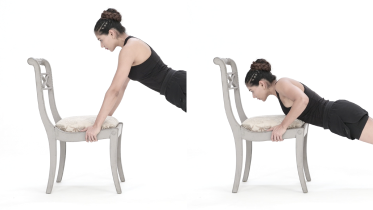 Incline push-ups
Stop signs and precautions for the incline push-ups
Before you start
- After a shoulder operation or a dislocated shoulder, your physio can tell you when pushing exercises are safe to start.
- After recent heart or chest surgery, get your surgeon's or surgical team's okay first, because lowering your chest toward your hands takes a large part of your body weight through your arms and across the healing breastbone. If the breastbone clicks, grinds, shifts or feels as if it is moving while you do it, stop, and contact your surgical team the same day.
- With a heart condition or high blood pressure, get your doctor's advice before starting.
When to stop and get help
- Chest pain or pressure, dizziness or feeling faint, a racing or irregular heartbeat, or being far more out of breath than the effort should cause.
- A sharp or pinching pain in the shoulder, elbow or wrist.
- The chair or surface moves under your hands.
- Pain, tingling or numbness that travels down one arm.
- Pins and needles in your arm or hand that do not go away after you stop, or part of your arm or hand goes numb. Get medical advice the same day. If one side of your face or body suddenly goes numb or weak, or your speech becomes slurred or muddled, call emergency services, even if it goes away.
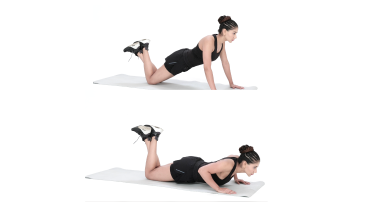 Knee push-ups
Stop signs and precautions for the knee push-ups
Before you start
- If you have had shoulder surgery or a dislocation, ask your physio when it is safe to take weight on your arms.
- After recent heart or chest surgery, get your surgeon's or surgical team's okay first, because even on your knees, lowering your chest toward the floor takes much of your body weight through your arms and across the healing breastbone. If the breastbone clicks, grinds, shifts or feels as if it is moving while you do it, stop, and contact your surgical team the same day.
- Get your doctor's advice first if your blood pressure is not well controlled.
- If your blood pressure is high or you have a heart problem, breathe out on each push and never hold your breath.
When to stop and get help
- Chest pain or pressure, dizziness or feeling faint, a racing or irregular heartbeat, or being far more out of breath than the effort should cause.
- A sharp or catching wrist, elbow or shoulder pain.
- Tingling, numbness or pain that runs from the neck or shoulder into an arm.
- Pins and needles in your arm or hand that do not go away after you stop, or part of your arm or hand goes numb. Get medical advice the same day. If one side of your face or body suddenly goes numb or weak, or your speech becomes slurred or muddled, call emergency services, even if it goes away.
- Pain at the front of the knee from kneeling, even with a folded towel underneath.
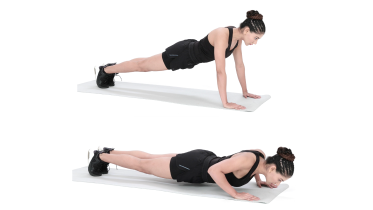 Push-ups
Stop signs and precautions for the push-ups
Before you start
- After recent heart or chest surgery, get your surgeon's or surgical team's okay first, because a push-up takes your whole body weight through your arms and chest, across the healing breastbone. If the breastbone clicks, grinds, shifts or feels as if it is moving while you do it, stop, and contact your surgical team the same day.
- After shoulder surgery or a shoulder dislocation, or with ongoing shoulder pain, check with your physio before doing push-ups on the floor. With high blood pressure or a heart condition, check with your doctor first and breathe out as you push rather than holding your breath.
When to stop and get help
- Chest pain or pressure, dizziness or feeling faint, a racing or irregular heartbeat, or being far more out of breath than the effort should cause.
- Sharp pain in a wrist, elbow or shoulder.
- Pain, numbness or tingling running down an arm.
- Pins and needles in your arm or hand that do not go away after you stop, or part of your arm or hand goes numb. Get medical advice the same day. If one side of your face or body suddenly goes numb or weak, or your speech becomes slurred or muddled, call emergency services, even if it goes away.
- A sudden pop, snap or tearing feeling with sharp pain in your chest, at the front of your armpit or at the top of your arm, often followed by bruising or swelling in the chest, armpit or upper arm, a fold at the front of your armpit that looks different from the other side, or weakness when you push or bring the arm across your body. Stop and go to an urgent care center or emergency department the same day, even if you can still move the arm, as this can be a torn chest muscle or its tendon (pectoralis major).
Getting back to pressing, push-ups and the bench
Pressing is how most of these injuries happen, and that shapes how pressing comes back. Weight training accounted for 48% of the 365 published cases in the classification review (ElMaraghy and Devereaux, 2012), and bench pressing specifically was behind 49% of the injuries pooled in the review of repairs (Yu and colleagues, 2019). That is a reason to change the lift for a while rather than to drop it for good.
Four changes do most of the work, and clinical reasoning, not a trial, is what sits behind them. Bring the grip in, so the upper arm stays closer to your body at the bottom. Stop the bar short of your chest, with boards, pins or a floor press, so the shoulder never reaches the stretched position the injury happened in. Cut the number of sets before you cut the weight. And keep rowing and back work going the whole time, because it rarely bothers a sore chest and it stops the shoulder losing ground while pressing is reduced.
Then put the range and the depth back last, one at a time, with a week between changes. Shoulder pain on the bench press goes through the same changes for a sore shoulder, and returning to the gym after injury covers how to plan the load across a training week. Dips and wide grip flyes are the two to leave until the end, for the same reason the warning signs on this page name a press and a dip.
After surgery to repair a pectoralis major tendon
This is a short section on purpose: your surgeon's protocol is your program, and nothing here replaces it.
What the operation does is quick to describe and slow to heal. The torn tendon is brought back against the arm bone and held there, through tunnels drilled in the bone, or with buttons, anchors or screws, and the meta-analysis of 384 injuries found no significant difference in outcome between those methods (Bodendorfer and colleagues, 2020). In the early weeks what holds the tendon on is that fixation rather than healed tissue, which is the reasoning behind the restrictions every protocol opens with.
The position a fresh repair is kept away from is the one the injury happens in: the arm going out to the side, turning outward, and travelling behind the line of the body. Your surgeon decides when each of those comes back, and if you were given a sling it is doing the same job. The three stages higher up this page are written for a strain and are not a post-operative program, so the wall push-up, the band press and the push-ups wait for your own team's date rather than for the way your chest feels on the day.
Protocols differ widely. A systematic review of 536 repaired patients found that rehabilitation varied across the studies it included. Of the 12 that reported a timetable at all, seven had shoulder movement inside 4 to 6 weeks of surgery and then isometric work before progressive resistance, seven allowed full activity within 6 months, two held it back for up to a year, and one had patients moving freely at 2 to 3 weeks (Yu and colleagues, 2019). That is the width of the real spread, and the review found no accepted standard for when return to sport should happen.
So a date you read somewhere else is not evidence that your own team is being slow, and no figure on this page is permission to do more than your own protocol allows. Where your team's plan is tighter than anything written here, theirs is the one that counts, every time.
The outcome figures from that review are easier to judge in plain numbers. Of the patients assessed, 90% returned to sport at an average of about 6 months and 74% to their previous level, 95% returned to work at an average of about 7 months, 18% had a complication, reruptures and wound infections being the commonest at about 4% each, and 7% needed a second operation (Yu and colleagues, 2019). Those patients averaged 28 years old and exactly 1 of the 536 was a woman, so read the figures as the experience of a young, almost entirely male and mostly athletic group. Read the months the same way, as descriptions of what happened inside surgeons' protocols rather than as dates you can clear yourself on. In that same review, rehabilitation did not begin until about 4 weeks after surgery on average, which is worth knowing if the first weeks feel slower than you expected (Yu and colleagues, 2019).
Day to day, four of the warning signs at the foot of this page are written for you and not for someone with a strain, and these are the four. Anything that feels like the original pop happening again, new weakness pushing, or the fold at the front of the armpit starting to look different from the other side again, with or without anything to blame it on. A wound going the wrong way, which includes one still leaking in the second week. An arm or hand that gets more swollen instead of settling, or turns throbbing, warm or red. And a calf or thigh doing the same thing, because a clot can form in a leg while an arm is out of action.
All four are same day, not Monday. Both clot signs turn into an emergency call if you are also short of breath or have chest pain, and the pulmonary embolism line in the emergency list is the one to read before you need it.
When to see a physio or doctor
See a physical therapist (physiotherapist) if the chest is getting worse instead of better, if two to three weeks of settling it down and stage 1 have made no real difference, if you cannot work out which stage you belong in, or if pushing is still weak once the pain has gone, because weakness that outlasts pain is worth examining rather than training through. Go the same day, not later, for anything on the warning list below.
Mention two things when you are seen, because both change what gets examined. Say whether there was a pop, and say where the bruising went. Say too if the pain is in the fold at the front of the armpit rather than across the chest, since that is where the tendon is and it is the part that matters most for the decision about surgery.
If the sore spot turns out to sit on top of the shoulder or deep at the front of the joint instead of in the chest, you may be in the wrong place: rotator cuff tendinopathy and AC joint sprain cover those, and shoulder pain when lifting your arm sorts between them. Nothing on this page is advice about your own chest pain, and nothing here is a way of deciding at home that a chest pain is safe.
For physiotherapists
Screen before you stage, and keep one figure and its denominator to hand. Disla and colleagues (1994) assessed 122 consecutive emergency department presentations of chest pain, having excluded trauma, fever and malignancy first; 36 of those patients had costochondritis, and the acute infarction rate inside that group was 6% against 28% among the others.
Note what the exclusions do to how far it travels. Trauma, fever and malignancy were screened out before anyone was counted, so the figure describes none of those three patients, and it was never a probability for a pectoralis major strain in the first place. The single inference it carries here is the one worth carrying: a reproducible chest wall source lowers the odds and clears nobody.
Reproduction of pain on resisted adduction and internal rotation localizes the problem to the pectoralis major. It excludes nothing. NICE CG95 recommendation 1.2.2.8 is the useful companion to that, since it asks a clinician who has made an acute coronary syndrome less likely to turn to the other acute causes and to take the life-threatening ones first, naming pulmonary embolism, aortic dissection and pneumonia. The warning list on this page carries a route for each.
The two facts that change management are location and extent, as ElMaraghy and Devereaux (2012) set them out: origin or muscle belly, musculotendinous junction through to insertion, or bony avulsion, with thickness and width stated separately. Weakness in adduction and internal rotation, loss or asymmetry of the anterior axillary fold, and bruising tracking into the axilla and upper arm are the findings that should move a patient toward imaging and a surgical opinion rather than into stage 2 (Long and colleagues, 2022). Butt and colleagues (2015) report that history and examination are often sufficient for diagnosis, with dedicated sequence MRI the imaging of choice.
The timing argument is why urgency is justified. Bak and colleagues (2000) put repair preferably inside 8 weeks. Bodendorfer and colleagues (2020) found acute repair superior to chronic on function and cosmesis across 384 injuries. Neither defines acute numerically, so refer urgently without quoting 8 weeks to a patient as a deadline.
Butt and colleagues (2015) is the counterweight for the late presentation: early surgery is preferable, direct repair to bone is achievable acutely and in most chronic cases, graft reconstruction where it is not, and their first point is referral to a surgeon who deals with these injuries. A chronic unrepaired rupture is a surgical opinion rather than a loading problem, whatever the date of injury.
Be straight with patients about what is not known. We found no published rehabilitation protocol for a low grade pectoralis major strain and no trial of one, so the staging here is reasoned from general muscle injury principles and from the doses our own exercise pages carry, rather than lifted from a guideline. Jarvinen and colleagues (2005) is the honest citation for the general case, including the point that mismanaged recovery costs weeks.
The staging decision worth defending is leaving end range pectoral stretch out altogether: horizontal abduction with external rotation is the injury mechanism, while isometric adduction and internal rotation load the muscle early at a length that does not provoke it. Progress pushing through wall angle and then body position rather than through repetitions, and leave wide grip pressing at full depth until the very end.
Clinical review kept both choices and added one gate to the first: the stage 1 holds are not for the patient who still has the tear signs, since resisted adduction and internal rotation are the provocation tests themselves, so the pendulum carries stage 1 alone until that patient has been seen. Where a stretch comes back at all, the anchor we give patients is a comfortable stage 3 rather than a week count, because nothing in the literature dates it.
Two dose caps were added at clinical review, and no number was changed to get them. Every figure in the stages came from the exercise page it belongs to and every one of them is in range on its own, but the stages prescribe exercises that load the same muscle, so the totals ran ahead of what the individual figures look like. Taken at their top ends, stage 1 came to 40 isometric holds a day across adduction and internal rotation, and stage 2 came to 90 pressing repetitions in one session between the wall push-up and the band press. The page now tells the patient to count each pair as one lot of work and to sit at the lower end where both are in on the same day.
The second cap also settles a frequency mismatch a patient can see for herself: this page puts the pressing work on 2 or 3 days a week, the band press page says most days or every other day, and the stage note is the one that governs here. A third multiplier sat between the stages rather than inside one, so neither of those caps touched it: nothing said whether a stage replaces the one before it or is added to it, and a patient who adds stage 2 to a stage 1 she is still doing takes the isometric load and the pressing load in the same day. The page now says each stage replaces the one before, with the pendulum the only carry-over.
The same review also corrected two instructions. The stage 2 note had offered a shorter band as the way to make the press easier, which is backward, since shortening the grip is how tension is added on that page; easing it now means letting band out, and the wall angle is the variable for the push-up. And the adduction hold's own page sets the arm height from the physio's instruction, which leaves a patient with no physio choosing it herself, so the stage note now specifies elbow in front of the chest rather than out to the side. Both of those are the injury mechanism in miniature: horizontal abduction with external rotation, arrived at by following a vague instruction rather than by a decision.
Warning signs
Get emergency help now
- Emergency: if chest pain, pressure or tightness does not ease quickly when you rest, spreads to your arm, neck, jaw, stomach or back, or comes with sweating, feeling sick, feeling light-headed or being short of breath, call emergency services straight away, as this can be a heart attack. If it eases quickly and none of these happen, get medical advice the same day, and do not exercise again until you have been checked.
- Emergency: chest pain or tightness, which may spread to your arm, neck or jaw, or shoulder or arm pain that comes with shortness of breath, sweating or feeling sick. This can be a heart attack. Call emergency services straight away.
- Emergency: chest pain, pressure or tightness, which may spread to your arm, neck, jaw, stomach or back, or upper back pain that comes with shortness of breath, sweating, feeling sick or feeling light-headed. Call emergency services straight away, as this can be a heart attack. The same applies to sudden, severe pain in your chest or between your shoulder blades that feels sharp, tearing or ripping, as this can be a tear in the main blood vessel from the heart (aortic dissection).
- Emergency: if you faint while exercising, call emergency services, even if you feel fine again quickly.
- Emergency: your arm, hand or fingers turn cold, pale, blue or gray compared with the other side. Call emergency services or go to an emergency department straight away, and do not drive yourself. The blood supply to the arm may be blocked.
- Emergency: a sudden sharp or stabbing pain in one side of your chest or shoulder that is worse when you breathe in. Stop and call emergency services, and say what you were doing. This can be a collapsed lung (pneumothorax) or a blood clot in the lungs, and both need treating quickly.
- Emergency: you suddenly become short of breath, you get chest pain or pain in your upper back that may be worse when you breathe in, you cough up blood, your heart is beating very fast, or you faint. Call emergency services straight away, even if your arms and legs look normal. These can be signs of a blood clot in the lungs (pulmonary embolism).
- Emergency: your arm or hand is numb, tingles or has pins and needles after the injury. Call emergency services or go to an emergency department straight away, and do not drive yourself. The NHS puts numbness or pins and needles in an injured part at that level, because the injury may have affected a nerve or the blood supply.
Get help today
- Same day: chest pain, pressure or tightness that is arriving at lower effort than it did at first, or coming back more often, even if each episode settles within a few minutes of stopping. Get medical advice the same day and say that it is happening at lower effort than before. NICE lists new chest pain that keeps coming back with little or no exertion among the symptoms that may mean a problem with the heart, so a chest that complains at lighter and lighter loads is not read here as a strain that needs a smaller step (NICE CG95, 1.2.1.3). If an episode does not ease quickly when you rest, spreads to your arm, neck, jaw, stomach or back, or comes with sweating, feeling sick, feeling light-headed or being short of breath, follow the first warning sign on this list instead.
- Same day: a sudden pop, snap or tearing feeling with sharp pain in your chest, at the front of your armpit or at the top of your arm during a press or a dip, often followed by bruising or swelling in the chest, armpit or upper arm, a fold at the front of your armpit that looks different from the other side, or weakness when you push or bring the arm across your body. Stop pressing and go to an urgent care center or emergency department the same day, even if you can still move the arm, as this can be a torn chest muscle or its tendon (pectoralis major). When a repair is needed, it usually does better if it is done early.
- Same day: pain in your chest, your ribs or your breastbone that started with a fall, a blow to the chest, a crush, or a seatbelt in a car accident, rather than with an effort you can name. Get medical advice the same day, and do not start this program until your chest has been checked, because the same knock can crack a rib or the breastbone and the sore spot sits right where a pulled chest muscle would be. Call emergency services or go to an emergency department straight away if the injury was a serious accident such as a car accident, your breathlessness is getting worse, your chest pain is getting worse, you have pain in your tummy or your shoulder, or you cough up blood, as a broken rib can damage something else such as a lung, the liver or the spleen. Do not drive yourself to hospital: ask someone else to drive you, or call an ambulance (NHS).
- Same day: new pain in one spot on your ribs or your breastbone after a minor fall, a knock, a cough, a sneeze or a lift, or pain in one spot that keeps getting worse with no injury at all, if you are older, have low bone density (osteoporosis) or have taken steroid tablets for a long time. Get medical advice the same day. A thin rib can break under very little force, and the NHS says a cough or a sneeze can be enough to break a rib. Until it has been checked, leave out the wall push-up, the band chest press and the push-up stages, because those load a rib that may be broken.
- Same day: since your operation, a sudden pop or tearing feeling in your chest or at the front of your armpit, new bruising there, a fold at the front of your armpit that starts to look different from the other side again, or new weakness when you push or bring the arm across your body, whether or not you can name a fall, a jolt, a sudden pull or a heavy lift that started it. Rest the arm, in its sling if you still have one, and contact your surgical team the same day, or get medical advice the same day if you cannot reach them. The repair may have torn again.
- Same day: your wound becomes more red, hot, swollen or painful, starts to leak or ooze, is still leaking in the second week or has never stopped, has pus coming out of it or its edges start to come apart, or you have a high temperature or feel hot, cold or shivery. Contact your surgical team or get medical advice the same day. Redness can be harder to see on brown or black skin. If you feel very unwell, go to an emergency department. If you have a very high or very low temperature, shivering you cannot control, you are breathing very fast or finding it hard to breathe, you are confused or your speech is slurred, your skin, lips or tongue look blue, gray, pale or blotchy (on brown or black skin this can be easier to see on the palms of the hands or soles of the feet), or you have a rash that does not fade when you press it, call emergency services, as this can be sepsis.
- Same day: since your operation, your arm or hand is getting more swollen instead of settling, or has a new throbbing or cramping pain, warm skin, red or darker skin, or swollen veins that are sore to touch. Some bruising and swelling of the arm is common after this operation and fades over a few weeks, but a blood clot can sometimes form in the arm. Get medical advice the same day. If you are also short of breath or have chest pain, call emergency services.
- Same day: a calf or thigh that is newly swollen or getting more swollen, warm, tender, red or darker than usual, has swollen veins that are sore to touch, or has a throbbing or cramping pain that does not fit your injury or condition, or that feels different from normal muscle soreness after exercise. This can be a sign of a blood clot (deep vein thrombosis), especially after surgery, an injury, time in a cast or boot, a long trip or a spell of being much less mobile than usual. Get medical advice the same day. If you are also short of breath or have chest pain, call emergency services.
- Same day: sharp pain in your chest or around your ribs that has been coming and going when you breathe in or cough, or chest pain with a cough, a high temperature or yellow or green mucus. Get medical advice the same day. These can be signs of inflammation of the lining of the lungs (pleurisy) or a chest infection. If the pain came on suddenly, or you find it hard to breathe, call emergency services straight away.
- Same day: sharp pain in your chest, ribs or upper back that has not got better after a few days, or you are feeling short of breath regularly. Get medical advice the same day. The NHS puts both of these at the urgent level for pleurisy.
- Same day: pins and needles in your arm or hand that do not go away after you stop, or part of your arm or hand goes numb. Get medical advice the same day. If one side of your face or body suddenly goes numb or weak, or your speech becomes slurred or muddled, call emergency services, even if it goes away.
- Same day: pain at night or at rest that keeps getting worse. If you are being treated for cancer now, contact your cancer team the same day.
Book an appointment
- Within a day or two: pain at night or at rest that keeps getting worse. If you have had cancer, now or in the past, see your doctor sooner, within a day or two, and mention it, even if the pain is not getting worse. Do the same if you have chest pain and are losing weight without trying, even if it does not hurt at night.
- Within a few days: pain at night or at rest that keeps getting worse. See your doctor within a few days.
Common questions
What does a strained pec feel like?
Most people describe a pulled, grabbing soreness across the front of the chest or in the fold at the front of the armpit, worst when they push, hug, reach across the body or roll onto that side in bed. It is tender when you press on it, and it complains when the arm goes out to the side and back, which is the position it was hurt in. A mild strain leaves the arm usable: sore, weaker than normal because using it hurts, but not suddenly powerless. That description comes from clinic rather than from a study, because nobody has published what the mild end of this injury feels like. What does have published signs is the severe end, and they are different enough to notice: a pop or a tearing feeling, swelling and bruising spreading into the armpit and upper arm, a change in the shape of the armpit fold, and real weakness bringing the arm in and turning it inward (Long and colleagues, 2022). Do not read any of that as a way of ruling your heart out. Pushing, hugging and reaching are all effort through the arm, and effort is one of the three features NICE uses to describe anginal pain, so a chest pain you can bring on with a movement still needs the same-day check this page asks for (NICE CG95, 1.3.3.1).
How long can a pec strain last?
Longer than most people expect, and no honest source can give you a date. There is no published figure for how long a mild pec strain takes to settle, because the research on this muscle is almost entirely about tears and repairs. What the muscle injury literature does say is that most muscle injuries recover well without surgery, that few treatments have been tested in trials, and that mismanaged recovery can push a return to sport back by weeks or months (Jarvinen and colleagues, 2005). In practice a mild one tends to settle over a few weeks with a short quiet spell and a graded return, while a strain that is still painful to push against after six weeks has either been pushed too hard or is not what everyone assumed. Either way that is a point to be examined rather than to keep grinding away at the program. Do not read six weeks as the week the examining starts, though, because two things come well before it. Chest pain itself gets assessed the same day, whatever you think is causing it. And a chest that popped or tore at the moment of injury goes the same day too, since that is the one version of this where waiting to see how it goes costs something. If you are reading this because your chest still hurts and nobody has examined it yet, the timetable is not the thing to work out first. Chest pain that is arriving at lower effort than it did at first, or coming back more often, is its own reason to be seen the same day rather than a sign that the strain is taking a while.
Pec strain or pec tear: how do I tell the difference?
By what happened at the moment of injury and by what the arm can do afterward, and then by an examination, because the last word is not yours or ours. A strain happens over a rep or two and leaves the arm working. A tear usually has a pop or a tearing feeling, then bruising and swelling that spread into the armpit and the upper arm, a change in the shape of the fold at the front of the armpit, and weakness pushing or pulling the arm across the body (Long and colleagues, 2022). The reason this matters more than most strain questions is timing: surgery for a torn tendon does better when it is early, preferably inside the first 8 weeks (Bak and colleagues, 2000), and a meta-analysis of repairs found better function and better appearance when the repair was done soon after the injury rather than late (Bodendorfer and colleagues, 2020). Those 8 weeks are a surgeon's preference and not a budget you get to spend. The clock starts the day it happened, earlier inside the window still beats later, and if you are already past it the opinion is still worth having, because early surgery is preferable rather than the only thing that works (Butt and colleagues, 2015). So this is one of the few injuries where waiting to see how it goes costs something, and the warning signs on this page say where to go the same day. One thing that question cannot do is narrow the field to two. Strain and tear are both muscle answers, and if the pain is in your chest, what rules the heart out is somebody who can examine you, not deciding which of the two you have.
Can a pulled chest muscle feel like a heart attack?
Yes, and that is exactly why this page will not help you tell them apart. Chest pain from a muscle is usually tied to a movement and tender to press, while heart pain classically sits heavy in the middle of the chest and spreads. Classically is doing a lot of work in that sentence. A tender chest wall and a heart problem can sit in the same person at the same time. In one emergency department series of 122 chest pain patients, 36 were found to have the chest wall condition costochondritis, and the acute heart attack rate inside that group was 6% while the rate among the rest was 28% (Disla and colleagues, 1994). The tenderness made a heart attack less likely and did not make it go away. Naming the effort does not settle it the other way either: discomfort that exertion brings on and rest eases within about 5 minutes is NICE's pattern for anginal pain, not proof of a muscle (NICE CG95). So the warning signs on this page apply whether or not you can name the moment it started, and today is the day to be checked.
Should I stretch a pec strain?
Not in the early weeks, and not at the end of the range. A hard stretch across the front of the chest puts the muscle in the position it was injured in, under the one load it is least ready for, which is why this program has no pec stretch in it. Reach and range come back a different way here: gentle active movement, then the stick lift, then pushing at a wall and only later on the floor. If your chest feels tight, that is usually a sore muscle guarding rather than a short one, and it eases as the loading stages go up. If a stretch is going to be part of this at all, the earliest sensible point is after stage 3 is comfortable, which means full push-ups to a depth that leaves the chest quiet the next morning. Before that, the stretch is asking the healing part to give way in the exact direction it gave way the first time. When stretching is right for you, and for some people it is, your physio is better placed to pick the moment than a page that cannot see your arm.
Do I need a scan for a pec strain?
Usually not for a mild one, and often yes when a tear is suspected. A review of management found that the story and the examination are frequently enough for a diagnosis, and that MRI with the right sequences is the imaging test of choice when imaging is needed (Butt and colleagues, 2015). What a scan changes is the decision about surgery: where the injury sits, whether the tendon is partly or completely off, and how far it has pulled back. If your chest pain has no injury behind it, imaging of the muscle is not the test you need first, and the chest pain itself gets assessed instead. Not needing a scan is also not the same as not needing to be seen. Chest pain gets assessed the same day either way, and it is the examination, not the scan, that decides whether any imaging follows.
References
- ElMaraghy AW, Devereaux MW. A systematic review and comprehensive classification of pectoralis major tears. Journal of Shoulder and Elbow Surgery. 2012;21(3):412-422. https://doi.org/10.1016/j.jse.2011.04.035
- Long MK, Ward T, DiVella M, Enders T, Ruotolo C. Injuries of the pectoralis major: diagnosis and management. Orthopedic Reviews. 2022;14(4). https://doi.org/10.52965/001c.36984
- Bak K, Cameron EA, Henderson IJ. Rupture of the pectoralis major: a meta-analysis of 112 cases. Knee Surgery, Sports Traumatology, Arthroscopy. 2000;8(2):113-119. https://doi.org/10.1007/s001670050197
- Bodendorfer BM, Wang DX, McCormick BP, et al. Treatment of pectoralis major tendon tears: a systematic review and meta-analysis of repair timing and fixation methods. American Journal of Sports Medicine. 2020;48(13):3376-3385. https://doi.org/10.1177/0363546520904402
- Yu J, Zhang C, Horner N, Ayeni OR, Leroux T, Alolabi B, Khan M. Outcomes and return to sport after pectoralis major tendon repair: a systematic review. Sports Health. 2019;11(2):134-141. https://doi.org/10.1177/1941738118818060
- Hanna CM, Glenny AB, Stanley SN, Caughey MA. Pectoralis major tears: comparison of surgical and conservative treatment. British Journal of Sports Medicine. 2001;35(3):202-206. https://doi.org/10.1136/bjsm.35.3.202
- Butt U, Mehta S, Funk L, Monga P. Pectoralis major ruptures: a review of current management. Journal of Shoulder and Elbow Surgery. 2015;24(4):655-662. https://doi.org/10.1016/j.jse.2014.10.024
- Mueller-Wohlfahrt HW, Haensel L, Mithoefer K, et al. Terminology and classification of muscle injuries in sport: the Munich consensus statement. British Journal of Sports Medicine. 2013;47(6):342-350. https://doi.org/10.1136/bjsports-2012-091448
- Jarvinen TA, Jarvinen TL, Kaariainen M, Kalimo H, Jarvinen M. Muscle injuries: biology and treatment. American Journal of Sports Medicine. 2005;33(5):745-764. https://doi.org/10.1177/0363546505274714
- Disla E, Rhim HR, Reddy A, Karten I, Taranta A. Costochondritis: a prospective analysis in an emergency department setting. Archives of Internal Medicine. 1994;154(21):2466-2469. https://doi.org/10.1001/archinte.154.21.2466
- NHS. Chest pain. Page last reviewed 8 August 2023. https://www.nhs.uk/symptoms/chest-pain/
- NHS. Heart attack. Page last reviewed 31 March 2026. https://www.nhs.uk/conditions/heart-attack/
- National Institute for Health and Care Excellence (NICE). Chest pain of recent onset: assessment and diagnosis. NICE guideline CG95. Recommendations 1.2.1.3, 1.2.1.5, 1.2.2.8 and 1.3.3.1. https://www.nice.org.uk/guidance/cg95
- NHS. Sprains and strains. Page last reviewed 23 April 2024. https://www.nhs.uk/conditions/sprains-and-strains/
- NHS. Broken or bruised ribs. Page last reviewed 10 January 2024. https://www.nhs.uk/conditions/broken-or-bruised-ribs/
- NHS. Osteoporosis. Page last reviewed 13 October 2022. https://www.nhs.uk/conditions/osteoporosis/
- NHS. Pleurisy. Page last reviewed 16 September 2026. https://www.nhs.uk/conditions/pleurisy/
- NHS. Pulmonary embolism. Page last reviewed 15 October 2026. https://www.nhs.uk/conditions/pulmonary-embolism/
- Asthma + Lung UK. Pneumothorax (collapsed lung). Page last reviewed 27 November 2025. https://www.asthmaandlung.org.uk/conditions/pneumothorax-collapsed-lung
Written and checked by the PocketPhysio editorial team. Last updated 2026-10-30.
This page is general education, not a diagnosis or a personal treatment plan. See a physiotherapist or doctor for advice about your own situation.