
Part of Sciatica
Sciatic nerve flossing (nerve glides): how they work and how to start
Warning signs, and when to get help
What is sciatic nerve flossing?
Your nerves are not fixed in place. When you bend your hip, knee, ankle or neck, the nerves running past those joints slide a short way through the tissue around them and take up a little slack. The sciatic nerve is the biggest of them. It leaves the lower back, runs through the buttock and down the back of the thigh, and splits behind the knee into branches that reach the foot.
When a nerve root in the lower back is irritated, as it is in sciatica, the nerve often becomes touchy about being pulled or squeezed. A nerve glide moves it gently through its range without loading it hard. "Flossing" is the popular name, borrowed from the to and fro action of dental floss. Physios also call it neural mobilization or neurodynamics, and the glossary lists all three.
Sliders and tensioners: what is the difference?
There are two main types. A slider moves one joint so that it lengthens the nerve's path while another joint shortens it, so the nerve slides toward one end without much overall pull. Looking up while you pull your toes toward you is one example. A tensioner lengthens the path at both ends at once, for example dropping your chin while pulling your toes up with the knee straight, so the nerve is drawn tight from both directions.
The difference has been measured. In a study on cadavers, sliding techniques moved the median nerve at the wrist 12.6 mm against 6.1 mm for tensioning, while the strain in the nerve rose by 0.8 percent with sliding and 6.8 percent with tensioning (Coppieters and Butler, 2008). A later ultrasound study of the sciatic nerve in 15 healthy volunteers found a slider moved it 17.0 mm on average, about five times as far as a tensioner (Coppieters and colleagues, 2015).
Neither study included anyone with sciatica, and moving a nerve further does not on its own prove that pain will ease. But the mechanics explain why sliders are the usual starting point for a sore nerve. Tensioners load the nerve more, so in practice physios usually save them for later, when the leg is calmer, and check the first attempts with you.
Does sciatic nerve flossing work?
The evidence is modest. A 2017 review in the Journal of Orthopaedic and Sports Physical Therapy pooled 40 studies of nerve mobilization across many conditions. For chronic low back pain, average pain was about 1.8 points lower on a 0 to 10 scale after nerve mobilization than in the comparison groups, and disability was lower too. The authors warned that the evidence was limited and of varying quality, so their conclusions may change (Basson and colleagues, 2017).
Trials of people with leg pain are smaller and less clear. A Brazilian trial gave 60 people with long-standing nerve-related leg pain advice to stay active, and half of them also had four sessions of nerve mobilization. There was no difference at 2 weeks.
By 4 weeks, leg pain in the mobilization group was 2.4 points lower on average, but disability was no different (Ferreira and colleagues, 2016). In a Spanish trial of 32 people with a slipped disc pressing on a nerve root, adding nerve mobilization to trunk control exercises did not improve pain or disability any further, because both groups improved a lot. It did ease the nerve-type symptoms more and let people lift a straight leg further (Plaza-Manzano and colleagues, 2020).
Taken together, glides look worth trying as part of a plan, with honest expectations: small trials, small effects, and results that differ from one study to the next. In practice, physios pair them with staying active and strength work rather than relying on them alone.
How to start nerve glides gently
Start with a slider, in the easy part of the range, slowly and smoothly with no hold at either end. A mild pull behind the knee or thigh that comes and goes with the movement is the right feeling. Tingling is not the goal: if a faint tingle shows up, make the movement smaller.
PocketPhysio has two slider versions. The lying sciatic nerve glide is done on your back holding one thigh, lifting your head as the knee bends and lowering it as the knee straightens. The seated sciatic nerve glide starts from a slump, then pairs looking up with pulling the toes toward you. Pick the one that feels easier on your neck and back, or the one your physio chose.
If you are pregnant and past the first three months, check with your physio before exercising flat on your back. That applies to the lying version.
Exercises that can help
Both of these are sliders, the gentler type of glide. Ask a physio to check your leg before you start either one. Lying sciatic nerve glide: a usual start is 5 to 10 slow, easy glides, done 1 to 3 times a day. Seated sciatic nerve glide: many programs start with 5 to 10 slow, easy glides, 1 to 3 times a day. Your physio will adjust this.
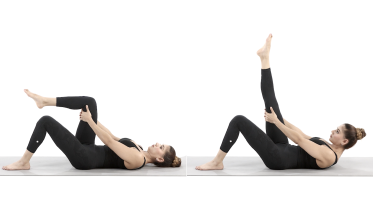 Lying sciatic nerve glide
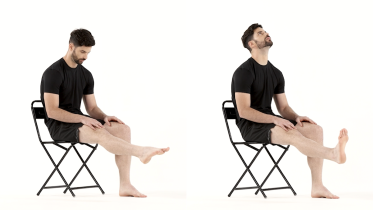 Seated sciatic nerve glide
Judge the dose by the next morning, not by how the glides feel at the time. If the leg is the same or better, carry on. If it is worse that evening or when you wake, drop back to fewer glides or stop and check with your physio. Nerve glides usually come in at stage 2 of the sciatica program, once the leg has calmed a little, and exercises to avoid with sciatica explains why strong hamstring stretches tend to wait longer.
When should you not do nerve flossing?
Stop the glides if tingling, numbness or pain lingers once you ease off, or if symptoms spread further down the leg or grow with each repetition. Leg pain that eases while numbness or weakness in the leg gets worse is not a good trade either: stop the exercises and get medical advice the same day. A foot that has started to drag or slap down when you walk means getting medical advice the same day, and going to an emergency department if the weakness is getting worse by the hour. The warning list below gives the full set of signs, and when sciatica needs urgent care explains each one.
The sciatica program asks you to have a physio check your leg before you start glides. That check matters most if the leg pain began after a fall or accident, or if you have had back surgery recently, in which case your surgeon's plan comes first. Glides fit best into a plan for leg pain that someone has assessed, because buttock pain from the piriformis area, a slipped disc and a narrowed spinal canal can all cause leg symptoms that look alike but call for different plans.
If you are still waiting for the leg to settle, how long does sciatica last covers the usual timeline, and sleeping with sciatica and driving with sciatica help with the parts of the day that stir it up. Arm nerves can be flossed the same way, and the cervical radiculopathy and carpal tunnel syndrome pages cover glides for the neck, arm and hand.
Related exercise programs
Warning signs
Get emergency help now
- Emergency: numbness, tingling or altered feeling around or under your genitals, between your inner thighs, or around your bottom (anus), for example it feels different when you wipe after using the toilet. Call emergency services or go to an emergency department straight away. This can be a sign of pressure on the bundle of nerves at the base of the spine (cauda equina syndrome), which needs emergency treatment.
- Emergency: you find it hard to start peeing, cannot pee, cannot feel yourself peeing or cannot control when you pee, or you do not notice when you need to poo or cannot control when you poo, and this is not normal for you. The same applies to a new change in how your genitals feel during sex, or new trouble getting an erection or ejaculating. Call emergency services or go to an emergency department straight away. These can also be signs of cauda equina syndrome.
- Emergency: sciatica in both legs, or pain, tingling, numbness or weakness in both legs. The same applies if you lose feeling in one leg. Call emergency services or go to an emergency department straight away.
- Emergency: back or leg pain that started after a serious accident, such as a car crash or a fall from a height, or back pain with chest pain. Call emergency services. If the pain started straight after the accident, keep still while you wait.
- Emergency: sudden, severe pain in your lower back or tummy that is not like your usual back pain, if you have been told you have a swelling of the main blood vessel in your tummy (abdominal aortic aneurysm), you are over 60, you smoke or used to smoke, or you have high blood pressure. The same applies if sudden, severe back or tummy pain comes with feeling faint or passing out, pale, sweaty or clammy skin, a racing heartbeat or being short of breath. Call emergency services straight away. This can be a sign of an aneurysm bursting, which needs treatment in hospital at once.
- Emergency: new neck or back pain after a fall, a knock or a jolt, even a minor one such as a trip or a sudden stop in a car, if you have a condition that stiffens the spine, such as ankylosing spondylitis. Call emergency services or go to an emergency department straight away, do not drive yourself, and tell the staff about your spine condition, so they keep your neck and back in their usual position. A stiff spine can break after a small injury, and the break is easy to miss at first. If the pain started straight after the injury, or you also have numbness, tingling or weakness in your arms or legs, keep still and call emergency services.
- Emergency: you have had cancer, now or in the past, and your back or neck pain feels like a tight band around your body, or comes with pain spreading down an arm or leg, weakness, numbness or pins and needles in your arms or legs, trouble walking, or trouble controlling your bladder or bowels. Call your cancer team's emergency number straight away, or go to an emergency department if you do not have one or cannot get through. This can be cancer pressing on the spinal cord (metastatic spinal cord compression), which needs treatment straight away.
- Emergency: back pain with a fever, or you feel hot, shivery or very unwell, and you also have new weakness, numbness or tingling in one or both legs, or new trouble with your bladder or bowels. Call emergency services or go to an emergency department straight away. This can be an infection pressing on the nerves in the spine (spinal epidural abscess), which needs emergency treatment.
Get help today
- Same day: a leg or foot that is getting weaker, for example your foot drags, catches on the ground or slaps down when you walk (foot drop). Get medical advice the same day. If the weakness is getting worse by the hour, go to an emergency department.
- Same day: back pain after a minor fall or strain if you are older, have low bone density (osteoporosis) or have taken steroid tablets for a long time. Get medical advice the same day.
- Same day: back or leg pain with a fever, or you feel hot, cold, shivery or generally unwell. Get medical advice the same day, and go to an emergency department if you feel very unwell.
- Same day: new back or leg pain and you have had cancer, now or in the past, or you have lost weight without trying. Get medical advice the same day and mention it. If you are being treated for cancer now, contact your cancer team the same day.
- Same day: severe pain that comes on suddenly or is getting worse quickly. Get medical advice the same day.
- Same day: pain that does not ease at all with rest or changing position, or is worse at night. Get medical advice the same day if you also feel unwell, have lost weight without trying, or have had cancer, now or in the past.
Book an appointment
- Within a few days: pain that does not ease at all with rest or changing position, or is worse at night. See your doctor within a few days.
Common questions
Does sciatic nerve flossing work?
It helps some people a little, and the evidence is thin. A 2017 review pooled trials of nerve mobilization and found less pain and disability in chronic low back pain, but the studies were limited and of mixed quality (Basson and colleagues, 2017). In a trial of 60 people with nerve-related leg pain, adding four sessions of nerve mobilization to advice to stay active made no difference at 2 weeks, while leg pain was lower at 4 weeks (Ferreira and colleagues, 2016). Physios use glides as one part of a plan, alongside staying active and strength work, not as a cure on their own.
How often should you do sciatic nerve flossing?
Have a physio check your leg before you start. For the lying sciatic nerve glide, a usual start is 5 to 10 slow, easy glides, done 1 to 3 times a day. For the seated version, many programs start with 5 to 10 slow, easy glides, 1 to 3 times a day. Your physio will adjust this. More is not better. If the leg feels worse that evening or the next morning, cut back and check with your physio.
Should nerve flossing hurt or tingle?
No. A mild pull behind the knee or thigh that comes and goes with the movement is fine. The aim is no tingling at all. If a faint tingle appears, make the movement smaller, and it should fade within a few seconds of easing off. Stop if tingling, numbness or pain hangs around after you ease off, or if symptoms spread further down the leg or grow with each glide.
What is the difference between a nerve glide and a hamstring stretch?
A stretch takes a muscle to the end of its range and holds it there. A glide keeps moving and never pushes into the tension, because an irritated nerve tends to dislike being held on a stretch. That is why many sciatica programs ease off strong hamstring stretching for a while and use glides instead. The two can look alike, so check the steps on each exercise page.
References
- Coppieters MW, Butler DS. Do 'sliders' slide and 'tensioners' tension? An analysis of neurodynamic techniques and considerations regarding their application. Manual Therapy. 2008;13(3):213-221. https://doi.org/10.1016/j.math.2006.12.008
- Coppieters MW, Andersen LS, Johansen R, et al. Excursion of the sciatic nerve during nerve mobilization exercises: an in vivo cross-sectional study using dynamic ultrasound imaging. Journal of Orthopaedic and Sports Physical Therapy. 2015;45(10):731-737. https://doi.org/10.2519/jospt.2015.5743
- Basson A, Olivier B, Ellis R, Coppieters M, Stewart A, Mudzi W. The effectiveness of neural mobilization for neuromusculoskeletal conditions: a systematic review and meta-analysis. Journal of Orthopaedic and Sports Physical Therapy. 2017;47(9):593-615. https://doi.org/10.2519/jospt.2017.7117
- Ferreira G, Stieven F, Araujo F, et al. Neurodynamic treatment did not improve pain and disability at two weeks in patients with chronic nerve-related leg pain: a randomised trial. Journal of Physiotherapy. 2016;62(4):197-202. https://doi.org/10.1016/j.jphys.2016.08.007
- Plaza-Manzano G, Cancela-Cilleruelo I, Fernández-de-las-Peñas C, et al. Effects of adding a neurodynamic mobilization to motor control training in patients with lumbar radiculopathy due to disc herniation: a randomized clinical trial. American Journal of Physical Medicine and Rehabilitation. 2020;99(2):124-132. https://doi.org/10.1097/PHM.0000000000001295
- National Institute for Health and Care Excellence. Low back pain and sciatica in over 16s: assessment and management (NG59). Published 2016, last updated July 2026. https://www.nice.org.uk/guidance/ng59
- NHS. Abdominal aortic aneurysm. https://www.nhs.uk/conditions/abdominal-aortic-aneurysm/
- National Institute for Health and Care Excellence. Abdominal aortic aneurysm: diagnosis and management (NG156). 2020. https://www.nice.org.uk/guidance/ng156
- Darouiche RO. Spinal epidural abscess. New England Journal of Medicine. 2006;355(19):2012-2020. https://doi.org/10.1056/NEJMra055111
Written and checked by the PocketPhysio editorial team. Last updated 2026-10-16.
This page is general education, not a diagnosis or a personal treatment plan. See a physiotherapist or doctor for advice about your own situation.