
Part of Sciatica
Exercises to avoid with sciatica, and what to do instead
Warning signs, and when to get help
Which exercises should you avoid with sciatica?
Fewer than most lists suggest, and rarely for good. The nerve root behind sciatica is irritated, not broken. Your job for the next few weeks is to keep moving without stirring it up further. The NHS puts regular exercise alongside your normal activities among the first things to try, and NICE asks clinicians to match the type of exercise to each person's needs, preferences and capabilities rather than hand out a banned list (NICE NG59). So the rule on this page is the one the sciatica program runs on: a movement that sends pain, tingling or numbness further down your leg gets paused, and one that leaves the leg the same or better stays in.
A handful of things fail that test far more than the rest.
Long hamstring stretches and toe touches come top of the list. Lifting a straight leg high, or reaching for your feet with your knees locked, pulls on the sciatic nerve as well as on the muscle behind the thigh. Clinicians use exactly that position, the straight leg raise, as one of their tests for an irritated nerve root, because it so often brings the leg pain on (van der Windt and colleagues, 2010). Leave strong hamstring stretching until the leg pain has settled, and ask your physio which version to restart with.
Held slumped stretches do something similar. Sitting with your back rounded, chin dropped and one knee straight puts the whole length of the nerve on tension at once. Held for 30 seconds, that asks a lot of a sensitive nerve. The same seated shape done as a moving glide is a different thing, covered below.
Heavy lifting and loaded bending are not banned, but the load comes down first. That covers deadlifts, heavy squats, and lifting boxes or children off the floor. Stage 3 of the program rebuilds these movements with sit to stand and the squat once the leg has calmed, and returning to the gym after injury has a step plan if you train with weights.
Running and jumping come back later rather than first, and sprint sports come last of all. Walking keeps you active in the meantime, and the running hub covers building back up once brisk walking leaves the leg no worse.
Long spells in one position count too, even though they are not exercise. An hour in a chair is often what turns a manageable leg into a bad evening, and sciatica pain when sitting covers how often to get up.
Why does your leg matter more than your back?
Because the leg tells you what the nerve thinks of a movement, and the back mostly does not. Some ache in your back during or after exercise is common with sciatica and fine if it settles within a day.
Watch where the leg symptoms sit after each exercise. Symptoms that pull back toward your buttock or lower back are a good sign, which physios call centralization. A review of back and neck pain studies found that 21 of 23 linked centralization to a better outlook (May and Aina, 2012). Symptoms that spread further toward your foot are the signal to stop that movement for now.
This is also why forward and backward bending are not on a banned list. Stage 1 of the program offers both directions: the pelvic tilt and knee to chest stretch bend the back forward, while prone lying and the standing back extension arch it back. One person's leg eases with the first pair and another's with the second. Try each gently and keep whichever leaves your leg the same or better.
One pattern overrides the rest. If the leg pain eases but numbness or weakness in the leg gets worse, stop the exercises and get medical advice the same day. A foot that drags, catches or slaps down as you walk also means getting medical advice the same day, and the warning list below says when to go to an emergency department instead.
What should you do instead of stretching the nerve?
Move it gently instead of pulling on it. A nerve glide, sometimes called nerve flossing, bends one joint while straightening another, so the nerve slides through its path without the tension building at either end. In an ultrasound study of 31 healthy adults, the sciatic nerve moved furthest with this kind of sliding exercise (Ellis and colleagues, 2012). Those volunteers did not have sciatica, so the study shows what the nerve does, not that glides cure anything.
The treatment evidence is modest. A review of nerve mobilization found improvements in pain and disability for chronic low back pain, but the evidence was limited and of mixed quality (Basson and colleagues, 2017). Exercise in general shows the same pattern for sciatica: a review comparing structured exercise with advice to stay active found only a small, short-term gain in leg pain, from low-quality evidence (Fernandez and colleagues, 2015). Glides earn their place as a way to keep the leg moving while it settles, not as a fix. Sciatic nerve flossing explains sliders and tensioners in more detail.
Glides are not for every stage. The program asks you to have a physio check your leg before you start them, and anyone who has had back surgery recently should get checked first too.
What can you do while the leg settles?
Keep the parts of you that do not upset the nerve working. The bridge and bird dog train the hip and trunk muscles while the back stays fairly still, walking keeps you active, and the two glides replace the stretches you have put on hold.
Exercises that can help
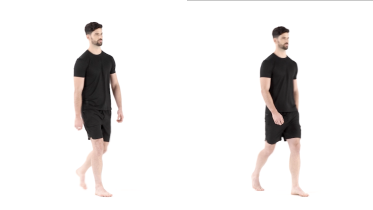
These five keep you moving while the leg settles. Ask a physio to check your leg before you start either nerve glide. Typical starting doses from each exercise page: seated and lying sciatic nerve glides, 5 to 10 slow, easy glides, 1 to 3 times a day; glute bridge, 2 to 3 sets of 10 to 12 with a short hold at the top; bird dog, 1 to 2 sets of 6 to 10 reps on each side, holding each reach for a few seconds at first; brisk walking, 10 to 20 minutes with a few minutes of slow walking at each end, on most days. Your physio will adjust this.
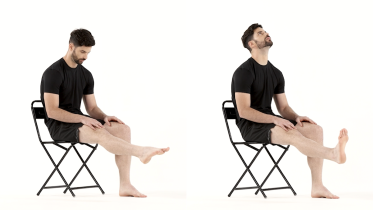 Seated sciatic nerve glide
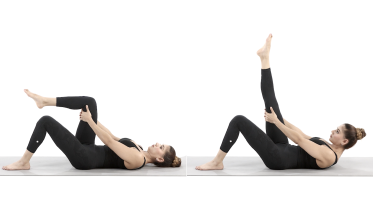 Lying sciatic nerve glide
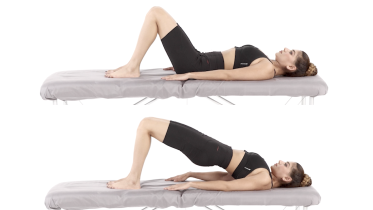 Glute bridge
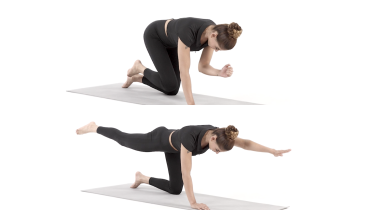 Bird dog
 Brisk walking
If you are pregnant and past the first three months, check with your physio before exercising flat on your back, which includes the bridge and the lying glide. If you have high blood pressure, breathe steadily through every repetition and never hold your breath.
How do you bring an exercise back?
Take the smallest version of it you can think of, and alter one thing only. A hamstring stretch held for 10 seconds at half the range. A lift at half the weight. Five minutes of easy running inside a walk. Alter two things at once and a flare tells you nothing about which one did it.
Check the leg twice afterwards, that evening and the next morning. A leg that is no worse at both checks has coped, and you can repeat that level a few times before adding a little more. A leg with pain reaching further down, or numbness that has spread, means you go back to the last level that felt fine for a few days. The pain monitoring model sets out a similar system for tracking how your body responds to exercise. If the same exercise flares the leg every time you return to it, your physio can look at how you do it or swap it.
Time matters too. The NHS says sciatica usually gets better within a few weeks to a few months, and how long sciatica lasts covers what slows recovery. Something you put on hold in week two may be fine by week eight.
Who needs to check first?
A few diagnoses change which direction is safe. If you have been told you have narrowing of the spinal canal (spinal stenosis) or a forward slip of one vertebra on another (spondylolisthesis), ask your physio before the exercises that bend the back backward: prone lying, the standing back extension, the cobra stretch and the prone back extension. With low bone density (osteoporosis), deep forward bending and twisting to the end of the range are usually limited, so ask before the knee to chest stretch and the trunk rotation.
After an operation on your back, your surgeon's or physio's plan comes first, not this page. If you are pregnant and have leg pain, ask your physio or midwife for a plan made for pregnancy. A child or teenager with pain running down one leg needs checking by a doctor or physio before starting any of these. If your leg feels weak or your balance is unsteady, do standing exercises next to a kitchen counter or a sturdy chair.
For back pain that stays in the back, exercises to avoid with lower back pain covers sit-ups, toe touches and back lifts from that angle. And if you are not sure whether your symptoms are safe to exercise with at all, when sciatica is an emergency sorts the warning signs by how fast to act.
Related exercise programs
Warning signs
Get emergency help now
- Emergency: numbness, tingling or altered feeling around or under your genitals, between your inner thighs, or around your bottom (anus), for example it feels different when you wipe after using the toilet. Call emergency services or go to an emergency department straight away. This can be a sign of pressure on the bundle of nerves at the base of the spine (cauda equina syndrome), which needs emergency treatment.
- Emergency: you find it hard to start peeing, cannot pee, cannot feel yourself peeing or cannot control when you pee, or you do not notice when you need to poo or cannot control when you poo, and this is not normal for you. The same applies to a new change in how your genitals feel during sex, or new trouble getting an erection or ejaculating. Call emergency services or go to an emergency department straight away. These can also be signs of cauda equina syndrome.
- Emergency: sciatica in both legs, or pain, tingling, numbness or weakness in both legs. The same applies if you lose feeling in one leg. Call emergency services or go to an emergency department straight away.
- Emergency: back or leg pain that started after a serious accident, such as a car crash or a fall from a height, or back pain with chest pain. Call emergency services. If the pain started straight after the accident, keep still while you wait.
- Emergency: sudden, severe pain in your lower back or tummy that is not like your usual back pain, if you have been told you have a swelling of the main blood vessel in your tummy (abdominal aortic aneurysm), you are over 60, you smoke or used to smoke, or you have high blood pressure. The same applies if sudden, severe back or tummy pain comes with feeling faint or passing out, pale, sweaty or clammy skin, a racing heartbeat or being short of breath. Call emergency services straight away. This can be a sign of an aneurysm bursting, which needs treatment in hospital at once.
- Emergency: new neck or back pain after a fall, a knock or a jolt, even a minor one such as a trip or a sudden stop in a car, if you have a condition that stiffens the spine, such as ankylosing spondylitis. Call emergency services or go to an emergency department straight away, do not drive yourself, and tell the staff about your spine condition, so they keep your neck and back in their usual position. A stiff spine can break after a small injury, and the break is easy to miss at first. If the pain started straight after the injury, or you also have numbness, tingling or weakness in your arms or legs, keep still and call emergency services.
- Emergency: you have had cancer, now or in the past, and your back or neck pain feels like a tight band around your body, or comes with pain spreading down an arm or leg, weakness, numbness or pins and needles in your arms or legs, trouble walking, or trouble controlling your bladder or bowels. Call your cancer team's emergency number straight away, or go to an emergency department if you do not have one or cannot get through. This can be cancer pressing on the spinal cord (metastatic spinal cord compression), which needs treatment straight away.
- Emergency: back pain with a fever, or you feel hot, shivery or very unwell, and you also have new weakness, numbness or tingling in one or both legs, or new trouble with your bladder or bowels. Call emergency services or go to an emergency department straight away. This can be an infection pressing on the nerves in the spine (spinal epidural abscess), which needs emergency treatment.
Get help today
- Same day: a leg or foot that is getting weaker, for example your foot drags, catches on the ground or slaps down when you walk (foot drop). Get medical advice the same day. If the weakness is getting worse by the hour, go to an emergency department.
- Same day: back or leg pain with a fever, or you feel hot, cold, shivery or generally unwell. Get medical advice the same day, and go to an emergency department if you feel very unwell.
- Same day: new back or leg pain and you have had cancer, now or in the past, or you have lost weight without trying. Get medical advice the same day and mention it. If you are being treated for cancer now, contact your cancer team the same day.
- Same day: back pain after a minor fall or strain if you are older, have low bone density (osteoporosis) or have taken steroid tablets for a long time. Get medical advice the same day.
- Same day: severe pain that comes on suddenly or is getting worse quickly. Get medical advice the same day.
- Same day: pain that does not ease at all with rest or changing position, or is worse at night. Get medical advice the same day if you also feel unwell, have lost weight without trying, or have had cancer, now or in the past.
Book an appointment
- Within a few days: pain that does not ease at all with rest or changing position, or is worse at night. See your doctor within a few days.
Common questions
Should I stop stretching my hamstrings with sciatica?
For now, ease off the strong ones. A straight leg lifted high, or a reach for your toes with straight knees, pulls on the sciatic nerve as well as the muscle, and holding that position into leg pain can stir sciatica up. Leave strong hamstring stretching until the leg pain has settled, then bring it back gently and ask your physio which version suits you. If the back of your thigh feels tight in the meantime, a nerve glide that keeps moving and stops short of tingling is the usual swap, once a physio has checked your leg.
Can I lift weights with sciatica?
Often yes, with less weight for a while. Keep training the parts that do not bother the leg, and cut the load, the range or the number of sets on the lifts that do. The test is the same as for any exercise: if a lift sends pain, tingling or numbness further down your leg, during the set or by the next morning, drop it back a level or leave it out for now. In the PocketPhysio sciatica program, sit to stand and the squat arrive in the last stage, and heavier lifting from the floor builds on them after that.
Is running bad for sciatica?
Not in itself, but it is one of the later things to return. Walk first, building up the time on flat ground, and try short, easy runs once brisk walking leaves your leg no worse the next day. If a run leaves the leg pain further down the leg or the numbness stronger, go back to walking for a while. There is no good trial evidence on when to return to running with sciatica, so this is practice experience, and your physio can set the steps with you.
Can exercise make sciatica worse?
The wrong amount at the wrong time can flare it. A flare usually means too much, too soon, or a movement that stretches the nerve. In practice, a flare like this often settles within a few days once you ease back, though no study has timed it. Go back to the last level that felt fine and build again more slowly. If it has not started to settle after a few days, or keeps getting worse, check with your physio or doctor. Leg pain that eases while numbness or weakness in the leg gets worse is different: stop the exercises and get medical advice the same day. A leg or foot that is getting weaker, for example your foot drags, catches on the ground or slaps down when you walk (foot drop). Get medical advice the same day. If the weakness is getting worse by the hour, go to an emergency department.
References
- National Institute for Health and Care Excellence. Low back pain and sciatica in over 16s: assessment and management (NG59). Published 2016, last updated July 2026. https://www.nice.org.uk/guidance/ng59
- NHS. Sciatica. https://www.nhs.uk/conditions/sciatica/
- May S, Aina A. Centralization and directional preference: a systematic review. Manual Therapy. 2012;17(6):497-506. https://doi.org/10.1016/j.math.2012.05.003
- van der Windt DA, Simons E, Riphagen II, et al. Physical examination for lumbar radiculopathy due to disc herniation in patients with low-back pain. Cochrane Database of Systematic Reviews. 2010;(2):CD007431. https://doi.org/10.1002/14651858.CD007431.pub2
- Ellis RF, Hing WA, McNair PJ. Comparison of longitudinal sciatic nerve movement with different mobilization exercises: an in vivo study utilizing ultrasound imaging. Journal of Orthopaedic and Sports Physical Therapy. 2012;42:667-675. https://doi.org/10.2519/jospt.2012.3854
- Basson A, Olivier B, Ellis R, Coppieters M, Stewart A, Mudzi W. The effectiveness of neural mobilization for neuromusculoskeletal conditions: a systematic review and meta-analysis. Journal of Orthopaedic and Sports Physical Therapy. 2017;47(9):593-615. https://doi.org/10.2519/jospt.2017.7117
- Fernandez M, Hartvigsen J, Ferreira ML, et al. Advice to stay active or structured exercise in the management of sciatica: a systematic review and meta-analysis. Spine. 2015;40(18):1457-1466. https://doi.org/10.1097/BRS.0000000000001036
- Getting It Right First Time (GIRFT), NHS England. National suspected cauda equina syndrome (CES) pathway. February 2023, updated March 2026. https://gettingitrightfirsttime.co.uk/wp-content/uploads/2026/04/National-Suspected-Cauda-Equina-Pathway-March-2026.pdf
- NHS. Abdominal aortic aneurysm. https://www.nhs.uk/conditions/abdominal-aortic-aneurysm/
- National Institute for Health and Care Excellence. Abdominal aortic aneurysm: diagnosis and management (NG156). 2020. https://www.nice.org.uk/guidance/ng156
- Darouiche RO. Spinal epidural abscess. New England Journal of Medicine. 2006;355(19):2012-2020. https://doi.org/10.1056/NEJMra055111
Written and checked by the PocketPhysio editorial team. Last updated 2026-10-16.
This page is general education, not a diagnosis or a personal treatment plan. See a physiotherapist or doctor for advice about your own situation.