
Tarsal tunnel syndrome exercises and physiotherapy
What is tarsal tunnel syndrome?
The tarsal tunnel is a tight channel on the inner side of your ankle. It sits just behind and below the bony bump there (the medial malleolus). A band of tissue forms the roof, and inside run the tibial nerve with its artery and veins, plus the tendons that bend the toes and hold up the arch. Tarsal tunnel syndrome is what happens when the tibial nerve or one of its branches gets squeezed in there. That nerve gives feeling to the sole of the foot, so the sole is where you notice it.
Burning or tingling in the sole is the usual complaint. Some people feel it more as pins and needles or numbness, and there is often pain on the inside of the ankle that spreads into the foot. Symptoms usually get worse with long spells of standing or walking and ease when the foot is raised (Rodríguez-Merchán and Moracia-Ochagavía, 2021).
The same review lists many possible causes. Some come from the foot itself: an old ankle fracture or sprain, or a flat or rolled-in foot; others are more general, such as extra body weight, diabetes or rheumatoid arthritis. Sometimes a lump inside the tunnel takes up room, like a fluid-filled cyst (ganglion) or enlarged veins. It is more common in keen runners whose feet roll in a lot. In about 1 in 5 people, no cause is found.
How it differs from plantar fasciitis and flat feet
Plantar fasciitis is a problem with the thick band under the foot, not a nerve. It hurts most with the first steps in the morning, and the pain sits under the heel rather than spreading as a burn or tingle. If that is your pattern, the plantar fasciitis program is the better match.
Flat feet are linked in a different way. A flat or rolled-in foot is one of the listed causes of pressure on the nerve, so an arch that is dropping may be part of the problem. If your main problem is an aching or collapsing arch without burning or numbness, see the flat feet program. Some people have both, and a physio can help you work out which matters more.
Other problems can look similar. A trapped nerve in the lower back can send tingling into the sole, Morton's neuroma causes burning between the toes, and a stress fracture can cause pain in the foot (Rodríguez-Merchán and Moracia-Ochagavía, 2021). That is one reason to get the diagnosis checked rather than guess.
How tarsal tunnel syndrome is diagnosed
There is no single test that confirms it. A 2026 systematic review of 82 studies found no agreed way to diagnose tarsal tunnel syndrome, and the tests used varied a lot from study to study (Boers and colleagues, 2026). Nearly all of them used a provocation test alongside the symptoms. The most common was tapping over the nerve behind the inner ankle to see whether it sends a tingle into the foot (the Tinel sign).
Nerve conduction studies can help, but they often miss the problem, so a normal result does not rule it out (Rodríguez-Merchán and Moracia-Ochagavía, 2021). An ultrasound or MRI scan can look for something pressing on the nerve, such as a cyst. No one result settles it. Doctors weigh up your story and the examination alongside any scan or nerve test, and they will decide which tests, if any, you need.
Do exercises help tarsal tunnel syndrome?
Perhaps a little. The evidence is thin. A 2017 review describes many treatment options but only limited strong evidence for them (Doneddu and colleagues, 2017).
In one small trial, 28 people were split into two groups at random: all had physiotherapy and supportive insoles for 6 weeks, and half also did nerve mobilization exercises (Kavlak and Uygur, 2011). Both groups improved by about the same amount in pain and strength, and in how far the ankle moved. The nerve exercise group also improved on some tests of feeling in the foot and on the tapping test, which the authors put down to the nerve exercises.
So exercise here is support, not a cure. The 2021 review (Rodríguez-Merchán and Moracia-Ochagavía, 2021) lists calf stretches and nerve glides among the options, along with strengthening the muscle deep in the calf that supports the arch (tibialis posterior). The nerve glide in this program is a gentle glide and not the exercise used in the trial. None of the strength work in stages 2 and 3 has been tested in a trial for tarsal tunnel syndrome. It is included because a foot that rolls in is one of the listed causes and because people often lose calf and foot strength when walking hurts.
Shoes and insoles to try first
The first steps aim to take pressure off the nerve. The 2021 review suggests footwear with good arch support, and notes that a wedge under the inner side of the heel can tip the heel slightly inward and ease the pull on the nerve (Rodríguez-Merchán and Moracia-Ochagavía, 2021). A podiatrist or physio can help you decide between off-the-shelf insoles and custom-made orthoses. This advice comes from expert reviews rather than trials, so judge it by how your foot responds.
Cut back for a while on the long standing and walking that bring the burning on. Your doctor may also talk about pain relief medicines or a splint. A steroid injection into the tunnel to reduce swelling is another option the same review lists. Ask a pharmacist if you are not sure a medicine is safe for you.
How to use this program
Use the program alongside the shoe and insole changes, not instead of them. Choose the stage that fits how your foot is today. If in doubt, begin at stage 1 and only move up once it feels easy and the foot has not flared up the morning after.
Nerve symptoms are the thing to watch. Aim for no tingling at all during the stretches and the nerve glide. A faint tingle means make the movement smaller, and it should be gone a few seconds after you stop. If burning, tingling or numbness builds up rep by rep, hangs around after you stop or is worse the next morning, the exercise was too much. Leave it out or go back a stage.
Starting points vary. Nerve glides tend to be done slowly, 5 to 10 at a time, 1 to 3 times a day, and calf stretches are often held about 30 seconds, 2 to 3 times on each leg, once or twice a day. For the strength work, a common start is 2 to 3 sets of 10 to 15, or 5 to 10 gentle holds of 5 to 10 seconds for the isometric push, once a day or a few days a week. Brisk walking often begins at 10 to 20 minutes on most days. The exercise pages give their own ranges, and your physio will adjust this to your foot.
A numb sole makes balance harder, so hold on to a counter or the wall for anything done standing. If you have diabetes or numb feet, look over the skin of both feet after every session. Before any exercise that presses or rolls on the sole, ask your doctor, podiatrist or physio.
The exercise program
Stage 1: Settle the nerve and keep the ankle moving
Start here if standing and walking make your foot burn, tingle or go numb, and for your first few weeks on the program. Ankle circles and toe curls keep the joints and small foot muscles moving without any weight on the foot. Pulling the foot up and rolling the arch in tightens the tibial nerve at the ankle, so keep both calf stretches gentle, stop well short of any tingling in the sole, and keep the arch lifted rather than letting it roll in. The seated sciatic nerve glide slides the whole nerve that runs down the back of the leg, which becomes the tibial nerve at the back of the knee. The goal is zero tingling: if a faint one comes on, go smaller, and if it lingers after you stop, leave that exercise out for now.
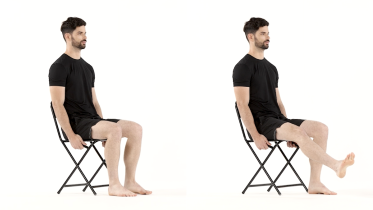 Ankle circles
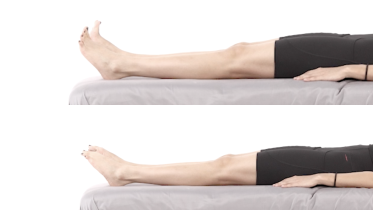 Toe curls
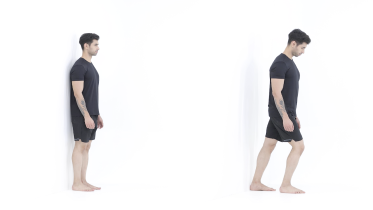 Calf stretch
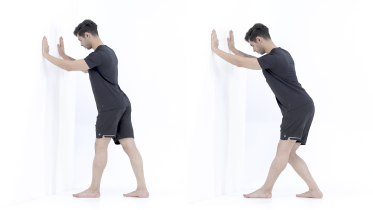 Soleus stretch
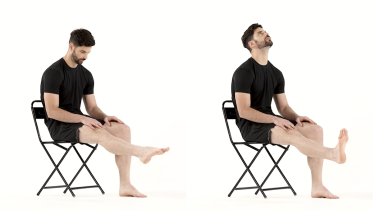 Seated sciatic nerve glide
Stage 2: Gentle strength for the foot and calf
Move on when stage 1 no longer stirs up burning or tingling and the foot feels no worse the morning after. The isometric inversion works the arch muscle (tibialis posterior) while the ankle stays still. Its tendon runs through the tunnel next to the nerve, so start with a gentle push. Towel scrunches train the small muscles in the sole, and the seated calf raise builds the calf while you keep most of your weight off the foot. If an exercise causes numbness or tingling in the sole or toes, or pain behind the bony bump on the inner ankle, stop it.
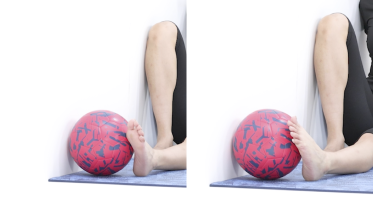 Isometric ankle inversion
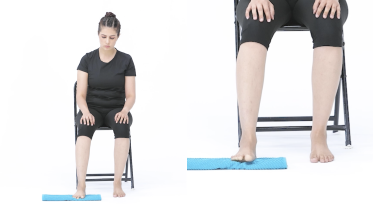 Towel scrunches
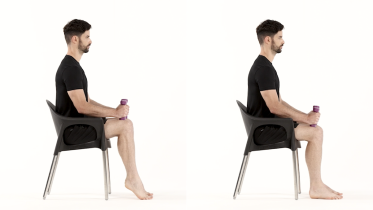 Seated calf raise
Stage 3: Standing strength and balance, then walking
When stage 2 feels easy and nerve symptoms are mild or gone. The band exercise loads the arch muscle against resistance: turn the foot in only as far as stays comfortable, not hard to the end of the movement. Calf raises on both feet put your full weight through the foot, so start with a small rise. Single leg stance trains balance, which matters if the sole of your foot feels numb: keep a hand on a counter. Brisk walking in your supportive shoes builds up time on your feet: add minutes before you add speed, and drop back a stage if the burning or tingling comes back.
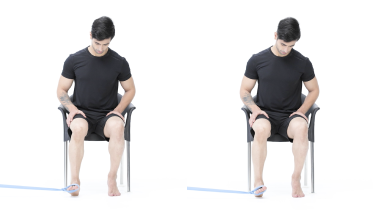 Ankle inversion with band
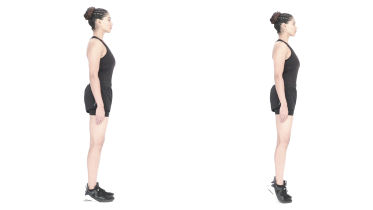 Calf raises
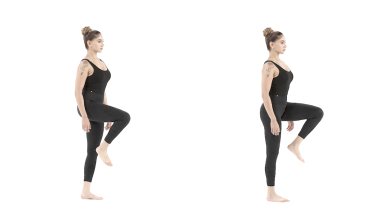 Single leg stance
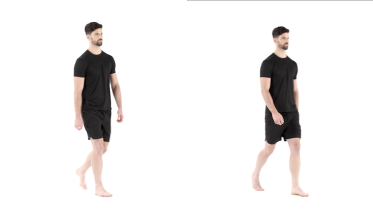 Brisk walking
When is surgery considered?
Surgery is usually considered when treatment without an operation has not worked and a clear cause for the pressure on the nerve has been found (Rodríguez-Merchán and Moracia-Ochagavía, 2021). The operation releases the band of tissue over the tunnel to give the nerve more room. Reported success rates range widely, from 44% to 96%. Results tend to be better in younger people, when there is a clear cause, a positive Tinel sign, a short history of symptoms and no earlier ankle problems.
A 2024 review of 32 studies found good or excellent results in about three quarters of people across the treatments reported, with fair or poor results in the rest (Haq and colleagues, 2024). The authors noted that the studies were of low quality, so firm conclusions are not possible. Problems after surgery can include slow wound healing, infection or scarring. And the operation does not always relieve the symptoms. If you have had surgery, follow your surgeon's program rather than this page.
When to see a physio or doctor
Burning, tingling or numbness in the foot is worth a proper assessment rather than a guess, so book one with a doctor or physical therapist (physiotherapist) in the next week or two. Numbness that no longer comes and goes, or toes that are getting weaker, needs a doctor within a few days. If you notice a lump or swelling behind the inner ankle bone, mention it, as a cyst or other lump can press on the nerve. If you have diabetes, a few changes in the feet need checking the same day; the warning signs below list them.
Symptoms that come with back pain, spread up the leg or affect both feet may point to a problem further up or to wider nerve damage, and the warning signs below give the urgency for each. This page is for adults. If a child has burning or numbness in the foot, get them checked by a doctor or physio.
For physiotherapists
This is a supporting home program for posterior tarsal tunnel syndrome managed without surgery. There is no reference standard: Boers and colleagues (2026) reviewed 82 studies (4,213 patients) and found provocative testing in 94% of them and the Tinel sign in 89%. Reported sensitivities varied widely, whether for provocative tests, electrodiagnostic studies or ultrasound. Rodríguez-Merchán and Moracia-Ochagavía (2021) report frequent false negatives on NCS and EMG, cite the dorsiflexion-eversion test reproducing or aggravating symptoms in 82% of 44 electrodiagnostically confirmed feet, and note that abnormally slow tibial nerve conduction usually predicts failure of conservative care.
Differentials in the same review: S1 radiculopathy, plantar fasciitis, interdigital neuroma, rheumatological disease, metatarsal stress fracture. Diabetes is listed among the extrinsic causes. Imaging looks for intrinsic space-occupying lesions such as ganglia or varicosities.
Kavlak and Uygur (2011) randomized 28 patients to physiotherapy and supportive inserts, with or without nerve mobilization, for 6 weeks. Both groups improved in pain and strength as well as range, with no between-group difference. Significant within-group improvement in two-point discrimination and light touch, and in the Tinel sign, was reported only for the mobilization group, with no between-group comparison reported for these.
The stage 1 stretches respect the dorsiflexion-eversion provocation: keep the calf stretches short of sole symptoms and avoid eversion. The seated sciatic slider is there as a low-tension glide; it is not a copy of the mobilization technique in the Kavlak and Uygur trial. Calf stretching and nerve gliding are among the conservative options in the 2021 review, as is tibialis posterior strengthening. It also notes that passive plantarflexion-inversion raises tunnel pressure, so the inversion work starts isometric and gentle, stays in mid-range and stops with sole paresthesia or retromalleolar pain.
Bilateral symptoms should prompt screening for polyneuropathy. Progress on the 24-hour symptom response. Refer for electrodiagnostic testing, imaging or a surgical opinion when symptoms persist, progress to constant numbness or intrinsic weakness, or a space-occupying lesion is suspected. Haq and colleagues (2024) list possible prognostic factors, drawn from low-quality studies: age, symptom duration, etiology, comorbidities, severity, nerve fibrosis.
See a doctor promptly if
- You have diabetes or numb feet, and one foot becomes hot, swollen or red, or changes color or shape, with or without pain. Take your weight off that foot straight away and get advice the same day from your doctor or your diabetes foot team. This can be Charcot foot, where the bones and joints of the foot are damaged and the foot can collapse. Do not exercise that foot until it has been checked. If you also have a fever or feel very unwell, or redness is spreading up your foot or leg, go to an emergency department.
- The foot is hot, red and swollen, or you have a fever or feel unwell. Get medical help the same day, and go to an emergency department if you feel very unwell. If you have a very high or very low temperature, shivering you cannot control, you are breathing very fast or finding it hard to breathe, you are confused or your speech is slurred, your skin, lips or tongue look blue, gray, pale or blotchy (on brown or black skin this can be easier to see on the palms of the hands or soles of the feet), or you have a rash that does not fade when you press it, call emergency services, as this can be sepsis.
- You have diabetes or numb feet and find a new blister, cut or sore on your foot, especially one you did not feel, a wound that smells or is leaking, or new pain in your foot that you cannot explain. Get it seen by your doctor or foot team the same day. If you also have a fever or feel very unwell, redness is spreading up your foot or leg, or part of your foot or a toe turns black, go to an emergency department.
- Part of your foot or a toe turns cold, pale, blue or black. Call emergency services or go to an emergency department straight away, and do not drive yourself, as the blood supply to the foot may be blocked.
- The pain started with a fall, a twist or a sudden pop on the inside of the ankle, and there is swelling or bruising, or you cannot put weight on the foot. Get it checked the same day.
- A calf or thigh that is newly swollen, warm, tender, red or darker than usual, has swollen veins that are sore to touch, or has a throbbing or cramping pain that does not fit your injury or condition, or that feels different from normal muscle soreness after exercise. This can be a sign of a blood clot (deep vein thrombosis), especially after surgery, an injury, time in a cast or boot, a long trip or a spell of being much less mobile than usual. Get medical advice the same day. If you are also short of breath or have chest pain, call emergency services.
- A leg or foot that is getting weaker, for example your foot drags, catches on the ground or slaps down when you walk (foot drop). Get medical advice the same day. If the weakness is getting worse by the hour, go to an emergency department.
- Emergency: pain, tingling, numbness or weakness in both legs, numbness or altered feeling around your genitals or bottom, or new trouble peeing or controlling your bladder or bowels. The same applies if you lose feeling in one leg. Call emergency services or go to an emergency department straight away. These can be signs of pressure on the nerves at the base of the spine (cauda equina syndrome).
- Numbness, tingling or burning in both feet that has built up slowly over months or years, often starting in the toes, with no weakness in your legs, no numbness around your genitals or bottom and no new trouble with your bladder or bowels. This is not usually an emergency, and it is often caused by nerve damage from diabetes or another cause (peripheral neuropathy) rather than tarsal tunnel syndrome. If it has not been checked, see your doctor in the next week or two. If it is new, came on over hours or days, is spreading up your legs or comes with weakness, follow the emergency line above.
- The pain is there at night or at rest as well as when you stand and walk, and it is getting worse. See your doctor within a few days. If you have had cancer, now or in the past, or are losing weight without trying, see your doctor sooner, within a day or two, and mention it. This applies even if the pain is not getting worse. If you are being treated for cancer now, contact your cancer team the same day.
- Numbness in the sole of your foot that is there all the time, or your toes are getting weaker. See a doctor within a few days rather than waiting for it to settle. If the weakness is getting worse from day to day, get medical advice the same day. Treatment tends to work better when the nerve problem is found early.
- You have new numbness, tingling, burning or loss of feeling in the foot or toes. Book an assessment with a doctor or physio in the next week or two.
- Numbness, tingling or burning spreads up past the ankle, or comes with back pain or pain running down one leg. Book an assessment with a doctor or physio in the next week or two, as the nerve may be irritated in the back rather than at the ankle.
Common questions
What does tarsal tunnel syndrome feel like?
Usually burning or tingling in the sole of the foot. Some people call it pins and needles, or say the sole feels numb. There is often pain on the inside of the ankle too, and it can spread into the sole. It usually gets worse with long spells of standing or walking and eases when you put your feet up (Rodríguez-Merchán and Moracia-Ochagavía, 2021). Tapping over the nerve behind the inner ankle may send a tingle into the foot.
Is tarsal tunnel syndrome the same as plantar fasciitis?
No, although both cause pain under the foot and one can be mistaken for the other. Plantar fasciitis is a problem with the thick band of tissue under the foot and typically hurts most with the first steps in the morning. Tarsal tunnel syndrome is a nerve problem, so the main features are burning, tingling or numbness. A physio or doctor can tell the two apart, and the plantar fasciitis program is the better fit when the pain sits mostly under the heel with no nerve symptoms.
Do I need a nerve conduction test for tarsal tunnel syndrome?
Not always. There is no single test that confirms tarsal tunnel syndrome, and nerve conduction studies can miss it, so a normal result does not rule it out (Rodríguez-Merchán and Moracia-Ochagavía, 2021). Doctors usually go on your symptoms and an examination, adding a scan or nerve tests if needed. Your doctor will decide which tests, if any, you need.
Do exercises help tarsal tunnel syndrome?
They may help a little, but the evidence is thin. In one small trial, people who added nerve mobilization exercises to insoles and physiotherapy also improved on some tests of feeling in the foot after 6 weeks, a change the authors put down to the nerve exercises. Pain and strength improved about the same in both groups (Kavlak and Uygur, 2011). That was one trial of 28 people, and the nerve glide in this program is a gentle glide, not the exercises used in the trial. Use them alongside insoles and changes to your day, and your physio will fit them to your foot.
When is surgery needed for tarsal tunnel syndrome?
Surgery is usually considered when treatment without an operation has not worked and there is a clear cause for the pressure on the nerve, such as a cyst. Reported success rates vary widely, from 44% to 96%, and results tend to be better in younger people, with a clear cause and a short history of symptoms (Rodríguez-Merchán and Moracia-Ochagavía, 2021). Your doctor or foot and ankle surgeon can talk through whether it suits you.
References
- Rodríguez-Merchán EC, Moracia-Ochagavía I. Tarsal tunnel syndrome: current rationale, indications and results. EFORT Open Reviews. 2021;6(12):1140-1147. https://doi.org/10.1302/2058-5241.6.210031
- Boers N, Haverkamp M, Eligh AM, Cabezas MC, Coert JH, Rinkel WD. Differences in diagnosing tarsal tunnel syndrome across the literature: a systematic review and a call for standardization. JBJS Reviews. 2026;14(2):e25.00222. https://doi.org/10.2106/JBJS.RVW.25.00222
- Kavlak Y, Uygur F. Effects of nerve mobilization exercise as an adjunct to the conservative treatment for patients with tarsal tunnel syndrome. Journal of Manipulative and Physiological Therapeutics. 2011;34(7):441-448. https://doi.org/10.1016/j.jmpt.2011.05.017
- Haq II, Banerjee AA, Arshad Z, Iqbal AM, Bhatia M. The management of tarsal tunnel syndrome: a scoping review. Journal of Clinical Orthopaedics and Trauma. 2024;54:102489. https://doi.org/10.1016/j.jcot.2024.102489
- Doneddu PE, Coraci D, Loreti C, Piccinini G, Padua L. Tarsal tunnel syndrome: still more opinions than evidence. Status of the art. Neurological Sciences. 2017;38(10):1735-1739. https://doi.org/10.1007/s10072-017-3039-x
- Diabetes UK. Charcot foot and diabetes. Last reviewed 8 November 2024. https://www.diabetes.org.uk/about-diabetes/looking-after-diabetes/complications/feet/charcot-foot
- Diabetes UK. Serious foot problems and diabetes. Last reviewed 24 December 2024. https://www.diabetes.org.uk/about-diabetes/looking-after-diabetes/complications/feet/serious-foot-problem
- National Institute for Health and Care Excellence. Diabetic foot problems: prevention and management. NICE guideline NG19. Published 26 August 2015, last updated 11 October 2019. https://www.nice.org.uk/guidance/ng19
- NHS. Sepsis. Page last reviewed 14 May 2026. https://www.nhs.uk/conditions/sepsis/
- NHS. Deep vein thrombosis (DVT). Page last reviewed 30 April 2026. https://www.nhs.uk/conditions/deep-vein-thrombosis-dvt/
- NHS. Peripheral neuropathy. Page last reviewed 10 October 2022. https://www.nhs.uk/conditions/peripheral-neuropathy/
Written and checked by the PocketPhysio editorial team. Last updated 2026-09-28.
This page is general education, not a diagnosis or a personal treatment plan. See a physiotherapist or doctor for advice about your own situation.