Leg kicks for lymphedema
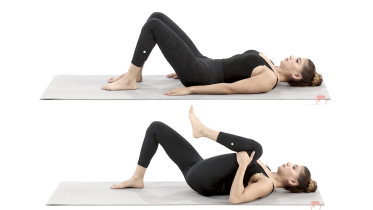
Leg kicks for lymphedema are slow leg lifts done lying on your back with your knees bent (crook lying). You lift one foot and straighten the knee, raise the straight leg toward the ceiling, lower it back to the height of your other knee, then bend the knee and set the foot down. After your lifts on one leg, you switch to the other. Despite the name, the movement is slow and controlled, not a kick. Lymphedema teams use it in leg routines, and what follows is the general technique.
How to do the leg kicks for lymphedema
- Lie on your back on a mat or firm bed with your knees bent, feet flat and arms resting by your sides.
- Lift one foot off the floor and straighten that knee, so the leg lines up with your other thigh.
- Keeping the knee straight, raise the leg slowly toward the ceiling, as far as feels comfortable. In the video it stops short of upright.
- Lower the straight leg until it is level with your other knee, then bend the knee and set the foot back on the floor with control.
- Repeat with the same leg, as in the video, then do the same number with the other leg. Alternating legs each time works too. Your lower back and pelvis stay settled on the mat throughout.
What you should feel
Work at the front of the hip and thigh as the leg lifts and straightens, and a mild stretch behind the knee at the top. Your stomach works lightly to keep your back still.
Common mistakes
- Swinging or kicking the leg up fast instead of lifting it slowly.
- Letting the straight leg drop lower than your other knee, which levers on the lower back. Bend the knee at that point and set the foot down.
- Arching the lower back or letting the pelvis tip as the leg rises.
- Holding your breath.
How often
Many routines start with 5 to 10 lifts on each leg, once or twice a day, or the amount your lymphedema team suggests. Your physio will adjust this.
Stop and check with your physio if
- Sharp pain in your hip, groin or knee, or a lower back ache that builds with each lift.
- Your leg or foot swells more, or feels heavier or tighter, during the exercise or afterward. Ease off for the day, and speak to your lymphedema team if the change is still there the next morning. If the swelling comes on quickly, or the leg becomes painful, warm, red or darker than usual, get medical advice the same day.
- Tingling, numbness or pain that runs down your leg. If it stays after you stop, or keeps getting worse, get medical advice the same day.
- Your calf or thigh becomes swollen, warm, tender, red or darker than usual, or has a throbbing or cramping pain that feels different from normal muscle ache. Stop and get medical advice the same day, as this can be a blood clot. If you are also short of breath or have chest pain, call emergency services.
From the clinic
Lymphedema is swelling that lasts because the lymphatic system is not clearing fluid from the tissues well. On the NHS page, secondary lymphedema often affects people with a cancer involving the lymph system or past treatment to the lymph nodes (NHS lymphoedema). For the legs, those are often the nodes in the groin or pelvis. Your lymphedema team's plan comes first, and they can tell you whether to wear your compression stocking while you do this.
If the straight leg feels heavy or your back arches, bring the knee up over your hip first and straighten it from there, then bend it again before you lower the foot. That keeps the leg shorter and lighter. If straightening the knee all the way is hard, supine marching lifts the leg with the knee kept bent, and ankle pumps keep the lower leg moving from the same lying position.
A thin pillow under your head is fine. To get up afterward, roll onto your side and push up to sitting, then sit for a moment before you stand. If you have had lymph nodes taken from the groin, or other cancer surgery, in recent months, ask your surgical team or physio before you begin. If you are pregnant and past the first three months, check with your physio before exercising flat on your back.
If you have had a hip replacement, get the go-ahead from your surgeon or physio before you try leg kicks for lymphedema. Raising the leg toward the ceiling, or bringing the knee up over the hip, bends the hip to about a right angle, and many surgeons ask you to avoid that for the first months after some operations.
Watch the swollen area for signs of a skin infection (cellulitis), which the NHS says often affects people with lymphedema. If the skin there becomes painful, hot or swollen, or turns red or darker than usual, get medical advice the same day, as early treatment can stop it becoming more serious. Do the same for a high temperature, or if you feel hot, cold or shivery. If the skin changes come with a very high temperature or feeling hot, cold or shivery, a fast heartbeat or fast breathing, purple patches on the skin, feeling dizzy or faint, confusion, or cold, clammy or pale skin, or you feel very unwell, call emergency services or go to an emergency department straight away, and do not drive yourself.
New swelling that nobody has checked yet needs a doctor's assessment before you start, and the same day if it is in one arm or leg and you do not know the cause, or it is severe, painful or came on very suddenly. Call emergency services if swelling comes with shortness of breath, a chest that feels tight, heavy or painful, coughing up blood, a pounding heartbeat, or feeling lightheaded, faint, confused, sick or clammy. Sudden shortness of breath, chest pain or coughing up blood also needs emergency services when the swelling looks no different, as these can be signs of a blood clot in the lungs.
Written and checked by the PocketPhysio editorial team. Last updated 2026-09-28.
This page is general education, not a diagnosis or a personal treatment plan. If you have pain, an injury or a health condition, see a physiotherapist or doctor before starting new exercises.