Standing cat camel
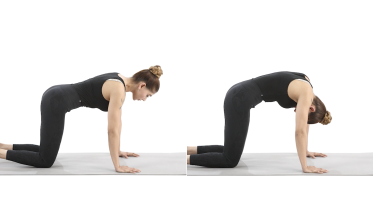
The standing cat camel moves your whole spine between an arch and a curl while you stand, so you get much the same back mobility as the hands and knees version without getting down on the floor. You arch your back as you draw your shoulder blades together with your elbows bent. Then you round your back, tuck your chin and push your hands forward. It is a good choice if kneeling is hard for you, and you can do it in a short break from sitting.
How to do the standing cat camel
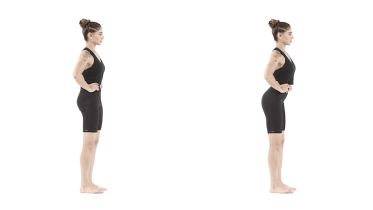
- Stand tall with your feet hip width apart and your knees slightly bent. Bend your elbows and bring your hands up in front of your shoulders, palms facing forward.
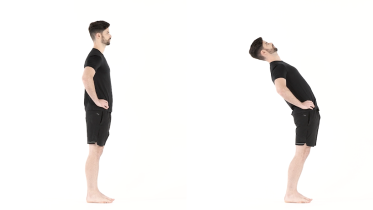
- Breathe in as you squeeze your shoulder blades together and draw your elbows back. Let your upper and lower back arch gently and lift your gaze a little.
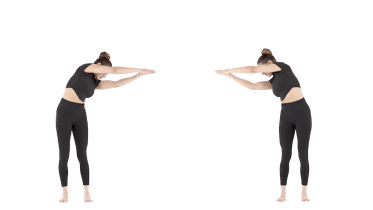
- Breathe out as you push your palms forward until your arms are straight. Tuck your chin toward your chest, round your upper and lower back, and tuck your tailbone under.
- In the video she also tips forward as she rounds, mostly by curling her spine, with only a small bend at the hips, so her arms reach out ahead of her. Lean only as far as feels comfortable and steady.
- Breathe in as you come back up, bending your elbows and arching again. Keep going at a slow, steady pace.
What you should feel
Easy movement through your back, a gentle stretch between your shoulder blades as you round, and a squeeze between them as you arch.
Common mistakes
- Letting the neck do all the work while the middle of the back stays still.
- Locking the knees straight.
- Leaning so far forward that your weight tips onto your toes.
- Forcing the arch at the end of the movement.
- Holding your breath instead of breathing in as you arch and out as you round.
How often
Many programs use 5 to 10 slow rounds, once or several times a day, for example during a break from sitting. Your physio will adjust this.
Stop and check with your physio if
- Sharp pain as you arch or round that does not settle when you make the movement smaller.
- Pain travels into your buttock or down a leg, or you feel numbness or tingling in a leg.
- You feel dizzy, lightheaded, faint or sick, or the room seems to spin. Stop, sit down and get medical advice the same day before you exercise again. If you faint, it does not settle within a few minutes of sitting still, your vision suddenly blurs or goes double, or you cannot stand or walk steadily, call emergency services.
- An electric shock feeling runs down your back or into your arms or legs as your head bends forward. Stop and get medical advice the same day.
From the clinic
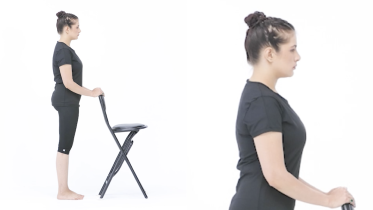
The app title mentions hands on a table, but in the video she stands free with no table, and the steps here follow the video. If leaning forward makes you wobble, stand close to a kitchen counter so you can rest a hand on it. On hands and knees, the same arch and curl is the cat-camel stretch.
If you have low bone density (osteoporosis) or have had a fracture in your spine, round only a little and ask your physio how far to go before you start. If arching your back brings on pain in the back or legs, keep the arch small too. People with a narrowed spinal canal (spinal stenosis) often find this.
If you have had a hip replacement, get the go-ahead from your surgeon or physio before you try the standing cat camel. Leaning further forward from the hips than the video shows can bend the hip past a right angle, and many surgeons ask you to avoid that for the first months after some operations. If you are pregnant, check with your midwife or physio before you start.
Written and checked by the PocketPhysio editorial team. Last updated 2026-09-28.
This page is general education, not a diagnosis or a personal treatment plan. If you have pain, an injury or a health condition, see a physiotherapist or doctor before starting new exercises.