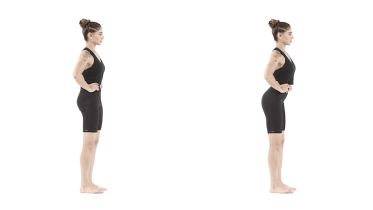
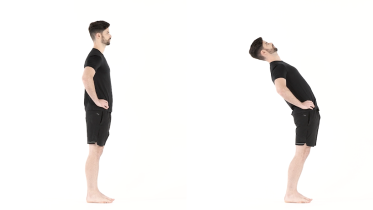
Standing pelvic tilt
The standing pelvic tilt is a small posture exercise done standing behind a chair with your hands resting on its back. You tighten your stomach and buttock muscles so your tailbone tucks under and the hollow of your lower back flattens, then hold for a few breaths and relax. It teaches you to feel where your pelvis sits, and to move it on purpose, while you are on your feet.
How to do the standing pelvic tilt
- Stand behind a sturdy chair, facing its back, with your feet about hip width apart. Rest your hands lightly on the top of the backrest.
- Stand tall with your knees relaxed, not locked, and your weight spread evenly over both feet.
- Gently tighten your lower stomach muscles and squeeze your buttocks.
- Let that tip your pelvis back: your tailbone tucks under and the curve in your lower back flattens. Keep your chest and shoulders upright and still.
- Hold the tilt while you breathe normally, then relax and let your pelvis return to where it started.
What you should feel
A light working feeling low in your stomach and in your buttocks, with a gentle lengthening across your lower back. The movement is small, and it should not hurt.
Common mistakes
- Leaning your upper body back or bending your knees to make the tilt look bigger.
- Stopping your breathing while you tighten.
- Pushing down hard on the chair instead of letting your stomach and buttocks do the work.
- Squeezing so hard that your back or hips ache.
How often
A common range is 5 to 10 tilts, holding each for about 5 to 10 seconds, once or twice a day. Your physio will adjust this.
Stop and check with your physio if
- Pain in your lower back that gets sharper as you tilt, or pain, tingling or numbness running down a leg.
- You feel unsteady even with your hands on the chair. Stop and sit down.
From the clinic
The app lists this as practicing neutral standing, but the voice guide and the video both teach the tuck: tailbone under and lower back flatter. Once you can do that on purpose, you can also find the middle point between a tucked and an arched back, which is what correct standing posture works on. The movement in the video is very small, and yours can be too. If you cannot feel your pelvis move while standing, try the pelvic tilt lying on your back or the seated pelvic tilt first.
Pick a heavy chair that will not slide or fold, or use a kitchen counter instead. Your hands are there for balance, so keep the touch light. After recent back surgery, check with your surgeon or physio before you start. If you are pregnant, check with your midwife or physio before you start. If you have recently given birth, including by cesarean section, or you have a gap down the middle of your stomach muscles (diastasis recti), ask your physio, midwife or doctor first.
Written and checked by the PocketPhysio editorial team. Last updated 2026-09-28.
This page is general education, not a diagnosis or a personal treatment plan. If you have pain, an injury or a health condition, see a physiotherapist or doctor before starting new exercises.