
Part of Meniscus tear
Meniscus tear sleeping position: how to get a better night
Warning signs, and when to get help
What is the best sleeping position with a meniscus tear?
The one your knee agrees to. No study has compared sleeping positions for a meniscus tear, so anyone who gives you a single answer is guessing, and the honest method is to test two or three and let the knee pick.
One thing settles before any of it: whether this knee has been operated on. After a meniscus repair, surgeons commonly cap how far the knee may bend for the first weeks, and some send you home with a brace for nights, in some cases one that holds the knee straight. A knee curled up on its side bends further than it feels like it does, and nobody is measuring it at three in the morning. If you were given a bend limit, a brace or a position to keep, that is your answer, and the rest of this section is written for a knee that has not been operated on. After a trim there are usually fewer limits, but the only people who can tell you which operation you had and what it allows are the team who did it.
Start on your back, with a rolled towel or a thin pillow under the calf rather than under the knee. That takes the weight of the leg off the bed and leaves the knee close to straight. Lie there for a few minutes and notice whether the joint line eases or starts to nag.
Then try your side, with a firm cushion between your knees. The cushion needs to be thick enough that the top knee sits roughly level with the hip, because when the top leg slides forward off a thin pillow the whole leg rolls and the knee twists a little. In practice that is one of the commoner reasons someone wakes with a sore knee and no idea what they did to it.
Whichever you settle on, give it a fair test. Ten minutes tells you more than ten seconds, and the real verdict comes in the morning: a knee that is no more swollen and no stiffer than usual means the position was fine.
Should you put a pillow under your knee?
Under the calf, yes. Directly under the knee, usually not.
The reason is the thing a torn meniscus most often loses: the last few degrees of straightening. A swollen knee tends to settle into a slightly bent position, the thigh muscle gets harder to switch on, and a knee that spends seven hours a night propped at a comfortable bend is being kept exactly where you are trying to get it out of. That is clinical reasoning rather than a tested rule, so it is a preference, not a ban.
If a bent knee is the only way you can sleep, say so to your physio rather than lying awake. The work to get the knee straight can be done in the day, with quad sets and the straightening exercises in the meniscus tear program, and a few weeks of broken sleep costs you more than one night in a comfortable position.
After an operation this is not your decision. Some surgeons set a position or a brace for nights as part of their protocol, and no society guideline covers it: the 2019 ESSKA consensus on injury tears gives no postoperative protocol at all (Kopf and colleagues, 2020). If you were given instructions, they win. If you have lost them, ring the team who operated, and until you reach them keep to whatever you were last told.
Whichever operation you had, this much holds. Getting the knee fully straight again is one of the first aims after knee surgery, so a knee parked at a comfortable bend for seven hours a night is working against that rather than resting it. And if you were told to keep the knee straight at night, or given a brace that holds it straight, a pillow under the knee is not a choice to weigh up. If the knee will not straighten as far as the other one and is not improving week by week, that is worth a call to your physio or surgeon rather than more stretching, and it is in the warning signs at the end of this page.
Why does a meniscus tear hurt more at night?
Three ordinary things usually explain it, and none of them means the knee is getting worse.
The first is stillness. A joint that has not moved for two hours stiffens, and the first movement after that is the one that hurts. Most people notice the pain when they turn over rather than while they lie there.
The second is fluid. A knee that has been on the go all day is often slightly more swollen by the evening, which is also why it feels tighter at bedtime than it did at lunchtime.
The third is attention. In daylight there is work, television and conversation competing for your notice. At two in the morning there is only the knee.
The practical consequence is that the fix is usually movement rather than endurance. Turn over, bend and straighten the knee slowly a few times, and if it has not settled after ten minutes or so, get up and walk gently round the house for a couple of minutes before going back to bed. Put a light on before you stand, and sit on the edge of the bed for a moment first, because a knee that has been still for hours is at its least reliable in the first few steps and most falls at home happen in the dark. If your knee has been giving way, or you are unsteady on your feet at night, do the bending and straightening sitting on the edge of the bed rather than walking about. Lying still waiting for it to stop rarely works.
After an operation the walking part is not automatic. If you were told to use crutches, or to keep some or all of your weight off the leg, that holds at two in the morning as much as at two in the afternoon: use the crutches the way you were shown, with the light on, or keep to movement you can do sitting or lying. Bending and straightening as far as your own limit allows is still movement, and it is usually enough to take the stiffness off. In the first night or two the leg can also be numb or the thigh weak from the anesthetic or a nerve block, and a thigh that cannot hold the knee lets it give way without warning, so do not get up on your own while that lasts.
What helps before bed?
A few small things, none dramatic.
Spread the day out. A knee that does its gardening, its stairs and its shopping in one three-hour block often complains at midnight. The same amount of activity split across the day usually does not.
Use ice if it suits you. For a flare or a recent injury the NHS suggests an ice pack wrapped in a towel for up to 20 minutes every 2 to 3 hours, which some people find settles the knee enough to get off to sleep. Never put ice on skin that cannot feel properly. Take any heat or ice away before you fall asleep. In the first days after an operation, keep ice off the wound and the dressings unless your team has told you how they want it used, and off skin that is still numb from the anesthetic, since you would not feel it being damaged.
Do the evening exercises on the bed. Heel slides and quad sets both work lying down, and a knee that has moved through its range just before lights out often stiffens less overnight.
Ask about pain relief rather than guessing. ESSKA lists anti-inflammatory medicine or an injection among the non-surgical options used while a degenerative tear settles (Beaufils and colleagues, 2017), but which one suits you depends on your other medicines and conditions, so that is a question for your doctor or pharmacist.
Getting in and out of bed is worth planning too. Swing both legs together rather than lifting the sore one on its own, and sit on the edge for a moment before you stand, because a knee that has been still for hours is at its least reliable in the first few steps.
When is night pain a reason to get checked?
A knee that grumbles until you move it is ordinary. Several other patterns are not, and the first of them cannot wait for the morning.
Pain in the leg, after an operation or an injury, that is much worse than you would expect and does not let up, especially with a bandage or a brace on. It can come with a tight, swollen leg, pain that gets worse when the muscle is stretched, or numbness, pins and needles or weakness. That is in the warning list as an emergency, because pressure can build up inside the leg (compartment syndrome), which needs urgent surgery. Painkillers that barely touch it are part of the picture rather than a reason to take more and go back to bed.
Pain at night or at rest that keeps getting worse. See your doctor within a few days. If you have had cancer, now or in the past, see your doctor sooner, within a day or two, and mention it, even if the pain is not getting worse. Do the same if you have knee pain and are losing weight without trying, even if it does not hurt at night. If you are being treated for cancer now, contact your cancer team the same day.
A knee that is hot, red and swollen, or knee pain with a temperature or shivering, needs medical advice the same day. The full warning list below sets out all of these and the rest.
If you have had an operation on this knee in the last few weeks, two more causes of a bad night are worth naming, and both mean contacting the team who operated, the same day, or urgent medical advice if you cannot reach them. A wound that is oozing or leaking, or a knee getting more tender, swollen, red or painful instead of less, with or without a temperature or feeling hot and cold and shivery, can be an infection in the wound or the joint. A calf or thigh that is newly swollen, warm, tender or sore to touch, or that has a cramping or throbbing pain not explained by the operation you had, can be a clot in the leg, and night is often when people first notice it. Go to an emergency department if you feel very unwell. If you are short of breath, your chest hurts or your heart is racing, call emergency services, even if your leg looks normal.
A knee that wakes you after it has locked, caught, given way or swollen up again is one more, and not one to sleep on. Keep your weight off the leg and take the same day route in the warning list, because a repair can come apart before the tear has healed and a trimmed meniscus can tear again.
If swelling, catching or the knee letting you down are the things keeping you up, swelling, locking and giving way explains which of them is urgent. If your knee is also arthritic, the night pain advice on the knee osteoarthritis page applies as well, and exercises to avoid with a meniscus tear covers what to turn down if your days are what is spoiling your nights.
Exercises that can help
These two are the ones worth doing in the evening, because they work on the two things that make nights uncomfortable: a knee that is stiff and a thigh that has switched off. Heel slides are often 10 to 15 slow repetitions, 2 or 3 times a day. Quad sets are often 10 repetitions with a 5 to 10 second hold, several times a day. Both can be done on the bed. Your physio will adjust this, and after surgery the plan from your surgeon and physio comes first.
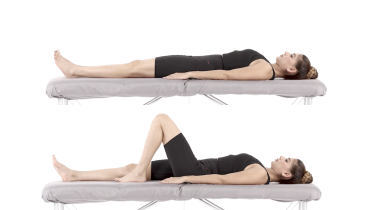 Heel slides
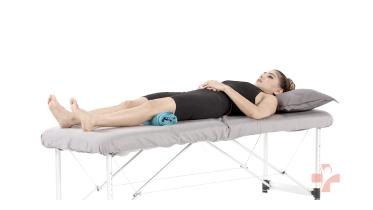 Quad sets (towel under knee)
Check with your doctor before you start if you have a heart or lung condition, or blood pressure that is not under control. If you have high blood pressure, breathe steadily through every hold and never hold your breath. If you are pregnant and past the first three months, check with your physio before exercising flat on your back, as both of these are done lying down. If you have had a hip replacement, get the go-ahead from your surgeon or physio before heel slides, because sliding the heel toward you bends the hip and many surgeons set a limit on that for the first months.
If you have had an operation on this knee, follow the program your surgeon and physio gave you instead of this one. That matters most after a repair: surgeons commonly cap how far the knee may bend for the first weeks, and a heel slide can take it past that cap, so slide only as far as the limit you were given and no further. If the tear came from a twist, a fall or a tackle and nobody has assessed the knee yet, get that done before you start, because some of those tears are best repaired early. This page is for adults. A child or teenager with a knee injury should be assessed by a doctor or physio before starting any exercise program.
Related exercise programs
Warning signs
Get emergency help now
- Emergency: the knee has moved out of place, looks misshapen or is pointing at an odd angle, or you have tingling or no feeling in the knee, leg or toes, or your foot turns cold, pale or blue. Go to an emergency department straight away. Do not drive yourself: ask someone to drive you or call an ambulance.
- Emergency: sudden, severe pain in your lower leg that is much worse than you would expect, especially with a tight bandage or brace on the leg. It may come with a tight, swollen leg, pain that gets worse when the muscle is stretched, numbness, pins and needles or weakness. Call emergency services or go to an emergency department straight away, and do not drive yourself. This can be acute compartment syndrome, which needs urgent surgery.
- Emergency: the knee became very swollen very quickly, within a few hours of a twist, fall or blow, or you felt a pop or snap. Go to an emergency department straight away. Do not drive yourself: ask someone to drive you or call an ambulance. Swelling from a meniscus tear often builds up more slowly, over a few hours to 2 or 3 days, and a meniscus tear from sport often comes with other damage inside the knee, such as a torn ligament (the ACL), so fast swelling needs checking.
Get help today
- Same day: the knee is locked, which means it is stuck bent and you cannot fully straighten it, even after gently trying to move it, or you cannot bend or straighten the leg at all. Get assessed the same day by a doctor, at urgent care or at an emergency department. A torn piece of meniscus can get caught in the joint and block it, and when a tear like this can be repaired, it should be done as early as possible. A knee that catches for a moment and then frees itself can happen with a meniscus tear. That is not the same as a locked knee, but tell your physio or doctor about it.
- Same day: you felt the kneecap slip out of place and it went back by itself. Get assessed the same day.
- Same day: since an operation on your meniscus, the knee locks, catches or gives way again, or you feel a pop or a shift inside it, or it swells up or becomes much more painful after a twist, a kneel or a deep bend. Keep your weight off it and contact your surgical team, or get assessed the same day at urgent care or an emergency department. A repair can come apart before the tear has healed, and a trimmed meniscus can tear again. If the knee is only a little achy after a busy day, with no swelling and no catching, it is not an emergency, but tell your physio or surgeon in the next few days.
- Same day: the knee swells up with no clear reason, especially if you take medicine to thin your blood. Get medical advice the same day.
- Same day: you cannot walk or put weight on the leg, whether or not there was a fall or injury, or you have very bad knee pain after a fall or injury, or very bad knee pain that came on suddenly with no injury at all. Get medical advice the same day.
- Same day: the knee keeps giving way under you, or it gave way after a recent injury, or it gives way and is also very painful or swollen. Get medical advice the same day. If it only happens now and then, with no recent injury and no swelling, it is not an emergency, but book an assessment with a physio or doctor in the next few days. Until it has been checked, leave out the exercises you do standing on one leg, hold the rail on stairs and take care on uneven ground, because a knee that gives way without warning is how people fall.
- Same day: since your operation, your wound is oozing, leaking or has pus coming out of it, or its edges start to come apart, or your knee is tender, swollen, painful or red and it is not getting better or is getting worse, or you have a high temperature or feel hot and cold or shivery. Redness can be harder to see on brown or black skin. Contact your surgical team the same day, or get urgent medical advice if you cannot reach them. These can be signs of an infection in the wound or the knee joint. If you feel very unwell, go to an emergency department. If you have a very high or very low temperature, shivering you cannot control, you are breathing very fast or finding it hard to breathe, you are confused or your speech is slurred, your skin, lips or tongue look blue, gray, pale or blotchy (on brown or black skin this can be easier to see on the palms of the hands or soles of the feet), or you have a rash that does not fade when you press it, call emergency services, as this can be sepsis.
- Same day: the knee is hot, red and swollen, or you have knee pain with a high temperature or feel hot, cold or shivery. Get medical advice the same day, and go to an emergency department if you feel very unwell. This can be a sign of infection in the joint, which needs treatment quickly.
- Same day: a calf or thigh that is newly swollen or getting more swollen, warm, tender, red or darker than usual, has swollen veins that are sore to touch, or has a throbbing or cramping pain that does not fit your injury or condition, or that feels different from normal muscle soreness after exercise. This can be a sign of a blood clot (deep vein thrombosis), especially after surgery, an injury, time in a cast or boot, a long trip or a spell of being much less mobile than usual. Get medical advice the same day. If you are also short of breath or have chest pain, call emergency services.
- Same day: pain at night or at rest that keeps getting worse. If you are being treated for cancer now, contact your cancer team the same day.
Book an appointment
- Within a few days: your knee will not straighten as far as the other one, or will not bend as far as your physio expects, and it is not improving from week to week, or it is slowly losing movement it had. This is not an emergency, but contact your physio or surgeon within the next few days, and tell them if the knee feels blocked at the very end of straightening, or clunks or hurts there, rather than simply feeling tight. Getting the knee fully straight is one of the first aims of rehab, and stretching harder is not the answer. A knee that is stuck bent and will not straighten however gently you try is a different problem, and it has its own warning above.
- Within a day or two: pain at night or at rest that keeps getting worse. If you have had cancer, now or in the past, see your doctor sooner, within a day or two, and mention it, even if the pain is not getting worse. Do the same if you have knee pain and are losing weight without trying, even if it does not hurt at night.
- Within a few days: pain at night or at rest that keeps getting worse. See your doctor within a few days.
Common questions
What is the best position to sleep in with a torn meniscus?
Whichever one leaves the knee no worse, because nobody has compared them in a trial. Two set-ups suit most people: on your back with light support under the calf so the knee rests nearly straight, or on your side with a firm cushion between the knees so the top leg cannot drop across. Give each about ten minutes before you judge it. If the knee is already short of straight, avoid propping it up bent on a pillow.
Should I sleep with a pillow under my knee?
Only if it does not hold the knee bent. A pillow under the calf, with the knee close to straight, supports the leg without parking it in a bent position. A pillow directly under the knee bends it for hours at a time, and if your knee is already struggling to straighten, that is the last thing it needs. This is practice experience rather than trial evidence, so if a bent knee is the only way you sleep, tell your physio and get the straightening work into your day instead. After an operation, use the position or brace your surgical team gave you instead of choosing, and if you were told to keep the knee straight at night, a pillow under the knee is not an option.
Can I sleep on the side of the torn meniscus?
Try it and see, unless you have had an operation on the knee, where the limit or the brace you were given decides it rather than trial and error. Many people settle better on the other side, with the sore leg on top and a cushion between the knees thick enough that the top knee sits level with the hip. Others are fine on the sore side once the pillows are right. The only rule is that you are not lying on a position that leaves the knee more swollen or sore in the morning.
Why is my knee pain worse at night?
Hours in one position, a joint that stiffens when it is still, and nothing to take your mind off it, all at the same time. That is what people describe, though nobody has studied it in meniscus tears as such. Turning over, bending the knee a little more or getting up and walking slowly round the house for a couple of minutes tends to settle that kind of night pain. Put a light on and sit on the edge of the bed before you stand, and if your knee has been giving way, keep the movement to the edge of the bed rather than walking about in the dark. If you have had an operation and were told to use crutches or to keep weight off the leg, that holds at night too, so keep to the movement your own plan allows rather than walking on it. Pain that does not ease at all whatever you do, or that keeps getting worse night after night, is a different story. After an operation or an injury, pain in the leg that is much worse than you would expect and does not let up, especially with a bandage or a brace on, is an emergency rather than something to wait on: call emergency services or go to an emergency department. Pain at night or at rest that keeps getting worse. See your doctor within a few days. If you have had cancer, now or in the past, see your doctor sooner, within a day or two, and mention it, even if the pain is not getting worse. Do the same if you have knee pain and are losing weight without trying, even if it does not hurt at night. If you are being treated for cancer now, contact your cancer team the same day.
Does sleeping position affect how a meniscus tear heals?
There is no evidence that it does, and whether a tear can heal at all depends on where it sits rather than on how you lie. What a good night does affect is how you feel the next day and how well you manage the exercises, which is reason enough to get the pillows right. After a meniscus repair, if your surgeon gave you a brace or a position to keep at night, follow that rather than this page.
References
- Beaufils P, Becker R, Kopf S, et al. Surgical management of degenerative meniscus lesions: the 2016 ESSKA meniscus consensus. Knee Surgery, Sports Traumatology, Arthroscopy. 2017;25(2):335-346. https://doi.org/10.1007/s00167-016-4407-4
- Kopf S, Beaufils P, Hirschmann MT, et al. Management of traumatic meniscus tears: the 2019 ESSKA meniscus consensus. Knee Surgery, Sports Traumatology, Arthroscopy. 2020;28(4):1177-1194. https://doi.org/10.1007/s00167-020-05847-3
- NHS. Meniscus tear (knee cartilage damage). Page last reviewed 2 September 2026. https://www.nhs.uk/conditions/meniscus-tear/
- NHS. Knee pain. Page last reviewed 21 December 2023. https://www.nhs.uk/symptoms/knee-pain/
- American Academy of Orthopaedic Surgeons. Meniscus Tears. OrthoInfo. https://www.orthoinfo.org/en/diseases--conditions/meniscus-tears/
Written and checked by the PocketPhysio editorial team. Last updated 2026-10-16.
This page is general education, not a diagnosis or a personal treatment plan. See a physiotherapist or doctor for advice about your own situation.