
Part of Meniscus tear
Knee braces for a meniscus tear: do they help?
Warning signs, and when to get help
Does a knee brace help a meniscus tear?
Not as far as anyone has shown, and the honest version of that answer is worth spelling out. Braces have been tested in randomized trials in people with torn menisci twice, and both times only after an operation. In an Austrian trial, 63 people who had just had a meniscus trimmed were randomly given 12 weeks in an unloading brace, 12 weeks of wedge insoles, or nothing in particular, and over the first year the brace group did no better than the group given nothing on knee scores, activity or general health (Dammerer and colleagues, 2019). In a Danish trial of 60 people after a meniscal repair, 6 weeks in a hinged brace with limited bending did not produce fewer failed repairs than no brace and free movement (Lind and colleagues, 2013). More on what that second trial does and does not mean further down, because it is not permission to take your own brace off.
What nobody has run is a trial of a brace for a torn meniscus that has not been operated on. We searched the medical literature for one and could not find it, so the fair way to put it is that this has not been tested rather than that a brace has been shown to do nothing. Either way, a claim on a box or a product page about supporting a torn meniscus is marketing and not evidence.
The nearest research is about knee arthritis, which matters here because degenerative meniscus tears and arthritis sit in the same group of problems. A Cochrane review brought together 13 trials of braces and foot or ankle insoles for knee osteoarthritis, and found too little agreement between the brace trials to combine their results at all. The reviewers could not reach a conclusion on pain, stiffness, function or quality of life, and rated the evidence low quality (Duivenvoorden and colleagues, 2015).
The UK guideline takes the same view. NICE says not to routinely offer insoles, braces, tape, splints or supports to people with osteoarthritis, and makes an exception only when three things are all true at once: the joint is unstable or being loaded abnormally, exercise is not working or is not suitable without an aid, and adding a device is likely to improve movement and function. The NICE committee also pointed out that some of these devices can cause blistering and other pressure damage. Guidelines disagree with each other on this more than you would expect, and knee braces for arthritis sets out where they differ.
What a brace does not do is treat the tear. The inside of the joint has been looked at, in the laboratory rather than in patients: when researchers put unloader braces on cadaver knees and ran walking and squatting movements through them, two braces cut the strain at the back of the inner meniscus, changed nothing at the front of it, and once the ACL had been cut did nothing anywhere (Kalra and colleagues, 2019). That cuts both ways. A strain reading on a bench has never been shown to change what happens to a person, which is why no guideline claims a brace protects a meniscus. And if your tear came with a ligament injury, which is common when the knee is twisted in sport, the protection people imagine they are buying was not there even in the laboratory, so do not let a brace talk you into a movement your knee is not ready for.
Which type of brace would you even be choosing?
Walk into a pharmacy or a brace shop and you are choosing between four quite different things. Knowing which one is in your hand tells you most of what to expect from it.
A sleeve is a tube of elastic or neoprene you pull on. It holds nothing mechanically. What people notice is warmth, gentle compression and a better sense of where the knee is, which for some is enough to make a long walk more comfortable. It is the cheapest and lowest risk thing to try.
A hinged brace has a hinge each side and straps above and below the knee, and it is aimed at a knee that feels wobbly. It is bulky, so most people use it for a particular job or outing rather than all day.
An unloader brace has a firm frame that shifts some load off the worn side of the joint, which only makes sense when the wear is mainly on one side. It has to be measured and adjusted by someone trained to fit it, and it is the most expensive option.
A kneecap brace has a pad or strap around the kneecap, and it is aimed at pain behind the kneecap rather than at the joint line, so it is the wrong tool for most meniscus symptoms. If your pain is at the front, patellofemoral pain may be a better match for what you have.
Should you wear a brace after meniscus surgery?
That is your surgeon's call, not a judgement for you or for this page.
Start with which operation you had, because a trim and a repair are different situations. In a trim the torn piece is taken out and nothing is left to heal, so a brace afterward could only ever be about how the knee feels, and the one trial that tested that found no benefit (Dammerer and colleagues, 2019). In a repair the torn edges are stitched together and left to knit, which takes months, so for a while the stitches are holding the tear while you walk on it. That is the situation a postoperative brace is meant for.
Whether it helps there is genuinely unsettled. The Danish trial compared 6 weeks in a hinged brace with limited bending and barely any weight through the leg against no brace and free movement, and found no difference in repairs that failed to heal, nor in knee scores at 2 years (Lind and colleagues, 2013). That sounds like a reason to skip the brace, and it is not, for two reasons. The trial repaired one particular kind of tear, a vertical tear close to the outer rim of the meniscus stitched from the inside, with no ligament surgery alongside it, so it says nothing about a radial tear, a root tear, a bucket-handle repair or a repair done at the same time as an ACL reconstruction. And roughly 3 in 10 of those repairs had not fully healed anyway, in both groups, which is the background risk your surgeon is working against.
There is also no guideline to appeal to. The 2019 ESSKA consensus on tears caused by an injury sets no postoperative protocol at all (Kopf and colleagues, 2020). A review of the published literature on meniscal repair found considerable variation in when protocols started movement, when they allowed full movement and when they allowed full weight bearing (Fried and colleagues, 2021).
Bracing varies the same way. When researchers collected 59 rehabilitation protocols that surgical units had put online, the time spent in a brace varied widely from one unit to the next, and protocols written for radial tears kept patients braced longer, restricted bending longer, delayed full weight bearing and delayed return to sport (Carder and colleagues, 2021). This page gives no weeks on purpose. The spread between units is too wide for a number here to be yours, and the only timetable that applies to your knee is the one your surgeon gave you.
One misunderstanding is worth naming, because it is the one that costs people a repair. The brace is not the thing protecting your stitches. The limits are: how much weight goes through the leg, how far the knee is allowed to bend, and when you may squat, kneel or twist. Wearing the brace while quietly ignoring the crutches or bending past the limit you were given is the wrong half of the instruction. If the brace is set to block bending beyond a certain point, do not loosen that setting to make a chair or a car easier.
So if you were given a brace, wear it exactly as the team described, including when to take it off, and keep to the weight bearing and bending limits that came with it. If you were not given one, do not add one because a web page suggested it. And if you have lost the instructions, ring the team who operated rather than working from a program written for a knee that has not been opened. Until you reach them, stay with whatever you were last told you could do rather than moving on.
No brace prevents a repair coming apart, so a knee that starts locking, catching, giving way, popping or swelling after a twist, a kneel or a deep bend needs that team the same day rather than a tighter strap. The warning list below sets out those signs.
If you are going to try one, how do you do it properly?
Decide in advance how you will judge it, and give it a fixed trial.
Pick one measure that matters to you, such as the pain on your hardest daily task or how far you can walk before the knee complains. Try the brace for a few weeks against that measure. If it clearly helps, keep it. If it makes no difference, it has not earned its place, and that is a useful answer rather than a failure.
Go for the simplest brace that could do the job. For a stable knee that simply aches, many physios suggest a sleeve as a cheap first try, which is common practice rather than trial evidence. An unloader brace is a different proposition and needs a proper assessment and fitting first, so get your physio to check which part of the knee is affected before you spend anything.
Some people should check with a doctor or physio first. Straps and frames press on skin, so take extra care if your skin is fragile, the circulation in your legs is poor, your legs swell, or your feet are numb, for example from diabetes, because you may not feel a sore starting. Check your skin each time the brace comes off. If your toes tingle, go numb or turn cold, pale or blue while you have it on, take it off at once. If feeling and color do not come back quickly, call emergency services or go to an emergency department straight away, and do not drive yourself.
What a brace will not replace
The thigh. A brace supports the knee from outside, and the muscles support it from inside, and only exercise builds those. In the Norwegian trial, the group doing 12 weeks of supervised exercise had stronger thigh muscles at 3 months and knee results at 2 years that matched the surgical group (Kise and colleagues, 2016). No brace has ever produced a result like that.
So keep the program going either way. The meniscus tear program is the staged version, exercises to avoid with a meniscus tear covers what to turn down while the knee is irritable, and if the knee is giving way rather than just aching, swelling, locking and giving way explains how quickly that needs looking at.
Exercises that can help
A brace does nothing for the thigh, so these carry on whether you wear one or not. Quad sets are often 10 repetitions with a 5 to 10 second hold, several times a day. Seated knee extension is often 2 to 3 sets of 10 to 15 on each leg with a short hold, once a day. The mini squat often starts at 2 to 3 sets of 10 to 15 once a day, and the step up at 2 to 3 sets of 8 to 12 on each leg. Do the step up next to a stair rail or a kitchen counter you can touch, and leave it out while your knee is catching, locking or giving way, until that has been assessed. Your physio will adjust this, and after an operation your surgeon's plan comes first.
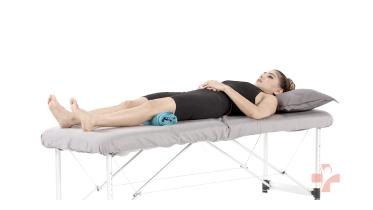 Quad sets (towel under knee)
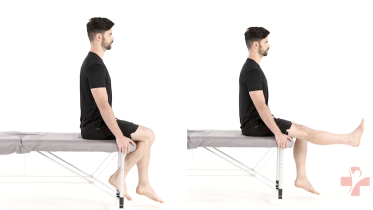 Seated knee extension
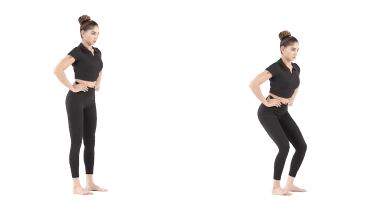 Mini squat
 Step up
Check with your doctor before you start if you have a heart or lung condition, or blood pressure that is not under control. If you have high blood pressure, breathe steadily through every repetition and never hold your breath. If you have osteoporosis, have fallen in the past year or feel unsteady, do the step up next to a rail or a kitchen counter and keep a hand on it for every step. If you have had a hip replacement, the step up bends the hip and puts your weight on one leg, so get the go-ahead from your surgeon or physio first. If you are pregnant and past the first three months, check with your physio before exercising flat on your back, as the quad sets are done lying down.
If you have had an operation on this knee, follow the program your surgeon and physio gave you instead of this one. That matters most after a repair: surgeons cap how far the knee may bend and how much weight may go through the leg for the first weeks, and the step up goes past both of those caps, so leave it out until your surgeon or physio lifts the limits.
If the tear came from a twist, a fall or a tackle and nobody has assessed the knee yet, get that done before you start, because some of those tears are best repaired early. This page is for adults. A child or teenager with a knee injury should be assessed by a doctor or physio before starting any exercise program.
Related exercise programs
Warning signs
Get emergency help now
- Emergency: the knee has moved out of place, looks misshapen or is pointing at an odd angle, or you have tingling or no feeling in the knee, leg or toes, or your foot turns cold, pale or blue. Go to an emergency department straight away. Do not drive yourself: ask someone to drive you or call an ambulance.
- Emergency: the knee became very swollen very quickly, within a few hours of a twist, fall or blow, or you felt a pop or snap. Go to an emergency department straight away. Do not drive yourself: ask someone to drive you or call an ambulance. Swelling from a meniscus tear often builds up more slowly, over a few hours to 2 or 3 days, and a meniscus tear from sport often comes with other damage inside the knee, such as a torn ligament (the ACL), so fast swelling needs checking.
Get help today
- Same day: the knee is locked, which means it is stuck bent and you cannot fully straighten it, even after gently trying to move it, or you cannot bend or straighten the leg at all. Get assessed the same day by a doctor, at urgent care or at an emergency department. A torn piece of meniscus can get caught in the joint and block it, and when a tear like this can be repaired, it should be done as early as possible. A knee that catches for a moment and then frees itself can happen with a meniscus tear. That is not the same as a locked knee, but tell your physio or doctor about it.
- Same day: you felt the kneecap slip out of place and it went back by itself. Get assessed the same day.
- Same day: since an operation on your meniscus, the knee locks, catches or gives way again, or you feel a pop or a shift inside it, or it swells up or becomes much more painful after a twist, a kneel or a deep bend. Keep your weight off it and contact your surgical team, or get assessed the same day at urgent care or an emergency department. A repair can come apart before the tear has healed, and a trimmed meniscus can tear again. If the knee is only a little achy after a busy day, with no swelling and no catching, it is not an emergency, but tell your physio or surgeon in the next few days.
- Same day: the knee swells up with no clear reason, especially if you take medicine to thin your blood. Get medical advice the same day.
- Same day: you cannot walk or put weight on the leg, whether or not there was a fall or injury, or you have very bad knee pain after a fall or injury, or very bad knee pain that came on suddenly with no injury at all. Get medical advice the same day.
- Same day: the knee keeps giving way under you, or it gave way after a recent injury, or it gives way and is also very painful or swollen. Get medical advice the same day. If it only happens now and then, with no recent injury and no swelling, it is not an emergency, but book an assessment with a physio or doctor in the next few days. Until it has been checked, leave out the exercises you do standing on one leg, hold the rail on stairs and take care on uneven ground, because a knee that gives way without warning is how people fall.
- Same day: since your operation, your wound is oozing, leaking or has pus coming out of it, or its edges start to come apart, or your knee is tender, swollen, painful or red and it is not getting better or is getting worse, or you have a high temperature or feel hot and cold or shivery. Redness can be harder to see on brown or black skin. Contact your surgical team the same day, or get urgent medical advice if you cannot reach them. These can be signs of an infection in the wound or the knee joint. If you feel very unwell, go to an emergency department. If you have a very high or very low temperature, shivering you cannot control, you are breathing very fast or finding it hard to breathe, you are confused or your speech is slurred, your skin, lips or tongue look blue, gray, pale or blotchy (on brown or black skin this can be easier to see on the palms of the hands or soles of the feet), or you have a rash that does not fade when you press it, call emergency services, as this can be sepsis.
- Same day: the knee is hot, red and swollen, or you have knee pain with a high temperature or feel hot, cold or shivery. Get medical advice the same day, and go to an emergency department if you feel very unwell. This can be a sign of infection in the joint, which needs treatment quickly.
- Same day: a calf or thigh that is newly swollen or getting more swollen, warm, tender, red or darker than usual, has swollen veins that are sore to touch, or has a throbbing or cramping pain that does not fit your injury or condition, or that feels different from normal muscle soreness after exercise. This can be a sign of a blood clot (deep vein thrombosis), especially after surgery, an injury, time in a cast or boot, a long trip or a spell of being much less mobile than usual. Get medical advice the same day. If you are also short of breath or have chest pain, call emergency services.
- Same day: pain at night or at rest that keeps getting worse. If you are being treated for cancer now, contact your cancer team the same day.
Book an appointment
- Within a day or two: pain at night or at rest that keeps getting worse. If you have had cancer, now or in the past, see your doctor sooner, within a day or two, and mention it, even if the pain is not getting worse. Do the same if you have knee pain and are losing weight without trying, even if it does not hurt at night.
- Within a few days: pain at night or at rest that keeps getting worse. See your doctor within a few days.
Common questions
Should I wear a knee brace with a meniscus tear?
Only if it earns its place, and not instead of exercise. Nobody has run a trial of a brace for a torn meniscus that has not been operated on, and the two trials in knees that had surgery found no benefit from one (Dammerer and colleagues, 2019; Lind and colleagues, 2013). The closest evidence for an unoperated knee comes from knee arthritis, and it is inconclusive and low quality (Duivenvoorden and colleagues, 2015). NICE advises against routinely offering braces and supports for osteoarthritis, making an exception only when the joint is unstable or loaded abnormally, exercise is not working or not suitable without an aid, and a device is likely to improve movement and function. A sleeve is a cheap thing to try if the knee simply feels better in one. If you have had an operation, wear what your surgeon told you to wear.
Will a knee brace protect my meniscus or stop it tearing further?
There is no evidence that it will. In the laboratory, two unloader braces did reduce the strain at the back of the inner meniscus in cadaver knees, but they did nothing at the front of it and nothing at all once the ACL was cut (Kalra and colleagues, 2019). That has never been shown to change what happens to a patient, no guideline claims a brace protects a meniscus, and after a meniscal repair a brace did not lower the number of repairs that failed to heal (Lind and colleagues, 2013). Treat a brace as something that may make a task more comfortable, not as armor. If your knee locks, catches or gives way, that needs assessing rather than strapping, as the warning list below explains.
Do I need a brace after meniscus surgery?
Your surgeon decides, and practice varies. No society guideline sets a postoperative protocol after a meniscal repair: the 2019 ESSKA consensus gives none at all (Kopf and colleagues, 2020), published protocols differ a good deal in how they handle weight bearing and range (Fried and colleagues, 2021), and among 59 protocols published online by surgical units, time spent in a brace ranged widely, with longer bracing and longer restriction for radial tears (Carder and colleagues, 2021). After a trim there is nothing left to heal and a brace made no difference to outcomes (Dammerer and colleagues, 2019). After a repair, some surgeons brace and some do not, and one trial found no difference in failed repairs either way (Lind and colleagues, 2013), although it only studied one kind of repair. So wear what you were given, exactly as you were told, and remember that the weight bearing and bending limits are what protect the stitches, not the brace. If you have lost the instructions, ring the team rather than guessing.
Is a sleeve or a hinged brace better for a meniscus tear?
They do different jobs, so it depends what bothers you. A sleeve gives warmth and gentle compression and suits a knee that aches but feels solid. A hinged brace is aimed at a knee that feels unstable. An unloader brace is for arthritis that sits mainly on one side of the knee and has to be measured and fitted. Our page on knee braces for arthritis goes through each type in detail, and a physio can tell you which, if any, fits your knee.
Will wearing a brace make my leg weaker?
There is little research on that exact question for any knee problem. The practical risk is not the brace itself but what it replaces: if wearing it becomes a reason to do less, the thigh gets weaker, and thigh strength is the thing that actually changed the outcomes in the meniscus trials (Kise and colleagues, 2016). Use it for the tasks that need it and keep the strength work going either way.
References
- Duivenvoorden T, Brouwer RW, van Raaij TM, Verhagen AP, Verhaar JAN, Bierma-Zeinstra SMA. Braces and orthoses for treating osteoarthritis of the knee. Cochrane Database of Systematic Reviews. 2015;(3):CD004020. https://doi.org/10.1002/14651858.CD004020.pub3
- National Institute for Health and Care Excellence. Osteoarthritis in over 16s: diagnosis and management (NG226). 2022. https://www.nice.org.uk/guidance/ng226
- Kopf S, Beaufils P, Hirschmann MT, et al. Management of traumatic meniscus tears: the 2019 ESSKA meniscus consensus. Knee Surgery, Sports Traumatology, Arthroscopy. 2020;28(4):1177-1194. https://doi.org/10.1007/s00167-020-05847-3
- Fried JW, Manjunath AK, Hurley ET, Jazrawi LM, Strauss EJ, Campbell KA. Return-to-play and rehabilitation protocols following isolated meniscal repair: a systematic review. Arthroscopy, Sports Medicine, and Rehabilitation. 2021;3(1):e241-e247. https://doi.org/10.1016/j.asmr.2020.07.023
- Carder SL, Messamore WG, Scheffer DR, Giusti NE, Schroeppel JP, Mullen S, Vopat BG. Publicly available rehabilitation protocols designated for meniscal repairs are highly variable. Arthroscopy, Sports Medicine, and Rehabilitation. 2021;3(2):e411-e419. https://doi.org/10.1016/j.asmr.2020.10.004
- Dammerer D, Fischer F, Mayr R, Giesinger J, El Attal R, Liebensteiner MC. Temporary postoperative treatment with compartment-unloading knee braces or wedge insoles does not improve clinical outcome after partial meniscectomy. Knee Surgery, Sports Traumatology, Arthroscopy. 2019;27(3):814-821. https://doi.org/10.1007/s00167-018-5106-0
- Lind M, Nielsen T, Faunø P, Lund B, Christiansen SE. Free rehabilitation is safe after isolated meniscus repair: a prospective randomized trial comparing free with restricted rehabilitation regimens. American Journal of Sports Medicine. 2013;41(12):2753-2758. https://doi.org/10.1177/0363546513505079
- Kalra M, Bakker R, Tomescu SS, Polak AM, Nicholls M, Chandrashekar N. The effect of unloader knee braces on medial meniscal strain. Prosthetics and Orthotics International. 2019;43(2):132-139. https://doi.org/10.1177/0309364618798173
- Kise NJ, Risberg MA, Stensrud S, Ranstam J, Engebretsen L, Roos EM. Exercise therapy versus arthroscopic partial meniscectomy for degenerative meniscal tear in middle aged patients: randomised controlled trial with two year follow-up. BMJ. 2016;354:i3740. https://doi.org/10.1136/bmj.i3740
- NHS. Meniscus tear (knee cartilage damage). Page last reviewed 2 September 2026. https://www.nhs.uk/conditions/meniscus-tear/
- American Academy of Orthopaedic Surgeons. Meniscus Tears. OrthoInfo. https://www.orthoinfo.org/en/diseases--conditions/meniscus-tears/
Written and checked by the PocketPhysio editorial team. Last updated 2026-10-16.
This page is general education, not a diagnosis or a personal treatment plan. See a physiotherapist or doctor for advice about your own situation.