
Part of Meniscus tear
Can you squat with a torn meniscus, and can you kneel?
Warning signs, and when to get help
Can you squat at all with a meniscus tear?
Yes, and a squat is part of the treatment rather than something to earn later. Stage 2 of the meniscus tear program contains squats on purpose, and the exercise programs that matched keyhole surgery in the trials were built from loaded knee exercise, not from leg lifts (Kise and colleagues, 2016).
What changes is the depth. Ask a dozen people with a degenerative tear where the knee bites and most of them will show you the bottom of a squat: reaching into a low cupboard, picking something off the floor, sitting down onto a camping chair. A shallow squat rarely does it. That pattern is what physios work with, and it is why the sensible first move is to cut the range rather than the exercise.
Set the knee up as well as you set the depth. Keep the kneecap tracking over the second toe, let the hips go back as the knee bends so the shin stays fairly upright, and go down slowly enough that you could stop halfway. A squat that drops into the bottom and bounces out of it is a different exercise from a squat that is controlled all the way, and the joint line notices.
How do you build squat depth back up?
One step at a time, with the next morning as the referee.
Start with the mini squat, a small bend with both feet on the floor. When that has felt easy for a week, move to the ball wall squat, where the ball supports your back and lets you go a little deeper without the knee drifting forward. Then the wall sit, which asks the thigh to hold a position rather than move through it. Then the chair squat, lowering the seat a little at a time, which is how you get real-world depth back. The split squat comes last, because it puts most of your weight through one bent knee.
The rule that keeps this honest: mild discomfort during the set is usually fine if it has faded soon after you finish and the knee is no worse the next day. More swelling, a sharper pain along the joint line or a knee that catches during a repetition means the last change was too much, so go back one step for a week. The pain monitoring model is the fuller version of that check.
Add weight last, not first. Depth, then control, then load, and only one of the three at a time.
Can you kneel with a meniscus tear?
Usually, once the knee has settled, and the way you kneel matters more than whether you kneel.
Kneeling does two things at once. It bends the knee all the way, which squeezes the joint where the tear sits, and it presses the front of the knee into a hard surface. Twenty minutes weeding on a patio is enough to leave a torn meniscus grumbling for two days, which people rarely connect to the gardening because the pain arrives later.
A few changes cover most of it. Put something soft under the knee, a gardening pad or a folded towel rather than a thin mat. Go down on one knee instead of both, which halves the time either knee spends folded. And break the job up: ten minutes down, then stand and walk about. For anything longer, a low stool beats kneeling altogether.
While the knee is irritable, most physios park kneeling entirely and bring it back in short spells once the swelling has gone. That is common practice rather than something a trial has tested, so your own knee gets a vote. All of that is for a knee that has not been operated on. After a repair, keeping kneeling back is not a cautious convention you can weigh against how the knee feels on the day: it is protecting a stitch line that has not finished healing, and the date it lifts belongs to your surgeon.
What about squatting and kneeling after meniscus surgery?
This belongs to your surgeon, and the two operations are not comparable. After a trim, the torn piece has gone and nothing has to heal, so limits tend to be brief. After a repair, the stitches are holding the tear together while it knits, and deep bending is exactly the load that pulls on them, which is why surgeons restrict squatting, kneeling and twisting for a period they decide.
The short wait after a trim only holds if the trim was all that was done. People come out of theatre having had something else dealt with in the same knee, a ligament reconstructed or a worn patch of cartilage drilled or patched, and the limits then belong to that operation rather than to the meniscus, and they run far longer. If you are not certain what you had, ask the team before you take a timescale from anywhere, this page included.
Where a repair sits matters as well. A deep squat and a kneel both close the back of the joint down onto the back part of the meniscus (the posterior horn), which is where a repair is put under the most strain, and the meniscus itself slides backward as the knee bends, moving further when the leg is carrying your weight than when it is not (Vedi and colleagues, 1999). Surgical reviews say it in those terms: after a radial tear repaired through the body of the meniscus, the weight stays off the leg and deep bending stays out while the repair knits (Mameri and colleagues, 2023). So getting your full bend back is not the same as being allowed to load the knee in that bend.
Weight bearing, bending and the return to deep squatting, kneeling and twisting are separate permissions, lifted at separate times, and the deep loading one comes last. In published series no surgeon allowed a return to full sporting activity before 3 months, and the commonest point was 6 (Fried and colleagues, 2021). That is the scale after a repair, months rather than weeks, and your own dates still come from the team who operated.
No guideline sets those dates. ESSKA's 2019 consensus on injury tears gives no postoperative protocol at all (Kopf and colleagues, 2020), and the published protocols for an isolated repair disagree with each other on both bending and weight bearing (O'Donnell and colleagues, 2017; Fried and colleagues, 2021). So there is no typical week for this page to give you, and a date lifted from a study is not a date for your knee: the right one turns on where your tear was, how it was stitched and what else was done at the same time. Exercises to avoid with a meniscus tear works through that evidence, including why the one review that found early movement did no harm is easier to over-read than it looks.
So the answer to when you can kneel after a repair is the date your surgeon gives you. If you no longer have the instructions, ring the team who operated rather than working from a program written for a knee that has not been opened. Until you reach them, stay with whatever you were last told you could do rather than moving on.
What if squatting makes the knee catch or lock?
A knee that catches for a second as you come out of a squat and then frees itself is worth telling your physio or doctor about, and it is not an emergency on its own.
A knee that gets stuck bent and will not fully straighten, however gently you try, is the one with its own warning sign below, and that needs assessing the same day. If you cannot tell which of the two you have, treat it as the same-day one. The page on swelling, locking and giving way goes through how to tell them apart, and exercises to avoid with a meniscus tear covers the other movements worth turning down. If your knee is also arthritic, the kneeling and stair advice in exercises to avoid with knee arthritis applies as well.
Exercises that can help
This is the ladder most physios work up, easiest first, and it is a ladder rather than a session: work on one or two rungs at a time instead of doing all five in a day. The mini squat often starts at 2 to 3 sets of 10 to 15 once a day. The ball wall squat often starts at 2 sets of 10 slow squats, building toward 3 sets of 12 to 15 on 3 or 4 days a week. Wall sit holds often start at 10 to 30 seconds, repeated 3 to 5 times. The chair squat often starts at 2 to 3 sets of 8 to 12 at a seat height you can control, and the split squat at 2 to 3 sets of 8 to 12 on each leg a few times a week, with a shorter range at first. Keep a hand on a wall or a solid chair back for the split squat, and leave it out while your knee is catching, locking or giving way, until that has been assessed. Your physio will adjust this, and after an operation on your meniscus your surgeon's plan comes first: while you are still on crutches, in a brace or under a limit on how far the knee may bend, none of these are started yet.
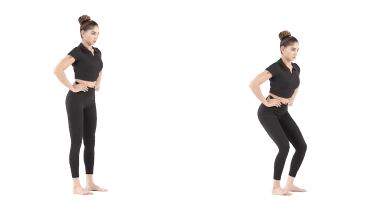 Mini squat
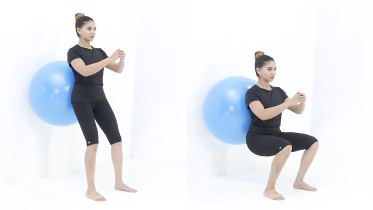 Ball wall squat
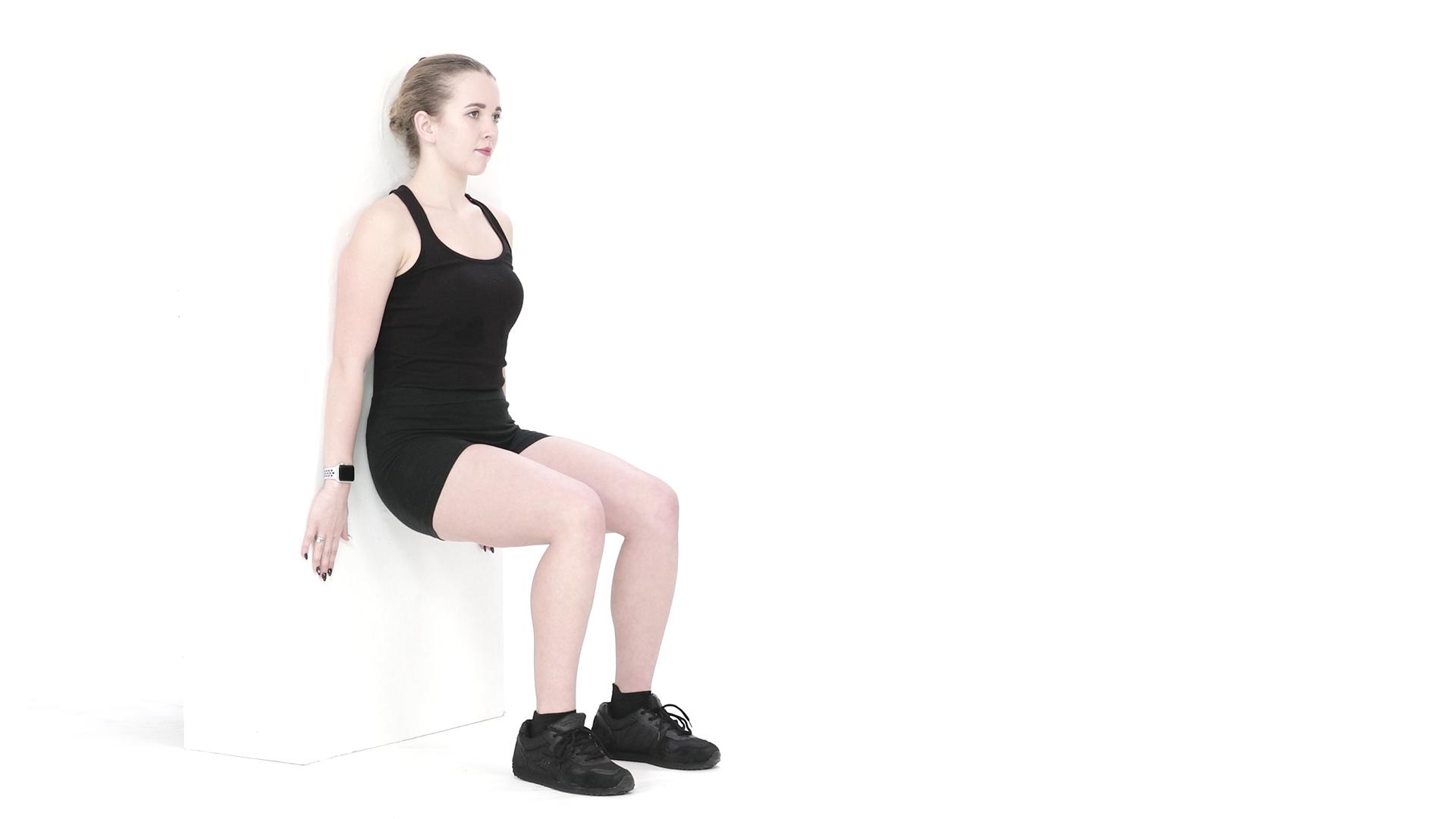 Wall sit
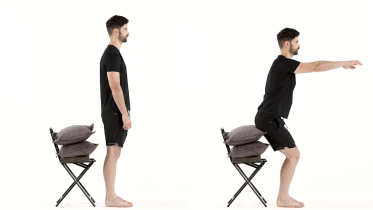 Chair squat
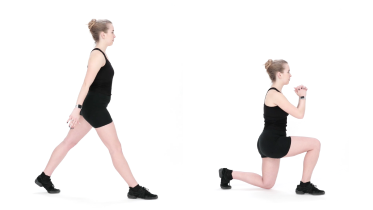 Split squat
If you have had an operation on this knee and you are still on crutches, still in a brace, or still under a limit on how far the knee may bend, none of these exercises are yours yet, however good the knee feels: wait until your surgeon or physio lifts those limits. Check with your doctor before you start if you have a heart or lung condition, or blood pressure that is not under control. If you have high blood pressure, breathe steadily through every repetition and never hold your breath. Holding your breath through a long hold can push your blood pressure up, so if you have high blood pressure or a heart condition, talk to your doctor or physio about the wall sit holds first. If you have had a hip replacement, get the go-ahead from your surgeon or physio first, because several of these bend the hip well past a right angle. If you have osteoporosis, have fallen in the past year or feel unsteady, keep a kitchen counter within reach for every repetition of the chair squat and the split squat, and ask your physio before you lower the seat height. If you are pregnant, check with your midwife, doctor or physio before you start.
If the tear came from a twist, a fall or a tackle and nobody has assessed the knee yet, get that done before you start, because some of those tears are best repaired early. This page is for adults. A child or teenager with a knee injury should be assessed by a doctor or physio before starting any exercise program.
Related exercise programs
Warning signs
Get emergency help now
- Emergency: the knee has moved out of place, looks misshapen or is pointing at an odd angle, or you have tingling or no feeling in the knee, leg or toes, or your foot turns cold, pale or blue. Go to an emergency department straight away. Do not drive yourself: ask someone to drive you or call an ambulance.
- Emergency: the knee became very swollen very quickly, within a few hours of a twist, fall or blow, or you felt a pop or snap. Go to an emergency department straight away. Do not drive yourself: ask someone to drive you or call an ambulance. Swelling from a meniscus tear often builds up more slowly, over a few hours to 2 or 3 days, and a meniscus tear from sport often comes with other damage inside the knee, such as a torn ligament (the ACL), so fast swelling needs checking.
Get help today
- Same day: the knee is locked, which means it is stuck bent and you cannot fully straighten it, even after gently trying to move it, or you cannot bend or straighten the leg at all. Get assessed the same day by a doctor, at urgent care or at an emergency department. A torn piece of meniscus can get caught in the joint and block it, and when a tear like this can be repaired, it should be done as early as possible. A knee that catches for a moment and then frees itself can happen with a meniscus tear. That is not the same as a locked knee, but tell your physio or doctor about it.
- Same day: you felt the kneecap slip out of place and it went back by itself. Get assessed the same day.
- Same day: since an operation on your meniscus, the knee locks, catches or gives way again, or you feel a pop or a shift inside it, or it swells up or becomes much more painful after a twist, a kneel or a deep bend. Keep your weight off it and contact your surgical team, or get assessed the same day at urgent care or an emergency department. A repair can come apart before the tear has healed, and a trimmed meniscus can tear again. If the knee is only a little achy after a busy day, with no swelling and no catching, it is not an emergency, but tell your physio or surgeon in the next few days.
- Same day: the knee swells up with no clear reason, especially if you take medicine to thin your blood. Get medical advice the same day.
- Same day: you cannot walk or put weight on the leg, whether or not there was a fall or injury, or you have very bad knee pain after a fall or injury, or very bad knee pain that came on suddenly with no injury at all. Get medical advice the same day.
- Same day: the knee keeps giving way under you, or it gave way after a recent injury, or it gives way and is also very painful or swollen. Get medical advice the same day. If it only happens now and then, with no recent injury and no swelling, it is not an emergency, but book an assessment with a physio or doctor in the next few days. Until it has been checked, leave out the exercises you do standing on one leg, hold the rail on stairs and take care on uneven ground, because a knee that gives way without warning is how people fall.
- Same day: since your operation, your wound is oozing, leaking or has pus coming out of it, or its edges start to come apart, or your knee is tender, swollen, painful or red and it is not getting better or is getting worse, or you have a high temperature or feel hot and cold or shivery. Redness can be harder to see on brown or black skin. Contact your surgical team the same day, or get urgent medical advice if you cannot reach them. These can be signs of an infection in the wound or the knee joint. If you feel very unwell, go to an emergency department. If you have a very high or very low temperature, shivering you cannot control, you are breathing very fast or finding it hard to breathe, you are confused or your speech is slurred, your skin, lips or tongue look blue, gray, pale or blotchy (on brown or black skin this can be easier to see on the palms of the hands or soles of the feet), or you have a rash that does not fade when you press it, call emergency services, as this can be sepsis.
- Same day: the knee is hot, red and swollen, or you have knee pain with a high temperature or feel hot, cold or shivery. Get medical advice the same day, and go to an emergency department if you feel very unwell. This can be a sign of infection in the joint, which needs treatment quickly.
- Same day: a calf or thigh that is newly swollen or getting more swollen, warm, tender, red or darker than usual, has swollen veins that are sore to touch, or has a throbbing or cramping pain that does not fit your injury or condition, or that feels different from normal muscle soreness after exercise. This can be a sign of a blood clot (deep vein thrombosis), especially after surgery, an injury, time in a cast or boot, a long trip or a spell of being much less mobile than usual. Get medical advice the same day. If you are also short of breath or have chest pain, call emergency services.
- Same day: pain at night or at rest that keeps getting worse. If you are being treated for cancer now, contact your cancer team the same day.
Book an appointment
- Within a day or two: pain at night or at rest that keeps getting worse. If you have had cancer, now or in the past, see your doctor sooner, within a day or two, and mention it, even if the pain is not getting worse. Do the same if you have knee pain and are losing weight without trying, even if it does not hurt at night.
- Within a few days: pain at night or at rest that keeps getting worse. See your doctor within a few days.
Common questions
Why does squatting hurt with a meniscus tear?
Because a squat loads the joint and folds it at the same time, and the deeper you go the more of both. Most people with a degenerative tear can put a fingertip on a line of soreness along one side of the knee, in the gap between the two bones, and that line is what a deep squat presses into. The NHS lists pain and tenderness around the knee, stiffness and trouble bending it among the usual symptoms of a tear. Flat walking often causes far less trouble than the bottom of one squat.
Should I stop kneeling with a meniscus tear?
Cut it down rather than stopping for good. A long spell on a hard floor is a common trigger for a flare, so use a thick cushion or a gardening pad, go down on one knee rather than both, or sit on a low stool for jobs near the floor. Many physios hold kneeling back entirely while an irritable knee settles, then bring it back in short spells. That is common practice, not a tested rule. After a meniscus repair, ask your surgeon when kneeling is allowed.
How deep can I squat with a meniscus tear?
As deep as your knee accepts without complaining the next morning. Start with a mini squat or a squat down to a high seat, and lower the seat or add depth once a level has felt easy for about a week. If a depth leaves the knee sorer, stiffer or puffier the following day, you went one step too far. Go back to the last level that settled and stay there a week before trying again.
When can I squat and kneel after meniscus surgery?
Your surgeon decides, and the answer is different after a trim and after a repair. After a trim nothing has to heal, so the limits are usually short. After a repair the stitches hold the tear while it knits, and surgeons routinely hold back deep bending, squatting, kneeling and twisting for a period they set themselves. Getting your full bend back is an earlier step than being cleared to load the knee in that bend, so a knee that bends freely is not a knee that is cleared to squat deeply or kneel. If anything else was done in the same operation, a ligament or a patch of cartilage, the limits come from that procedure and run longer. No society guideline fixes those dates: the 2019 ESSKA consensus on injury tears sets no postoperative protocol at all (Kopf and colleagues, 2020). If you have lost your instructions, ring the team who operated, and until you reach them stay with whatever you were last told you could do.
References
- Kopf S, Beaufils P, Hirschmann MT, et al. Management of traumatic meniscus tears: the 2019 ESSKA meniscus consensus. Knee Surgery, Sports Traumatology, Arthroscopy. 2020;28(4):1177-1194. https://doi.org/10.1007/s00167-020-05847-3
- Kise NJ, Risberg MA, Stensrud S, Ranstam J, Engebretsen L, Roos EM. Exercise therapy versus arthroscopic partial meniscectomy for degenerative meniscal tear in middle aged patients: randomised controlled trial with two year follow-up. BMJ. 2016;354:i3740. https://doi.org/10.1136/bmj.i3740
- Fried JW, Manjunath AK, Hurley ET, Jazrawi LM, Strauss EJ, Campbell KA. Return-to-play and rehabilitation protocols following isolated meniscal repair: a systematic review. Arthroscopy, Sports Medicine, and Rehabilitation. 2021;3(1):e241-e247. https://doi.org/10.1016/j.asmr.2020.07.023
- O'Donnell K, Freedman KB, Tjoumakaris FP. Rehabilitation protocols after isolated meniscal repair: a systematic review. American Journal of Sports Medicine. 2017;45(7):1687-1697. https://doi.org/10.1177/0363546516667578
- Vedi V, Williams A, Tennant SJ, Spouse E, Hunt DM, Gedroyc WM. Meniscal movement. An in-vivo study using dynamic MRI. Journal of Bone and Joint Surgery (British). 1999;81(1):37-41. https://doi.org/10.1302/0301-620x.81b1.8928
- Mameri ES, Jackson GR, Gonzalez F, et al. Meniscus radial tears: current concepts on management and repair techniques. Current Reviews in Musculoskeletal Medicine. 2023;16(5):182-191. https://doi.org/10.1007/s12178-023-09831-5
- NHS. Meniscus tear (knee cartilage damage). Page last reviewed 2 September 2026. https://www.nhs.uk/conditions/meniscus-tear/
- American Academy of Orthopaedic Surgeons. Meniscus Tears. OrthoInfo. https://www.orthoinfo.org/en/diseases--conditions/meniscus-tears/
Written and checked by the PocketPhysio editorial team. Last updated 2026-10-16.
This page is general education, not a diagnosis or a personal treatment plan. See a physiotherapist or doctor for advice about your own situation.