
Part of Meniscus tear
Meniscus tear symptoms: where it hurts, including the back of the knee
Warning signs, and when to get help
Where does a meniscus tear usually hurt?
Along the joint line, on one side. If you sit with your knee bent and run a finger into the gap between your thigh bone and your shin bone, that groove is the joint line, and the classic description is a line of soreness in it that you can trace. Most people point to it before they have been asked to.
The NHS lists the usual symptoms of a tear as pain and tenderness around the knee, swelling and stiffness, trouble bending or straightening the knee, and sometimes a clicking or crunching feeling as it moves. Joint line tenderness is also one of the clinical clues physios lean on, though it is a pointer rather than proof: across 9 studies it picked up about 83% of tears and correctly cleared about 83% of knees without one (Smith and colleagues, 2015).
Read the rest of that review before you put weight on those numbers. The reviewers rated the 9 studies as generally poor quality, the range around both figures was wide, and their conclusion was that the accuracy of these tests remains poor and should be used with caution. So where the soreness sits narrows the field and no more. It does not confirm a tear, and it says nothing about whether a tear needs an operation.
The inner side comes up more often in middle-aged knees. The trials that compared exercise with surgery recruited people with degenerative tears on the inner side of the knee (Kise and colleagues, 2016), which is a reasonable sign of where these tears tend to sit, and it matches what walks through the door.
What tends to hurt most is not distance. It is deep bending and twisting on a foot that is planted: squatting to a low cupboard, climbing out of a car, turning to load the washing machine. A long flat walk can pass without complaint and then one movement in the kitchen sets the knee off.
Can a meniscus tear hurt at the back of the knee?
It can, and there are two reasons that come up repeatedly.
The first is simple anatomy. Each meniscus is a curved pad of cartilage anchored at the front and the back of the joint, the inner one shaped like a C and the outer one closer to a full ring, and the joint line it sits in curves the same way. So tenderness along that line can be felt a good way back on the inner or outer side rather than neatly at the sides, and a tear in the back part of the pad tends to be felt further back again.
The second is fluid. When a knee makes extra fluid it can get pushed into a small sac behind the joint, which swells into a Baker's cyst. That gives a lump, a feeling of fullness or tightness behind the knee, and often trouble with the last part of a bend. In adults these cysts rarely appear alone: they usually come with another problem inside the knee, most often knee osteoarthritis, a meniscus tear or rheumatoid arthritis (Herman and Marzo, 2014). Our Baker's cyst page covers that side of it.
Leave the lump alone. Squeezing, massaging or pressing it does not empty it, and pressing hard can make a cyst leak or burst. A lump behind the knee that throbs or beats with your pulse is a different matter again, and that one is looked at by a doctor before anyone presses on it at all.
Which part of the meniscus is torn matters to a surgeon for a different reason. Only the outer rim has a blood supply, roughly the outer tenth to quarter of it, fed from the capsule around the joint, while the inner part has none and the attachments at either end are well supplied (Arnoczky and Warren, 1982). That is about what can heal or be stitched rather than about where it hurts, which is why a tear at the rim is handled differently from one in the middle.
Plenty of other things cause pain behind a knee, from the hamstring tendons to the calf, and pain behind the knee works through them. Two patterns are not wait-and-see, and both of them are in the calf. New swelling, warmth, tenderness or a throbbing pain there needs medical advice the same day, because a burst Baker's cyst and a blood clot can look alike and nobody should be guessing between them.
That holds even when you have been told you have a cyst, so do not put a newly swollen or painful calf down to the cyst. The other one is calf pain that is sudden and severe, or that keeps getting worse, which is an emergency department rather than a same-day call, and more so if you take medicine to thin your blood, because bleeding from a burst cyst can build up pressure inside the calf. Both of those are written out in full in the warning signs at the end of this page.
If you have had an operation on this knee, pain in a new place is not something to work around. Swelling or pain in the calf in the weeks after knee surgery follows the same calf warning as anyone else's, so it is checked the same day rather than put down to the operation settling, and new pain in a part of the knee that did not hurt before goes to your surgical team rather than into your exercises.
What does the pain pattern tell you?
More than the pain level does. A few patterns are worth separating.
A line of soreness along one joint line, worse with deep bending and twisting, fits a meniscus tear. Inner knee pain and outer knee pain go through the other causes on each side.
Pain around or behind the kneecap, worst on stairs, squats and getting out of a low chair, fits patellofemoral pain better. A meniscus tear can sit alongside it, but the kneecap pattern is a different complaint with a different program.
A knee that aches generally, is stiff in the morning and grumbles on stairs looks more like knee osteoarthritis, and degenerative tears and arthritis often share a knee. The BMJ guideline panel treated them as one group for that reason.
Does the pain tell you how bad the tear is?
No, and this is worth saying plainly. Meniscus tears show up on scans of knees that have never hurt. In a study that scanned the right knee of 991 people aged 50 to 90, 61% of the people who had a tear had not had any knee pain, aching or stiffness in the previous month (Englund and colleagues, 2008).
The other direction holds too. A small tear in an irritable, swollen knee can be thoroughly miserable, while a bigger one in a strong leg can be quiet. So the size of the tear on a report does not set how much it will hurt or how long it will take, which is why physios treat the knee in front of them rather than the picture.
How does the pain usually change as things settle?
In a fairly predictable order, and unevenly. The swelling and the constant background ache tend to quiet first. Then walking. Then stairs. Deep bending and twisting come last, because they need a thigh strong enough to control the knee through that range.
One part of this catches people out. A swollen knee makes the muscle at the front of the thigh hard to switch on, so the leg can feel weak out of all proportion to how much it hurts, and the last few degrees of straightening go at the same time. That is exactly what the early exercises below are aimed at, and it is why the meniscus tear program starts lying down rather than with squats.
Exercises that can help
These are the three exercises that help most when the knee is sore and swollen, whichever part of it you feel. Quad sets are often 10 repetitions with a 5 to 10 second hold, several times a day. Heel slides are often 10 to 15 slow repetitions, 2 or 3 times a day. Short arc quads are often 2 to 3 sets of 10 to 15 with a 3 to 5 second hold at the top, once or twice a day. Your physio will adjust this, and after surgery the plan from your surgeon and physio comes first.
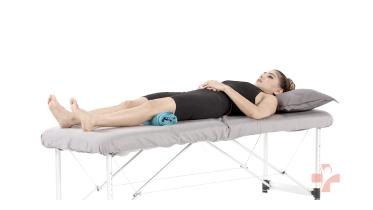 Quad sets (towel under knee)
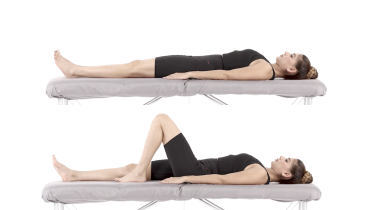 Heel slides
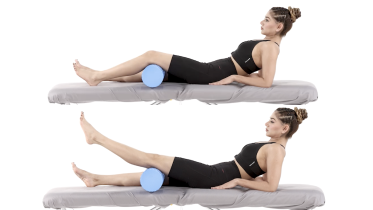 Short arc quads
If the main thing you notice is swelling, catching or the knee letting you down, swelling, locking and giving way explains which of those changes how quickly you need to be seen. If the pain started with a twist in sport, meniscus tear vs ACL tear or MCL sprain covers what else may have been injured at the same time.
Check with your doctor before you start the exercises if you have a heart or lung condition, or blood pressure that is not under control. If you are pregnant and past the first three months, check with your physio before exercising flat on your back, because all three are done lying down. If you have had a hip replacement, get the go-ahead from your surgeon or physio first, because the heel slide bends the hip as the knee comes up. If you have high blood pressure, breathe steadily through every hold and never hold your breath.
If you have had an operation on this knee, follow the program your surgeon and physio gave you instead of this one, and keep going to your post-operative appointments, which no page can stand in for. That matters most after a repair: surgeons commonly cap how far the knee may bend and how much weight goes through the leg for the first weeks, and a heel slide can take the knee past a bending cap, so slide only as far as the limit you were given and no further. Surgeons differ on what those limits are and on when they lift them, so the figures in your own plan win over anything written here. After a trim there is nothing stitched waiting to heal, and the limits are usually fewer, but they are still your surgeon's to set.
If the tear came from a twist, a fall or a tackle and nobody has assessed the knee yet, get that done before you start, because some of those tears are best repaired early. This page is for adults. A child or teenager with a knee injury should be assessed by a doctor or physio before starting any exercise program.
Related exercise programs
Warning signs
Get emergency help now
- Emergency: the knee has moved out of place, looks misshapen or is pointing at an odd angle, or you have tingling or no feeling in the knee, leg or toes, or your foot turns cold, pale or blue. Go to an emergency department straight away. Do not drive yourself: ask someone to drive you or call an ambulance.
- Emergency: the knee became very swollen very quickly, within a few hours of a twist, fall or blow, or you felt a pop or snap. Go to an emergency department straight away. Do not drive yourself: ask someone to drive you or call an ambulance. Swelling from a meniscus tear often builds up more slowly, over a few hours to 2 or 3 days, and a meniscus tear from sport often comes with other damage inside the knee, such as a torn ligament (the ACL), so fast swelling needs checking.
- Emergency: sudden, severe pain in your calf that is much worse than you would expect or keeps getting worse, especially if you take medicine to thin your blood. It may come with a tight, swollen calf, pain that gets worse when the muscle is stretched, numbness, pins and needles or weakness. Call emergency services or go to an emergency department straight away, and do not drive yourself. Rarely, bleeding from a burst cyst builds up pressure inside the calf (compartment syndrome), which needs urgent surgery.
Get help today
- Same day: the knee is locked, which means it is stuck bent and you cannot fully straighten it, even after gently trying to move it, or you cannot bend or straighten the leg at all. Get assessed the same day by a doctor, at urgent care or at an emergency department. A torn piece of meniscus can get caught in the joint and block it, and when a tear like this can be repaired, it should be done as early as possible. A knee that catches for a moment and then frees itself can happen with a meniscus tear. That is not the same as a locked knee, but tell your physio or doctor about it.
- Same day: you felt the kneecap slip out of place and it went back by itself. Get assessed the same day.
- Same day: since an operation on your meniscus, the knee locks, catches or gives way again, or you feel a pop or a shift inside it, or it swells up or becomes much more painful after a twist, a kneel or a deep bend. Keep your weight off it and contact your surgical team, or get assessed the same day at urgent care or an emergency department. A repair can come apart before the tear has healed, and a trimmed meniscus can tear again. If the knee is only a little achy after a busy day, with no swelling and no catching, it is not an emergency, but tell your physio or surgeon in the next few days.
- Same day: the knee swells up with no clear reason, especially if you take medicine to thin your blood. Get medical advice the same day.
- Same day: you cannot walk or put weight on the leg, whether or not there was a fall or injury, or you have very bad knee pain after a fall or injury, or very bad knee pain that came on suddenly with no injury at all. Get medical advice the same day.
- Same day: the knee keeps giving way under you, or it gave way after a recent injury, or it gives way and is also very painful or swollen. Get medical advice the same day. If it only happens now and then, with no recent injury and no swelling, it is not an emergency, but book an assessment with a physio or doctor in the next few days. Until it has been checked, leave out the exercises you do standing on one leg, hold the rail on stairs and take care on uneven ground, because a knee that gives way without warning is how people fall.
- Same day: since your operation, your wound is oozing, leaking or has pus coming out of it, or its edges start to come apart, or your knee is tender, swollen, painful or red and it is not getting better or is getting worse, or you have a high temperature or feel hot and cold or shivery. Redness can be harder to see on brown or black skin. Contact your surgical team the same day, or get urgent medical advice if you cannot reach them. These can be signs of an infection in the wound or the knee joint. If you feel very unwell, go to an emergency department. If you have a very high or very low temperature, shivering you cannot control, you are breathing very fast or finding it hard to breathe, you are confused or your speech is slurred, your skin, lips or tongue look blue, gray, pale or blotchy (on brown or black skin this can be easier to see on the palms of the hands or soles of the feet), or you have a rash that does not fade when you press it, call emergency services, as this can be sepsis.
- Same day: the knee is hot, red and swollen, or you have knee pain with a high temperature or feel hot, cold or shivery. Get medical advice the same day, and go to an emergency department if you feel very unwell. This can be a sign of infection in the joint, which needs treatment quickly.
- Same day: a calf or thigh that is newly swollen or getting more swollen, warm, tender, red or darker than usual, has swollen veins that are sore to touch, or has a throbbing or cramping pain that does not fit your injury or condition, or that feels different from normal muscle soreness after exercise. This can be a sign of a blood clot (deep vein thrombosis), especially after surgery, an injury, time in a cast or boot, a long trip or a spell of being much less mobile than usual. Get medical advice the same day. If you are also short of breath or have chest pain, call emergency services.
- Same day: pain or swelling in your calf or leg that suddenly gets worse, or new bruising on your leg, even if you know you have a Baker's cyst. Get medical advice the same day. A burst cyst and a blood clot can look exactly the same, and a doctor may need a scan to tell them apart. Do not assume it is the cyst.
- Same day: pain at night or at rest that keeps getting worse. If you are being treated for cancer now, contact your cancer team the same day.
Book an appointment
- Within a day or two: pain at night or at rest that keeps getting worse. If you have had cancer, now or in the past, see your doctor sooner, within a day or two, and mention it, even if the pain is not getting worse. Do the same if you have knee pain and are losing weight without trying, even if it does not hurt at night.
- Within a few days: pain at night or at rest that keeps getting worse. See your doctor within a few days.
Common questions
Can a meniscus tear cause pain behind the knee?
Yes. Each meniscus is a curved pad of cartilage anchored at the front and the back of the joint, and the inner one is shaped like a C while the outer one is closer to a full ring, so soreness along the joint line can be felt further back than people expect. A swollen knee can also push fluid into a sac behind the joint and make a Baker's cyst, which gives a lump, a tight feeling and trouble with a full bend. In adults a Baker's cyst rarely turns up on its own: it usually comes with another knee problem, most often knee osteoarthritis, a meniscus tear or rheumatoid arthritis (Herman and Marzo, 2014).
Which side of the knee does a meniscus tear hurt?
Whichever side the torn meniscus is on, and most people can show you the line with one fingertip. The inner side is the commoner one in middle-aged knees: the trials of exercise against surgery recruited people with degenerative tears on the inner side (Kise and colleagues, 2016). Joint line tenderness is one of the better clinical clues, though it is a pointer and not proof: it picked up about 83% of tears and correctly cleared about 83% of knees without one, in 9 studies the reviewers rated as generally poor quality and with a wide range around both figures, which is why they said the accuracy of these tests remains poor and should be used with caution (Smith and colleagues, 2015). No single test on the couch settles it, and a sore joint line in a middle-aged knee can come from the wear in the joint as easily as from the tear.
Why does my knee hurt more when I twist than when I walk?
A twist on a planted, bent knee is the movement people with a torn meniscus most often name as the worst, while a long flat walk is one of the easiest. That is a clinical pattern rather than something a trial has measured, and it is one you can use. If a long walk is fine and getting out of the car is awful, the problem is more likely to be about position and twist than about distance, and the program can be built around that.
Can a meniscus tear cause pain at the front of the knee?
It can contribute, but pain around or behind the kneecap fits patellofemoral pain better, especially if stairs, squatting and getting out of a low chair are the worst moments and there is no clear line of soreness at the joint. Many knees have more than one thing going on, and a degenerative tear often sits in a knee with some arthritis as well. An assessment sorts out which part of it is driving your symptoms.
Is pain behind the knee ever serious?
Two patterns need acting on, and both of them are in the calf rather than the knee. A calf or thigh that is newly swollen, warm, tender, red or darker than usual, or has a throbbing or cramping pain that does not fit your injury, can be a blood clot and needs medical advice the same day, and emergency services if you are also short of breath or have chest pain. A Baker's cyst that bursts can look exactly like a clot, so new calf swelling is checked rather than assumed, even when you know the cyst is there. Sudden severe calf pain, or calf pain that keeps getting worse, is the second one, and that goes to an emergency department, because bleeding from a burst cyst can build up pressure inside the calf. The warning list below gives the full set of signs.
References
- Smith BE, Thacker D, Crewesmith A, Hall M. Special tests for assessing meniscal tears within the knee: a systematic review and meta-analysis. Evidence Based Medicine. 2015;20(3):88-97. https://doi.org/10.1136/ebmed-2014-110160
- Herman AM, Marzo JM. Popliteal cysts: a current review. Orthopedics. 2014;37(8):e678-e684. https://doi.org/10.3928/01477447-20140728-52
- Englund M, Guermazi A, Gale D, et al. Incidental meniscal findings on knee MRI in middle-aged and elderly persons. New England Journal of Medicine. 2008;359(11):1108-1115. https://doi.org/10.1056/NEJMoa0800777
- Kise NJ, Risberg MA, Stensrud S, Ranstam J, Engebretsen L, Roos EM. Exercise therapy versus arthroscopic partial meniscectomy for degenerative meniscal tear in middle aged patients: randomised controlled trial with two year follow-up. BMJ. 2016;354:i3740. https://doi.org/10.1136/bmj.i3740
- Siemieniuk RAC, Harris IA, Agoritsas T, et al. Arthroscopic surgery for degenerative knee arthritis and meniscal tears: a clinical practice guideline. BMJ. 2017;357:j1982. https://doi.org/10.1136/bmj.j1982
- Arnoczky SP, Warren RF. Microvasculature of the human meniscus. American Journal of Sports Medicine. 1982;10(2):90-95. https://doi.org/10.1177/036354658201000205
- NHS. Meniscus tear (knee cartilage damage). Page last reviewed 2 September 2026. https://www.nhs.uk/conditions/meniscus-tear/
- NHS. Knee pain. Page last reviewed 21 December 2023. https://www.nhs.uk/symptoms/knee-pain/
- NHS. Deep vein thrombosis (DVT). Page last reviewed 30 April 2026. https://www.nhs.uk/conditions/deep-vein-thrombosis-dvt/
- American Academy of Orthopaedic Surgeons. Meniscus Tears. OrthoInfo. https://www.orthoinfo.org/en/diseases--conditions/meniscus-tears/
Written and checked by the PocketPhysio editorial team. Last updated 2026-10-16.
This page is general education, not a diagnosis or a personal treatment plan. See a physiotherapist or doctor for advice about your own situation.