
Part of Meniscus tear
Exercises to avoid with a meniscus tear: what to change instead
Warning signs, and when to get help
Do you have to avoid exercise with a meniscus tear?
No. For a degenerative tear, exercise is the treatment rather than the risk. A Norwegian trial put 140 middle-aged adults with a degenerative tear on the inner side of the knee through 12 weeks of supervised strength and control work, 24 to 36 sessions of it, and their knees ended up much the same at 2 years as the knees that were operated on (Kise and colleagues, 2016). A Dutch trial used 16 sessions over 8 weeks and found physical therapy was not worse than surgery over 2 years (van de Graaf and colleagues, 2018). Neither program was gentle, and neither avoided loading the knee.
So the useful question is not what to cut out. It is which dial to turn down. Every knee exercise has four: how far the joint bends, how much weight goes through it, how fast each repetition lands, and how much of it you do in a week. When someone tells me squats wreck their knee, the squat is almost never the problem. One of those four settings is wrong for this week.
Which movements usually flare a torn meniscus?
The same short list comes up in clinic over and over, and it is what most physios hold back while the knee settles: deep squats, kneeling, and twisting or pivoting on a bent knee. That is common practice rather than something trials have tested, so treat it as a starting point your own knee can overrule.
That last sentence applies to a knee that has not been operated on. After a meniscus repair the same three movements are held back for a firmer reason, because they pull on the stitches holding the tear while it knits, and published protocols stage how far the knee may bend and when loaded twisting comes back even though they differ on the numbers (Fried and colleagues, 2021). After a repair, the dates come from your surgeon and not from how the knee feels.
Deep squats and deep lunges
Keep the movement, lose the depth. The joint line complains most in the bottom third of a squat, so a shallow squat against a wall or down to a high chair asks far less of a torn meniscus than a full squat. Work from the mini squat and the ball wall squat, lower the seat or deepen the range once a level has felt easy for a week, and leave added weight until last. There is more detail in squatting and kneeling with a meniscus tear.
Kneeling
Kneeling bends the knee all the way and then presses the front of it into the floor. Long spells on a hard surface are a reliable way to make a torn meniscus grumble for two days. Pad the knee, keep the spells short, and bring anything that lives near the floor up onto a stool, which squatting and kneeling with a meniscus tear sets out properly. This is housework rather than training, so changing it costs you nothing. After a meniscus repair, kneeling is one of the movements your surgeon puts a date on, so wait for that date instead of testing it with a cushion, and do not kneel on a wound that has not fully healed.
Twisting and pivoting on a planted foot
This is the one people underestimate. Turning on a bent, loaded knee is the movement that tore many of these menisci in the first place, and it stays provocative for a while. Move your feet to turn instead of pivoting on the sore leg, swing your whole body around on the car seat and put both feet down together, and bring low jobs up onto a table while the knee is irritable. Those are short-term habits that buy the program time, not rules for life. After a repair they are not short-term either: turning on a loaded bent knee is the shear the stitches cope with worst, and when it comes back is your surgeon's decision.
Jumping, cutting and pivot sports
Landing and changing direction load the knee hard and fast, and a knee that still swells after a long walk is not ready for them. If your sport needs them, build the strength base first and plan the last steps with a physio, which is what return to sport after a meniscus tear is about. After a repair this is your surgeon's decision rather than a judgement you make from how the knee feels, and it is counted in months.
Gym machines
No guideline bans them. On the leg press, set the seat so the knees do not fold past the depth that feels comfortable at the bottom, start light and push slowly. On the leg extension machine, use a light weight and shorten the range if the joint line complains. That is practice experience rather than tested advice, so let the next-morning check below decide it. After a meniscus repair, leave both machines until your surgeon, or a physio working to their protocol, clears them, because each of them loads the knee well past what a healing repair is meant to take and neither lets you feel that happening.
How do you know an exercise was too much?
Judge it by tomorrow morning, not by how it felt at the time. Mild discomfort while you exercise is usually fine when it fades soon after you finish and the knee is no worse the next day. Three signs say the load was too much: a sharp pain along the side of the joint, a knee that catches during a repetition, or more swelling the following morning. If your knee was injured recently, keep the early exercises pain free.
There is one group this check is not for. If you have had a repair or a trim on this meniscus and the knee locks, catches, gives way, pops or shifts, or swells up or turns much more painful after a twist, a kneel or a deep bend, that is not a dial to turn down. Keep your weight off the leg and contact your surgical team the same day, as the warning list below says, because a repair can come apart before the tear has healed and a trimmed meniscus can tear again.
When one of those three signs turns up in a knee that has not been operated on, drop back one step rather than stopping altogether. A shallower squat, a lower step, one set instead of three. Stay there for a week before you try again. The pain monitoring model explains how physios use this check, and if the knee is thoroughly flared, go back to the lying and sitting exercises in stage 1 of the meniscus tear program.
What should you avoid after meniscus surgery?
Whatever your surgeon says. Everything above this heading was written for a tear that is being managed without an operation, usually a degenerative one, and it is not a post-operative program. A trim and a repair are different operations with different aftercare, and neither of them follows the turn-the-dial-down approach on this page until your own surgeon says the knee is ready for it.
After a trim (arthroscopic partial meniscectomy) the torn piece has been taken out. Nothing was stitched and nothing has to heal, so people are usually back on their feet quickly and any limits tend to be short ones.
After a repair the torn edges were stitched back together and left to knit, which takes months rather than weeks. For all of that time the stitches are what holds the tear while you walk on it, and the loads that pull on them are the three this page spends its length on: weight through the leg, deep bending, and twisting on a loaded bent knee. That is why surgeons set limits on how much weight may go through the leg, how far the knee may bend, and when squatting, kneeling and twisting come back.
Nobody has agreed on what those limits should be. Two systematic reviews of rehabilitation after an isolated meniscal repair both found protocols varying widely, with no consensus on weight bearing or on how far the knee may bend (O'Donnell and colleagues, 2017; Fried and colleagues, 2021), and the later one closes by calling for an evidence-based consensus statement that still does not exist. The 2019 ESSKA consensus on injury tears sets no post-operative protocol at all (Kopf and colleagues, 2020). The spread is too wide for a page like this to print a typical week, and a week taken from a study is not permission for your knee: what is right after one repair can be far too early after another, because it depends on where the tear was, how it was stitched, and what else was done to the knee at the same time (O'Donnell and colleagues, 2017).
One of those reviews did find that the protocols allowing early movement and early weight bearing came out no worse than the restrictive ones (O'Donnell and colleagues, 2017), which is reassuring if your surgeon has you moving early. Read it carefully, though, because it is easy to take as permission. Only 2 of the 17 treatment groups in it were the early sort, the comparison ran between separate studies rather than inside a trial, and what it measured was how the knee scored rather than whether anyone looked again to see if the tear had knitted (O'Donnell and colleagues, 2017). Surgeons also choose the protocol to suit the repair in front of them, and a stitched rim tear, a radial tear and a root repair are not protected the same way.
So this page deliberately gives no weeks and no angles after a repair. Your own protocol is the one that counts. If you have lost it, ring the team who operated and ask for four things in writing: how much weight may go through the leg and until when, how far the knee may bend, when you may squat, kneel and twist, and when you may run. Until you reach them, stay with whatever you were last told you could do rather than moving on, because a knee that feels better is not the same as a repair that has healed. The warning list below includes the signs that mean contacting them the same day rather than waiting for your next appointment.
Exercises that can help
These are gentler versions to work from, roughly easiest first. Quad sets are often 10 repetitions with a 5 to 10 second hold, several times a day. Short arc quads are often 2 to 3 sets of 10 to 15 with a 3 to 5 second hold, once or twice a day. The mini squat often starts at 2 to 3 sets of 10 to 15 once a day, the ball wall squat at 2 sets of 10 slow squats building toward 3 sets of 12 to 15 on 3 or 4 days a week, and the step up at 2 to 3 sets of 8 to 12 on each leg. Do the step up next to a stair rail or a kitchen counter you can touch, and leave it out while your knee is catching, locking or giving way, until that has been assessed. Your physio will adjust this, and after an operation on your meniscus your surgeon's plan comes first.
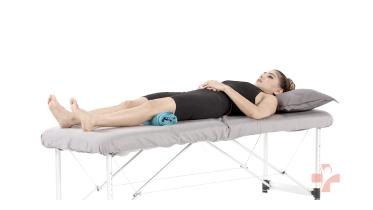 Quad sets (towel under knee)
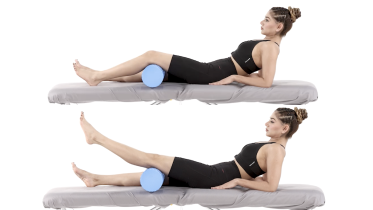 Short arc quads
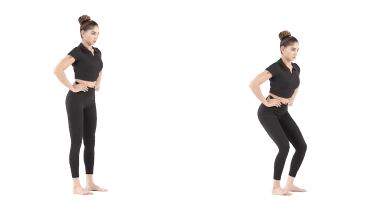 Mini squat
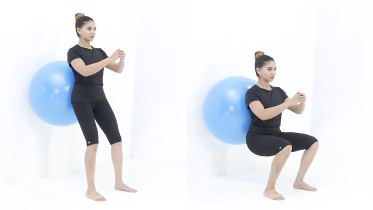 Ball wall squat
 Step up
If you have had an operation on this meniscus, do not start any of these without the go-ahead from your surgeon, or from a physio working to their protocol. How much weight may go through the leg and how far the knee may bend are theirs to set, and the mini squat, the ball wall squat and the step up all put weight through a bending knee.
Check with your doctor before you start if you have a heart or lung condition, or blood pressure that is not under control. If you have high blood pressure, breathe steadily through every repetition and never hold your breath. If you have osteoporosis, have fallen in the past year or feel unsteady, do the standing exercises next to a kitchen counter and keep a hand on it for every step up. If you have had a hip replacement, the ball wall squat and the step up bend the hip past a right angle or put your weight on one leg, so get the go-ahead from your surgeon or physio first. If you are pregnant and past the first three months, check with your physio before exercising flat on your back, as the quad sets and short arc quads are done lying down.
If the tear came from a twist, a fall or a tackle and nobody has assessed the knee yet, get that done before you start, because some of those tears are best repaired early. This page is for adults. A child or teenager with a knee injury should be assessed by a doctor or physio before starting any exercise program.
Degenerative tears and knee osteoarthritis often share a knee, so the advice on exercises to avoid with knee arthritis fits many people here too. If you are not sure whether the tear needs an operation at all, meniscus tear surgery or physio covers that question.
Related exercise programs
Warning signs
Get emergency help now
- Emergency: the knee has moved out of place, looks misshapen or is pointing at an odd angle, or you have tingling or no feeling in the knee, leg or toes, or your foot turns cold, pale or blue. Go to an emergency department straight away. Do not drive yourself: ask someone to drive you or call an ambulance.
- Emergency: the knee became very swollen very quickly, within a few hours of a twist, fall or blow, or you felt a pop or snap. Go to an emergency department straight away. Do not drive yourself: ask someone to drive you or call an ambulance. Swelling from a meniscus tear often builds up more slowly, over a few hours to 2 or 3 days, and a meniscus tear from sport often comes with other damage inside the knee, such as a torn ligament (the ACL), so fast swelling needs checking.
Get help today
- Same day: the knee is locked, which means it is stuck bent and you cannot fully straighten it, even after gently trying to move it, or you cannot bend or straighten the leg at all. Get assessed the same day by a doctor, at urgent care or at an emergency department. A torn piece of meniscus can get caught in the joint and block it, and when a tear like this can be repaired, it should be done as early as possible. A knee that catches for a moment and then frees itself can happen with a meniscus tear. That is not the same as a locked knee, but tell your physio or doctor about it.
- Same day: you felt the kneecap slip out of place and it went back by itself. Get assessed the same day.
- Same day: since an operation on your meniscus, the knee locks, catches or gives way again, or you feel a pop or a shift inside it, or it swells up or becomes much more painful after a twist, a kneel or a deep bend. Keep your weight off it and contact your surgical team, or get assessed the same day at urgent care or an emergency department. A repair can come apart before the tear has healed, and a trimmed meniscus can tear again. If the knee is only a little achy after a busy day, with no swelling and no catching, it is not an emergency, but tell your physio or surgeon in the next few days.
- Same day: the knee swells up with no clear reason, especially if you take medicine to thin your blood. Get medical advice the same day.
- Same day: you cannot walk or put weight on the leg, whether or not there was a fall or injury, or you have very bad knee pain after a fall or injury, or very bad knee pain that came on suddenly with no injury at all. Get medical advice the same day.
- Same day: the knee keeps giving way under you, or it gave way after a recent injury, or it gives way and is also very painful or swollen. Get medical advice the same day. If it only happens now and then, with no recent injury and no swelling, it is not an emergency, but book an assessment with a physio or doctor in the next few days. Until it has been checked, leave out the exercises you do standing on one leg, hold the rail on stairs and take care on uneven ground, because a knee that gives way without warning is how people fall.
- Same day: since your operation, your wound is oozing, leaking or has pus coming out of it, or its edges start to come apart, or your knee is tender, swollen, painful or red and it is not getting better or is getting worse, or you have a high temperature or feel hot and cold or shivery. Redness can be harder to see on brown or black skin. Contact your surgical team the same day, or get urgent medical advice if you cannot reach them. These can be signs of an infection in the wound or the knee joint. If you feel very unwell, go to an emergency department. If you have a very high or very low temperature, shivering you cannot control, you are breathing very fast or finding it hard to breathe, you are confused or your speech is slurred, your skin, lips or tongue look blue, gray, pale or blotchy (on brown or black skin this can be easier to see on the palms of the hands or soles of the feet), or you have a rash that does not fade when you press it, call emergency services, as this can be sepsis.
- Same day: the knee is hot, red and swollen, or you have knee pain with a high temperature or feel hot, cold or shivery. Get medical advice the same day, and go to an emergency department if you feel very unwell. This can be a sign of infection in the joint, which needs treatment quickly.
- Same day: a calf or thigh that is newly swollen or getting more swollen, warm, tender, red or darker than usual, has swollen veins that are sore to touch, or has a throbbing or cramping pain that does not fit your injury or condition, or that feels different from normal muscle soreness after exercise. This can be a sign of a blood clot (deep vein thrombosis), especially after surgery, an injury, time in a cast or boot, a long trip or a spell of being much less mobile than usual. Get medical advice the same day. If you are also short of breath or have chest pain, call emergency services.
- Same day: pain at night or at rest that keeps getting worse. If you are being treated for cancer now, contact your cancer team the same day.
Book an appointment
- Within a day or two: pain at night or at rest that keeps getting worse. If you have had cancer, now or in the past, see your doctor sooner, within a day or two, and mention it, even if the pain is not getting worse. Do the same if you have knee pain and are losing weight without trying, even if it does not hurt at night.
- Within a few days: pain at night or at rest that keeps getting worse. See your doctor within a few days.
Common questions
Are squats bad for a meniscus tear?
Depth is the problem, not the squat. A shallow squat is one of the standard strength exercises for a degenerative tear and sits in stage 2 of our program, while a deep squat folds the joint into the position a torn meniscus usually objects to. Start with a mini squat or a squat onto a high chair, and add depth once a height has felt easy for a week. After a meniscus repair, squatting is one of the things your surgeon sets a date for, so ask them rather than guessing.
Should I stop walking with a meniscus tear?
Usually not. The NHS advises resting the knee when you can in the first few days after an injury or a flare, without stopping moving it completely, and then trying gentle movement after a few days. Flat walking often troubles a torn meniscus far less than the two seconds of twist getting out of a car. Walk as far as the knee tolerates and cut back if it is more swollen or sore the next morning. If you cannot walk or put weight on the leg after an injury, get it checked the same day. That advice is for a knee that has not been operated on: after a meniscus repair, how much weight may go through the leg and how far you may walk are set in your surgeon's protocol, so follow that rather than what the knee will tolerate.
Can I run with a meniscus tear?
Some people can, and there is no trial to settle it. In practice, if you already run, the knee is not swelling and it is settled by the next morning, adjust your distance and pace rather than stopping. Starting to run for the first time on a knee that is still swollen and catching is a big jump, and a few months of strength work first usually makes it stick. That is practice experience, not tested advice. After a meniscus repair, running is your surgeon's call.
Is cycling good or bad for a meniscus tear?
It suits most knees with a degenerative tear, because the load is steady and there is no twisting. Set the saddle high enough that the knee does not fold deeply at the top of the pedal stroke, keep the resistance light at first, and judge it by the next morning. No trial has tested cycling on its own for a meniscus tear, so that is practice experience. After a meniscus repair, ask your surgeon when the bike is allowed and how much resistance you may use.
References
- Kise NJ, Risberg MA, Stensrud S, Ranstam J, Engebretsen L, Roos EM. Exercise therapy versus arthroscopic partial meniscectomy for degenerative meniscal tear in middle aged patients: randomised controlled trial with two year follow-up. BMJ. 2016;354:i3740. https://doi.org/10.1136/bmj.i3740
- van de Graaf VA, Noorduyn JCA, Willigenburg NW, et al. Effect of early surgery vs physical therapy on knee function among patients with nonobstructive meniscal tears: the ESCAPE randomized clinical trial. JAMA. 2018;320(13):1328-1337. https://doi.org/10.1001/jama.2018.13308
- Beaufils P, Becker R, Kopf S, et al. Surgical management of degenerative meniscus lesions: the 2016 ESSKA meniscus consensus. Knee Surgery, Sports Traumatology, Arthroscopy. 2017;25(2):335-346. https://doi.org/10.1007/s00167-016-4407-4
- Kopf S, Beaufils P, Hirschmann MT, et al. Management of traumatic meniscus tears: the 2019 ESSKA meniscus consensus. Knee Surgery, Sports Traumatology, Arthroscopy. 2020;28(4):1177-1194. https://doi.org/10.1007/s00167-020-05847-3
- Siemieniuk RAC, Harris IA, Agoritsas T, et al. Arthroscopic surgery for degenerative knee arthritis and meniscal tears: a clinical practice guideline. BMJ. 2017;357:j1982. https://doi.org/10.1136/bmj.j1982
- Fried JW, Manjunath AK, Hurley ET, Jazrawi LM, Strauss EJ, Campbell KA. Return-to-play and rehabilitation protocols following isolated meniscal repair: a systematic review. Arthroscopy, Sports Medicine, and Rehabilitation. 2021;3(1):e241-e247. https://doi.org/10.1016/j.asmr.2020.07.023
- O'Donnell K, Freedman KB, Tjoumakaris FP. Rehabilitation protocols after isolated meniscal repair: a systematic review. American Journal of Sports Medicine. 2017;45(7):1687-1697. https://doi.org/10.1177/0363546516667578
- NHS. Meniscus tear (knee cartilage damage). Page last reviewed 2 September 2026. https://www.nhs.uk/conditions/meniscus-tear/
- NHS. Knee pain. Page last reviewed 21 December 2023. https://www.nhs.uk/symptoms/knee-pain/
- American Academy of Orthopaedic Surgeons. Meniscus Tears. OrthoInfo. https://www.orthoinfo.org/en/diseases--conditions/meniscus-tears/
Written and checked by the PocketPhysio editorial team. Last updated 2026-10-16.
This page is general education, not a diagnosis or a personal treatment plan. See a physiotherapist or doctor for advice about your own situation.