
Part of TMJ disorder
TMJ and tinnitus: can a jaw problem cause ringing and ear fullness?
Warning signs, and when to get help
Can TMJ cause tinnitus?
TMJ and tinnitus do turn up together. Whether one causes the other is a different question, and the evidence behind it is thinner than it usually sounds. The clinical name for the jaw problem is temporomandibular disorder, or TMD.
Start with the two national sources, because they do not agree, and the disagreement tells you more than either list does on its own.
The US National Institute of Dental and Craniofacial Research puts ringing in the ears, hearing loss or dizziness on its symptom list for temporomandibular disorders, grouped as one item. The NHS page for the same condition lists pain around the jaw, ear and temple, clicking, popping or grinding noises, a headache around the temples, difficulty opening the mouth fully and a jaw that locks. Ringing in the ears is not on it. Neither is hearing loss, dizziness or anything about ear fullness.
Two national bodies read the same literature and came out with different symptom lists. That is what an unsettled question looks like from the outside.
The research is the same shape. A 2025 systematic review reported a significant correlation between tinnitus and various temporomandibular disorders, said the relationship involves somatosensory and neuroplastic mechanisms, and then wrote that the available evidence remains inconsistent. Its own limitations section is blunter than its conclusion. It reports that many of the studies it gathered had no control group, that sample sizes were often small, and that several were cross-sectional, a design that cannot show which problem came first. It also records one group finding no direct correlation between temporomandibular disorders and the origin of tinnitus (Dipalma and colleagues, 2025).
What is missing from all of it is a study showing that a jaw problem produces tinnitus, or that fixing the jaw reliably removes it. Association is what has been measured. That is not nothing, and it is not causation.
The NHS tinnitus page is worth reading for what it leaves out. Its list of what tinnitus is often linked to runs through some form of hearing loss, Meniere's disease, conditions such as diabetes, thyroid disorders or multiple sclerosis, anxiety or depression, and certain medicines including some chemotherapy drugs, antibiotics, anti-inflammatories and aspirin. The jaw is not on that list either.
TMJ ear fullness and ear pressure: the same thing?
Fullness and pressure are the words people bring to the clinic, and they are not on either national symptom list. That gap matters, because the reassurance you are after has not been written down by anybody with authority.
What has been counted is this. A retrospective review of the records of 400 people with temporomandibular disorders, 301 women and 99 men, seen at a craniofacial pain clinic and a dentistry clinic between February 2016 and December 2017, found that 76 percent reported new-onset ear symptoms. Aural fullness was the commonest, at 33.3 percent, ahead of tinnitus at 23 percent and vertigo at 19.8 percent. Tinnitus showed no significant association with grinding, clenching, nail biting, sleeping face down, gum chewing or prolonged talking. The authors' conclusion was that everyone with a temporomandibular disorder should be screened for new ear symptoms, whatever their oral habits (Alde and colleagues, 2022).
Read it for what it is. Records reviewed afterwards rather than a study designed in advance, two clinics rather than a population, and no comparison group of people without jaw problems. So it tells you that ear fullness is the ear symptom people with jaw problems report most, and it cannot tell you that their jaws caused it.
Are fullness and pressure the same thing? In the research they are usually one item, aural fullness, and in clinic people use the words interchangeably along with blocked, muffled and underwater. We treat them as one symptom with one route.
That route goes through the ear first, and for a good reason: both words are already on NHS lists for things that are quick to check and quick to treat. A feeling of pressure in your ear is listed as a symptom of an ear infection. A feeling that your ear is blocked is listed for earwax build-up, and that same page puts ringing or buzzing in the ears, and vertigo, on the list of what a plug of wax can do. Neither needs weeks of jaw exercises, and both are findable by somebody with a light looking in your ear.
If it comes with pain, the NHS earache page asks for same-day advice when earache has lasted more than 2 to 3 days, or comes with feeling generally unwell, a high temperature, swelling around the ear, fluid coming from the ear, hearing loss or a change in hearing, or something stuck in the ear. Those lines are on the warning list at the foot of this page.
Why the jaw and the ear get confused
Anatomy is the short version: the jaw joint sits directly in front of the ear canal, so a sore joint is a sore spot about a centimeter from your ear. Patients point to the ear because that is where it hurts.
The better-documented part is referred pain, and there is a study to put behind it. In 230 people with temporomandibular disorder, an examiner pressed firmly for about five seconds on trigger points, tender spots and selected chewing structures in the head and neck and asked whether pain appeared or intensified somewhere else. Of those, 196, which is 85 percent, reported referred pain. The cheek, the ear and the forehead were the sites reported most often, and pressing the trapezius, the lateral pterygoid area and the masseter produced it most often (Wright 2000).
That is a study of where pressing a muscle sends pain, and nothing more. It says the ear is a common destination for pain that starts in the chewing and neck muscles. It is not a study of tinnitus, and it does not explain a sound.
For the sound itself, the mechanism on offer is the somatosensory account: nerve traffic from the jaw and face reaching parts of the nervous system that also handle hearing, with changes in how those pathways behave. The 2025 review names somatosensory and neuroplastic mechanisms and then calls for research into them, which is the state of play. Where tinnitus changes with jaw or neck movement or position, the hearing literature calls it somatic, or somatosensory, tinnitus. An international panel of clinicians and researchers agreed a set of criteria for it in 2018, describing a subtype of subjective tinnitus in which altered signals from the neck or the jaw area cause or change what a person hears, and putting tinnitus that can be changed by jaw or neck movement among the criteria that point to it (Michiels and colleagues, 2018). The manual therapy trial below was done in people described that way; the other trials enrolled people who had a jaw disorder and tinnitus together.
The overlap with headache and neck pain is real and better understood than the ear link. Can TMJ cause neck pain goes through the evidence that the jaw and the neck travel together, and cervicogenic headache and tension-type headache cover the headache patterns that sit in the same group. If the neck is the louder problem, the neck pain program is the better starting point.
Tinnitus in one ear, or both?
This is the question people ask most, and the answer is about what gets checked rather than about your jaw.
Your two jaw joints work separately in every bite, and jaw problems are usually worse on one side, so a one sided ear symptom alongside a one sided jaw problem is not strange. Nothing we can cite shows that a left jaw gives a left ear, so a sore right jaw with a ringing left ear is not evidence of anything exotic.
What matters is that some one sided ear symptoms have their own routes, and they do not wait for a jaw diagnosis.
Sudden hearing loss in one or both ears, on its own, goes to an urgent GP appointment or NHS 111 on the NHS hearing loss page, which says the cause may not be serious but may need treating quickly. Hearing that has been getting worse over the last few days or weeks goes the same way. Sudden hearing loss alongside tinnitus goes higher than that, as the next paragraphs set out, and if you are reading this page you have the tinnitus.
A sound in one ear that pulses or whooshes in time with your heartbeat goes to an urgent GP appointment on the NHS tinnitus page, and it has its own same day line on the warning list at the foot of this page. One version of it goes further. Alongside new pain on one side of your face, jaw or neck, a drooping eyelid or a smaller pupil, it sits on the emergency list here, because that combination can be a tear in an artery in the neck. Either way, a sound that keeps time with your pulse is not a sound a jaw makes.
Tinnitus after a head injury, and tinnitus with sudden hearing loss, facial muscle weakness or vertigo, go to an emergency department or 999 on the NHS tinnitus page. The NICE guideline on tinnitus is more specific about the spinning: it asks for an immediate referral when tinnitus comes with acute, uncontrolled vestibular symptoms, vertigo being its own example (NICE NG155). So the warning line at the foot of this page reads spinning that is new, is severe, or will not settle, rather than any spinning at all, and short positional spells that a clinician has already diagnosed and checked keep the dizziness routes further down that list.
So the sequence is: ear symptoms that are on those lists get dealt with on their own timeframe, and then the jaw is worth working on. Doing it the other way round is how a treatable ear problem spends three months being stretched.
What helps, and what the trials actually showed
This is where it becomes a physiotherapy question rather than only a dental one. Jaw treatment has been trialled for tinnitus. The trials are small and their quality is mixed, and the numbers are only any use to you with both of those attached.
A systematic review of 11 studies on conservative temporomandibular treatment concluded that there is low-quality evidence for a positive effect on tinnitus complaints. Risk of bias was high, and the differences between studies in who they included, what they measured and what they did made pooling impossible. Splint therapy combined with exercise was the best-investigated approach and showed a decrease in tinnitus severity and intensity (Michiels and colleagues, 2019).
An earlier review by the same group, looking at physical therapy aimed at the neck or the jaw joint in subjective tinnitus, found six studies, four on the neck and two on the jaw. All six reported positive effects on tinnitus. The authors graded the evidence low quality, with a high risk of bias mainly from lack of randomization and blinding, and said the findings need confirmation in larger and better studies before recommendations can be made (Michiels and colleagues, 2016).
A 2023 review looked specifically at physical therapy for temporomandibular disorders with tinnitus. Four trials, and the review counts 187 people in total. All of them showed physical therapy reducing the intensity or severity of tinnitus, with reduced jaw pain, higher pressure pain thresholds over the chewing muscles and better jaw function in two of them. Overall certainty of evidence was low, methodological quality ranged widely, and heterogeneity meant no meta-analysis (da Silva and colleagues, 2023).
A 2024 meta-analysis did pool five trials with 329 people and found a significant pooled effect, with a risk ratio of 0.49 and a confidence interval of 0.40 to 0.59. Its own limitations are the part to read: few studies, concerns about risk of bias in more than half of the evidence, and treatments too unalike to compare cleanly. In the analysis where that variation showed up most, the authors wrote that a cautious interpretation of the findings is warranted. They used no formal certainty rating (d'Apuzzo and colleagues, 2024).
The single trial worth knowing in detail is the one that asked whether adding hands-on treatment helps. Sixty-one people with tinnitus attributed to temporomandibular disorder were randomized to six sessions over one month of cranio-cervical and jaw joint exercises, self-massage and education, with or without added cervico-mandibular manual therapy to the joint and the neck and chewing muscles. The group that got the manual therapy did better on jaw pain and tinnitus severity, assessed by a blinded assessor at one week, three months and six months. Patients and therapists were not blinded, which is normal for hands-on treatment and still a limitation (Delgado de la Serna and colleagues, 2020).
What that adds up to, said plainly: treating the jaw is a reasonable thing to try if you have a jaw problem and tinnitus, several small trials point the same way, and the quality is not good enough to promise you a result. The 2023 BMJ guideline for jaw pain lasting 3 months or more, which does not cover tinnitus, strongly recommends supervised jaw exercise and stretching, therapist-assisted mobilization, manual trigger point therapy, supervised posture exercise and cognitive behavioral therapy (Busse and colleagues, 2023), and the word supervised in that list is not decoration.
One word we will not use is cure. Nothing above supports it.
The practical starting point is the TMJ disorder program, which carries the NHS self-care advice: soft food, teeth apart when you are not eating, a warm or cold pack, and ways to wind down. If your ear symptoms arrive in bouts with the jaw pain, TMJ flare ups is about managing those weeks, and if the jaw also catches or locks, when your jaw locks or catches comes first, because none of the research above was done in people with a locked joint.
The jaw work that has been trialled for ear symptoms
These are the relaxation and jaw movements from the TMJ program, which is the kind of treatment the tinnitus trials used alongside education and self-massage. As a starting guide, many programs use 5 to 10 slow breaths or a few minutes of diaphragmatic breathing 1 to 3 times a day, 3 to 5 facial relaxation squeezes once or twice a day or whenever you notice tension, 5 to 10 slow jaw openings held for a few seconds a few times a day, and a 5 to 10 second temporalis stretch repeated 3 to 5 times once or twice a day. Your physio will adjust this, and each exercise page carries its own dose and cautions. Do the facial relaxation with your teeth slightly apart, squeezing only around your eyes and cheeks and never the jaw. Keep the opening small: open only as far as your tongue allows and only while it stays pain free, and stop if your jaw catches, locks or clicks painfully. If your jaw clicks painfully, catches, will not open fully or has ever locked, have it checked in person before you start any of this. If your jaw has ever got stuck open, check with your dentist or physio before you start. If your jaw was dislocated or stuck open in the last 6 weeks, do not start this on your own. MedlinePlus says that after dislocating your jaw you should not open your mouth widely for at least 6 weeks. Those 6 weeks are a minimum rather than a finish line, and nothing changes by itself on the day they end, so ask the team who treated your jaw first and follow what they say. After jaw surgery or a broken jaw, check with your surgeon before you start, and follow their plan. Ask your dentist before you rest your teeth on anything for the temporalis stretch if you have loose teeth, fresh dental work or a crown on that side. Breathe steadily through every hold and never hold your breath, which matters most if you have high blood pressure. If you have a lung condition such as COPD, or a heart condition, ask your physio or doctor how breathing exercises fit your own plan. After eye surgery, such as a cataract operation, ask your eye team before you squeeze your eyes shut in the facial relaxation, and if your face is weak after a stroke, ask your stroke team before you start.
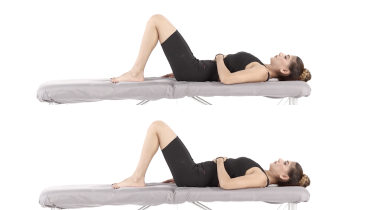 Diaphragmatic breathing
 Facial muscle relaxation
 Jaw opening with the tongue on the roof of the mouth
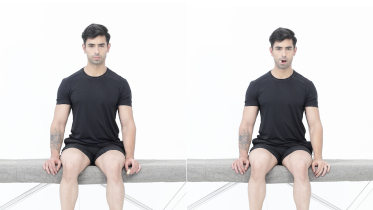 Temporalis stretch
Two things go wrong most often when people do these with an ear symptom. Keep the jaw opening small and genuinely pain free, because people chasing an ear symptom tend to work the jaw harder than the program asks. And judge the ear symptom over weeks rather than hours, because tinnitus varies through the day on its own and a single better evening tells you nothing.
Ear symptoms that are not coming from your jaw
A sore jaw does not protect you from ear problems, and some patterns belong to the ear whatever your jaw is doing.
The combination to know about is tinnitus with ear fullness, vertigo and hearing that comes and goes. The NHS names Meniere's disease among the things tinnitus is often linked to, and that pattern needs assessing in its own right rather than filing under a jaw diagnosis. Vertigo causes, from BPPV to vestibular migraine and Meniere's is the page for it, and dizziness and BPPV covers the spinning side of the same problem.
Hearing loss is next. The NHS asks for an urgent GP appointment or 111 for sudden hearing loss in one or both ears, for hearing getting worse over days or weeks, and for hearing loss with other symptoms such as earache or discharge from the ear. With tinnitus alongside it, sudden hearing loss is on the emergency list on this page instead, which is the route to take if you have both. It also says that sudden hearing loss along with dizziness, vertigo or tinnitus may be labyrinthitis or Meniere's disease, and that sudden loss after an ear infection, a very loud noise or a change in air pressure such as flying may be a perforated eardrum. None of those is a jaw problem.
Then there is ear pain with discharge, swelling around the ear, a temperature or feeling generally unwell, and the NHS earache page puts all of those at the urgent level. That page also pairs ear pain with toothache and names a dental abscess among the causes, so an earache that arrived alongside a sore tooth is a dental question before it is a jaw one, and TMJ or tooth pain covers that sorting.
Dizziness is the last of them, and here the sources split again in the same direction as before. The NIDCR puts dizziness on its TMD list. The NHS does not. Neither tells you what is causing yours, and the list of things that make a room spin is long, so it gets assessed on its own.
A spinning feeling that is new, severe or will not settle, alongside the tinnitus, is on the emergency list at the foot of this page, and that holds even when the spinning only arrives as you move your head. If your positional spells have already been diagnosed and checked and these are the same, stop the exercises when one comes on and get advice the same day.
One pattern does not belong in this section at all. A sound in one ear that keeps time with your heartbeat has its own same day line below, and the emergency list covers it where it comes with new one sided face, jaw or neck pain, a drooping eyelid or a smaller pupil.
When to get checked
Two appointments, not one, and in this order.
Get the ear looked at. The NHS asks you to see a GP if you have tinnitus regularly or constantly, if it is getting worse, or if it bothers you, for example by affecting your sleep or concentration or making you feel anxious and depressed. That holds whatever your jaw is doing, and it is the appointment people with a jaw diagnosis skip. The NHS describes what happens there plainly: the GP looks in your ears for something they can treat, such as an ear infection or a build-up of earwax, and may check for hearing loss. Ask specifically whether your hearing has been tested, because tinnitus and some form of hearing loss are linked on the NHS's own account.
Tinnitus wears some people down badly, and the most urgent referral in the NICE guideline is for exactly that: tinnitus with a high risk of suicide goes immediately to a mental health crisis team (NICE NG155). If you are having thoughts of harming yourself, that is help the same day, and the line at the foot of this page says where to get it.
Then get the jaw assessed. See a dentist, doctor, physio or physical therapist if the jaw pain is not settling with self-care, if it keeps coming back, or if you grind your teeth. Say both things at that appointment: the jaw symptoms and the ear symptoms, and which came first. The order they appeared in is one of the few pieces of information nobody else in the room has.
Some things do not wait for either appointment. Tinnitus after a head injury, or with sudden hearing loss, facial weakness or a spinning feeling that is new, severe or will not settle, is an emergency. So is a sound in one ear that pulses with your heartbeat alongside one sided face, jaw or neck pain, a drooping eyelid or a smaller pupil. On its own, a sound that keeps time with your pulse needs advice the same day.
Jaw pain with chest pain, or brought on by effort and eased by rest, is a cardiac pattern and goes to emergency services. A swollen face or jaw with difficulty breathing, speaking, swallowing or opening your mouth, a lot of swelling in your mouth, or a swollen neck or swelling around an eye, is an infection route. Every line on the list below carries its own timeframe, and red flags in physiotherapy explains how to read it.
Related exercise programs
Warning signs
Get emergency help now
- Emergency: any sign of a stroke, even if it goes away. That means a face that droops on one side, an arm you cannot lift or keep up, slurred or muddled speech, weakness or numbness on one side of your body or face, sudden blurred vision, double vision or loss of sight, trouble swallowing, sudden dizziness with unsteadiness or falling over, a sudden severe headache, or a sudden fall where your legs give way but you do not black out (a drop attack). Call emergency services straight away. With neck pain, these can rarely come from a tear in an artery in the neck.
- Emergency: a new headache, or new pain on one side of your face, jaw or neck, with a drooping eyelid or a smaller pupil on the same side, or with a new pulsing or whooshing sound in one ear that keeps time with your heartbeat. Call emergency services or go to an emergency department straight away, and do not drive yourself. This can be a tear in an artery in the neck (cervical artery dissection), which can lead to a stroke.
- Emergency: tinnitus or ringing in your ears that starts after a knock or blow to the head, or tinnitus together with sudden hearing loss, weakness in the muscles of your face, or a spinning feeling (vertigo) that is new, is severe, or will not settle. Go to an emergency department or call emergency services straight away, and do not drive yourself.
- Emergency: vertigo or dizziness together with new hearing loss, double vision or loss of vision, trouble speaking, or weakness, numbness or tingling in an arm or leg. Call emergency services or go to an emergency department straight away.
- Emergency: neck, jaw or arm pain that comes with chest pain, shortness of breath, sweating or feeling sick. Call emergency services.
- Emergency: jaw, neck, shoulder or arm pain that comes on when you exert yourself, feel stressed or go out in the cold, and does not ease within a few minutes of rest, or comes with sweating, feeling sick, feeling light-headed or being short of breath. Call emergency services straight away, as this can be a heart attack. If it eases quickly with rest and none of these happen, get medical advice the same day, and do not exercise again until you have been checked. Jaw pain that comes with effort and goes with rest can be a sign of angina, a heart problem, rather than TMD.
- Emergency: a headache or face pain with sudden, intense eye pain, a red eye, blurred vision or rainbow-colored rings around lights, often with feeling or being sick. Call emergency services or go to an emergency department straight away, and do not drive yourself. This can be a sudden rise in pressure inside the eye (acute glaucoma).
- Emergency: you think you have a tooth infection, or your face or jaw is swollen, and you find it hard to breathe, speak, swallow or open your mouth, have a lot of swelling in your mouth, have swelling of your neck or around your eye, or have a swollen or painful eye or sudden problems with your eyesight. Call emergency services or go to an emergency department straight away, and do not drive yourself. This can be a spreading infection, for example from a tooth abscess.
- Emergency: your mouth is stuck open and you cannot close it, for example after a big yawn, or after a blow to your face your jaw looks out of place, your teeth no longer meet as they did or you cannot bite together. Go to an emergency department straight away, supporting your jaw gently with your hand, and do not drive yourself. Call emergency services if you also find it hard to breathe or are bleeding heavily.
- Emergency: your jaw locked, you cannot open or close your mouth properly, part of your lower lip, chin or jaw feels numb, a tooth is loose or broken or your gum or mouth is bleeding, your jaw swings to one side as it opens, or your cheek or jaw has a lump or a changed shape, after a blow to the face, a fall, a sports injury or any other accident, even if your teeth still meet as they did. Go to an emergency department straight away, supporting your jaw gently with your hand, and do not drive yourself. Call emergency services if you also find it hard to breathe, are bleeding heavily or your face is swelling quickly. A jaw can be broken without looking out of place, and jaw stiffness, trouble opening your mouth widely, pain in front of your ear that is worse when you bite or chew, or a numb lower lip can be the main sign.
- Emergency: new problems walking, for example your legs feel stiff, heavy or weak or you have become unsteady on your feet, new trouble controlling your bladder or bowels, or hands that suddenly become clumsy, for example you can no longer do up buttons. Call emergency services straight away. These can be signs of pressure on the spinal cord in the neck.
Get help today
- New, frequent headaches with pain or tenderness at your temples or on your scalp, or, if you are 50 or over, new jaw pain or aching that comes on as you chew or talk and eases when you stop, or a temple or scalp that has become tender to touch, for example when you brush your hair or rest your head on a pillow. Get medical advice the same day. These can be signs of inflamed arteries in the head (temporal arteritis, also called giant cell arteritis). If your vision changes, call emergency services.
- Same day: tinnitus that beats or whooshes in time with your pulse, without any of the emergency signs above. Get medical advice the same day, as this kind of tinnitus needs checking in its own right.
- Same day: sudden hearing loss in one or both ears, or hearing that has got worse over a few days, without dizziness or any of the emergency signs above. Get medical advice the same day, as it may need treating quickly.
- Same day: ear pain with fluid coming from your ear, swelling around your ear, hearing loss or a change in your hearing, something stuck in your ear, a high temperature, or feeling hot, cold, shivery or generally unwell, or ear pain that has lasted more than 2 to 3 days, without any of the emergency signs above. Get medical advice the same day.
- Same day: you feel dizzy after a knock to the head, without any of the emergency signs above. Get medical advice the same day.
- Same day: dizziness or spinning that has been there all the time for a day or more, rather than coming in short spells when you move your head, without any of the emergency signs above. Get medical advice the same day. If you cannot stand or walk steadily, call emergency services.
- Dizziness, a spinning feeling or feeling sick that comes on when you turn or tip your head, without any of the emergency signs above. Stop the exercises and get medical advice the same day. If you faint, it does not settle within a few minutes of sitting still, or you cannot stand or walk steadily, call emergency services.
- Your jaw suddenly locks so you cannot open your mouth fully, or the pain or stiffness stops you eating or drinking, without any of the emergency signs above. Get medical advice the same day from your doctor or dentist.
- Frequent, severe headaches alongside your jaw problem, without any of the emergency signs above. Get medical advice the same day.
- Numbness, tingling or a dead feeling in part of your face, lips, tongue or chin, or weakness in the muscles of your face, that has come on gradually, without any of the emergency signs above. Get medical advice the same day. Changes like these point to a nerve problem rather than TMD and need checking.
- Jaw or face pain with a high temperature, a swollen face or gum, or you feel hot, cold, shivery or generally unwell, without any of the emergency signs above. Get medical advice the same day. If you think a tooth is the cause, contact a dentist for an urgent appointment.
- Hands that have slowly become clumsy, for example trouble doing up buttons or dropping things, or numbness in both hands. Get medical advice the same day. These can be signs of pressure on the spinal cord in the neck (cervical myelopathy). If the clumsiness or numbness gets worse quickly, call emergency services straight away.
- Pain or tingling in both arms at the same time, rather than in one. Get medical advice the same day. This can also be a sign of pressure on the spinal cord in the neck.
- An arm or hand that is getting weaker. Get medical advice the same day.
- New jaw or face pain and you have had cancer, now or in the past, or you have lost weight without trying. Get medical advice the same day and mention it. If you are being treated for cancer now, contact your cancer team the same day.
- Jaw or face pain that is there all the time and does not ease with rest, or pain at night that keeps getting worse. If you have had cancer, now or in the past, or you have lost weight without trying, get medical advice the same day.
- Thoughts of suicide or of harming yourself, even if you do not plan to act on them. Get urgent help the same day from your GP or NHS 111 in the UK, and you can also talk to Samaritans on 116 123. If you have harmed yourself or feel you may be about to, call emergency services or go to an emergency department straight away.
Book an appointment
- Tinnitus that is there regularly or all the time, tinnitus that is getting worse, or tinnitus that is affecting your sleep or your concentration, or making you feel anxious or low in mood, without any of the emergency signs above. See your doctor within a few days, whatever your jaw is doing.
- Jaw or face pain that is there all the time and does not ease with rest, or pain at night that keeps getting worse. See your doctor within a few days.
- A mouth ulcer that has lasted more than 3 weeks, a lump in your mouth, on your lip, in your neck or in your throat, a red or white patch in your mouth, pain in your mouth that is not going away, difficulty swallowing or speaking, or a hoarse voice that does not go away. See your doctor or dentist within a few days. These are usually caused by something else, but they need checking for mouth cancer.
Common questions
Can TMJ cause tinnitus?
The honest answer is that the two go together and nobody has shown that one causes the other. The NIDCR lists ringing in the ears, hearing loss or dizziness among the symptoms of temporomandibular disorders, and the NHS page on the same condition lists none of them. A 2025 systematic review reported a significant correlation between tinnitus and temporomandibular disorders, attributed it to somatosensory and neuroplastic mechanisms, and stated that the available evidence remains inconsistent; it also notes an earlier group finding no direct correlation between temporomandibular disorders and the origin of tinnitus (Dipalma and colleagues, 2025). The NHS list of what tinnitus is often linked to does not mention the jaw. So the jaw is worth treating, and it is not a reason to leave your ear unexamined.
Can TMJ cause tinnitus in one ear?
Tinnitus in one ear is the version people ask about most, and the useful answer is about who looks at it rather than about the jaw. A jaw problem is usually worse on one side, so a one sided ear symptom alongside it is not surprising. But the NHS treats some one sided ear symptoms as needing quick attention whatever else is going on. Sudden hearing loss in one or both ears goes to an urgent GP appointment or 111, and the NHS tinnitus page sends sudden hearing loss together with tinnitus to an emergency department or 999. A sound in one ear that pulses or whooshes in time with your heartbeat has its own same day line on this page, and it is on the emergency list where it comes with new one sided face, jaw or neck pain, a drooping eyelid or a smaller pupil. Get the ear checked, then treat the jaw.
Can TMJ cause ear fullness and ear pressure?
Fullness and pressure are the words people actually use, and neither appears on the NHS symptom list for temporomandibular disorders or on the NIDCR one. The one measurement we can point to is a retrospective review of records from 400 people with temporomandibular disorders, in which 76 percent reported new-onset ear symptoms, aural fullness was the commonest at 33.3 percent, tinnitus came next at 23 percent, and vertigo at 19.8 percent (Alde and colleagues, 2022). It had no control group, so it describes what people with jaw problems report rather than what jaw problems cause. Meanwhile the NHS lists a feeling of pressure in your ear among the symptoms of an ear infection, and a feeling that your ear is blocked for earwax build-up, and both of those can be identified in a few minutes by somebody looking in your ear.
How do you relieve tinnitus from TMJ?
By treating the jaw, with honest expectations. Three reviews have looked at it. A review of 11 studies found low-quality evidence for a positive effect of conservative temporomandibular treatment on tinnitus complaints, with a high risk of bias, and splint therapy with exercise the best-investigated combination (Michiels and colleagues, 2019). A 2023 review of physical therapy specifically found that all its included trials reduced tinnitus intensity, on low certainty of evidence from four trials with 187 people in total (da Silva and colleagues, 2023). A 2024 meta-analysis of five trials with 329 people found a significant pooled effect and said that a cautious interpretation is warranted given the heterogeneity, with risk of bias concerns in more than half of the evidence (d'Apuzzo and colleagues, 2024). That is a reasonable basis for trying, and not a basis for promising.
Can TMJ cause tinnitus and dizziness together?
The NIDCR groups dizziness with ringing in the ears and hearing loss in its symptom list, so the combination is recognized in that source. It does not tell you what is causing yours, and that combination is also the shape of several inner ear conditions, which is why vertigo causes exists as a separate page. Dizziness with new hearing loss, double vision, trouble speaking or weakness in an arm or leg is an emergency and has its own line on this page, and so is a spinning feeling that is new, severe or will not settle alongside tinnitus. Dizziness that comes on when you turn or tip your head, in someone whose positional spells have already been looked at, means stopping the exercises and getting advice the same day.
References
- National Institute of Dental and Craniofacial Research (NIDCR). Temporomandibular disorders (TMD). https://www.nidcr.nih.gov/health-info/tmd
- NHS. Temporomandibular disorder (TMD). Page last reviewed 20 June 2023. https://www.nhs.uk/conditions/temporomandibular-disorder-tmd/
- NHS. Tinnitus. Page last reviewed 12 January 2024. https://www.nhs.uk/conditions/tinnitus/
- National Institute for Health and Care Excellence (NICE). Tinnitus: assessment and management. NICE guideline NG155. Published 11 March 2020. https://www.nice.org.uk/guidance/ng155
- NHS. Earwax build-up. Page last reviewed 5 January 2024. https://www.nhs.uk/conditions/earwax-build-up/
- NHS. Hearing loss. Page last reviewed 30 May 2025. https://www.nhs.uk/conditions/hearing-loss/
- NHS. Earache. Page last reviewed 27 October 2025. https://www.nhs.uk/conditions/earache/
- Dipalma G, Inchingolo AD, Pezzolla C, Sardano R, Trilli I, Di Venere D, et al. The association between temporomandibular disorders and tinnitus: evidence and therapeutic perspectives from a systematic review. Journal of Clinical Medicine. 2025;14(3):881. https://doi.org/10.3390/jcm14030881
- Michiels S, Nieste E, Van de Heyning P, Braem M, Visscher C, Topsakal V, et al. Does conservative temporomandibular therapy affect tinnitus complaints? A systematic review. Journal of Oral and Facial Pain and Headache. 2019;33(3):308-317. https://doi.org/10.11607/ofph.2055
- Michiels S, Naessens S, Van de Heyning P, Braem M, Visscher CM, Gilles A, et al. The effect of physical therapy treatment in patients with subjective tinnitus: a systematic review. Frontiers in Neuroscience. 2016;10:545. https://doi.org/10.3389/fnins.2016.00545
- da Silva MT, Silva C, Silva J, Costa M, Gadotti I, Ribeiro K. Effectiveness of physical therapy interventions for temporomandibular disorders associated with tinnitus: a systematic review. Journal of Clinical Medicine. 2023;12(13):4329. https://doi.org/10.3390/jcm12134329
- d'Apuzzo F, Minervini G, Cerbone M, Rotolo RP, Grassia V, Nucci L. Treatment approaches, outcomes and prognostic indicators in patients with tinnitus and temporomandibular disorders evaluated with DC/TMD: a systematic review and meta-analysis. Journal of Oral Rehabilitation. 2025;52(2):230-242. Published online 17 July 2024. https://doi.org/10.1111/joor.13796
- Michiels S, Ganz Sanchez T, Oron Y, Gilles A, Haider HF, Erlandsson S, et al. Diagnostic criteria for somatosensory tinnitus: a Delphi process and face-to-face meeting to establish consensus. Trends in Hearing. 2018;22:2331216518796403. https://doi.org/10.1177/2331216518796403
- Delgado de la Serna P, Plaza-Manzano G, Cleland J, Fernandez-de-las-Penas C, Martin-Casas P, Diaz-Arribas MJ. Effects of cervico-mandibular manual therapy in patients with temporomandibular pain disorders and associated somatic tinnitus: a randomized clinical trial. Pain Medicine. 2020;21(3):613-624. https://doi.org/10.1093/pm/pnz278
- Alde M, Didier HA, Gianni AB, Sessa F, Borromeo G, Didier AH, et al. Prevalence of new-onset otological symptoms in patients with temporomandibular disorders. Journal of Otorhinolaryngology, Hearing and Balance Medicine. 2022;3(2):3. https://doi.org/10.3390/ohbm3020003
- Wright EF. Referred craniofacial pain patterns in patients with temporomandibular disorder. Journal of the American Dental Association. 2000;131(9):1307-1315. https://doi.org/10.14219/jada.archive.2000.0384
- Busse JW, Casassus R, Carrasco-Labra A, Durham J, Mock D, Zakrzewska JM, et al. Management of chronic pain associated with temporomandibular disorders: a clinical practice guideline. BMJ. 2023;383:e076227. https://doi.org/10.1136/bmj-2023-076227
- NHS. Temporal arteritis. Page last reviewed 14 August 2023. https://www.nhs.uk/conditions/temporal-arteritis/
- NHS. Angina. Page last reviewed 18 March 2025. https://www.nhs.uk/conditions/angina/
- NHS. Dental abscess. Page last reviewed 18 March 2026. https://www.nhs.uk/conditions/dental-abscess/
- NHS. Mouth cancer: symptoms. Page last reviewed 19 June 2023. https://www.nhs.uk/conditions/mouth-cancer/symptoms/
- NHS. Glaucoma. Page last reviewed 13 June 2025. https://www.nhs.uk/conditions/glaucoma/
- NHS. Stroke: symptoms. Page last reviewed 12 September 2024. https://www.nhs.uk/conditions/stroke/symptoms/
- MedlinePlus. Broken or dislocated jaw. US National Library of Medicine. Review date 3 April 2025. https://medlineplus.gov/ency/article/000019.htm
Written and checked by the PocketPhysio editorial team. Last updated 2026-10-23.
This page is general education, not a diagnosis or a personal treatment plan. See a physiotherapist or doctor for advice about your own situation.