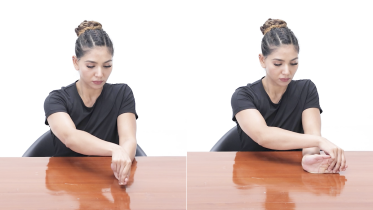
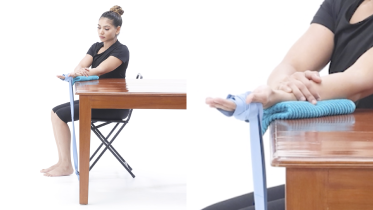
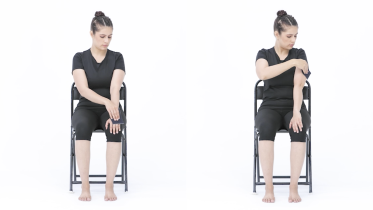
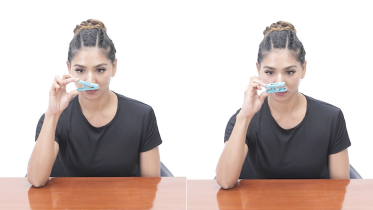
Open and close the fist, elbow bent
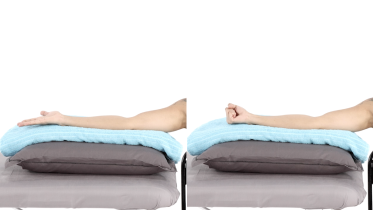
This is a simple finger exercise done with the hand held up. You sit beside a bed or table with your upper arm resting on a stack of pillows, the elbow bent to a right angle and the fingers pointing at the ceiling, then close the hand into a fist and open it out again. Physios often give it in the first weeks after a wrist fracture, when the fingers need to keep moving and a swollen hand is best kept raised.
How to do the open and close the fist, elbow bent
- Sit on a chair beside a bed or table. Stack pillows on it, with a folded towel on top, until your upper arm can rest on them out to the side a little below shoulder height, as in the video.
- Rest the upper arm and elbow on the pillows. Bend the elbow to a right angle so the forearm stands upright and the hand sits above the elbow, fingers straight and pointing up.
- Slowly close your fingers into a full fist. If you are in a cast or splint, make the fist only as tight as it lets you.
- Open the hand again until the fingers are straight and pointing at the ceiling.
- Keep opening and closing at a steady pace, letting the pillows take the weight of the arm while your shoulder stays relaxed. The video shows the right arm; work whichever side your program lists.
What you should feel
Movement through the knuckles and finger joints, and light work in the forearm. Stiff or swollen fingers may not close all the way at first.
Common mistakes
- Holding the arm up with your own effort instead of letting the pillows carry it.
- Squeezing the fist as hard as you can. Close it fully but without force.
- Closing the hand only halfway, so the fingertips never reach the palm.
- Letting the forearm tip over until the hand sinks below the elbow.
How often
Many programs use 10 to 20 slow fists at a time, several times a day. Your physio will adjust this.
Stop and check with your physio if
- Sharp pain in the fingers, the palm or the wrist.
- Tingling or numbness in your fingers while you work, most often in the ring and little fingers while the elbow is bent. If you are in a cast or splint, follow the two cast signs below. Otherwise, lower the arm and straighten the elbow. If it stays after you stop, or keeps getting worse, get medical advice the same day. If one side of your face or body suddenly goes numb or weak, or your speech becomes slurred or muddled, call emergency services, even if it goes away.
- Emergency: while you are in a cast or splint, your fingers turn blue, white or pale, or feel cold. Do not wait to see if raising your hand helps. Go to an emergency department straight away, and do not drive yourself. The cast or splint may be cutting off the blood supply, or pressure may be building up inside the forearm (compartment syndrome), and both need checking quickly.
- In a cast or splint, the pain gets worse, your fingers feel numb or tingle or look more swollen, or the cast feels too tight. Stop, raise your hand above your head, keep moving your fingers and contact your fracture clinic or get medical advice straight away. If you cannot move your fingers, the pain is severe even after painkillers, or the numbness, tingling or swelling has not settled within 30 minutes of raising your hand, go to your fracture clinic or an emergency department straight away, and do not drive yourself.
- Since the fracture or cast, the hand is getting more painful rather than less, the skin becomes very sensitive to light touch, or the hand changes color, temperature, swelling or sweating compared with the other one, or looks shiny. See your doctor or physio as soon as you can, within a few days at most, as this can be complex regional pain syndrome (CRPS) and early treatment may help.
From the clinic
Resting the whole arm on pillows lets the hand sit above the elbow without your shoulder working to hold it there. Fracture clinics often ask you to keep a swollen hand raised and the fingers moving, and this position does both at once. If the stack is too low, the hand drops; if it is too high, the shoulder creeps up toward your ear. Add or take away a pillow until the arm rests easily.
Keeping the elbow bent for a long spell can bring on tingling in the ring and little fingers, so let the arm down and straighten it between sets. If your shoulder or elbow was hurt as well, or your arm is kept in a sling, check with your fracture clinic or physio before you rest the arm out to the side like this, and move the fingers in the position they have shown you.
After a wrist fracture, keep moving your fingers and thumb as far as the cast or splint allows, unless your fracture clinic has told you otherwise. After a broken hand or finger, a tendon repair or other hand surgery, how far you may move the fingers and thumb is often limited for several weeks, so do only the movements your surgeon or hand therapist has shown you.
The same finger movement with the forearms resting flat on a chair's armrests is open and close the hands. Once a full fist comes easily, tendon glides move the fingers through a wider set of positions, and the hand grip squeeze adds gentle resistance. The wrist fracture rehab program shows where finger work fits in the weeks after a break.
Written and checked by the PocketPhysio editorial team. Last updated 2026-09-28.
This page is general education, not a diagnosis or a personal treatment plan. If you have pain, an injury or a health condition, see a physiotherapist or doctor before starting new exercises.