Single leg hop and hold
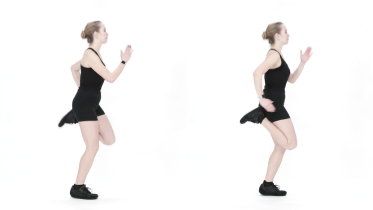
The single leg hop and hold is a small hop on the spot from one foot to the other. You land on one leg with the other knee lifted to hip height, hold that position still for a moment, then hop back across. The point is to soak up a landing on one leg and then keep yourself still. It comes late in knee and ankle rehab, once balancing on one leg is easy.
How to do the single leg hop and hold
- Stand on a firm, non-slip floor with a wall or counter within reach and your hands on your hips, as in the video.
- Shift your weight onto one leg and lift the other knee up in front of you until the thigh is level with your hip.
- Hop up a small way and switch legs in the air, landing softly on the ball of the foot that was lifted. Let the heel settle and bend the knee and hip a little as you land, while the other knee rises to hip height.
- Hold the landing still, knee up and body tall, until you are fully steady, for a slow count of two or three.
- Hop back across to the first leg and hold again. Keep alternating, with low hops and quiet landings.
What you should feel
Work in the calf, thigh and buttock of the leg you land on, and at the front of the hip holding the other knee up. Each landing should feel soft, and each hold steady.
Common mistakes
- Landing stiff-kneed and loud.
- The landing knee rolling inward, or the hip dropping on the side of the lifted leg.
- Rushing into the next hop before the hold is steady.
- Hopping higher or faster than you can control.
How often
Many programs start with 2 to 3 sets of 6 to 10 hops, counting both legs, with a rest between sets, on 2 or 3 days a week. Your physio will adjust this.
Stop and check with your physio if
- Sharp pain in the foot, ankle, shin or knee as you land, or later that day.
- Your landing knee buckles or your ankle turns over.
- A sudden pop or snap at the back of your ankle or heel, a feeling that someone kicked you there, or sudden pain there after which you cannot push off or rise onto your toes on that leg. Stop, take the weight off that leg carefully and go to an urgent care center or emergency department the same day, even if you can still walk, as this can be a torn Achilles tendon.
- Urine leaks as you land, or your pelvis feels heavy or as if something is dragging down.
- Chest pain or pressure, dizziness or feeling faint, a racing or irregular heartbeat, or being far more out of breath than the effort should cause.
From the clinic
Despite the name, you do not stay on one leg for the whole set. The app title calls it hopping on the spot with a hold, and every hop lands you on the other foot. Save it for the later stages of rehab. Physios usually want you to stand steadily on each leg in single leg stance, and to manage small two-footed hops such as pogo hops without pain, before you land on one leg. Single leg hops over a line and hopping in four directions are related drills that keep you on the same leg and move you across the floor.
Keep a wall or counter close enough to touch, and clear the floor around you. The video shows bare feet, but supportive sports shoes with a grippy sole are the safer start for most people. End the set once your landings get noisy or you need to grab the support.
Ask your doctor or physio before you start if you have thin bones (osteoporosis) or have fallen in the past year. Landing on one leg pushes force down onto your pelvic floor, so if you leak urine or feel heaviness in your pelvis, stop and get pelvic floor advice from your physio. If you are pregnant, check with your midwife or physio before you start. If you have recently given birth, including by cesarean section, or you have a gap down the middle of your stomach muscles (diastasis recti), ask your physio, midwife or doctor first.
After a knee fracture or knee surgery, including a knee replacement, follow your surgeon's or physio's plan, and start this exercise only when they have cleared you. After an ankle fracture or ankle surgery, follow your surgeon's or physio's weight-bearing plan, and start this exercise only when they have cleared you. If you have had a hip or knee replacement, get the go-ahead from your surgeon before you try the single leg hop and hold. Many surgeons advise against jumping and hopping after a joint replacement for good, not just for the first months, because each landing sends high impact through the new joint.
With a heart condition or high blood pressure, check with your doctor before you start. If chest pain, pressure or tightness does not ease quickly when you rest, spreads to your arm, neck, jaw, stomach or back, or comes with sweating, feeling sick, feeling light-headed or being short of breath, call emergency services straight away, as this can be a heart attack. If it eases quickly and none of these happen, get medical advice the same day, and do not exercise again until you have been checked. If you faint while exercising, call emergency services, even if you feel fine again quickly.
Written and checked by the PocketPhysio editorial team. Last updated 2026-09-28.
This page is general education, not a diagnosis or a personal treatment plan. If you have pain, an injury or a health condition, see a physiotherapist or doctor before starting new exercises.