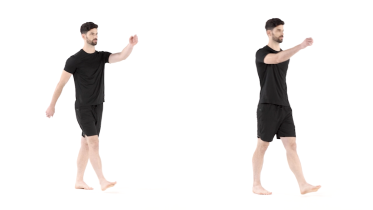
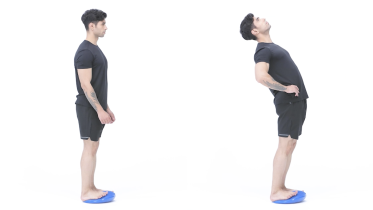
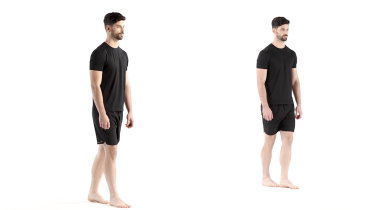
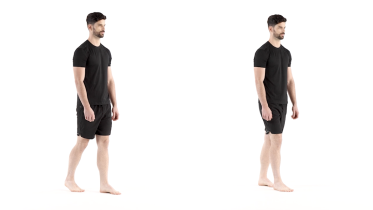
Tandem walking with head turns
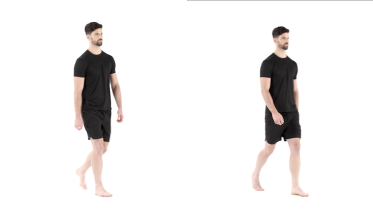
Tandem walking with head turns is a vestibular rehab exercise. You walk slowly heel to toe along a straight line, turning your head from side to side while your eyes stay fixed on one target ahead. The narrow steps test your balance, and the head turns ask your inner ear and eyes to keep your vision steady at the same time (the vestibulo-ocular reflex, or VOR). Some mild dizziness can be part of the work, which is why it belongs in a program your physio sets once the cause of your dizziness is known.
How to do the tandem walking with head turns
- Mark a straight line with tape along a hallway wall or kitchen counter, so one hand can reach the support at every step. Choose a target at eye level at the far end, such as a sticker or a picture on the wall.
- Stand at the start of the line with your feet together and your eyes on the target. Before you walk, turn your head slowly a little to one side and then the other, keeping the target clear.
- Step forward heel to toe, setting the heel of the front foot just ahead of the toes of the back foot, and keep the slow head turns going.
- Walk slowly to the end of the line. Your body faces forward and your eyes stay on the target, so only your head turns.
- At the end, stop with your feet side by side and turn slowly in a half circle with a few ordinary steps, rather than turning on the spot. Pick a new target and walk back the same way.
- Once you feel steady and the target stays sharp, your physio may ask for slightly quicker head turns, as the voice guide suggests. If the target blurs, slow down. Blurred or double vision that stays after your head stops moving is a stop sign, not part of the exercise.
What you should feel
Your ankles and hips correcting all the time on the narrow line, and your eyes working to keep the target sharp. Some mild dizziness while your head is moving is expected, as long as it fades within a few minutes once you stop.
Common mistakes
- Losing the target with your eyes each time your head moves.
- Turning your shoulders with your head, so your steps wander off the line.
- Speeding up the walk or the head turns before a slow version feels steady.
- Looking down at your feet between turns.
How often
Many programs start with 2 to 3 slow lengths of a short hallway, a few times a day, with head turns slow enough that the target stays clear. Your physio will adjust this.
Stop and check with your physio if
- The dizziness becomes severe or stronger than your physio said to expect, you are being sick, or you feel faint. Stop, sit or lie still and get medical advice the same day before you do these exercises again. If you faint, it is no better after 10 minutes of keeping still, you suddenly lose hearing in one or both ears, or you are far more unsteady on your feet than usual, call emergency services.
- Things look double, your vision suddenly blurs or goes, your speech slurs or becomes muddled, swallowing becomes hard, your face or lips go numb, one side of your face droops or one side of your body goes weak or numb, you suddenly become so dizzy or unsteady that you fall or cannot stand or walk, your legs suddenly give way but you do not black out (a drop attack), or you get a sudden severe headache. Stop and call emergency services, even if it goes away.
- You step off the line and need the wall or counter to stop yourself falling.
- Your neck hurts as you turn, or pain or tingling runs into an arm.
From the clinic
Start these exercises only after a doctor or vestibular physio has found the cause of your dizziness. New dizziness, or dizziness that has changed, needs checking first. Your physio sets the speed of the head turns and how far you walk, and tells you how much dizziness to expect. Mild dizziness that clears within a few minutes of stopping is usually part of the work. If it is stronger than that, keeps building or lingers, stop, hold your support and use the stop signs on this page.
The man in the video walks in open space with nothing to hold. At home, walk beside a hallway wall or counter every time, on a floor with no loose rugs or cables. Wear flat shoes that fit well and grip the floor, not socks, tights or bare feet. If you have fallen in the last 12 months, feel unsteady on your feet, or take a medicine that can make you drowsy or dizzy, have another adult walk beside you, and ask your physio whether to start with an easier version.
Easier exercises build up the two parts separately: tandem walking without head turns, and walking with head turns with ordinary steps. Gaze exercises done lying down, such as lying gaze stabilization with head turns, are often an earlier step. The dizziness and BPPV page explains where exercises like this fit.
After neck surgery or a broken bone in the neck, check with your surgeon or physio before you start. If you have another neck condition, ask your doctor or physio whether the head turns suit you, and keep them small.
A sudden loss of balance is different. Call emergency services straight away for any sign of a stroke, even if it goes away: sudden dizziness with unsteadiness or falling over, a face that droops on one side, an arm you cannot lift or keep up, slurred or muddled speech, weakness or numbness on one side of your body or face, sudden blurred vision, double vision or loss of sight, or a sudden severe headache.
If you have had a hip replacement, get the go-ahead from your surgeon or physio before you try tandem walking with head turns. Some operations limit this kind of work for the first months, so the timing depends on your surgery.
Written and checked by the PocketPhysio editorial team. Last updated 2026-09-28.
This page is general education, not a diagnosis or a personal treatment plan. If you have pain, an injury or a health condition, see a physiotherapist or doctor before starting new exercises.