
Part of Padel injuries and how to keep playing
Padel elbow: the tendon behind the nickname
Is padel elbow the same as tennis elbow?
What players call padel elbow is pain at the shared tendon of the wrist extensors, where it anchors to the outside of the elbow. The name in a clinic letter is lateral elbow tendinopathy, and it does not change with the sport that brought it on. Tennis and squash players get the same thing. So do plumbers and decorators, and plenty of people who have never held a racket in their lives.
That is worth knowing before you spend money. No padel version of this tendon problem is waiting to be described, and there is no padel-only exercise for it, so the treatment is the one that already has research behind it. The tennis elbow program sets out the staging, from static holds through light lifting to slow lowering, with the numbers and the progression rules on the page. What follows here is only the part the sport adds.
Work out where the pain actually sits first. On the inner side of the elbow instead of the outer it is a different tendon with a different plan, and golfer's elbow is the page to read. If the pain travels down from your neck, or turning your head changes the tingling in your hand, the source may be the neck instead, which is what cervical radiculopathy covers. Find the sore bony point with one finger before you commit to a program.
How common is padel elbow?
The elbow leads every padel injury list that reports individual joints. The 2023 systematic review brought together 8 studies and 2,022 players and found the elbow first in all five studies that reported joints, one of which asked only about the upper body and could not have found anything else. The figures behind that run from 20.5% to 74.4% and are not comparable with each other, because some count the elbow's share of the injuries reported and others the percentage of players who named the elbow at all. The review puts it plainly: it was not possible to extract one most common diagnosis, though common extensor tendinopathy was the one reported most often across the studies (Dahmen and colleagues, 2023, tables 3 and 4). In a questionnaire answered by 950 amateur players from 12 countries, 482 reported an upper body injury in the previous year, and the elbow was the site for about a third of them in both sexes (Muñoz and colleagues, 2022, table 4).
Read those as shares of the injuries people reported, not as your own odds. None of the underlying studies counted how many hours the uninjured players were on court, so none can turn a share into a risk. What the agreement does tell you is that this is not a local rumor. Spanish surveys, a Belgian one, a Chilean one and a 12-country questionnaire all put the same joint at or near the top.
The onset pattern matters more for what you do next. In the Chilean survey of 364 amateurs, an exploratory analysis put 85.7% of elbow and forearm injuries as coming on gradually instead of arriving in one moment (Belmar-Arriagada and colleagues, 2025). A gradual problem gives you weeks of notice, which means there is almost always a point where a smaller change would have been enough.
What the racket does and does not change
Three things on the racket get blamed for a sore elbow: the weight, the shape, the overgrip. The three cross-sectional surveys that have looked at them were not built around the elbow, and they do not agree with each other.
A survey of 80 elite professional and 147 amateur women players recorded equipment alongside injuries from the previous year. Tendon injuries were the commonest type across the two groups, at 44.1% to 48.3%, and mainly affected the elbow and shoulder.
The amateurs tended to use rounder, lighter rackets of 350 g or less (0.35 kg, 0.77 lb) with two overgrips, while the professionals used 351 to 370 g (0.35 to 0.37 kg, 0.77 to 0.82 lb) with none. Racket shape was the only significant predictor in their logistic regression, with an odds ratio of 1.43 and a confidence interval of 1.01 to 2.04, and a separate exploratory analysis pointed at round rackets (Escudero-Tena and colleagues, 2026). Those figures come from the paper's abstract, since the full tables are paywalled. A confidence interval whose lower edge sits on 1.01 is a result that a handful of different answers would erase.
The other two surveys do not back it up. In the 950-player questionnaire, racket shape was not associated with having been injured, at p = 0.250, and neither was the number of overgrips, at p = 0.116; racket weight was, weakly, with 83.0% of injured players using a racket of 350 g or more (0.35 kg, 0.77 lb) against 77.1% of the uninjured, at p = 0.024 and an effect size the authors put at 0.073 (Muñoz and colleagues, 2022, table 5 and results). Among 364 Chilean amateurs, racket shape was split almost evenly between the injured and the uninjured, at p = 0.78 (Belmar-Arriagada and colleagues, 2025, table 2).
Line those up and there is no equipment story to act on. The one positive result for shape comes from a single survey of women players, with the direction of it resting on an exploratory analysis, and the two larger amateur surveys do not reproduce it. The same survey turns on itself, too: the amateurs were the group who favored round rackets, and they were the group with the lower proportion reporting any injury, 40.1% against 61.1% in the professionals. Racket choice travels with playing level, which travels with hours on court and with technique, and none of these designs can pull them apart. Anyone telling you that a round racket or a teardrop one causes padel elbow has gone further than the data.
The overgrip finding is the easiest of the three to misread. In the Belgian survey of 457 recreational players, using an overgrip was independently associated with having been injured in the previous year (Declève and colleagues, 2025), while the 950-player questionnaire found no such association. The likeliest reading of the Belgian result is that people with sore arms add an overgrip, rather than that the overgrip hurt them. Nothing in either study supports taking one off to settle an elbow. Choose the handle thickness that lets your hand sit relaxed on it, and change one thing at a time so you can tell what helped.
Why the arm, and why this sport
No study has measured what a padel shot does to the wrist extensor tendon, so everything in this section is reasoning from the equipment and the rules rather than a finding about padel.
The racket is shorter than a tennis racket and has a much thicker head to take the impact (LTA), and its hitting surface carries no strings and is perforated with cylindrical holes (Federación Internacional de Pádel). A strung frame lets the string bed deform and give some of the impact back gradually, and a solid face does less of that, with the hand closer to the contact point than it is on a tennis racket. The muscles that hold your wrist steady against that impact are the ones whose tendon is sore, which is the mechanism physios propose and nobody has confirmed in this sport.
Then there are the walls. Once the ball has bounced on the floor it can come off the glass, so a share of your shots are played late, in a corner, off a bounce you did not quite read (LTA). Catching a ball that arrives at an unplanned angle means gripping harder and steadying the racket with the forearm, which is the same tissue doing the same job under worse conditions. The overhead shots ask for a firmer grip and a faster racket head than a lob or a drop shot, which is again reasoning about the shots and not a measurement. Grip pressure is the part of this you can change today, and loosening it between points costs nothing.
What to change on court
Start with the change that costs you the least and work down. None of these has been tested against elbow pain in padel players. They are borrowed from general tendon rehab and applied to a racket sport.
- Trim the volume first. Shorter or fewer sessions beat stopping altogether, and most of what you like about an evening on court survives a shorter one.
- Let the handle go between rallies. A tight grip has one job, at contact, and an hour of holding it is extra work for the tendon you are trying to settle.
- Drop the shots that need a hard grip and a fast head: smashes, viboras, flat drives. The lobs and the volleys can stay, and so can the balls you take off the back wall.
- Take the ball earlier. A late contact in a corner leaves the forearm fighting to keep the frame straight.
- Change a grip that has gone shiny or slippery, since a handle that slides gets held tighter.
- Look at the rest of the week too. Bags carried on two fingers, heavy pans, a long day on a mouse: they all pull on the same tendon between sessions.
A forearm strap or an elbow brace is on the NHS list of things to try at home for tennis elbow, and plenty of players find it takes the sting out of a match. Wear one to play in if it helps, and keep the loading work going underneath it, because a strap does not mend a tendon.
How long it takes, and what progress looks like
The NHS says tennis elbow usually gets better after resting the arm for a few weeks but can sometimes last over a year, and advises seeing a GP if the pain is still there after at least 2 weeks of self-care. The 2022 clinical practice guideline for lateral elbow pain describes the condition as often self-limiting while noting high recurrence rates and long periods of work absence, which is the argument for treating it properly instead of waiting it out (Lucado and colleagues, 2022).
Progress rarely arrives as an absence of pain. It arrives as more tolerance: the same session hurting less the next morning, then a longer session doing the same. Track the morning rather than the game, because the morning is honest and the game is not.
Three exercises for the forearm
A stringless racket puts its impact straight into the forearm, which is why these three work the forearm: lifting the wrist against a weight, a controlled twist and release, and turning the palm up and down. The staged program is still the treatment, and these three sit inside it.
A dull ache at the outer elbow while you work is usually fine, as long as it has gone within a few hours and the elbow is no angrier when you wake up. How much of that to accept is a judgment your physio makes with you. Anything sharp inside a single repetition means that exercise stops for today. If you have high blood pressure, breathe steadily through every repetition and never hold your breath.
After a broken or dislocated elbow, or elbow surgery such as a tendon repair, follow your surgeon's or physio's plan, and start these exercises only when they have cleared you. If you have just hurt your arm and have severe pain, cannot move the elbow or heard a snap, do not exercise it. Go to an urgent care center or emergency department the same day. If the arm looks a different shape or sits at an odd angle, a bone is showing, or your arm or hand tingles, feels numb or turns cold, pale or blue, go to an emergency department straight away or call emergency services, and do not drive yourself. After a broken wrist, hand or forearm, or surgery on any of them such as a tendon repair, start only when your doctor, surgeon, physio or hand therapist says the bone or repair is ready for this, and follow their plan for how much to do.
Gripping a weight or a bar hard can set off pain at the base of the thumb if you have arthritis there, so agree the starting weight with your physio, and leave these out on days when the small joints of your hand are hot and swollen, as they can be in rheumatoid arthritis.
Exercises that can help
A padel racket loads the forearm in three directions, so the exercises follow them: lifting the wrist against a weight, a slow twist and release through a flexible bar, and turning the palm up and down under load. All three commonly start at 2 to 3 sets of 10 to 15 slow repetitions once a day, with the weight or the stiffness of the bar being what changes, not the count. Read the numbers, precautions and stop signs off each exercise page, not off this paragraph. Your physio will adjust this.
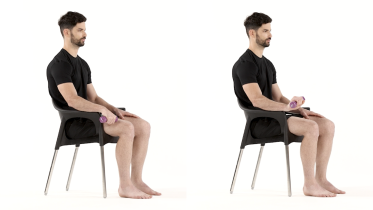 Wrist extension with weight
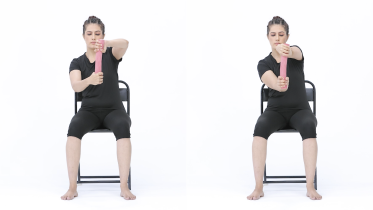 Wrist twist with a flexible bar
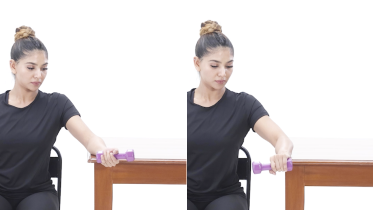 Forearm rotation with a dumbbell
When to see a physio
Two weeks of self-care with no change is the NHS threshold for booking a GP appointment, and it works just as well for booking a physio. Do not sit the fortnight out if weakness has replaced the soreness, if the fingers have started tingling, or if the whole thing began with a snap.
Most of the appointment is sorting out what is actually sore and how much load it will take. Expect resisted wrist lifting compared side to side, a finger pressed on each bony point in turn, a few neck movements to rule the neck in or out, and then a starting dose you can manage this week, not the one you want. Bring your playing record, because the sessions in the fortnight before a flare explain more than any pain score. Anyone who has had elbow surgery follows their surgical team's timetable, and new exercises start when that team says so.
Related exercise programs
See a doctor promptly if
- Emergency: after a fall or a blow to the elbow, the arm has changed shape or sits at an odd angle, a bone is showing through the skin, a cut is bleeding heavily, or the hand has gone numb or tingly or turns cold, pale or blue. Go to an emergency department or call emergency services straight away, and do not drive yourself.
- Emergency: jaw, neck, shoulder or arm pain that comes with chest pain or tightness, sweating, feeling sick, feeling light-headed or being short of breath, or that comes on when you exert yourself, feel stressed or go out in the cold and does not ease within a few minutes of rest. Call emergency services straight away, as this can be a heart attack. If it eases quickly with rest and none of these happen, get medical advice the same day, and do not exercise again until you have been checked.
- Emergency: any sign of a stroke, even if it goes away. That means a face that droops on one side, an arm you cannot lift or keep up, slurred or muddled speech, weakness or numbness on one side of your body or face, sudden blurred vision, double vision or loss of sight, trouble swallowing, sudden dizziness with unsteadiness or falling over, a sudden severe headache, or a sudden fall where your legs give way but you do not black out (a drop attack). Call emergency services straight away.
- Same day: the pain started with a fall or a blow to the elbow, and the pain is severe, you heard a snap, the elbow is swollen or bruised, or you cannot bend or straighten the arm. Go to an urgent care center or emergency department the same day.
- Same day: a sudden pop or snap at the front of your elbow, sudden sharp pain there, or the muscle at the front of your upper arm bunches up or changes shape. Stop and go to an urgent care center or emergency department the same day, even if you can still bend the elbow, as this can be a torn biceps tendon.
- Same day: the elbow is hot, red and swollen, or you have elbow pain with a high temperature or feel hot, cold or shivery. Get medical advice the same day, and go to an emergency department if you feel very unwell. This can be a sign of infection in the joint, which needs treatment quickly.
- Same day: your wrist or fingers will not lift properly, for example the fingers droop at the knuckles or the wrist drops when you hold your arm out in front of you. Get medical advice the same day. If the weakness is getting worse by the hour, go to an emergency department.
- Same day: pain spreads from your neck down the arm, or turning or tilting your neck brings on the tingling in your hand. The problem may be in the neck rather than the elbow. If a doctor or physio has not checked it yet, get medical advice the same day.
- Same day: pins and needles in your arm or hand that do not go away after you stop, or part of your arm or hand goes numb. Get medical advice the same day. If one side of your face or body suddenly goes numb or weak, or your speech becomes slurred or muddled, call emergency services, even if it goes away.
- Within a few days: the elbow locks, catches or keeps giving way in everyday use, without a pop from throwing. Stop the exercises that bring it on and see a physio or doctor within a few days rather than pushing on.
- Within a few days: the pain is there at night or at rest and keeps getting worse. See your doctor within a few days. If you have had cancer, now or in the past, or are losing weight without trying, see your doctor sooner, within a day or two, and mention it. This applies even if the pain is not getting worse. If you are being treated for cancer now, contact your cancer team the same day.
Common questions
What is padel elbow?
It is lateral elbow tendinopathy, the condition most people know as tennis elbow, with the sport's name attached. The pain sits on the bony bump on the outside of the elbow, at the shared tendon of the muscles that lift your wrist and fingers. The NHS describes the main features as pain on the outside of the elbow, tenderness or swelling there, pain in the forearm and difficulty straightening the arm fully, usually worse with lifting, gripping or moving the wrist. Most players notice it away from the court first, picking up a full kettle or a laptop bag. No padel study has shown that the sport produces a different tendon problem from the one tennis players, painters and plumbers get, so nothing about the nickname changes the treatment.
Does a lighter padel racket help elbow pain?
Nobody knows, and the surveys that looked at equipment point in different directions. A survey of 80 elite professional and 147 amateur women padel players found racket shape the only significant predictor of injury in its model, with an exploratory analysis pointing at round rackets; the amateurs in it tended to use rounder, lighter rackets of 350 g or less (0.35 kg, 0.77 lb) with two overgrips, while the professionals used 351 to 370 g (0.35 to 0.37 kg, 0.77 to 0.82 lb) without them (Escudero-Tena and colleagues, 2026). A questionnaire of 950 amateurs did not find the same: shape made no difference there, while rackets of 350 g or more were a little more common among the injured players, by an amount whose effect size the authors put at 0.073 (Muñoz and colleagues, 2022, table 5 and results). Playing level, hours on court and technique all travel with the racket, so no survey of this kind can separate them. This page will not tell you which racket to buy, because the evidence does not support telling you.
Should I take the overgrip off if my elbow hurts?
There is no evidence that it would help, and the finding people quote for it points the wrong way round. Among 457 Belgian recreational players, using an overgrip was independently associated with having been injured in the previous year, alongside doing a warm-up, age over 30, insomnia, less playing experience, playing on the right and not playing another racket sport (Declève and colleagues, 2025). A retrospective survey cannot say which came first, and the obvious explanation is that players with sore arms are the ones who add an overgrip to make the handle more comfortable. A separate questionnaire of 950 amateur players found no association between the number of overgrips and having been injured at all (Muñoz and colleagues, 2022). Choose a grip thickness that lets your hand relax, since a handle that feels wrong makes you squeeze harder, and squeezing is the part that involves the sore tendon.
Can I keep playing padel with a sore elbow?
Usually yes, once you shorten the session and take the hardest shots out of it. Stopping altogether takes the pull off the tendon and removes what rebuilds it, which is why the program on our tennis elbow page adds load in stages. Halving your court time for 2 weeks is a fair trial: leave out the smashes and the flat drives, keep the lobs, the drop shots and the volleys, and let the next morning tell you whether you got it right. An arm that is worse on waking means the session was too big, whatever it felt like at the time. If gripping a mug has started to hurt, cut back further and book an assessment instead of pushing on.
How long does padel elbow take to settle?
Longer than anyone wants. The NHS says tennis elbow usually improves after resting the arm for a few weeks but can sometimes last over a year, and advises seeing a GP if pain is still there after at least 2 weeks of self-care. The 2022 clinical practice guideline for lateral elbow pain describes the condition as often self-limiting, while pointing to high recurrence rates and long spells of work absence as the reason to treat it properly instead of waiting it out (Lucado and colleagues, 2022). Progress usually shows up as more tolerance before soreness, not as a day when the pain stops, so give a loading program months before you judge it and build your playing hours back in steps.
References
- Dahmen J, Emanuel KS, Fontanellas-Fes A, Verhagen E, Kerkhoffs GMMJ, Pluim BM. Incidence, prevalence and nature of injuries in padel: a systematic review. BMJ Open Sport and Exercise Medicine. 2023;9(2):e001607. https://doi.org/10.1136/bmjsem-2023-001607
- Declève P, Nourissat G, Neyens D, Cools A, Borms D. Prevalence and injury profiles for recreational padel players: a cross-sectional survey-based study. Physical Therapy in Sport. 2025;75:8-14. https://doi.org/10.1016/j.ptsp.2025.07.002
- Escudero-Tena A, Fernández-de-Osso AI, Ibáñez Godoy SJ, Conde-Ripoll R. Upper-body injury epidemiology in women's padel: impact of playing level, side of play, and racquet characteristics. Journal of Sports Sciences. 2026;44(16):2167-2179. https://doi.org/10.1080/02640414.2026.2711552
- Muñoz D, Coronado M, Robles-Gil MC, Martín M, Escudero-Tena A. Incidence of upper body injuries in amateur padel players. International Journal of Environmental Research and Public Health. 2022;19(24):16858. https://doi.org/10.3390/ijerph192416858
- Belmar-Arriagada H, Gajardo-Burgos R, Armstrong R, Bascour-Sandoval C. Padel related injuries: prevalence and characteristics in Chilean amateur players, a cross sectional analytic study. BMC Sports Science, Medicine and Rehabilitation. 2025;17:173. https://doi.org/10.1186/s13102-025-01141-2
- Lucado AM, Day JM, Vincent JI, MacDermid JC, Fedorczyk J, Grewal R, Martin RL. Lateral elbow pain and muscle function impairments: clinical practice guideline. Journal of Orthopaedic and Sports Physical Therapy. 2022;52(12):CPG1-CPG111. https://doi.org/10.2519/jospt.2022.0302
- Federación Internacional de Pádel. Rules of Padel. Review of application 01.01.2026. Accessed 1 October 2026. https://www.padelfip.com/rules-of-padel/
- LTA. Padel vs tennis. Accessed 1 October 2026. https://www.ltapadel.org.uk/play/padel-vs-tennis/
- LTA. Padel rules. Accessed 1 October 2026. https://www.ltapadel.org.uk/play/how-to-get-started-playing-padel/rules/
- NHS. Tennis elbow. Page last reviewed 31 May 2024. https://www.nhs.uk/conditions/tennis-elbow/
- NHS. Chest pain. Page last reviewed 8 August 2023. https://www.nhs.uk/symptoms/chest-pain/
- NHS. Symptoms of a stroke. Page last reviewed 12 September 2024. https://www.nhs.uk/conditions/stroke/symptoms/
Written and checked by the PocketPhysio editorial team. Last updated 2026-10-01.
This page is general education, not a diagnosis or a personal treatment plan. See a physiotherapist or doctor for advice about your own situation.