
Padel injuries and how to keep playing
What the game asks of your body
Start with the court, because it explains most of the rest. Padel is doubles on a rectangle of 20 m by 10 m, enclosed by glass walls and a metal cage, against a tennis court of 23.77 m by 10.97 m with nothing around it (LTA). Less ground to cover, and far less time in which to cover it. The walls are part of the game, not the edge of it, so once the ball has bounced on the floor it can come off the glass, and the shot you play next is often one you turn your back on the net to reach.
Two rules shape the arm. The serve is underarm: you bounce the ball on the ground, then strike it at or below waist level with at least one foot touching the ground, having started with a foot behind the service line (Federación Internacional de Pádel, rule 6). That makes the serve the one shot in this sport that is not an overhead, which is the opposite of tennis and worth knowing before you blame your serve for a sore shoulder. The overhead work sits in the bandeja, the vibora and the smash instead, and those are the shots that arrive as soon as you stop being a beginner.
The racket is shorter than a tennis racket and has a much thicker head to take the impact (LTA). Its hitting surface carries no strings and is perforated with cylindrical holes, and the frame may be no more than 45.5 cm long and 26 cm wide (Federación Internacional de Pádel). Contact feels different from anything a tennis player is used to.
The rhythm has been measured, though only in competition. Across 6 matches of the Italian men's second division and 4,287 logged shots, the average rally lasted 6.7 seconds with 14.8 seconds of recovery between points, a work to rest ratio of about 1 to 3.4, and 4.7 shots per rally; 20% of all shots were played above head height (Ungureanu and colleagues, 2022, results and table 2). In 20 World Padel Tour matches covering 3,239 points and 35,145 hits, lobs turned up in 76% to 86% of points and bandejas in 44% to 66%, while flat smashes appeared in 20% to 33% and shots off the back wall in 29% to 48%, the ranges running across both sexes and all three sets (Martín-Miguel and colleagues, 2024, tables 3 and 4). Both describe players well above club level, so treat them as the shape of the game rather than your Tuesday night.
What the injury research can and cannot tell you
Almost everything known about padel injuries comes from questionnaires. Players are asked what hurt them over the past six or twelve months, and the answers are counted. The strength of that design is that it catches the slow aches a clinic never sees. The weakness is that it asks people to remember a whole year. It also has no denominator unless the study asks how many hours everyone played, and most do not.
So the design comes before the figure, every time. A percentage in this field almost always means a slice of the injuries people reported, not a chance of anything happening to you. Where a rate per hour does exist, hold on to it, because there are only a couple of them.
The 2023 systematic review brought together 8 studies and 2,022 participants with mean ages from 31 to 57, nearly all cross-sectional questionnaires and most of them Spanish (Dahmen and colleagues, 2023, table 1). It scored their methodological quality at a mean of 7 out of 9, range 5 to 8, on the Joanna Briggs Institute tool, and its authors say the differences in injury definition and design made a formal meta-analysis impossible, so nothing in it is a pooled figure. From those studies it reports about 3 injuries per 1,000 hours of padel training and 8 per 1,000 matches, both traceable to a single study within the review (table 4).
Two more recent surveys land in the same territory from different countries. Among 457 Belgian recreational players with a median age of 42, 167 of them, or 36.5% with a confidence interval of 32.3 to 41.1, reported at least one injury in the previous year, giving 185 injuries and a rate of 2.81 per 1,000 hours of play, with a median time to recovery of 30 days (Declève and colleagues, 2025). Among 364 Chilean amateurs with a mean age of 37.4, 196 of them, or 53.8%, reported an injury in the previous six months (Belmar-Arriagada and colleagues, 2025). The two prevalence figures look far apart until you notice that the recall windows and the injury definitions differ, which is exactly the problem the systematic review flagged.
Where padel players get hurt
The elbow leads the lists and does so consistently. In the systematic review, all five studies that reported individual joints put the elbow first. The knee came next, then the shoulder and the lower back, though one of those five studies asked only about the upper body and could not have found anything else. The figures behind that run from 20.5% to 74.4%, and they do not mean the same thing: some are the share of the injuries reported, others the percentage of players who named the elbow at all. Tendon injuries were the largest group in three of the four studies that recorded tissue type, at 40.4% to 48%, with muscle largest in the fourth.
The review says plainly that it could not extract one most common diagnosis, though tennis elbow was the one reported most often across the studies (Dahmen and colleagues, 2023, tables 3 and 4). It has its own page in this hub.
Below the waist the picture is less tidy and depends on who was asked. The Belgian survey put 53.5% of its injuries in the lower limb. The Chilean survey, which grouped by region, found the ankle and foot the largest single group at 18.5%, then the shoulder and upper arm and the elbow and forearm at 15.2% each, then the knee at 13.6%, with 46.7% in the lower limb and 42.4% in the upper. Every one of those runs on the 184 injuries that named a body region, out of the 196 players who reported being hurt (Belmar-Arriagada and colleagues, 2025, table 3).
One finding from that study is more useful than any of the percentages. An exploratory analysis in its results separated injuries that came on gradually from those that arrived in a moment: 85.7% of elbow and forearm injuries and 77.1% of tendon injuries built up slowly, while 64.7% of ankle and foot injuries and 70% of ligament injuries happened suddenly. That is the practical split. The arm gives you weeks of warning and the ankle gives you none.
A questionnaire answered by 950 amateur players from 12 countries looked only at the upper body, so it cannot compare arms with legs by design. Of the 482 who reported an upper body injury in the previous year, the elbow took about a third and the shoulder about a third, the same in men as in women, with the wrist some way behind (Muñoz and colleagues, 2022, table 4). Surveys run in different countries keep landing in the same order, and that is worth more than any single percentage in them.
What does not wait until Monday
Chest pain is first, and it is first on every sport page on this site for the same reason. A padel point is a short burst of hard effort, often several times a minute, frequently in a hot glass box with no breeze, in people old enough for a first cardiac symptom to be a real possibility. Pain, pressure or tightness in the chest during a game means you stop the point and sit down, then follow the first line in the warning list below. It is not a reason to finish the set.
A pop at the back of the ankle is second. Players describe being kicked or struck from behind and turn round to apologize to somebody who is not there, and then find they cannot push off. No padel study has counted Achilles ruptures separately, so this page will not give you a number, but walking is still possible on a torn tendon and that is precisely why people wait a week. The NHS says to get urgent advice if you think you have ruptured a tendon, and the warning list below gives the wording and the timing.
The third is the one almost nobody has studied. One Spanish survey inside the systematic review recorded eye contusion as 1.7% of the injuries its players reported. Head and neck injuries together came to 10.2% by body part, of which the neck accounted for 8.4% (Dahmen and colleagues, 2023, tables 3 and 4). That is close to the whole padel literature on faces and heads, and none of it tells you how often a ball finds an eye. The entries in the warning list are there because of what they cost if they are missed.
On a court this size the ball comes off glass at unexpected angles, a partner swings a solid racket within arm's reach, and people run into walls. If a ball, a racket, a collision or a fall catches you in the face or the head, the lines below set out what goes to an emergency department straight away.
Playing with less risk, honestly labeled
No injury prevention program has been tested in padel players. The authors of a 2026 scoping review protocol state that no full overview of the evidence on padel injuries and their prevention exists, and that the sport has no consensus guidelines or official primary prevention protocols from its international federation, unlike tennis or football (Goossens and colleagues, 2026, introduction). Anyone selling you a padel-specific injury prevention routine is selling you an opinion. It may still be a good opinion. It is not a finding.
What can be borrowed comes with its own limits. Pooling 6 randomized trials, 7,738 participants aged 12 to 40 and 177 injuries across several sports, strength training was associated with a relative risk of injury of 0.338, with a confidence interval from 0.238 to 0.480, and the effect grew with the amount of strength training done (Lauersen and colleagues, 2018). None of those trials involved padel, and their age range stops at 40, while the padel surveys here sit at mean or median ages of 37 to 42 and the systematic review included studies with mean ages up to 57. The direction has held across sports for years; the size of the effect on a padel court is unknown. The staged version, with the same caveats attached, is the padel strength plan.
There is one padel finding that looks like prevention advice and is not. In the Belgian survey, carrying out a warm-up and using an overgrip were both independently associated with having been injured in the past year, alongside age over 30, insomnia, less playing experience, playing on the right side and not playing another racket sport (Declève and colleagues, 2025). A retrospective survey cannot show direction. The obvious reading is that people who keep getting hurt are the people who start warming up and who wrap the handle, not that warming up hurt them, and the authors say themselves that causality needs further work.
Nothing in that survey is a reason to stop warming up, and this hub does not use it as one. The padel warm-up page works through what warm-up evidence does and does not support.
A few habits cost nothing, and none of them has been tested in this sport. Add court time in steps, not in jumps, because the flare usually belongs to the fortnight before it and not to the session it appeared in. Loosen your grip between points, since a hand clamped on the handle for an hour is work for the same forearm muscles that get sore. Have a small complaint looked at while it is still small, in the week it turns up rather than the month it has settled into.
Where to start if it already hurts
Each of the common padel complaints has a staged program here. Pain on the outside of the elbow goes to tennis elbow, and a shoulder that objects to the bandeja and the smash goes to rotator cuff tendinopathy. An ache at the front of the knee after a session of low volleys belongs with patellofemoral pain, a rolled ankle with ankle sprain, and a heel and tendon that stiffen overnight with Achilles tendinopathy. A back that complains after a night of smashing is usually low back pain rather than anything structural.
No diagnosis yet? Start from the symptom instead. Elbow pain when lifting, shoulder pain when lifting your arm, lower back pain when bending forward and heel pain in the morning all describe complaints that fill padel club group chats. Muscle soreness after exercise or injury is the one to read after a weekend of three matches, because it separates ordinary stiffness from the kind that needs attention. The hub then goes region by region, beginning with the injuries padel players actually report, and the shoulder and lower back page takes the overhead shots apart on their own.
Exercises that can help
One exercise each for the parts of you this game leans on: the calf that pushes you back out of a corner, the leg that takes a sideways lunge, the rotator cuff that steers the arm through a bandeja, and the trunk that stops your lower back doing the smash for you. Bent knee calf raises often start at 2 to 3 sets of 8 to 15 on each leg a few days a week, the lateral lunge at 2 to 3 sets of 8 to 12 on each side, band external rotation at 2 to 3 sets of 10 to 15 slow repetitions with a light band, and the dead bug at 2 to 3 sets of 6 to 10 slow repetitions on each side. Where this paragraph and an exercise page differ, the exercise page wins. Your physio will adjust this.
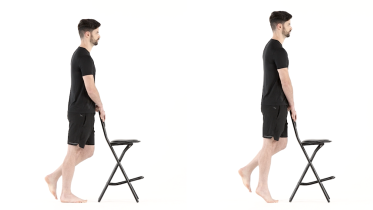 Bent-knee calf raise
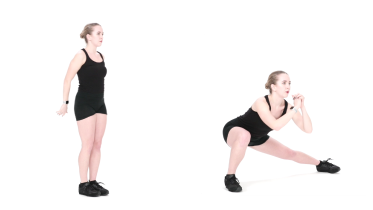 Lateral lunge
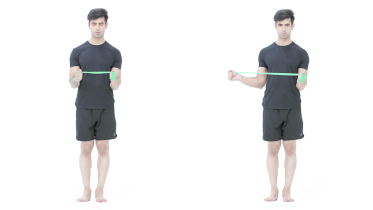 Shoulder external rotation with band
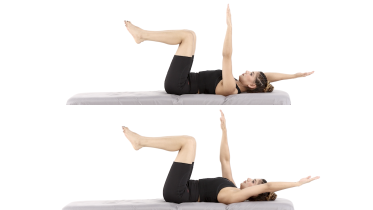 Dead bug
Every exercise page carries its own precautions, and those come before anything in this paragraph. Keep a sturdy chair or a counter within reach for the calf raises, and keep your hand on it throughout if your balance is poor or you have had falls. Single leg calf raises come at a set stage of rehab after an Achilles tendon repair or ankle surgery, so wait until your surgeon's protocol and your physio say you are ready for them. With the lateral lunge, start with a short step and a shallow bend if your groin has been sore, and go wider and lower only once that feels steady.
Band external rotation is done with the elbow tucked against your side, which is where most rotator cuff programs begin. The arm-up version at shoulder height, the one that looks like the top of a bandeja, is a later step and sits in the padel strength plan. After shoulder surgery, including a rotator cuff repair, or after a shoulder fracture or dislocation, follow your surgeon's or physio's plan, and do only the movements and range they have cleared. If you are pregnant and past the first three months, check with your physio before exercising flat on your back, which covers the dead bug. If you have high blood pressure, breathe steadily through every repetition and never hold your breath, and with a heart condition or high blood pressure, check with your doctor before you start.
If chest pain, pressure or tightness does not ease quickly when you rest, spreads to your arm, neck, jaw, stomach or back, or comes with sweating, feeling sick, feeling light-headed or being short of breath, call emergency services straight away, as this can be a heart attack. If it eases quickly and none of these happen, get medical advice the same day, and do not exercise again until you have been checked.
When to see a physio
Two weeks of the same soreness is the usual trigger for booking. So is a problem that returns reliably whenever you play two evenings in a row, and so is noticing that you have quietly rearranged your game around it. An ankle that has given way twice, a shoulder that has started waking you up, or a grip that has become painful off the court all move that appointment forward.
Most of a first session is spent watching you move. A physiotherapist will look at how far the ankle bends, what the shoulder does at the top of a bandeja, how the knee behaves when you push off sideways, and how tightly you hold a handle, then build the program around whichever of those is furthest behind. Take a note of what you have been playing, since the fortnight before a flare usually contains the explanation. The warning list below comes first, at whatever speed each line sets.
In this topic
- Padel, your shoulder and your lower back
The padel serve is underarm by rule, so the overhead load comes from the bandeja, the vibora and the smash. What that asks of a shoulder and a back.
- Common padel injuries
Where padel players report getting hurt, what kind of study each figure comes from, what builds slowly versus what arrives in one moment.
- Padel elbow: the tendon behind the nickname
Padel elbow is tennis elbow with a new name. What the racket, the overgrip and your playing week really change, and the program that treats it.
- A strength plan for padel players
Padel asks for lateral pushes, stops and overheads. A twice weekly home strength session built around that, with what the evidence does not say.
- Warming up for padel
A 10 minute padel warm-up for club players, what the evidence really says about warming up, where stretching fits, and when to stop and get help.
Related exercise programs
- Tennis elbow
- Rotator cuff tendinopathy
- Patellofemoral pain
- Ankle sprain
- Achilles tendinopathy
- Low back pain
See a doctor promptly if
- Emergency: if chest pain, pressure or tightness does not ease quickly when you rest, spreads to your arm, neck, jaw, stomach or back, or comes with sweating, feeling sick, feeling light-headed or being short of breath, call emergency services straight away, as this can be a heart attack. If it eases quickly and none of these happen, get medical advice the same day, and do not exercise again until you have been checked.
- Emergency: any sign of a stroke, even if it goes away. That means a face that droops on one side, an arm you cannot lift or keep up, slurred or muddled speech, weakness or numbness on one side of your body or face, sudden blurred vision, double vision or loss of sight, trouble swallowing, sudden dizziness with unsteadiness or falling over, a sudden severe headache, or a sudden fall where your legs give way but you do not black out (a drop attack). Call emergency services straight away.
- Emergency: after a ball, a racket, a collision or a fall to the face, any change to your sight, severe pain in the eye, a headache or finding light hard to bear, feeling sick or being sick, an eye you cannot move or keep open, or blood or pus coming from the eye. The same applies if something has pierced the eye or hit it at high speed, or if a strong chemical has gone into it. Go to an emergency department or call emergency services straight away, and do not drive yourself.
- Emergency: after a knock to the head, being very drowsy or finding it hard to keep your eyes open, confusion, a fit (seizure), new weakness or numbness anywhere in your body, new trouble understanding, speaking, walking or keeping your balance, new problems seeing or hearing, clear fluid coming from your ears or nose, bleeding from your ears or bruising behind them, a black eye when your eye was not hit, a dent in your head or a wound with something stuck in it, or a change in behavior. Call emergency services straight away. These can be signs of an injury to the brain.
- Emergency: after a knock to the head, you were knocked out, even for a moment, you cannot remember what happened just before or after, you have had a headache ever since, or you are being sick (vomiting). The same applies, even if you feel fine, if you take medicine that thins your blood, other than aspirin on its own, have a bleeding or clotting condition, have had brain surgery in the past, or had been drinking alcohol or taking drugs when it happened. Go to an emergency department straight away, and do not drive yourself.
- Emergency: the shoulder feels as if it has slipped out of place, looks a different shape or suddenly locks so you cannot move the arm, or the pain is severe after a fall or an injury. Go to an emergency department straight away, without driving yourself, and do not try to put the shoulder back in yourself.
- Emergency: your arm, hand or fingers turn cold, pale, blue or gray compared with the other side. Call emergency services or go to an emergency department straight away, and do not drive yourself. The blood supply to the arm may be blocked.
- Emergency: the knee became very swollen very quickly, within a few hours of a twist, fall or blow, or you felt a pop or snap. Go to an emergency department straight away. Do not drive yourself: ask someone to drive you or call an ambulance. A knee that fills up that fast has usually bled inside the joint, which can come from a torn ligament, a kneecap that slipped out or a break, so it needs checking before you play again.
- Emergency: the ankle or foot looks deformed or out of place, you heard a crack when you were injured, or the foot is numb, tingling, cold, pale or blue. Go to an emergency department straight away.
- Same day: a sudden pop or snap at the back of your ankle or heel, a feeling that someone kicked you there, or sudden pain there after which you cannot push off or rise onto your toes on that leg. Stop, take the weight off that leg carefully and go to an urgent care center or emergency department the same day, even if you can still walk, as this can be a torn Achilles tendon.
- Same day: you cannot walk or put weight on the leg, or you have very bad knee pain after a fall or injury. Get medical advice the same day.
- Same day: a calf or thigh that is newly swollen, warm, tender, red or darker than usual, has swollen veins that are sore to touch, or has a throbbing or cramping pain that does not fit your injury or condition, or that feels different from normal muscle soreness after exercise. This can be a sign of a blood clot (deep vein thrombosis), especially after surgery, an injury, time in a cast or boot, a long trip or a spell of being much less mobile than usual. Get medical advice the same day. If you are also short of breath or have chest pain, call emergency services.
- Within a few days: the pain is there at night or at rest and keeps getting worse. See your doctor within a few days. If you have had cancer, now or in the past, or are losing weight without trying, see your doctor sooner, within a day or two, and mention it. This applies even if the pain is not getting worse. If you are being treated for cancer now, contact your cancer team the same day.
Common questions
Is padel bad for your elbow?
The elbow is the part of a padel player that complains most, though no study has followed players and non-players to say the sport caused it. The 2023 systematic review brought together 8 studies and 2,022 players and found that every one of the five studies reporting individual joints put the elbow first, at figures from 20.5% to 74.4% that are not comparable with each other, since some count the elbow's share of the injuries reported and others the percentage of players who named the elbow at all. One of those five asked only about the upper body, so it could not have found anything else. In the review's own words it was not possible to pick out one commonest diagnosis, though tendinopathy of the common extensor tendon, the thing people call tennis elbow, was reported most often across the studies (Dahmen and colleagues, 2023, tables 3 and 4); none of that is a chance of it happening to you. The padel elbow page works through what the racket, the grip and your playing week do and do not change, and the tennis elbow program is the treatment, because the tissue and the plan are the same whichever sport brought it on.
Is padel harder on the body than tennis?
Nobody has compared them properly, so the truthful reply is that nobody knows. A fair comparison needs the same injury definition, the same recall period and the hours played by everyone in both sports, and no padel study has collected the last of those. What can be said is that the two games ask for different things. Padel takes place on a court of 20 m by 10 m against a tennis court of 23.77 m by 10.97 m, so there is less ground to cover but far less time to cover it, the walls send the ball back to you instead of ending the point, and the serve is struck underarm at or below waist level after a bounce rather than overhead (Federación Internacional de Pádel, rule 6; LTA). If you have moved across from tennis, expect your legs to be surprised by the short, repeated pushes long before your serving shoulder notices anything.
How many times a week can I play padel without getting hurt?
There is no number, and the one survey that looked for a link found something that should make everyone cautious about answering. Among 457 Belgian recreational players, less padel experience was independently associated with having been injured in the previous year, and so, oddly, were carrying out a warm-up and using an overgrip, alongside age over 30, insomnia, playing on the right side and not playing another racket sport (Declève and colleagues, 2025). A retrospective survey cannot say which came first: players who keep getting hurt are exactly the players who start warming up and who wrap the handle. It is not a reason to skip a warm-up, and this page does not read it as one. What clinicians watch instead is change, because tendons and calves object to a jump rather than to a total, so the week that matters is usually the one where you went from two sessions to five or added a weekend tournament.
Should I wear eye protection for padel?
One Spanish survey inside the 2023 systematic review recorded eye contusion as 1.7% of the injuries its players reported, and that single line is close to the whole padel literature on eyes (Dahmen and colleagues, 2023, table 4). It cannot tell you how often a ball finds an eye, nobody has tested eyewear in this sport, and this page will not pretend otherwise. The reason the eye warning is on the page at all is the consequence rather than the frequency: a court this size puts four players, a hard ball, glass walls and a metal cage inside 200 square meters, and a ball or a partner's racket to the face is something club players see. If it happens, treat these as an emergency, whatever the eye looks like from the outside: after a ball, a racket, a collision or a fall to the face, any change to your sight, severe pain in the eye, a headache or finding light hard to bear, feeling sick or being sick, an eye you cannot move or keep open, or blood or pus coming from the eye. The same applies if something has pierced the eye or hit it at high speed, or if a strong chemical has gone into it. Go to an emergency department or call emergency services straight away, and do not drive yourself. Wearing protective eyewear is a personal choice with no padel evidence either way, and it is not a substitute for looking before you swing in a corner.
Is padel safe to start in your fifties?
For most people it is exercise, and that is worth having at any age. The players in the research are not young: the systematic review covered studies with mean ages from 31 to 57, the Belgian survey had a median age of 42, and the Chilean one a mean of 37.4 (Dahmen 2023; Declève 2025; Belmar-Arriagada 2025). Two cautions apply more in this decade than in the one before. If you have a heart condition, high blood pressure, or symptoms you have never had looked at, see your doctor before the first session rather than after it, and build your playing days up in steps instead of accepting every invitation in week one.
References
- Dahmen J, Emanuel KS, Fontanellas-Fes A, Verhagen E, Kerkhoffs GMMJ, Pluim BM. Incidence, prevalence and nature of injuries in padel: a systematic review. BMJ Open Sport and Exercise Medicine. 2023;9(2):e001607. https://doi.org/10.1136/bmjsem-2023-001607
- Declève P, Nourissat G, Neyens D, Cools A, Borms D. Prevalence and injury profiles for recreational padel players: a cross-sectional survey-based study. Physical Therapy in Sport. 2025;75:8-14. https://doi.org/10.1016/j.ptsp.2025.07.002
- Belmar-Arriagada H, Gajardo-Burgos R, Armstrong R, Bascour-Sandoval C. Padel related injuries: prevalence and characteristics in Chilean amateur players, a cross sectional analytic study. BMC Sports Science, Medicine and Rehabilitation. 2025;17:173. https://doi.org/10.1186/s13102-025-01141-2
- Muñoz D, Coronado M, Robles-Gil MC, Martín M, Escudero-Tena A. Incidence of upper body injuries in amateur padel players. International Journal of Environmental Research and Public Health. 2022;19(24):16858. https://doi.org/10.3390/ijerph192416858
- Ungureanu AN, Lupo C, Brustio PR. Padel match analysis: notational and time-motion analysis during official Italian sub-elite competitions. International Journal of Environmental Research and Public Health. 2022;19(14):8386. https://doi.org/10.3390/ijerph19148386
- Martín-Miguel I, Almonacid B, Muñoz D, Sánchez-Alcaraz BJ, Courel-Ibáñez J. Game dynamics in professional padel: shots per point, point pace and technical actions. Sports. 2024;12(8):218. https://doi.org/10.3390/sports12080218
- Goossens L, Ramos-Munell J, Fernández-de-Osso AI, Ceballos-Sánchez JL. Translating injury prevention evidence into safer padel: protocol of a TRIPP-guided scoping review. PLOS One. 2026;21(7):e0352442. https://doi.org/10.1371/journal.pone.0352442
- Lauersen JB, Andersen TE, Andersen LB. Strength training as superior, dose-dependent and safe prevention of acute and overuse sports injuries: a systematic review, qualitative analysis and meta-analysis. British Journal of Sports Medicine. 2018;52(24):1557-1563. https://doi.org/10.1136/bjsports-2018-099078
- Federación Internacional de Pádel. Rules of Padel. Review of application 01.01.2026. Accessed 1 October 2026. https://www.padelfip.com/rules-of-padel/
- LTA. Padel rules. Accessed 1 October 2026. https://www.ltapadel.org.uk/play/how-to-get-started-playing-padel/rules/
- LTA. Padel vs tennis. Accessed 1 October 2026. https://www.ltapadel.org.uk/play/padel-vs-tennis/
- NHS. Chest pain. Page last reviewed 8 August 2023. https://www.nhs.uk/symptoms/chest-pain/
- NHS. Symptoms of a stroke. Page last reviewed 12 September 2024. https://www.nhs.uk/conditions/stroke/symptoms/
- NHS. Eye injuries. Page last reviewed 12 March 2026. https://www.nhs.uk/conditions/eye-injuries/
- NHS. Head injury and concussion. Page last reviewed 29 May 2025. https://www.nhs.uk/conditions/head-injury-and-concussion/
- NHS. Dislocated shoulder. Page last reviewed 16 September 2026. https://www.nhs.uk/conditions/dislocated-shoulder/
- NHS. Knee pain. Page last reviewed 21 December 2023. https://www.nhs.uk/symptoms/knee-pain/
- NHS. Tendonitis. Page last reviewed 9 June 2023. https://www.nhs.uk/conditions/tendonitis/
- NHS. DVT (deep vein thrombosis). Page last reviewed 30 April 2026. https://www.nhs.uk/conditions/deep-vein-thrombosis-dvt/
Written and checked by the PocketPhysio editorial team. Last updated 2026-10-02.
This page is general education, not a diagnosis or a personal treatment plan. See a physiotherapist or doctor for advice about your own situation.