
Part of Padel injuries and how to keep playing
Warming up for padel
Start with the honest part
Two things get claimed for a warm-up, and only one of them is settled. Changing how a body moves in the first few minutes is easy to believe and easy to feel. Preventing injury is a separate claim, and in padel it rests on nothing.
The protocol for a 2026 scoping review of padel injury prevention says so directly: the sport has no consensus guidelines and no official primary prevention protocols from the International Padel Federation or from its national federations (Goossens 2026). Nobody has put padel players through a warm-up program and counted what happened to them.
Outside the sport the evidence is narrow rather than absent. Nine studies, six of them randomized controlled trials and three controlled clinical trials, tested neuromuscular warm-up programs and reported fewer lower limb injuries in young amateur female athletes and in male and female military recruits (Herman 2012). Seven of the nine enrolled women only, and every one of them ran in team sport or army training. So it is fair evidence that warming up does something. It says nothing about a glass box with four club players in it.
What the first game actually asks for
Padel is a sideways game in an enclosed court, played off the glass in short bursts. Because the walls keep the ball alive, a rally lasts longer than the first shot suggests, and it keeps asking you to stop low and push off again.
The professional game has been counted, and club padel is a slower version of the same pattern. Across 20 World Padel Tour matches and 3,239 points, men's points ran 13.5 to 14.8 seconds with 10 to 11 hits in them, and women's ran 14.4 to 16.2 seconds with a similar hit count (Martin-Miguel 2024). The same study counted the share of points containing a given shot at least once: lobs in 76 to 86 percent, bandejas in 44 to 48 percent of men's points and 60 to 66 percent of women's, flat smashes in about a fifth to a third. So the arm goes up high in a good share of rallies rather than now and then, and that is the part of the game nothing else in your week rehearses.
Ten minutes before all that, you were in a car. Closing that gap is the job a warm-up is really doing.
How do you warm up for padel?
Get warm: 2 to 4 minutes
Jog on the spot, or walk a lap of the club while the fourth player parks. What you want is mild warmth and breathing you can hear, nothing beyond that. Picking up a racket while you are still cold makes most of what follows pointless.
Open the ranges padel uses: 3 to 5 minutes
Next, move each joint slowly and unloaded toward the edge of the range the game will use. Hips go wide and across. Ankles bend under a flexed knee. The mid back turns, and the arms travel up a wall toward the overhead position.
Stay smooth, and stay inside a range that does not bite. Anything on one leg is done with a hand on a post, a bench or a partner's shoulder.
Take it onto the court: 2 to 3 minutes
Now rehearse padel itself, slowly at first. Soft volleys and easy drives, then a few balls deliberately let through to the back glass, so that you have turned your back on the net once before the score matters. Two or three overhead reaches without a full swing come next, and only then match pace. Most club players skip this third part, and it is the one that rehearses the movements the game hits you with hardest.
Short stretches before, long ones after
Numbers settle this better than the argument in the car park does. In a review of the acute effects, static stretching held for 60 seconds or less per muscle group changed the strength and power that followed by around 1 to 2 percent, which is trivial, while holds longer than 60 seconds brought falls of roughly 4 to 7.5 percent (Chaabene 2019). That trivial figure holds whether the short stretch stands alone or sits inside a full warm-up with aerobic and dynamic work around it. For the longer holds the review cites a single study in which sport-specific work afterward removed the deficit, which is one study and not a plan.
So hold nothing for a full minute before you play, put any stretch after you are already warm, and move again before the first point. The long stretches for your groin and calves belong at the end of the session, when a drop in power costs you nothing.
Cold courts and a second match
An outdoor court in Stockholm in February is a different proposition from an indoor club in Malaga in June. The answer is more minutes rather than more effort: lengthen the first part, keep a layer on until you are properly warm, and take the on-court rehearsal slower than feels necessary.
A second match on the same day needs less. Five minutes of easy movement and a few shots will do if you have not cooled down, and rather more if you have been sitting in the clubhouse for an hour.
Stiffness in a hip, knee or shoulder that lasts the first half hour of every morning is a separate problem, and no amount of warming up will sort it out. Get it looked at rather than spending another season working through it.
What to notice afterward
Soreness that arrives a day or two later, spreads through a muscle and then fades is the ordinary kind. Pain that is sharper the morning after than it was on court, or that sits in one small spot, is the kind worth acting on. Our page on muscle soreness after exercise or injury separates the two in detail.
Exercises that can help
One to raise your temperature, three to open the ranges padel uses, and two to rehearse the footwork, in the sequence above. Jogging on the spot usually runs at 2 to 4 rounds of 30 seconds to 2 minutes at an easy pace, thoracic rotation at 8 to 10 slow repetitions on each side, wall angels at 1 to 3 sets of 8 to 12 slow repetitions, the lunge with twist at 2 to 3 sets of 6 to 10 on each leg, the grapevine at 2 to 4 rounds of 20 to 30 seconds traveling both ways, and skater hops at 2 to 3 sets of 10 to 20 hops, counting each landing. On court you will do fewer of each and move on faster. Each exercise page carries its own precautions and stop signs, so go through those before your first session. Your physio will adjust this.
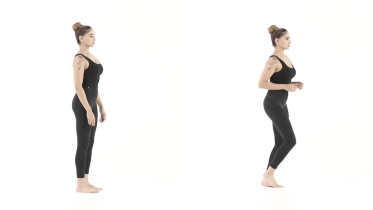 Jogging on the spot
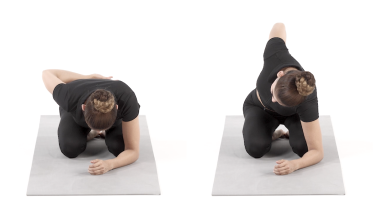 Thoracic rotation
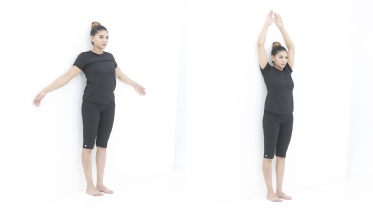 Wall angels
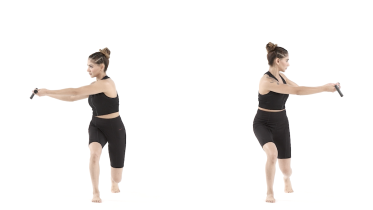 Lunge with twist
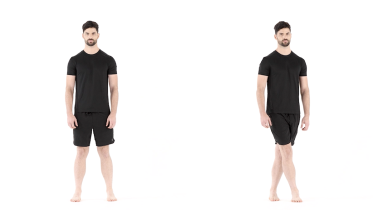 Grapevine drill
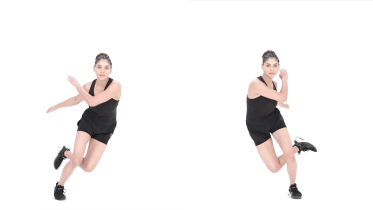 Skater hops
Some precautions first. Wear flat shoes that fit well and grip the floor, not socks, tights or bare feet. Have a fence post, a rail or a sturdy chair beside you for the grapevine, the lunge with twist and the skater hops. If you have low bone density (osteoporosis), have fallen in the past year, or often feel unsteady, keep a hand on that support, check with your physio before you let go, and learn the footwork drills indoors with someone else at home first.
Jogging on the spot and skater hops are impact work. Ask your doctor or physio before you start if you have a heart or lung condition, high blood pressure or osteoporosis, or are coming back from a leg injury or operation. The same applies if you notice urine leaking when you jog or hop. If you are pregnant or had a baby in the past months, talk to your midwife or physio first. Stop the hopping and speak to your physio if urine leaks while you are doing it, or if you feel pressure or heaviness low in your pelvis.
If you have had a hip or knee replacement, get the go-ahead from your surgeon or physio before you try jogging on the spot and skater hops. Many surgeons advise against running, jogging, jumping and hopping after a joint replacement for good, not just for the first months, because each step and each landing sends impact through the new joint. After any other hip, knee or ankle surgery, such as a ligament repair, ask your surgical team or physio before doing any hopping.
If you have had a hip replacement or other hip surgery, get the go-ahead from your surgeon or physio before you try the grapevine, the thoracic rotation and the lunge with twist. Crossing one leg in front of or behind the other takes that leg across the middle of your body, and sitting back toward your heels with your body leaned forward bends the hip well past a right angle, and many surgeons ask you to avoid both for the first months after some operations. The lunge with twist is a question of load rather than of position. Some operations limit this kind of work for the first months, so the timing depends on your surgery.
Two of these turn a loaded spine. With low bone density (osteoporosis) or a past fracture in the spine, check with your physio before you add the twist to the lunge, and ask how far to turn in the thoracic rotation, since twisting to the end of the range is usually limited. After a shoulder dislocation, shoulder surgery or a recent shoulder injury, ask your physio before you take the arms overhead in wall angels.
If you have high blood pressure, breathe steadily through every repetition and never hold your breath. With a heart condition or high blood pressure, check with your doctor before you start. Stop and sit down for chest pain or pressure, dizziness or feeling faint, a racing or irregular heartbeat, or being far more out of breath than the effort should cause. If chest pain, pressure or tightness does not ease quickly when you rest, spreads to your arm, neck, jaw, stomach or back, or comes with sweating, feeling sick, feeling light-headed or being short of breath, call emergency services straight away, as this can be a heart attack. If it eases quickly and none of these happen, get medical advice the same day, and do not exercise again until you have been checked.
When to see a physio
See someone when the warm-up stops feeling like a formality. Needing twenty minutes before a hip will bend, a calf that tightens in the first rally of every match, an arm that will not go overhead without a wince: none of those is a warm-up problem.
Come sooner if you have gone down on court even once, or if you have quietly stopped playing a shot because of how the last one felt. The padel hub has the rest of the picture, including what the injury research does and does not show. A physiotherapist can watch you lunge and reach overhead, work out which link is stiff or weak, and build the warm-up around that instead of handing you a general list. Go through the warning list below before you start, and follow the timing on each line.
Related exercise programs
See a doctor promptly if
- Emergency: if chest pain, pressure or tightness does not ease quickly when you rest, spreads to your arm, neck, jaw, stomach or back, or comes with sweating, feeling sick, feeling light-headed or being short of breath, call emergency services straight away, as this can be a heart attack. If it eases quickly and none of these happen, get medical advice the same day, and do not exercise again until you have been checked.
- Emergency: chest pain or tightness, which may spread to your arm, neck or jaw, or shoulder or arm pain that comes with shortness of breath, sweating or feeling sick. This can be a heart attack. Call emergency services straight away.
- Emergency: call emergency services straight away for any sign of a stroke, even if it goes away: sudden dizziness with unsteadiness or falling over, a face that droops on one side, an arm you cannot lift or keep up, slurred or muddled speech, weakness or numbness on one side of your body or face, sudden blurred vision, double vision or loss of sight, or a sudden severe headache.
- Emergency: after a ball, a racket, a collision or a fall to the face, any change to your sight, severe pain in the eye, a headache or finding light hard to bear, feeling sick or being sick, an eye you cannot move or keep open, or blood or pus coming from the eye. The same applies if something has pierced the eye or hit it at high speed, or if a strong chemical has gone into it. Go to an emergency department or call emergency services straight away, and do not drive yourself.
- Emergency: after a knock to the head, being very drowsy or finding it hard to keep your eyes open, confusion, a fit (seizure), new weakness or numbness anywhere in your body, new trouble understanding, speaking, walking or keeping your balance, new problems seeing or hearing, clear fluid coming from your ears or nose, bleeding from your ears or bruising behind them, a black eye when your eye was not hit, a dent in your head or a wound with something stuck in it, or a change in behavior. Call emergency services straight away. These can be signs of an injury to the brain.
- Emergency: after a knock to the head, you were knocked out, even for a moment, you cannot remember what happened just before or after, you have had a headache ever since, or you are being sick (vomiting). The same applies, even if you feel fine, if you take medicine that thins your blood, other than aspirin on its own, have a bleeding or clotting condition, have had brain surgery in the past, or had been drinking alcohol or taking drugs when it happened. Go to an emergency department straight away, and do not drive yourself.
- Emergency: you fell and cannot remember the fall or how it happened. Go to an emergency department straight away, and do not drive yourself. You may have blacked out or hit your head without knowing it.
- Emergency: you have had a fall or an injury and now have severe hip pain, or you cannot walk or put weight on the leg. Call emergency services or go to an emergency department. This can be a sign of a broken hip (hip fracture).
- Same day: a sudden pop or snap at the back of your ankle or heel, a feeling that someone kicked you there, or sudden pain there after which you cannot push off or rise onto your toes on that leg. Stop, take the weight off that leg carefully and go to an urgent care center or emergency department the same day, even if you can still walk, as this can be a torn Achilles tendon.
- Same day: sudden new dizziness, or feeling faint or unsteady, without any of the stroke signs above. Stop, sit down and get medical advice the same day. If you faint, it does not settle within a few minutes of sitting still, or you cannot stand or walk steadily, call emergency services.
- Same day: you blacked out or fainted, even for a moment. Get medical advice the same day. Call emergency services instead if the person cannot be woken within 1 minute, has not fully recovered or has trouble speaking or moving, has chest pain or a pounding, fluttering or irregular heartbeat, fainted while exercising or lying down, is shaking or jerking, or was badly hurt.
- Same day: pins and needles in your arm or hand that do not go away after you stop, or part of your arm or hand goes numb. Get medical advice the same day. If one side of your face or body suddenly goes numb or weak, or your speech becomes slurred or muddled, call emergency services, even if it goes away.
- Same day: new hip or groin pain after a fall, even a small one, if you are older, have low bone density (osteoporosis) or have taken steroid tablets for a long time, even if you can still walk. Get medical advice the same day. A broken hip is not always obvious at first.
- Same day: a calf or thigh that is newly swollen, warm, tender, red or darker than usual, has swollen veins that are sore to touch, or has a throbbing or cramping pain that does not fit your injury or condition, or that feels different from normal muscle soreness after exercise. This can be a sign of a blood clot (deep vein thrombosis), especially after surgery, an injury, time in a cast or boot, a long trip or a spell of being much less mobile than usual. Get medical advice the same day. If you are also short of breath or have chest pain, call emergency services.
Common questions
How long should you warm up before padel?
Ten minutes is enough for most club players, and the order matters more than the clock: temperature first, joint range second, court speed last. On a cold morning or an early indoor booking, add time at the front rather than rushing the end. The version that fails is treating the first two games as the warm-up, because that is when every padel movement arrives at once. The professional game shows the density involved: across 20 World Padel Tour matches and 3,239 points, men's points lasted 13.5 to 14.8 seconds with 10 to 11 hits, and women's 14.4 to 16.2 seconds (Martin-Miguel 2024). Club padel is slower than that, and the pattern of short, repeated efforts is the same.
Does warming up prevent padel injuries?
Nobody knows, because the study does not exist. A 2026 protocol for a scoping review of padel injury prevention states that padel has no consensus guidelines or official primary prevention protocols from the International Padel Federation or national federations, which is a fair summary of where the field sits (Goossens 2026). In other sports the picture is better but still narrow: a systematic review of neuromuscular warm-up programs found nine studies, six of them randomized controlled trials, with reduced lower limb injuries in young amateur female athletes and in male and female military recruits, and seven of the nine studied women only (Herman 2012). That is general evidence from football, basketball and army training, and nobody in any of those studies was playing padel, so treat it as a reason to warm up rather than as a promise. Do it because ten minutes costs you nothing and the alternative is sprinting cold.
Should you stretch before padel?
Keep them short and put them after you are already warm. The long held ones belong at the end of the session. A review of the acute effects found that static stretching of 60 seconds or less per muscle group has a trivial effect on the strength and power that follow, around 1 to 2 percent, while holds longer than 60 seconds produce falls of about 4 to 7.5 percent (Chaabene 2019). So keep a courtside hold well under a minute, do it once you are already warm, and always move again before the first point. The long calf, hip flexor and adductor holds belong after the last game, when a dip in power costs you nothing.
What should I warm up before a padel match?
The hips, the ankles, the mid back and the shoulders, in that order of time spent. Padel keeps you low and wide, so the hips and groin take the sideways work, and the ankles take the stop and the push off the glass. The mid back and shoulders need their turn because the bandeja and the smash send the arm overhead, which nothing else in the warm-up does. Finish on court: slow drop shots and drives, a few balls let through to the back glass so you rehearse turning and stepping in, then two or three easy overhead reaches without a full swing, then match pace.
Do I need to warm up for a social game?
A friendly game still opens with somebody hitting a ball you did not expect, off a wall, at an angle you have to turn for. Injury surveys in padel describe what tends to go wrong rather than how likely it is for you, and they agree with each other: in a systematic review of eight studies and 2,022 players, seven of the eight using self-administered questionnaires, the elbow came first, followed by the knee, shoulder and lower back, with tendon and muscle injuries the commonest types (Dahmen 2023). Five minutes will do for a relaxed morning. It is skipping it entirely that catches people out, whatever the format is called.
References
- Dahmen J, Emanuel KS, Fontanellas-Fes A, Verhagen E, Kerkhoffs GMMJ, Pluim BM. Incidence, prevalence and nature of injuries in padel: a systematic review. BMJ Open Sport and Exercise Medicine. 2023;9(2):e001607. https://doi.org/10.1136/bmjsem-2023-001607
- Belmar-Arriagada H, Gajardo-Burgos R, Armstrong R, Bascour-Sandoval C. Padel related injuries: prevalence and characteristics in chilean amateur players, a cross sectional analytic study. BMC Sports Science, Medicine and Rehabilitation. 2025;17:173. https://doi.org/10.1186/s13102-025-01141-2
- Goossens L, Ramos-Munell J, Fernandez-de-Osso AI, Ceballos-Sanchez JL. Translating injury prevention evidence into safer padel: protocol of a TRIPP-guided scoping review. PLOS One. 2026;21(7):e0352442. https://doi.org/10.1371/journal.pone.0352442
- Martin-Miguel I, Almonacid B, Munoz D, Sanchez-Alcaraz BJ, Courel-Ibanez J. Game dynamics in professional padel: shots per point, point pace and technical actions. Sports. 2024;12(8):218. https://doi.org/10.3390/sports12080218
- Herman K, Barton C, Malliaras P, Morrissey D. The effectiveness of neuromuscular warm-up strategies, that require no additional equipment, for preventing lower limb injuries during sports participation: a systematic review. BMC Medicine. 2012;10:75. https://doi.org/10.1186/1741-7015-10-75
- Chaabene H, Behm DG, Negra Y, Granacher U. Acute effects of static stretching on muscle strength and power: an attempt to clarify previous caveats. Frontiers in Physiology. 2019;10:1468. https://doi.org/10.3389/fphys.2019.01468
- Lawn Tennis Association. Padel FAQs. https://www.ltapadel.org.uk/play/padel-faqs/
- NHS. Chest pain. Page last reviewed 8 August 2023. https://www.nhs.uk/symptoms/chest-pain/
- NHS. Heart attack. Page last reviewed 31 March 2026. https://www.nhs.uk/conditions/heart-attack/
- NHS. Symptoms of a stroke. Page last reviewed 12 September 2024. https://www.nhs.uk/conditions/stroke/symptoms/
- NHS. Eye injuries. Page last reviewed 12 March 2026. https://www.nhs.uk/conditions/eye-injuries/
- NHS. Head injury and concussion. Page last reviewed 29 May 2025. https://www.nhs.uk/conditions/head-injury-and-concussion/
- NHS. Fainting. Page last reviewed 17 August 2026. https://www.nhs.uk/symptoms/fainting/
- NHS. Falls. Page last reviewed 6 March 2025. https://www.nhs.uk/conditions/falls/
- NHS. Tendonitis. Page last reviewed 9 June 2023. https://www.nhs.uk/conditions/tendonitis/
- NHS. DVT (deep vein thrombosis). Page last reviewed 30 April 2026. https://www.nhs.uk/conditions/deep-vein-thrombosis-dvt/
- NHS. Shoulder pain. Page last reviewed 22 May 2023. https://www.nhs.uk/symptoms/shoulder-pain/
Written and checked by the PocketPhysio editorial team. Last updated 2026-10-01.
This page is general education, not a diagnosis or a personal treatment plan. See a physiotherapist or doctor for advice about your own situation.