
Part of Padel injuries and how to keep playing
Padel, your shoulder and your lower back
The serve is not where the overhead load comes from
One rule decides most of this, and hardly anyone links it to their shoulder. The International Padel Federation's rules of padel say the server must bounce the ball on the ground to serve, must hit it at or below waist level, and must keep at least one foot in contact with the ground as they do (rule 6, The Service). That keeps the serving arm low, which is the opposite of the tennis or volleyball serve that gives shoulders a hard time.
When a player says serving is the shot that hurts, the useful next question is which other shots they hit. The smash is the one true above-the-head action in padel. The bandeja and the vibora sit just below it, arm high and the racket cutting across the ball, and going back for a lob adds a third demand, because the arm travels up and behind you while your feet are still moving.
Everything else in the game sits lower. Volleys at the net, drop shots and groundstrokes are played below head height, which is why a player who spends a morning at the net seldom blames a shoulder afterward. Alter the mix of shots and you alter the shoulder's workload without altering how long you play.
How often the overheads actually come
There are numbers for this, and they come from the professional game rather than from club play. Across 20 World Padel Tour matches and 3,239 points, the researchers counted the share of points containing each shot at least once. Bandejas appeared in 44 to 48 percent of men's points and 60 to 66 percent of women's, and flat smashes in roughly a fifth to a third, while lobs turned up in 76 to 86 percent (Martin-Miguel 2024).
Read that as a description of how the sport is played, not as a measure of load on your shoulder. This page quotes no measurement of rotator cuff load in a padel smash, so what follows is anatomy and clinical reasoning rather than a padel finding.
What an overhead asks of a shoulder
Four muscles wrap the top of the arm bone and make up the rotator cuff. They are not the engine of the swing. Their work is to hold the ball of the joint where it belongs in a shallow socket while the larger muscles throw the arm around.
That work splits in two inside a single overhead, and the second half is the demanding one. As the arm cocks back and turns out, the cuff is holding a joint together in the position where it has least mechanical advantage. Then the arm accelerates, hits the ball and has to be stopped, and stopping it means the cuff works while it lengthens. Braking is the part that shows up as next-day soreness, and in clinic it is usually where the weakness sits in a cuff that has not been trained.
None of this happens without the shoulder blade. The blade rotates upward and tilts back across the ribcage so the arm has somewhere to go, and the muscles holding it there run out of stamina on a long morning like everything else. How much that matters to a painful shoulder is less clear than it sounds, and guidelines have moved away from the old idea of a tendon being squeezed inside a narrowing gap. Our shoulder impingement program sets out why the label became subacromial pain.
Why the back gets involved on an enclosed court
An arched, turning trunk is part of every overhead. You are extending the spine and rotating it at speed, often while moving backward and reaching for a ball that is behind your head. Your feet have not finished arriving and the spine is already working.
Then there is the court itself. A padel court is 20 m long by 10 m wide with glass and wired mesh rebound walls, roughly 25 percent smaller than a tennis court. Because the walls are in play, a rally that would have ended in tennis carries on, and you spend it turning and dropping low, with your back organizing each shot on the move.
None of that makes padel bad for backs, and no study has shown that it is. It does explain why a player who adds two matches a week in April often notices the back before anything else.
What the padel injury numbers do and do not show
Shoulders and backs both appear in the published padel work. Not one of those studies can tell you your own odds.
A systematic review brought together eight studies and 2,022 players, mean age across studies 31 to 57, with seven of the eight collecting data by self-administered questionnaire and one by structured interview. Differences in injury definition and design made pooling impossible, so the review describes rather than adds up: the elbow was the most frequently reported site, followed by the knee, shoulder and lower back. Across individual studies the shoulder ran from about 7 to 34 percent and the lower back from about 9 to 27.5 percent, and those figures are not comparable with one another, because some studies report a share of the injuries counted and others the share of players who named that region (Dahmen 2023, table 3). The reviewers add that most included studies came from Spain, that injury definitions varied between them, and that study quality ran from relatively low to moderate.
A cross-sectional survey of club players adds a second view. Of 364 amateur padel players in southern Chile, average age 37.4 years, 196 (53.8 percent) reported a padel-related injury in the previous six months. Of the 184 who named a body region, shoulder and upper arm accounted for 15.2 percent and the lumbosacral spine for 6.0 percent, and of the 194 who described how the injury began, 56.2 percent said it came on gradually rather than suddenly (Belmar-Arriagada 2025, table 3).
All of it is a map of where trouble collects, and nothing more. Each study counted players who said they had been hurt, and none of them divided injuries by time spent on court, so a survey total cannot be converted into a risk for one person. The protocol for a 2026 scoping review of padel injury prevention makes a related point about the state of the field, noting that the sport has no consensus guidelines and no official primary prevention protocols from its international or national federations (Goossens 2026).
Can you play padel with a sore shoulder or a stiff back?
Changing which shots you play buys more comfort than most people expect. None of it has been trialed in padel, so treat the list as load management rather than proven prevention.
- Share the overheads. Agree with your partner that the healthier shoulder takes the balls above head height for the next few weeks.
- Choose the bandeja over the flat smash while a shoulder is grumbling. It is a lower, more controlled action, and it keeps you in the point.
- Let a lob bounce and play it off the glass where you can. Going backward and reaching upward in one movement is the hardest thing padel asks of a shoulder and a spine at the same time.
- Meet high balls in front of your body. A ball taken behind your head puts the arm in its most stretched position and arches the spine further than it needs to go.
- Plan the season, not the session. In clinic the change that turns up most often just before a sore shoulder is a third or fourth playing day.
- Do the shoulder and trunk work while everything feels fine. Starting it once the pain arrives is the commoner pattern and much the slower one.
Where the trouble is mostly about raising the arm, shoulder pain when lifting your arm explains what the arc of pain is telling you. Where it is the nights, shoulder pain at night deals with sleeping positions and the gentlest way in.
Exercises for a padel shoulder and back
Start with the cuff worked below shoulder height, add the shoulder blade muscles that let the arm travel overhead, then the stretch for the back of the shoulder. The last three open and control the spine that every overhead works through. Work below the height that pinches to begin with, and lift that ceiling gradually over weeks instead of inside a single session.
The night is your best gauge. Aching while you work is acceptable as long as the shoulder is quiet again within a few hours and your sleep is no worse than usual. Any sharp catch, or an ache that climbs from the first repetition to the last, means that exercise stops for today.
Exercises that can help
Two to load the cuff and the shoulder blade muscles, one stretch for the back of the shoulder, and three for the mid back and the lower back that the overheads work through. Usual starting points are 2 to 3 sets of 10 to 15 slow repetitions once a day with no weight in the hand, 2 to 3 sets of 8 to 12 with a hold of 3 to 5 seconds at the top once a day, a 20 to 30 second hold 2 to 3 times on each side once or twice a day, 5 to 10 slow repetitions with a short hold of a few seconds once or twice a day, 1 to 2 sets of 6 to 10 reps on each side, and 10 to 15 slow rolls to each side with a hold of 3 to 5 seconds at the end of each roll. Whatever each exercise page says takes precedence over this summary, and your physio will adjust this.
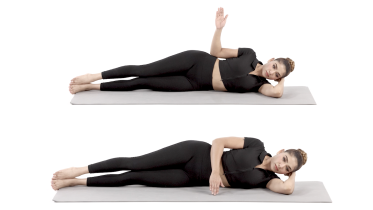 Side-lying external rotation
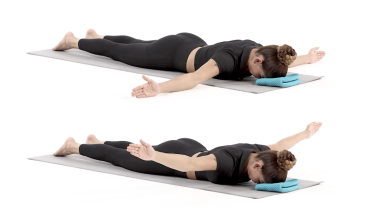 Prone T raise
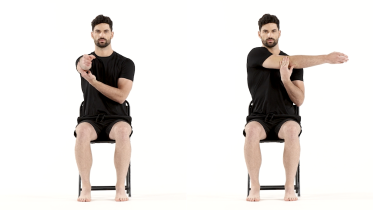 Cross body shoulder stretch
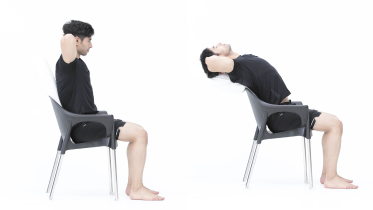 Thoracic extension over a chair
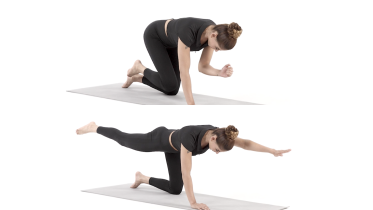 Bird dog
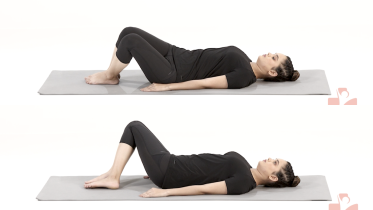 Lower trunk rotation
Set up before you start. You need a chair with a back high enough to reach your mid back, and a mat or carpet for the floor work. Getting down to the floor and back up again is part of the session, so roll onto your side and push up with your arms rather than curling straight up.
After shoulder surgery, including a rotator cuff repair, or after a shoulder fracture or dislocation, follow your surgeon's or physio's plan, and do only the movements and range they have cleared. Many plans allow only passive movement at first, where the arm is moved for you and its muscles stay relaxed. Turning the arm out against resistance, even the weight of your own forearm, is often held off for several weeks, and lifting both arms against gravity in the prone T usually comes later still, so ask your surgical team when each one may start.
If you have had a hip replacement, get the go-ahead from your surgeon or physio before you try side-lying external rotation and lower trunk rotation. Lying on your side lets the top leg slide forward or drop across the lower one, and rolling the knees over turns the upper hip inward and across the middle of your body, and many surgeons ask you to avoid that for the first months after some operations. A pillow between your knees helps keep the legs apart.
Low bone density changes three of these. If you have osteoporosis, a past fracture in the spine or ribs, or have had recent heart or chest surgery, check with your physio before you lean back over a chair edge, since they may keep the range small or offer a gentler version. Keep the trunk rolls small and gentle as well, because twisting to the end of the range is usually avoided, and use the simpler bird dog where the hand and knee go back to the floor after each reach. After back surgery, stay with that simpler version until your surgeon and physio say bending the spine is fine.
If you are pregnant, lying on your stomach usually stops being comfortable somewhere in the middle months, and your physio can give you a version of the prone T done sitting or leaning forward. If you are pregnant and past the first three months, check with your physio before exercising flat on your back.
Keep the cross body stretch light, because the pulling hand is far stronger than the shoulder it is pulling on, and speak to your physio first if that shoulder has slipped out before or feels loose. If you have high blood pressure, breathe steadily through every hold and never hold your breath. If chest pain, pressure or tightness does not ease quickly when you rest, spreads to your arm, neck, jaw, stomach or back, or comes with sweating, feeling sick, feeling light-headed or being short of breath, call emergency services straight away, as this can be a heart attack. If it eases quickly and none of these happen, get medical advice the same day, and do not exercise again until you have been checked.
The rotator cuff tendinopathy program covers the same shoulder ground in stages, and the low back pain program does the same for the back if that is the half giving you trouble.
When to see a physio
NHS advice is to see a doctor if shoulder pain is getting worse or has not improved after 2 weeks, or if moving the arm is very difficult, and to stay active and keep moving the shoulder in the meantime. For the back, the NHS advice is to stay active and carry on with daily activities, and to see a doctor if the pain is not improving after a few weeks or is stopping you doing what you normally do. Go sooner than either if an arm or a leg has been weak since an injury.
Some questions cannot be answered from a page. Is the arm held back by pain or by stiffness, does your neck reproduce any of it, and is the back genuinely stiff in extension or simply unhappy about load? A physiotherapist will separate those, put the trunk through the positions your overheads use, and then set a level the tissue can take this month. Take them the details that matter: your playing week, the shot that hurts, and what the shoulder or back does between midnight and six. Where you have had surgery, your surgical team decides when a new exercise starts, and the warning list below carries its own timings.
Related exercise programs
See a doctor promptly if
- Emergency: if chest pain, pressure or tightness does not ease quickly when you rest, spreads to your arm, neck, jaw, stomach or back, or comes with sweating, feeling sick, feeling light-headed or being short of breath, call emergency services straight away, as this can be a heart attack. If it eases quickly and none of these happen, get medical advice the same day, and do not exercise again until you have been checked.
- Emergency: chest pain or tightness, which may spread to your arm, neck or jaw, or shoulder or arm pain that comes with shortness of breath, sweating or feeling sick. This can be a heart attack. Call emergency services straight away.
- Emergency: any sign of a stroke, even if it goes away. That means a face that droops on one side, an arm you cannot lift or keep up, slurred or muddled speech, weakness or numbness on one side of your body or face, sudden blurred vision, double vision or loss of sight, trouble swallowing, sudden dizziness with unsteadiness or falling over, a sudden severe headache, or a sudden fall where your legs give way but you do not black out (a drop attack). Call emergency services straight away.
- Emergency: the shoulder feels as if it has slipped out of place, looks a different shape or suddenly locks so you cannot move the arm, or the pain is severe after a fall or an injury. Go to an emergency department straight away, without driving yourself, and do not try to put the shoulder back in yourself.
- Emergency: your arm, hand or fingers turn cold, pale, blue or gray compared with the other side. Call emergency services or go to an emergency department straight away, and do not drive yourself. The blood supply to the arm may be blocked.
- Emergency: after a fall or a blow to the shoulder or collarbone, bone is sticking out through the skin, the shoulder swells up very quickly, you are bleeding heavily, or you find it hard to breathe, have chest pain or cough up blood. Call emergency services straight away.
- Emergency: numbness, tingling or altered feeling around or under your genitals, between your inner thighs, or around your bottom (anus), for example it feels different when you wipe after using the toilet. Call emergency services or go to an emergency department straight away. This can be a sign of pressure on the bundle of nerves at the base of the spine (cauda equina syndrome), which needs emergency treatment.
- Emergency: you find it hard to start peeing, cannot pee, cannot feel yourself peeing or cannot control when you pee, or you do not notice when you need to poo or cannot control when you poo, and this is not normal for you. The same applies to a new change in how your genitals feel during sex, or new trouble getting an erection or ejaculating. Call emergency services or go to an emergency department straight away. These can also be signs of cauda equina syndrome.
- Emergency: sciatica in both legs, or pain, tingling, numbness or weakness in both legs. The same applies if you lose feeling in one leg. Call emergency services or go to an emergency department straight away.
- Emergency: back or leg pain that started after a serious accident, such as a car crash or a fall from a height, or back pain with chest pain. Call emergency services.
- Emergency: new neck or back pain after a fall, a knock or a jolt, even a minor one such as a trip or a sudden stop in a car, if you have a condition that stiffens the spine, such as ankylosing spondylitis. Call emergency services or go to an emergency department straight away, do not drive yourself, and tell the staff about your spine condition, so they keep your neck and back in their usual position. A stiff spine can break after a small injury, and the break is easy to miss at first. If the pain started straight after the injury, or you also have numbness, tingling or weakness in your arms or legs, keep still and call emergency services.
- Emergency: you have had cancer, now or in the past, and your back or neck pain feels like a tight band around your body, or comes with pain spreading down an arm or leg, weakness, numbness or pins and needles in your arms or legs, trouble walking, or trouble controlling your bladder or bowels. Call your cancer team's emergency number straight away, or go to an emergency department if you do not have one or cannot get through. This can be cancer pressing on the spinal cord (metastatic spinal cord compression), which needs treatment straight away.
- Same day: a leg or foot that is getting weaker, for example your foot drags, catches on the ground or slaps down when you walk (foot drop). Get medical advice the same day. If the weakness is getting worse by the hour, go to an emergency department.
- Same day: after a fall or a blow to the shoulder, the shoulder is very swollen or bruised, or you cannot use your arm normally. Get it checked the same day, as the collarbone or the top of the arm may be broken.
- Same day: the shoulder is hot, red and swollen, or you have a fever or feel unwell. This can be a joint infection. Go to an emergency department the same day.
- Same day: sudden, very bad shoulder pain, or you suddenly cannot lift or move your arm at all. Get medical help the same day.
- Same day: a sudden pop or tearing feeling in the shoulder that brings sharp pain, new weakness or trouble lifting the arm. Stop and contact your surgical team the same day, or get medical advice the same day if you have not had surgery.
- Same day: pins and needles or numbness in the arm that does not go away, no feeling in part of the arm, or weakness that is getting worse. Get medical advice the same day. For pain spreading down the arm from your neck, ask for an urgent appointment with your doctor. If one side of your face or body suddenly goes numb or weak, or your speech becomes slurred or muddled, call emergency services, even if it goes away.
- Same day: you feel dizzy, faint or unsteady. Stop and get medical advice the same day. If you faint, it does not settle within a few minutes of sitting still, or you cannot stand or walk steadily, call emergency services.
- Same day: severe pain that comes on suddenly or is getting worse quickly. Get medical advice the same day.
- Same day: back or leg pain with a fever, or you feel hot, cold, shivery or generally unwell. Get medical advice the same day, and go to an emergency department if you feel very unwell.
- Same day: back pain after a minor fall or strain if you are older, have low bone density (osteoporosis) or have taken steroid tablets for a long time. Get medical advice the same day.
- Same day: you have back pain and have lost weight without trying. Get medical advice the same day and mention the weight loss.
- Same day: new back pain and you have had cancer, now or in the past. Get medical advice the same day and mention your cancer history. If you are being treated for cancer now, contact your cancer team the same day.
- Within a day or two: severe pain in both shoulders that has come on recently. Ask for an urgent appointment with your doctor.
- Within a day or two: new shoulder pain and you have had cancer, now or in the past, or you are losing weight without trying. See your doctor within a day or two and mention it. If you are being treated for cancer now, contact your cancer team the same day.
- Within a few days: the pain started after a fall, a pull or another injury, especially if the arm has been weak since, for example you cannot lift it out to the side or hold it up. This can be a broken bone or a torn tendon. Ask for an urgent appointment with your doctor, within days rather than weeks, because UK shoulder surgeons advise urgent referral for a rotator cuff tear caused by an injury.
- Within a few days: you are over 50 and have aching and stiffness in both shoulders, often in the neck or hips too, that is worst in the morning and lasts more than 45 minutes after you get up. See your doctor within a few days, as this can be an inflammatory condition (polymyalgia rheumatica) rather than a rotator cuff problem. If you also get a new headache, pain or tenderness at your temples or on your scalp, or jaw pain when you eat or talk, get medical advice the same day, and if your vision changes, call emergency services.
- Within a few days: night pain is common with shoulder problems, but get checked within a few days if the pain is constant, no rest or change of position eases it at all, and it keeps getting worse. If you have had cancer, now or in the past, or are losing weight without trying, see your doctor sooner, within a day or two, and mention it. If you are being treated for cancer now, contact your cancer team the same day.
- Within a few days: back pain that is worse at night, or does not ease at all when you rest. See your doctor within a few days. If you have had cancer, now or in the past, or you have lost weight without trying, get medical advice the same day. If you are being treated for cancer now, contact your cancer team the same day.
Common questions
Why does my shoulder hurt after padel?
Usually because the overheads asked the rotator cuff for more than it had been doing lately, and the bill arrives the next morning rather than on court. The cuff works hardest with the arm above shoulder height, and hardest of all while it brakes the arm after contact, which is general shoulder biomechanics rather than a padel measurement, so an afternoon of smashes and bandejas is a different job from an hour of volleys at the net. Going back for a lob stacks a second demand on top, since the arm ends up high and behind you while your feet are still moving. An ache that lasts a day and then goes is normally a report on an unfamiliar workload. An ache that is bigger after every session, or that wakes you up, has stopped being adaptation and is worth an assessment.
Is the padel serve bad for your shoulder?
No, and that surprises most people arriving from tennis, because the padel serve is not an overhead action at all. The International Padel Federation's rules require the server to bounce the ball on the ground first and to strike it at or below waist level, with at least one foot in contact with the ground, which rules out the tennis-style action that asks most of a shoulder. That does not make serving free, since you may hit a hundred of them in a morning, but it makes the serve a question of repetition rather than of overhead load. Where the serve genuinely is the shot that hurts, it is worth having somebody watch how far you reach across your body and how much trunk rotation you are adding on top of it.
Why does my lower back hurt after padel?
Two features of the game put the back to work, and neither of them is the serve. The first is the overhead: a bandeja or a smash arches and turns the trunk at speed, often while you are moving backward and off balance. The second is the enclosure, because the walls keep the ball alive and you spend the rally chasing the ball into corners and hitting from low or twisted positions rather than from a stance you had time to set. The lower back shows up in the padel surveys somewhere between about 9 and 27.5 percent across the studies in one systematic review, and at 6.0 percent among the 184 injured Chilean amateurs who named a body region in a survey (Dahmen 2023, Belmar-Arriagada 2025). Every one of those figures is a count of what players reported, on a different definition each time, so read them as a picture of what gets sore rather than as your risk.
Should I stop hitting smashes if my shoulder hurts?
Cut them down before you cut them out. The NHS advises keeping a painful shoulder moving gently and staying active rather than stopping using it, while steering clear of whatever obviously makes it worse. In padel that usually looks like keeping your volleys and groundstrokes, parking the smash for a few weeks, and calling your partner across for anything above head height. Add them back one session at a time, once the shoulder leaves your nights alone and a light band rotation no longer catches. The NHS puts the threshold at 2 weeks, so a shoulder that is getting worse, or that has not improved after 2 weeks, is your cue to get it looked at rather than to serve out another month of hoping.
How long does padel shoulder pain take to settle?
Think in weeks, put a review date in the calendar, and stop checking it every morning. The NHS suggests seeing a doctor if shoulder pain is getting worse or has not improved after 2 weeks, or if moving the arm is very difficult, and it also says recovery can take 6 months or longer. So a slow answer is the ordinary answer here, not a sign that something has gone wrong. Tendon problems change gradually, which is why the first thing you notice is doing more rather than hurting less. A shoulder that has gone stiff as well as sore, where helping the arm up with your other hand gets it no further, is a different pattern with a different program and is worth checking early.
References
- Federacion Internacional de Padel. Rules of Padel. Review of application 01.01.2026.
- Lawn Tennis Association. Padel FAQs. https://www.ltapadel.org.uk/play/padel-faqs/
- Martin-Miguel I, Almonacid B, Munoz D, Sanchez-Alcaraz BJ, Courel-Ibanez J. Game dynamics in professional padel: shots per point, point pace and technical actions. Sports. 2024;12(8):218. https://doi.org/10.3390/sports12080218
- Dahmen J, Emanuel KS, Fontanellas-Fes A, Verhagen E, Kerkhoffs GMMJ, Pluim BM. Incidence, prevalence and nature of injuries in padel: a systematic review. BMJ Open Sport and Exercise Medicine. 2023;9(2):e001607. https://doi.org/10.1136/bmjsem-2023-001607
- Belmar-Arriagada H, Gajardo-Burgos R, Armstrong R, Bascour-Sandoval C. Padel related injuries: prevalence and characteristics in chilean amateur players, a cross sectional analytic study. BMC Sports Science, Medicine and Rehabilitation. 2025;17:173. https://doi.org/10.1186/s13102-025-01141-2
- Goossens L, Ramos-Munell J, Fernandez-de-Osso AI, Ceballos-Sanchez JL. Translating injury prevention evidence into safer padel: protocol of a TRIPP-guided scoping review. PLOS One. 2026;21(7):e0352442. https://doi.org/10.1371/journal.pone.0352442
- NHS. Shoulder pain. Page last reviewed 22 May 2023. https://www.nhs.uk/symptoms/shoulder-pain/
- NHS. Back pain. Page last reviewed 5 March 2026. https://www.nhs.uk/conditions/back-pain/
- NHS. Sciatica. Page last reviewed 3 December 2024. https://www.nhs.uk/conditions/sciatica/
- NHS. Osteoporosis. Page last reviewed 13 October 2022. https://www.nhs.uk/conditions/osteoporosis/
- NHS. Dislocated shoulder. Page last reviewed 16 September 2026. https://www.nhs.uk/conditions/dislocated-shoulder/
- NHS. Septic arthritis. Page last reviewed 3 September 2026. https://www.nhs.uk/conditions/septic-arthritis/
- NHS. Polymyalgia rheumatica. Page last reviewed 23 April 2023. https://www.nhs.uk/conditions/polymyalgia-rheumatica/
- NHS. Temporal arteritis. Page last reviewed 14 August 2023. https://www.nhs.uk/conditions/temporal-arteritis/
- NHS. Chest pain. Page last reviewed 8 August 2023. https://www.nhs.uk/symptoms/chest-pain/
- NHS. Heart attack. Page last reviewed 31 March 2026. https://www.nhs.uk/conditions/heart-attack/
- NHS. Symptoms of a stroke. Page last reviewed 12 September 2024. https://www.nhs.uk/conditions/stroke/symptoms/
Written and checked by the PocketPhysio editorial team. Last updated 2026-10-01.
This page is general education, not a diagnosis or a personal treatment plan. See a physiotherapist or doctor for advice about your own situation.