
Part of Padel injuries and how to keep playing
A strength plan for padel players
Six movements and a padel week
The same six every time, on 2 or 3 days of the week, working from the biggest muscles down: a split squat, a single leg heel raise, a slow hamstring lower, an adductor squeeze, a bent-over band row and a band rotation with the arm up at shoulder height.
Never two sessions back to back. Once the six are familiar the whole thing runs about half an hour, and the opening fortnight is shorter than that, because most of the time goes on where your feet and your back are rather than on what you are lifting. A minute between sets is about right, longer when a set has been hard, and what you are waiting for is your breathing rather than the clock.
Where the 2 days comes from
This number does not come from padel research. The UK Chief Medical Officers' physical activity guidelines ask adults to do muscle strengthening activities on at least 2 days a week, working the major muscle groups, and note that any strengthening activity is better than none. The same guidelines ask for at least 150 minutes of moderate intensity activity a week, which a couple of hours of padel goes a long way toward on its own.
That is a general population figure built from public health evidence. It is not a dose anyone has tested in racket sport players, and the guideline itself stops at two days rather than three. So two sessions you actually keep all year is the plan here, and a third is something a quiet month can absorb.
What nobody can promise you
Start with what has not been tested. No trial has put padel players on a strength program and then counted their injuries. The protocol for a 2026 scoping review of padel injury prevention states that the sport has no consensus guidelines and no official primary prevention protocols from the International Padel Federation or from its national federations (Goossens 2026). So anything sold as padel injury prevention is somebody's opinion, however confident the packaging.
The padel literature does describe what tends to get hurt, and the description is worth reading slowly. The 2023 systematic review is where it comes from: eight studies and 2,022 players, mean age across studies 31 to 57, and seven of the eight collected their data by self-administered questionnaire. Its authors judged a meta-analysis impossible, because injury definitions and designs differed too much, so what it reports is a list and not a pooled number: the elbow was the most frequently reported site, followed by the knee, shoulder and lower back, with tendon and muscle injuries the commonest tissue types (Dahmen 2023). Most of the included studies came from Spain, and study quality ran from relatively low to moderate.
One survey sits closer to a club player's week. Among 364 amateur padel players in southern Chile, average age 37.4 years, 196 of them (53.8 percent) reported a padel-related injury in the previous six months on an online self-report survey. Of the 184 who named a body region, the ankle and foot came first at 18.5 percent, the elbow and forearm and the shoulder and upper arm at 15.2 percent each, the knee at 13.6 percent, and the wrist and hand at 12.0 percent, with the lumbosacral spine at 6.0 percent. Of the 194 who described how the injury started, 56.2 percent said it came on gradually rather than suddenly (Belmar-Arriagada 2025, table 3). That is six months of remembering, from one group of players, with no count of hours on court underneath it, so nothing in there is your own risk.
None of that makes this session preventive. It does tell you which tissues the sport keeps asking for, and that is what the six movements are built around.
What each movement is there for
The split squat is the padel lunge with the feet nailed down. Every wide ball and every step in to take a ball early ends with one leg accepting the load, so training that position with a long, staggered stance is closer to the game than a two-legged squat.
Next is the single leg heel raise, which covers the push off and the stop. Your calf and Achilles take the first step out of the ready position and the last one back into it, and working one leg at a time shows up the side that has been doing less. A two-legged version hides exactly that.
The slow hamstring lower trains the back of the thigh while it lengthens, which is the part of the movement that slows a leg down. Padel asks for that every time you brake for a lob or turn out of the corner.
Then the groin, which is what the adductor squeeze is for. Low, wide positions load the inner thigh in a way that running never does, and a squeeze loads it without asking a sore joint to move.
The bent-over band row and the 90/90 band rotation are for the shoulder blade and the rotator cuff. The bandeja, the vibora and the smash send the arm overhead repeatedly, and the muscles that control the arm through that arc are the ones that fade over a long morning.
Weeks one to three: position before load
This list assumes no gym and no history of lifting. Every one of the six has an easier starting version described on its own page, and the first three weeks buy you technique rather than strength.
Starting deep and heavy is the usual mistake. A split squat can begin a quarter of the way down with a hand on the wall, and a heel raise can begin on two feet, shifting your weight onto the working leg at the top. For the row, choose a band that leaves your back still while your arms and shoulder blades move, and go lighter again on the 90/90 rotation so the last repetitions stay smooth.
In each session, pick one of the six and watch it closely. The rest will keep. Three weeks of that is dull work, and it is why the weight you add in week four lands on a movement you can control.
Knowing when a set is finished
End each set while the last repetition still looks like the first one. If the front knee drifts inward on the split squat, or the back rounds under the row, the set actually finished two repetitions earlier, whatever the plan on the page says.
A muscle that aches for a day or two after new work is behaving normally, and the ache settles as the pattern becomes familiar. Sharp pain inside a single repetition is a different message: stop that movement for the day. If a joint is more swollen or more painful the next morning, the session was too big, so drop back a rung and build again instead of abandoning the exercise. Where that line sits, and how little evidence sits behind the usual traffic light numbers, is the subject of our guide to the pain monitoring model.
Plan from the next morning, not from how the session felt at the time.
Adding load without losing the movement
Change one thing, and keep the change small. Repetitions first: work every set up to the top of its range and leave everything else where it is. A set next, then a harder version of the movement, and only then weight.
The six do not climb at the same pace. Depth comes before a dumbbell on the split squat. The heel raise goes from two feet to one and adds range off a step when your physio says the tendon is ready, while the hamstring lower gets slower before it gets an ankle weight. Band work moves to a firmer band or one pace further from the anchor, and the adductor squeeze buys hold time before anything else changes.
Step up only when two sessions in a row have felt comfortable, and treat a step that spoils your technique as a no: back a rung, a fortnight there, then try it again. Our guide to exercise progression works the same order through other programs with examples.
The week the league starts
Plans rarely fail on their own terms. They fail in the first week of the league, when every free evening turns into a match and the strength work disappears without anyone deciding to drop it.
Shrink it rather than skip it. Two sets of four movements will hold the habit together through a busy fortnight, and that is worth more than one immaculate week in February. Fix the session to something that already happens, a Monday evening or the hour after the school run, because a session that waits for a spare half hour will not happen in May.
Playing four or five days a week changes the sum. Those sessions belong in the same total as the matches: a leg that has had three padel mornings and two split squat sessions has had five hard days, and it does not care which two of them were called training.
Two things this session does not cover
Speed and changing direction are the obvious gap. Strength work will not teach a body to stop dead and turn inside a rally: that is court movement practice, kept at low intensity on its own day and built up over weeks.
The forearm and the elbow are left out on purpose. The elbow is the site the padel surveys report most often, and how much load a forearm will take depends on what that elbow is doing this week, which is a question for an assessment rather than for a page. If gripping the racket or hitting a backhand already hurts, get it looked at before you add anything for it. The padel elbow page covers that side, including where the loading starts once somebody has examined it.
Exercises that can help
All six in one session, in the order below: split squats commonly use 2 to 3 sets of 8 to 12 on each leg, a few times a week, often starting with a shorter range, and single leg heel raises start with 2 to 3 sets of 8 to 15 on each leg, a few days a week. The eccentric hamstring curl uses 2 to 3 sets of 8 to 12 slow lowers on each leg, each taking about 3 to 5 seconds, on 2 to 3 days a week with a rest day in between, and the adductor ball squeeze starts with holds of 5 to 10 seconds, repeated 5 to 10 times, once or twice a day. The bent-over band row commonly begins with 2 to 3 sets of 8 to 15, 2 to 3 times a week, using a band light enough that your back stays still, and the 90/90 external rotation uses a light band and 2 to 3 sets of 8 to 15 slow repetitions, once a day or a few days a week. Go through the technique notes and the stop signs on each exercise page before session one. Your physio will adjust this.
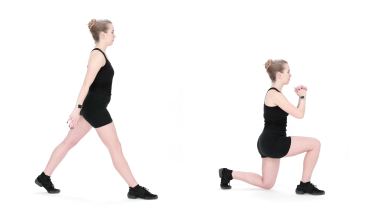 Split squat
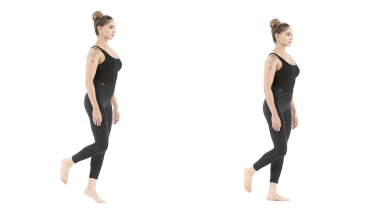 Single leg heel raise
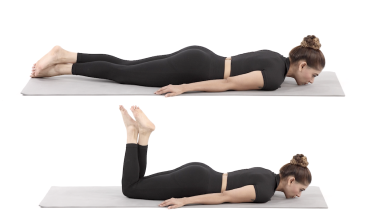 Eccentric hamstring curl
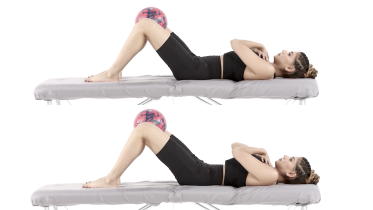 Adductor ball squeeze
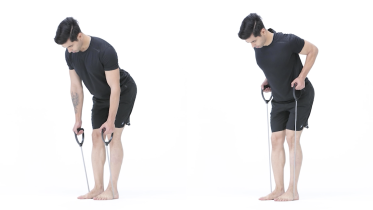 Bent-over band row
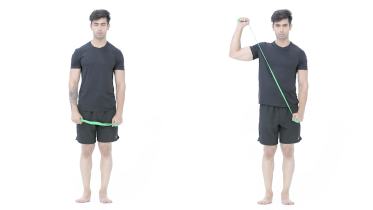 90/90 external rotation with band
Deal with the space before session one: a counter or a heavy chair that will not slide, with clear floor around it. Wear flat shoes that fit well and grip the floor, not socks, tights or bare feet. Keep fingertips on the support for the split squat and the heel raise until both feel steady.
If you have had a hip replacement or other hip surgery, get the go-ahead from your surgeon or physio before you try split squats and the adductor ball squeeze. Some operations limit this kind of work for the first months, so the timing depends on your surgery. After a knee fracture or knee surgery, including a knee replacement, follow your surgeon's or physio's plan, and start these exercises only when they have cleared you.
After any ankle problem the heel raise goes last in the queue. After an ankle fracture or ankle surgery, follow your surgeon's or physio's weight-bearing plan, and start this exercise only when they have cleared you, and after an Achilles repair the surgical protocol decides when single leg rises begin. If the tendon is clearly more sore the next morning, the last step was too big.
The hamstring lower comes later after a hamstring injury. Start it only when your physio says the muscle is ready, and ask your surgeon or physio first if you have had an ACL reconstruction that used a hamstring graft. The adductor squeeze puts effort through the joint at the front of the pelvis, so check with your physio before you start it if you are pregnant or have pain over the pubic bone. If you are pregnant and past the first three months, check with your physio before exercising flat on your back.
Look the band over before every row, and check whatever is holding it down. Bands tear at nicks and worn patches, and one that escapes from under a foot comes back at head height. If you have low bone density (osteoporosis), or your back is sore at the moment, ask your physio before the bent-over row, since leaning forward while you pull puts extra load through the spine. If you go ahead, keep your back straight throughout and never let it round under the pull.
After shoulder surgery, including a rotator cuff repair, or after a shoulder fracture or dislocation, follow your surgeon's or physio's plan, and do only the movements and range they have cleared. Many plans allow only passive movement at first, where the arm is moved for you and its muscles stay relaxed. The arm-up, turned-out position of the 90/90 rotation is the one where an unstable shoulder can feel as if it might slip, and it is often held back until later in rehab, so check with your physio before you try it. After a broken or dislocated elbow, or elbow surgery such as a tendon repair, follow your surgeon's or physio's plan, and start these exercises only when they have cleared you.
If you have high blood pressure, breathe steadily through every repetition and never hold your breath. With a heart condition or high blood pressure, check with your doctor before you start. Stop the session for chest pain or pressure, dizziness or feeling faint, a racing or irregular heartbeat, or being far more out of breath than the effort should cause. If chest pain, pressure or tightness does not ease quickly when you rest, spreads to your arm, neck, jaw, stomach or back, or comes with sweating, feeling sick, feeling light-headed or being short of breath, call emergency services straight away, as this can be a heart attack. If it eases quickly and none of these happen, get medical advice the same day, and do not exercise again until you have been checked.
When to see a physio
Book one appointment before session one if weights are new to you, if an old hip, knee, back or shoulder objects every time you add load, or if you have had surgery in the past year. All six starting points can be set in a single visit, and having them set saves a lot of guessing. If one of these six does not suit you, a physiotherapist can swap in something that asks the same muscles for the same job.
Come back when a niggle outlasts two sessions, when a month has gone by with nothing moving, or when you want your two legs compared with something better than your own impression. Where a surgical team is involved, what they say comes before anything here. Read the warning list below first, and follow the timing each line gives.
Related exercise programs
See a doctor promptly if
- Emergency: if chest pain, pressure or tightness does not ease quickly when you rest, spreads to your arm, neck, jaw, stomach or back, or comes with sweating, feeling sick, feeling light-headed or being short of breath, call emergency services straight away, as this can be a heart attack. If it eases quickly and none of these happen, get medical advice the same day, and do not exercise again until you have been checked.
- Emergency: chest pain or tightness, which may spread to your arm, neck or jaw, or shoulder or arm pain that comes with shortness of breath, sweating or feeling sick. This can be a heart attack. Call emergency services straight away.
- Emergency: any sign of a stroke, even if it goes away. That means a face that droops on one side, an arm you cannot lift or keep up, slurred or muddled speech, weakness or numbness on one side of your body or face, sudden blurred vision, double vision or loss of sight, trouble swallowing, sudden dizziness with unsteadiness or falling over, a sudden severe headache, or a sudden fall where your legs give way but you do not black out (a drop attack). Call emergency services straight away.
- Emergency: the shoulder feels as if it has slipped out of place, looks a different shape or suddenly locks so you cannot move the arm, or the pain is severe after a fall or an injury. Go to an emergency department straight away, without driving yourself, and do not try to put the shoulder back in yourself.
- Emergency: your arm, hand or fingers turn cold, pale, blue or gray compared with the other side. Call emergency services or go to an emergency department straight away, and do not drive yourself. The blood supply to the arm may be blocked.
- Emergency: pain, tingling, numbness or weakness in both legs, numbness or altered feeling around your genitals or bottom, or new trouble peeing or controlling your bladder or bowels. Call emergency services or go to an emergency department straight away. These can be signs of pressure on the nerves at the base of the spine (cauda equina syndrome).
- Same day: a sudden pop or snap at the back of your ankle or heel, a feeling that someone kicked you there, or sudden pain there after which you cannot push off or rise onto your toes on that leg. Stop, take the weight off that leg carefully and go to an urgent care center or emergency department the same day, even if you can still walk, as this can be a torn Achilles tendon.
- Same day: a sudden sharp pain, pop or snap at the back of your thigh. Stop straight away. If you then get large bruising spreading down the back of the thigh, a gap or dip you can feel, a stiff-legged walk, or clear weakness when you bend the knee, get assessed the same day at urgent care or an emergency department, as the tendon may have pulled away from the bone near the buttock.
- Same day: a sudden pop or tearing feeling in the shoulder that brings sharp pain, new weakness or trouble lifting the arm. Stop and contact your surgical team the same day, or get medical advice the same day if you have not had surgery.
- Same day: a sudden pop or snap at the front of your elbow, sudden sharp pain there, or the muscle at the front of your upper arm bunches up or changes shape. Stop and go to an urgent care center or emergency department the same day, even if you can still bend the elbow, as this can be a torn biceps tendon.
- Same day: pins and needles in your arm or hand that do not go away after you stop, or part of your arm or hand goes numb. Get medical advice the same day. If one side of your face or body suddenly goes numb or weak, or your speech becomes slurred or muddled, call emergency services, even if it goes away.
- Same day: a lump or bulge in your groin or upper thigh has become painful or tender, or you have a groin lump and a bloated tummy, you feel or are being sick, you are constipated, or you have a high temperature or feel hot, cold or shivery. This can be a hernia that has become trapped. Get medical help straight away, the same day, for example at urgent care or an emergency department. If the pain is severe or came on suddenly, you cannot poo or pass wind at all, you are vomiting blood or your vomit looks like coffee grounds, or you have suddenly become confused, call emergency services or go to an emergency department straight away.
- Same day: dizziness or feeling faint during or after exercise, without any of the emergency signs above. Stop the exercises and get medical advice the same day. If you faint, it does not settle within a few minutes of sitting still, or you cannot stand or walk steadily, call emergency services.
- Same day: a calf or thigh that is newly swollen, warm, tender, red or darker than usual, has swollen veins that are sore to touch, or has a throbbing or cramping pain that does not fit your injury or condition, or that feels different from normal muscle soreness after exercise. This can be a sign of a blood clot (deep vein thrombosis), especially after surgery, an injury, time in a cast or boot, a long trip or a spell of being much less mobile than usual. Get medical advice the same day. If you are also short of breath or have chest pain, call emergency services.
- Same day: back pain that comes on suddenly after lifting, bending, a cough or a sneeze, even without a fall, if you have low bone density (osteoporosis). Get medical advice the same day. This can be a sign of a broken bone in the spine (vertebral fracture). Stop the exercises until you have been checked.
- Same day: back pain after a minor fall or strain if you are older, have low bone density (osteoporosis) or have taken steroid tablets for a long time. Get medical advice the same day.
- Within a few days: sharp pain during an exercise, a joint that gives way, new swelling, or pain that is still worse a few days after you drop back a step. Stop that exercise and check with your physio before you do it again.
- Within a few days: the pain is there at night or at rest and keeps getting worse. See your doctor within a few days. If you have had cancer, now or in the past, or are losing weight without trying, see your doctor sooner, within a day or two, and mention it. This applies even if the pain is not getting worse. If you are being treated for cancer now, contact your cancer team the same day.
- Within 2 weeks: a lump in your groin or upper thigh that is not painful, especially one that gets bigger when you cough or sneeze and smaller when you lie down. This can be a hernia. Book an appointment with your doctor.
Common questions
How often should padel players do strength training?
Two days a week is the floor, and a third belongs in a quiet month rather than in a standing plan. The UK Chief Medical Officers' physical activity guidelines ask adults to do muscle strengthening activities on at least 2 days a week, and add that any strengthening activity is better than none. That is a general population figure drawn from public health evidence, not a dose anyone has tested in padel players, so read it as a minimum rather than a prescription. Put a rest day between two sessions, and count your court time as part of the week's load rather than as something separate. Your physio will adjust this.
Will strength training stop me getting injured playing padel?
That is not a claim anyone is in a position to make, because the trial has not been run. Padel players have never been randomized onto a strength program and followed for injuries, and the protocol for a 2026 scoping review of padel injury prevention reports that the sport has no consensus guidelines and no official primary prevention protocols from the International Padel Federation or from its national federations (Goossens 2026). What the padel literature does give you is a map of what tends to get hurt. A systematic review of eight studies and 2,022 players, seven of the eight using self-administered questionnaires, found the elbow most often reported, then the knee, shoulder and lower back, with tendon and muscle injuries leading the tissue types (Dahmen 2023). Those are counts of people who reported an injury, not a risk you can apply to yourself, so train because the game keeps asking these tissues for work, and treat injury rates in padel as unmeasured.
Can I lift on the same day I play padel?
Yes. Padel goes first if both land on the same day, since legs that have just done split squats will not thank you for a sprint into the back corner. A day with no court booked is easier to protect, and the heavier leg work wants about 48 hours between it and a tournament or a league night. If there are already four padel mornings in your week, keep the strength work to two short sessions and let the court time carry the rest.
Do I need a gym for this?
No. The list needs a resistance band, a door anchor or a solid rail at about waist height, a small ball or a rolled towel for the adductor squeeze, and something sturdy to stand next to. Weight comes later and in small steps: a light dumbbell in each hand for the split squat, and an ankle weight for the hamstring lower once your physio says the timing is right. A 1 kg (2.2 lb) ankle weight is a bigger jump than it sounds on a slow lowering exercise, so that one is worth asking about rather than guessing. You will want a gym the month the heaviest thing in the house stops feeling heavy, and for most people that is a long way off.
How long before I notice it on court?
8 to 12 weeks is a fair trial, and what you watch matters as much as how long you wait. Ordinary jobs change first: a low car seat, a flight of stairs with shopping in both hands. On court the usual report is that the push back to the middle after a wide ball costs less, since that movement asks one leg to take a load and then send you the other way. Nothing on this page has been measured against padel performance, so judge it on how you move rather than on results.
What about my forearm and elbow?
Leave those out of this session and treat them separately. The elbow is the most frequently reported injury site in the padel surveys, and forearm loading is usually built around what your elbow is doing now, which is a different question from a general strength session. If your elbow already hurts on the backhand or when you grip the racket, get it assessed before you add grip or wrist work, because the starting load depends on how irritable it is. Our padel elbow page is where that loading is set out.
References
- Department of Health and Social Care. UK Chief Medical Officers' physical activity guidelines. Updated 10 July 2026. https://www.gov.uk/government/publications/physical-activity-guidelines-uk-chief-medical-officers-report/uk-chief-medical-officers-physical-activity-guidelines
- Dahmen J, Emanuel KS, Fontanellas-Fes A, Verhagen E, Kerkhoffs GMMJ, Pluim BM. Incidence, prevalence and nature of injuries in padel: a systematic review. BMJ Open Sport and Exercise Medicine. 2023;9(2):e001607. https://doi.org/10.1136/bmjsem-2023-001607
- Belmar-Arriagada H, Gajardo-Burgos R, Armstrong R, Bascour-Sandoval C. Padel related injuries: prevalence and characteristics in chilean amateur players, a cross sectional analytic study. BMC Sports Science, Medicine and Rehabilitation. 2025;17:173. https://doi.org/10.1186/s13102-025-01141-2
- Goossens L, Ramos-Munell J, Fernandez-de-Osso AI, Ceballos-Sanchez JL. Translating injury prevention evidence into safer padel: protocol of a TRIPP-guided scoping review. PLOS One. 2026;21(7):e0352442. https://doi.org/10.1371/journal.pone.0352442
- Martin-Miguel I, Almonacid B, Munoz D, Sanchez-Alcaraz BJ, Courel-Ibanez J. Game dynamics in professional padel: shots per point, point pace and technical actions. Sports. 2024;12(8):218. https://doi.org/10.3390/sports12080218
- Lawn Tennis Association. Padel FAQs. https://www.ltapadel.org.uk/play/padel-faqs/
- NHS. Chest pain. Page last reviewed 8 August 2023. https://www.nhs.uk/symptoms/chest-pain/
- NHS. Heart attack. Page last reviewed 31 March 2026. https://www.nhs.uk/conditions/heart-attack/
- NHS. Symptoms of a stroke. Page last reviewed 12 September 2024. https://www.nhs.uk/conditions/stroke/symptoms/
- NHS. Dislocated shoulder. Page last reviewed 16 September 2026. https://www.nhs.uk/conditions/dislocated-shoulder/
- NHS. Shoulder pain. Page last reviewed 22 May 2023. https://www.nhs.uk/symptoms/shoulder-pain/
- NHS. Sciatica. Page last reviewed 3 December 2024. https://www.nhs.uk/conditions/sciatica/
- NHS. Back pain. Page last reviewed 5 March 2026. https://www.nhs.uk/conditions/back-pain/
- NHS. Tendonitis. Page last reviewed 9 June 2023. https://www.nhs.uk/conditions/tendonitis/
- NHS. DVT (deep vein thrombosis). Page last reviewed 30 April 2026. https://www.nhs.uk/conditions/deep-vein-thrombosis-dvt/
- NHS. Fainting. Page last reviewed 17 August 2026. https://www.nhs.uk/symptoms/fainting/
- NHS. Hernia. Page last reviewed 19 May 2026. https://www.nhs.uk/conditions/hernia/
- NHS. Osteoporosis. Page last reviewed 13 October 2022. https://www.nhs.uk/conditions/osteoporosis/
Written and checked by the PocketPhysio editorial team. Last updated 2026-10-01.
This page is general education, not a diagnosis or a personal treatment plan. See a physiotherapist or doctor for advice about your own situation.