
Part of TMJ disorder
Jaw pain on one side: is it TMJ, a tooth or something else?
Warning signs, and when to get help
Why does my jaw hurt on one side?
Two answers cover most of it: the jaw joint and the chewing muscles on that side, which is temporomandibular disorder or TMD, or a tooth. Which of the two you have decides what you do this week, so most of what follows is about telling them apart.
First, though, the short list that is not the jaw at all, because for these, reading on is the wrong thing to do. Jaw, neck, shoulder or arm pain that comes with chest pain or tightness, sweating, feeling sick, light-headedness or breathlessness, or that comes on when you exert yourself, feel stressed or go out in the cold and does not ease within a few minutes of rest, can be a heart attack or angina. Call emergency services. Any sign of a stroke is the same, and so is new one-sided pain in the face, jaw or neck with a drooping eyelid, a smaller pupil on that side, or a new pulsing or whooshing sound in one ear.
A swollen face or jaw with difficulty breathing, speaking, swallowing or opening your mouth can be a spreading infection: call emergency services or go to an emergency department straight away, and do not drive yourself. And if you are 50 or over and a new ache comes on while you chew or talk and eases when you stop, get medical advice the same day, because inflamed arteries in the head can present exactly like a tired chewing muscle. A review of facial pain written for clinicians names that condition, acute angle-closure glaucoma and cancer as the main red flags in face pain, and adds that any neurological change points away from the ordinary causes (Ong and colleagues, 2026). Every one of those lines is on the warning list at the foot of this page with its own instruction.
Most one-sided jaw pain is none of that, and the pattern is usually easy to tell apart. Pain that belongs to the jaw is pain you can bring on by pressing the muscle or by chewing, and it does not change when you walk up a hill.
Now the ordinary answers.
Can you have TMJ on only one side?
Yes, and it is the normal pattern, not a sign of anything unusual. The NIDCR describes two temporomandibular joints, one on each side of the jaw, and tells you to feel them by putting your fingers in front of your ears and opening your mouth. They are used separately in every bite, so there is nothing strange about one of them being the sore one.
The NHS symptom list is where to check your own pattern: pain around the jaw, the ear or the temple, clicking, popping or grinding noises when you move the jaw, headache around the temples, difficulty opening your mouth fully, and a jaw that locks when you open. It adds that the pain is often worse when you chew and when you feel stressed. The NIDCR adds pain that spreads to the face or neck, jaw stiffness, limited movement or locking, and ringing in the ears, hearing loss or dizziness.
Where the soreness sits is worth noticing before an appointment. A tender spot right in front of the ear, with clicking or catching, points at the joint. A duller ache over the temple and the cheek that spreads and feels like a tired muscle is more often the chewing muscles. One-sided noise on its own is not a problem to solve: the NIDCR says clicking or popping without pain is common, is considered normal and does not need treatment. A jaw that locks or catches is different, and when your jaw locks or catches is the page for it.
Jaw pain on one side with no tooth pain
This is the commonest version of the question, and the absence of tooth pain is useful information, not a dead end. A muscle or joint problem tends to give you a duller ache spread over the cheek, the temple or in front of the ear, soreness that builds while you chew and eases when you stop, and a muscle that is tender when you press it. A tooth is more often a pain you can put a fingertip on, and the NHS puts pain when you bite, red gums, a bad taste in your mouth and a swollen cheek or jaw on its list of reasons to see a dentist about toothache.
None of this is a test. A tooth problem does not always announce itself as toothache, so if nobody has looked at your teeth, a dentist still looks. TMJ or tooth pain: how to tell them apart goes through the full comparison, including the evidence on pain from the chewing muscles being felt in and around the teeth.
When it is a tooth, and why that changes what you do today
A tooth changes the route, not just the diagnosis. Dental problems go to a dentist, and the NHS is blunt about why: a dental abscess will not go away on its own, and a doctor's surgery cannot give you dental treatment, so going to a GP instead costs you time you do not have.
The NHS lists tooth decay, a dental abscess, a cracked or damaged tooth, a loose or broken filling, gum disease, problems with braces, an infection around a tooth that has not fully come through, and grinding your teeth among the causes of toothache. That last one is where the two halves of this page meet, and it is why a jaw problem and a tooth problem are not alternatives: plenty of people have both.
The timings are the useful part. The NHS says to see a dentist for toothache that has lasted more than 2 days, toothache that does not go when you take painkillers, or toothache with a high temperature, pain on biting, red gums or a bad taste, and for a swollen cheek or jaw. It sends you to an emergency department, without driving yourself, if the area around your eye or your neck is swollen, or if swelling in your mouth or neck is making it hard to breathe, swallow or speak.
Pain in front of the ear, and pain in the ear itself
Put a fingertip just in front of your ear canal and open your mouth. What moves under your finger is the jaw joint, which is why joint pain is so often described as earache, and why so many people ask about jaw pain on one side near the ear. The NHS lists pain around the jaw, ear and temple together among the symptoms of TMD.
Pain inside the ear is its own route. The NHS earache page lists ear and throat problems as the causes, including an ear infection, earwax, glue ear, a perforated eardrum, tonsillitis and a dental abscess. For the ear itself, the NHS asks for same-day advice, which it gives as an urgent GP appointment or help from NHS 111, for earache that has lasted more than 2 to 3 days, or earache with feeling generally unwell, a high temperature or feeling hot, cold or shivery, swelling around the ear, fluid coming from the ear, hearing loss or a change in hearing, something stuck in the ear, or a child under 2 with earache in both ears. A jaw exercise is not the answer to any of those, and that line is on the warning list at the foot of this page. TMJ, tinnitus and ear fullness covers the ringing, blocked and full feelings in more detail.
Sinus trouble sits higher again. The NHS symptom list for sinusitis is pain, swelling and tenderness around your cheeks, eyes or forehead, plus toothache and a feeling of pressure in the ears, and the jaw is not on it. So upper cheek and upper teeth with a blocked or runny nose behaves like a sinus, and the joint in front of the ear that hurts more as you chew behaves like a jaw. Sinusitis usually clears within 4 weeks on the NHS's account, and it asks for urgent advice if you are very unwell, if painkillers are not helping, if things are getting worse, or if you have a weakened immune system, for example because you are having chemotherapy. One detail earns its place on a page about one side: the NHS puts symptoms on only one side of the face among the reasons a GP refers someone with sinusitis to an ear, nose and throat specialist, so if yours never swaps sides, say that at the appointment.
One-sided jaw pain that is not the jaw
A few other causes have patterns clear enough to recognize, and each comes with one instruction.
A blocked salivary gland is the one people never guess, and the timing gives it away. The NHS describes dull pain in the mouth that comes and goes, swelling that flares up from time to time, and, when a gland is fully blocked, intense pain during meals that usually lasts 1 to 2 hours, with most stones forming in a gland below the tongue. Pain that arrives with food and fades afterwards, instead of aching on through the afternoon, belongs to a GP and not to a jaw program, and sooner if there is redness or a high temperature, which the NHS lists as signs of infection.
The neck refers pain into the jaw and face often enough to be worth ruling in or out, and it is not a side question on a jaw page. TMJ and neck pain covers what is and is not shown about the link, and neck pain on one side covers the one-sided neck pattern in its own right.
Trigeminal neuralgia is the last one, and it is unmistakable once described. The NHS calls it sudden, severe facial pain, like a sharp shooting pain or an electric shock in the jaw, teeth or gums, in attacks lasting from a few seconds to about 2 minutes, usually on one side and usually in the lower part of the face, set off by ordinary things such as talking, chewing, swallowing, brushing your teeth, washing your face or a light touch, or by a cool breeze or air conditioning. That is a doctor, not a physio: the NHS says to see a GP for frequent or persistent facial pain, that dental causes are ruled out first, and that carbamazepine is the first treatment usually recommended.
Jaw pain on one side when chewing, opening or biting down
What the pain does during a mouthful is the most useful thing you can describe at an appointment, so pay attention to it for a day before you go.
Aching that builds through a meal and eases when you stop, spread over the cheek and temple, behaves like a working muscle. Sharp pain when you bite down on one particular spot behaves like a tooth, and the NHS puts pain on biting in its dentist list and not its jaw list. Pain that arrives partway through opening, with a click, a catch or a jaw that will not go any further, is the joint.
One exception cuts across all of that. In anyone of 50 or over, new aching that comes on while chewing or talking and eases on stopping is the trigger for inflamed arteries in the head, and it needs advice the same day rather than a program. The NHS lists jaw pain while eating or talking among the main symptoms of temporal arteritis.
Then there is the habit that keeps a one-sided problem one-sided. Chewing everything on the comfortable side leaves the sore side doing nothing and the other side doing everything, and both ends of that go wrong eventually. Cut food smaller and share it out rather than forcing yourself back onto the painful side.
What helps a sore jaw on one side
The self-care is the same whichever side it is, and the NHS list is where to start: soft food such as pasta, omelettes or soup, an ordinary painkiller, a heat pack or an ice pack wrapped in a tea towel, massaging the sore jaw muscles, and finding ways to relax. The NHS puts a limit on each: an ice pack for no more than 5 minutes at a time, and a wrapped hot water bottle for 15 to 20 minutes, twice a day. On the do-not list: no chewing gum or pen tops, no biting food with your front teeth, no biting your nails, no wide yawns, and apart from when you are eating, your teeth should be apart. The NHS physiotherapy leaflet for TMJ pain adds cutting tougher food into smaller pieces and being mindful of your posture.
For pain that has been going for 3 months or more, there is a guideline to lean on. The 2023 clinical practice guideline in the BMJ made strong recommendations for cognitive behavioral therapy, supervised jaw exercise and stretching, supervised posture exercise, therapist-assisted mobilization, manual trigger point therapy and usual care such as home exercise, stretching and education, and a conditional recommendation against removable occlusal splints (Busse and colleagues, 2023). Supervised is doing real work in those recommendations, which is the honest limit of what a page can give you.
Work both sides when you do the exercises, so you are not training an uneven opening, and judge the sore side on its own response and not on how the other one feels. The temporalis stretch is the one most people want for a sore chewing muscle, and it waits until gentle opening is comfortable.
Jaw exercises when one side is the sore side
These are the relaxation and jaw movements from the TMJ program, and they are for a muscle or joint problem rather than a tooth problem, so they come after a dental examination rather than instead of one. As a starting guide, many programs use 3 to 5 facial relaxation squeezes once or twice a day or whenever you notice tension, 5 to 10 slow breaths or a few minutes of diaphragmatic breathing 1 to 3 times a day, 5 to 10 slow jaw openings held for a few seconds a few times a day, and a 5 to 10 second temporalis stretch 3 to 5 times, once or twice a day. Your physio will adjust this, and each exercise page carries its own dose and cautions. Work both sides rather than only the sore one, so the jaw opens evenly, and judge the sore side on its own response. Do the facial relaxation with your teeth slightly apart, squeezing only around your eyes and cheeks and never the jaw. Keep the opening small: open only as far as your tongue allows and only while it stays pain free, and stop if your jaw catches, locks or clicks painfully. Start the temporalis stretch only once that jaw opening is comfortable, keep the block small so your teeth are only slightly apart, and never bite down. Use a block that is clean and firm and long enough for one end to stay outside your lips, never food, candy, a coin or anything that could break, crumble or be swallowed, and always do it sitting upright. Ask your dentist first if you have a loose tooth, a broken tooth, fresh dental work or a crown on that side. If your jaw clicks painfully, catches, will not open fully or has ever locked, have it checked in person before you start any of this. If your jaw has ever got stuck open, check with your dentist or physio before you start. If your jaw was dislocated or stuck open in the last 6 weeks, do not start this on your own. MedlinePlus says that after dislocating your jaw you should not open your mouth widely for at least 6 weeks. Those 6 weeks are a minimum rather than a finish line, and nothing changes by itself on the day they end, so ask the team who treated your jaw first and follow what they say. After jaw surgery or a broken jaw, check with your surgeon before you start, and follow their plan. Breathe steadily through every hold and never hold your breath, which matters most if you have high blood pressure. The breathing exercise is done lying on your back. If you are pregnant and past the first three months, check with your physio before exercising flat on your back. If you have a lung condition such as COPD, or a heart condition, ask your physio or doctor how breathing exercises fit your own plan, as the approach can be quite different. After eye surgery, such as a cataract operation, ask your eye team before you squeeze your eyes shut in the facial relaxation, and if your face is weak after a stroke, ask your stroke team before you start.
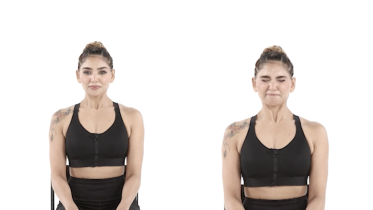 Facial muscle relaxation
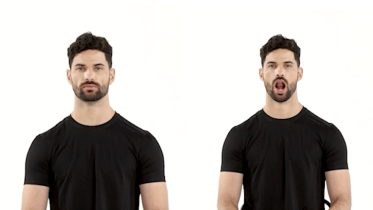 Jaw opening with the tongue on the roof of the mouth
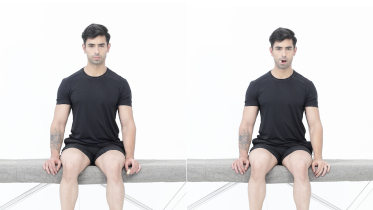 Temporalis stretch
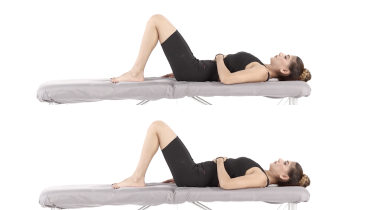 Diaphragmatic breathing
If the jaw is at its worst when you wake, the position you sleep in and the clenching behind it are the next thing to look at, and how to sleep with TMJ jaw pain covers both. The TMJ disorder program carries the full staged version of the exercises above.
When jaw pain on one side needs to be seen, and when it is an emergency
The emergency routes are at the top of this page because they are the ones that cannot wait, and they stay true however ordinary the rest of your pain feels: the cardiac pattern, any sign of a stroke, one-sided face or jaw pain with a drooping eyelid, a smaller pupil or a new pulsing sound in one ear, a swollen face with difficulty breathing or swallowing, and sudden intense eye pain with a red eye or blurred vision.
New, frequent headaches with pain or tenderness at your temples or on your scalp, or, if you are 50 or over, new jaw aching that comes on as you chew or talk and eases when you stop, need medical advice the same day, as they can be signs of inflamed arteries in the head (giant cell arteritis). If your vision changes, call emergency services.
A few patterns need a timeframe, not an exercise. Pain that is there all the time and does not ease with rest, or night pain that keeps getting worse, has its own lines below, with a shorter route if you have had cancer at any point or have lost weight without trying. A mouth ulcer lasting more than 3 weeks, a lump in the mouth, lip, neck or throat, a red or white patch in the mouth, trouble swallowing or speaking, or a hoarse voice that will not clear, goes to a doctor or dentist within a few days. Numbness or a dead feeling in part of your face, lip, tongue or chin needs advice the same day.
Short of all that, see a dentist, doctor, physio or physical therapist if one-sided jaw pain is not settling with self-care, if it keeps coming back, or if you cannot tell whether you are dealing with a tooth or a jaw. That last one is the best reason to go, and it is the question a single appointment answers fastest. Every line below carries its own timeframe, and red flags in physiotherapy explains how to read a list like that.
Related exercise programs
Warning signs
Get emergency help now
- Emergency: any sign of a stroke, even if it goes away. That means a face that droops on one side, an arm you cannot lift or keep up, slurred or muddled speech, weakness or numbness on one side of your body or face, sudden blurred vision, double vision or loss of sight, trouble swallowing, sudden dizziness with unsteadiness or falling over, a sudden severe headache, or a sudden fall where your legs give way but you do not black out (a drop attack). Call emergency services straight away. With neck pain, these can rarely come from a tear in an artery in the neck.
- Emergency: jaw, neck, shoulder or arm pain that comes with chest pain or tightness, sweating, feeling sick, feeling light-headed or being short of breath, or that comes on when you exert yourself, feel stressed or go out in the cold and does not ease within a few minutes of rest. Call emergency services straight away, as this can be a heart attack. If it eases quickly with rest and none of these happen, get medical advice the same day, and do not exercise again until you have been checked. Jaw pain that comes with effort and goes with rest can be a sign of angina, a heart problem, rather than TMD.
- Emergency: chest pain or tightness, which may spread to your arm, neck or jaw, or shoulder or arm pain that comes with shortness of breath, sweating or feeling sick. This can be a heart attack. Call emergency services straight away.
- Emergency: your mouth is stuck open and you cannot close it, for example after a big yawn, or after a blow to your face your jaw looks out of place, your teeth no longer meet as they did or you cannot bite together. Go to an emergency department straight away, supporting your jaw gently with your hand, and do not drive yourself. Call emergency services if you also find it hard to breathe or are bleeding heavily.
- Emergency: your jaw locked, you cannot open or close your mouth properly, part of your lower lip, chin or jaw feels numb, a tooth is loose or broken or your gum or mouth is bleeding, your jaw swings to one side as it opens, or your cheek or jaw has a lump or a changed shape, after a blow to the face, a fall, a sports injury or any other accident, even if your teeth still meet as they did. Go to an emergency department straight away, supporting your jaw gently with your hand, and do not drive yourself. Call emergency services if you also find it hard to breathe, are bleeding heavily or your face is swelling quickly. A jaw can be broken without looking out of place, and jaw stiffness, trouble opening your mouth widely, pain in front of your ear that is worse when you bite or chew, or a numb lower lip can be the main sign.
- Emergency: you think you have a tooth infection, or your face or jaw is swollen, and you find it hard to breathe, speak, swallow or open your mouth, have a lot of swelling in your mouth, have swelling of your neck or around your eye, or have a swollen or painful eye or sudden problems with your eyesight. Call emergency services or go to an emergency department straight away, and do not drive yourself. This can be a spreading infection, for example from a tooth abscess.
- Emergency: a new headache, or new pain on one side of your face, jaw or neck, with a drooping eyelid or a smaller pupil on the same side, or with a new pulsing or whooshing sound in one ear that keeps time with your heartbeat. Call emergency services or go to an emergency department straight away, and do not drive yourself. This can be a tear in an artery in the neck (cervical artery dissection), which can lead to a stroke.
- Emergency: a headache or face pain with sudden, intense eye pain, a red eye, blurred vision or rainbow-colored rings around lights, often with feeling or being sick. Call emergency services or go to an emergency department straight away, and do not drive yourself. This can be a sudden rise in pressure inside the eye (acute glaucoma).
- Emergency: new problems walking, for example your legs feel stiff, heavy or weak or you have become unsteady on your feet, new trouble controlling your bladder or bowels, or hands that suddenly become clumsy, for example you can no longer do up buttons. Call emergency services straight away. These can be signs of pressure on the spinal cord in the neck.
Get help today
- New, frequent headaches with pain or tenderness at your temples or on your scalp, or, if you are 50 or over, new jaw pain or aching that comes on as you chew or talk and eases when you stop, or a temple or scalp that has become tender to touch, for example when you brush your hair or rest your head on a pillow. Get medical advice the same day. These can be signs of inflamed arteries in the head (temporal arteritis, also called giant cell arteritis). If your vision changes, call emergency services.
- Your jaw suddenly locks so you cannot open your mouth fully, or the pain or stiffness stops you eating or drinking, without any of the emergency signs above. Get medical advice the same day from your doctor or dentist.
- Frequent, severe headaches alongside your jaw problem, without any of the emergency signs above. Get medical advice the same day.
- Numbness, tingling or a dead feeling in part of your face, lips, tongue or chin, or weakness in the muscles of your face, that has come on gradually, without any of the emergency signs above. Get medical advice the same day. Changes like these point to a nerve problem rather than TMD and need checking.
- An electric shock feeling runs down your back or into your arms or legs as your head bends forward. Stop and get medical advice the same day.
- Hands that have slowly become clumsy, for example trouble doing up buttons or dropping things, or numbness in both hands. Get medical advice the same day. These can be signs of pressure on the spinal cord in the neck (cervical myelopathy). If the clumsiness or numbness gets worse quickly, call emergency services straight away.
- Pain or tingling in both arms at the same time, rather than in one. Get medical advice the same day. This can also be a sign of pressure on the spinal cord in the neck.
- An arm or hand that is getting weaker. Get medical advice the same day.
- Jaw or face pain with a high temperature, a swollen face or gum, or you feel hot, cold, shivery or generally unwell, without any of the emergency signs above. Get medical advice the same day. If you think a tooth is the cause, contact a dentist for an urgent appointment.
- Same day: ear pain that has lasted more than 2 to 3 days, or ear pain with feeling generally unwell, a high temperature or feeling hot, cold or shivery, swelling around your ear, fluid coming from your ear, hearing loss or a change in your hearing, something stuck in your ear, or a child under 2 with earache in both ears, without any of the emergency signs above. Get medical advice the same day. The NHS route for any of these is an urgent GP appointment or NHS 111.
- New jaw or face pain and you have had cancer, now or in the past, or you have lost weight without trying. Get medical advice the same day and mention it. If you are being treated for cancer now, contact your cancer team the same day.
- Jaw or face pain that is there all the time and does not ease with rest, or pain at night that keeps getting worse. If you have had cancer, now or in the past, or you have lost weight without trying, get medical advice the same day.
- Dizziness, a spinning feeling or feeling sick that comes on when you turn or tip your head, without any of the emergency signs above. Stop the exercises and get medical advice the same day. If you faint, it does not settle within a few minutes of sitting still, or you cannot stand or walk steadily, call emergency services.
Book an appointment
- Toothache that has lasted more than 2 days, toothache that does not go away with painkillers, pain when you bite, red gums, a bad taste in your mouth, or a swollen cheek or jaw, without any of the signs above. See a dentist within a day or two, and ask for an urgent appointment the same day if the pain is severe or getting worse. Do not go to a doctor instead, because a doctor's surgery cannot give you dental treatment.
- Jaw or face pain that is there all the time and does not ease with rest, or pain at night that keeps getting worse. See your doctor within a few days.
- A mouth ulcer that has lasted more than 3 weeks, a lump in your mouth, on your lip, in your neck or in your throat, a red or white patch in your mouth, pain in your mouth that is not going away, difficulty swallowing or speaking, or a hoarse voice that does not go away. See your doctor or dentist within a few days. These are usually caused by something else, but they need checking for mouth cancer.
Common questions
Why does my jaw hurt on one side?
Most often the jaw joint or the chewing muscles on that side, which is temporomandibular disorder, or a tooth. One side is the normal pattern for a jaw problem, because you have two jaw joints and each works on its own, so a one-sided ache is not a sign of anything unusual in itself. After those two, the causes worth knowing by their pattern are the ear, the sinuses, a blocked salivary gland that flares at mealtimes, the neck, and trigeminal neuralgia. A few causes are not the jaw at all and need acting on rather than reading about, including a cardiac pattern and any sign of a stroke, and they are on the warning list on this page.
Can you have TMJ on one side only?
Yes, and it is the usual way it turns up. The NIDCR describes two temporomandibular joints, one on each side of the jaw, which you can feel by putting your fingers in front of your ears and opening your mouth. Each one is used separately in every bite, so a sore joint, a sore set of chewing muscles or both on one side is the ordinary presentation, not something odd. The same source puts TMD at about 5% of adults in the US and twice as common in women as in men. Painless clicking is a different matter: the NIDCR says clicking or popping without pain is common, considered normal and does not need treatment.
Why does my jaw hurt on one side with no tooth pain?
That combination usually points at the muscle or the joint, not a tooth. The giveaways are a duller ache that spreads over the cheek and temple, tenderness when you press the muscle, soreness that builds while you chew and eases when you stop, and nothing sharp when you bite on one particular tooth. Compare that with a tooth, which is more often a pain you can put a fingertip on, and may come with sensitivity to hot or cold, red gums or a bad taste. It is not a test, and a tooth problem does not always announce itself, so if nobody has examined your teeth, a dentist still looks.
Can jaw pain on one side be a heart attack?
It can, which is why this one is answered before anything else on the page. The NHS lists chest pain spreading to the jaw, neck and arms among the signs of a heart attack, and names the jaw among the places angina pain is felt, with exercise, stress, emotion and cold as triggers. So jaw, neck, shoulder or arm pain that comes with chest pain or tightness, sweating, feeling sick, light-headedness or breathlessness, or that comes on with effort and does not ease within a few minutes of rest, means calling emergency services rather than reading on. What does not fit that pattern is pain that is tender to press on, worse when you chew and unchanged by walking up a hill.
Why does my jaw hurt on one side near my ear?
Because the joint is there. Put a fingertip just in front of your ear canal and open your mouth, and the thing moving under your finger is the jaw joint, so joint pain is felt in exactly the place people describe as earache. The NHS lists pain around the jaw, ear and temple among the symptoms of temporomandibular disorder, and the NIDCR adds ringing in the ears, hearing loss or dizziness. Pain inside the ear is a different route, and the NHS asks for same-day advice, which it gives as an urgent GP appointment or help from NHS 111, for earache that has lasted more than 2 to 3 days, or earache with feeling generally unwell, a high temperature or feeling hot, cold or shivery, swelling around the ear, fluid coming from the ear, hearing loss or a change in hearing, something stuck in the ear, or a child under 2 with earache in both ears.
Can a sinus infection cause jaw pain on one side?
Sinus trouble is felt higher up than the jaw joint, and the NHS symptom list for sinusitis is pain, swelling and tenderness around your cheeks, eyes or forehead, along with toothache and a feeling of pressure in the ears. The jaw is not on that list. So upper cheek and upper teeth pain, with a blocked or runny nose and a recent cold, behaves like sinusitis, while pain in the joint in front of the ear that is worse when you chew behaves like the jaw. The NHS says sinusitis usually clears up within 4 weeks, and asks for urgent advice if you are very unwell, if painkillers are not helping, if symptoms are getting worse or if your immune system is weakened. It also lists symptoms on one side of the face only among the reasons for a referral to an ear, nose and throat specialist.
References
- NHS. Temporomandibular disorder (TMD). Page last reviewed 20 June 2023. https://www.nhs.uk/conditions/temporomandibular-disorder-tmd/
- National Institute of Dental and Craniofacial Research (NIDCR). Temporomandibular disorders (TMD). Last reviewed September 2026. https://www.nidcr.nih.gov/health-info/tmd
- NHS. Toothache. Page last reviewed 1 July 2024. https://www.nhs.uk/conditions/toothache/
- NHS. Dental abscess. Page last reviewed 18 March 2026. https://www.nhs.uk/conditions/dental-abscess/
- NHS. Earache. Page last reviewed 27 October 2025. https://www.nhs.uk/conditions/earache/
- NHS. Sinusitis (sinus infection). Page last reviewed 31 January 2024. https://www.nhs.uk/conditions/sinusitis-sinus-infection/
- NHS. Salivary gland stones. Page last reviewed 14 August 2023. https://www.nhs.uk/conditions/salivary-gland-stones/
- NHS. Trigeminal neuralgia. Page last reviewed 27 January 2023. https://www.nhs.uk/conditions/trigeminal-neuralgia/
- NHS. Trigeminal neuralgia: symptoms. https://www.nhs.uk/conditions/trigeminal-neuralgia/symptoms/
- Ong DSM, Ramireddi GK, Lim ZV, Lim MW, Leong AZ. Approach to facial pain. Singapore Medical Journal. 2026;67(6):387-392. https://doi.org/10.4103/singaporemedj.SMJ-2025-198
- Busse JW, Casassus R, Carrasco-Labra A, Durham J, Mock D, Zakrzewska JM, et al. Management of chronic pain associated with temporomandibular disorders: a clinical practice guideline. BMJ. 2023;383:e076227. https://doi.org/10.1136/bmj-2023-076227
- NHS Borders. Temporomandibular joint (TMJ) pain, a guide for patients. Right Decision Service, NHS Scotland. Next review date 1 May 2026. https://www.rightdecisions.scot.nhs.uk/patient-information-leaflets/primary-community-services/physiotherapy/temporomandibular-joint-tmj-pain-a-guide-for-patients/
- NHS. Temporal arteritis. Page last reviewed 14 August 2023. https://www.nhs.uk/conditions/temporal-arteritis/
- NHS. Angina. Page last reviewed 18 March 2025. https://www.nhs.uk/conditions/angina/
- NHS. Heart attack: symptoms. Page last reviewed 31 March 2026. https://www.nhs.uk/conditions/heart-attack/symptoms/
- NHS. Symptoms of a stroke. Page last reviewed 12 September 2024. https://www.nhs.uk/conditions/stroke/symptoms/
- NHS. Glaucoma. Page last reviewed 13 June 2025. https://www.nhs.uk/conditions/glaucoma/
- NHS. Symptoms of mouth cancer. Page last reviewed 19 June 2023. https://www.nhs.uk/conditions/mouth-cancer/symptoms/
- MedlinePlus. Broken or dislocated jaw. US National Library of Medicine. Review date 3 April 2025. https://medlineplus.gov/ency/article/000019.htm
Written and checked by the PocketPhysio editorial team. Last updated 2026-10-24.
This page is general education, not a diagnosis or a personal treatment plan. See a physiotherapist or doctor for advice about your own situation.