
Part of Total hip replacement rehab
Exercises before hip replacement surgery: what actually helps
Warning signs, and when to get help
What exercises should you do before hip replacement surgery?
Start with the ones you are going to be asked for first. The exercises before hip replacement surgery that pay off are the day-one set from the program you will be given afterward, because the morning after an operation is the worst possible classroom. Ankle pumps and quad sets ask almost nothing of the hip, and they are the ones handed out in hospital beds. Heel slides rehearse a bend your team will put a limit on. The front of the thigh gets worked by short arc quads, and by straight leg raises if your own hospital uses them, though not all do.
Then sit to stand using the armrests: you will repeat that one more than anything else in the first fortnight at home.
The total hip replacement rehab program sets all of those out as stage 1, with the doses and the technique points, and the first six weeks after a hip replacement is the page that takes over once the operation is done. Here they are rehearsal. Learn the shape of each movement and where you need to be sitting or lying to do it, and leave the amount to the ward physio or physical therapist, whose version will be built around the operation you actually had.
Four things need a word with your team before you start any of this, not after: a restriction you have already been given for that hip, a heart or lung condition, blood pressure that is not under control, and a fall in the past year. When to stop and get advice before the operation, at the foot of this page, is where each of those is set out.
One thing to get in hand early is the walking aid. What you go home on varies by hospital, crutches or a walking frame or walker in some and two sticks in others, and most people come down to one stick or cane after that. The walking with a cane page shows the pattern and which hand it belongs in. Practicing that sequence before the operation costs you nothing and saves a conversation on a day when you will not remember it.
The research has looked at a good deal more than a sheet of leg exercises. The one review that looked only at hips compared ten different kinds of preparation: strength work for the legs, mixed exercise programs run in a clinic, home exercise with and without protein supplements, prehabilitation delivered remotely, electrical muscle stimulation, Tai Chi, high-intensity upper body training, heat with resistance training, and education on its own (van der Vorst and colleagues, 2026). Only three of the ten came out ahead.
How far the hip may bend and which way it may turn after the operation depends on how the surgeon reached the joint, and that is not ours to tell you: hip precautions, what they are and how long they last explains why those lists differ between hospitals and sometimes point in opposite directions. And if your surgical team has already given you a sheet, that sheet is your program. This page is for filling the gaps in it, and anything your team has forbidden stays forbidden no matter what you read here.
Does prehab shorten the recovery?
Probably not in any way you would notice, and the people selling you a four-week program will not tell you that. The largest hip-only study is a network meta-analysis of 21 randomized trials in 1,061 people waiting for a hip replacement. Tai Chi improved physical function and performance on the timed up and go test, which is a timed stand from a chair, short walk and sit back down. Mixed exercise programs reduced pain and improved health-related quality of life, and leg strength training improved quality of life.
Everything else that review tested, including education on its own, showed no statistically significant effect, and confidence in the findings was low to very low except for the Tai Chi result on the walking test, which reached moderate. Read the headline carefully: every one of those gains was measured before the operation, in people still waiting (van der Vorst and colleagues, 2026).
Look at outcomes after the operation and it gets thinner. An overview of 3 systematic reviews and 21 meta-analyses of both operations found structured prehabilitation favorable for complication rates, strength, measured function, quality of life and people's own ratings of function, with the effects fading and generally confined to the first 6 months, and it rated the evidence underneath from critically low to moderate quality. Its hip arm was 19 trials in 1,110 patients (Keogh and colleagues, 2025). A review of prehabilitation before hip and knee replacement for osteoarthritis judged most of its trials at high risk of bias, found several benefits on the knee side, and said there were too few hip trials to draw a conclusion (Adebero and colleagues, 2024).
A broader review of prehabilitation across orthopedic surgery is more encouraging about the weeks before the operation than about the months after it, and it does include the hip: before surgery it reported moderate-certainty evidence for quality of life on the 36-item Short Form Health Survey and for hip abduction strength in people having a hip replacement, alongside function and strength in people having a knee replacement. After surgery its moderate-certainty findings were function at 6 weeks after a knee replacement and at 6 months after lumbar surgery, and there was none for the hip (Punnoose and colleagues, 2023).
So this page does not promise you a shorter stay, a complication avoided or an earlier week without the stick or cane. The complication finding above is a group result on evidence its own authors graded from critically low to moderate, which is a reason to do the work rather than a reason to count on a particular outcome. The NHS does say the things you do while waiting may lower your risk of complications and speed your recovery. Notice what it attaches that to, though: the whole list, which includes stopping smoking, losing weight if you are overweight and keeping inside the weekly alcohol limits, not the exercises on their own.
What the NICE guideline puts its weight on is the rehabilitation after surgery, not before it. It asks for a physiotherapist or occupational therapist to start you on the day of the operation where that is possible, and no later than 24 hours afterward. It wants anyone doing rehabilitation on their own to have clear goals and a point of contact for advice and support. And it asks for supervised outpatient rehabilitation, in a group or one to one, for people who are struggling with daily activities, who have lasting problems with specific rehabilitation needs, or who are not getting where they wanted to on their own work (NICE NG157, recommendations 1.10.1, 1.10.4 and 1.10.5). Those three sentences are worth more to you than any prehab program, because they tell you what to ask for and when to ask for it.
The real reason to do this work is simpler than a trial result. Strength you take into the operation is strength you start rehabilitation with, and a movement you already know is one fewer thing to learn in a sore week. OrthoInfo makes the second half of that point itself, asking you to find out what exercises will be prescribed after the operation, because becoming familiar with them now means you will be ready to do them afterward. The strength half is practice reasoning, labeled as such and not dressed up as a study finding.
What if the hip is too painful to exercise?
Most people reading this have a hip bad enough to be on a surgical list, which is usually a hip bad enough to make an exercise sheet look like a joke. That is the normal starting point, not a reason to skip the section.
Change the exercise and keep the habit. OrthoInfo names isometric exercise, where the muscle tightens while the joint hardly moves, as a way to hold on to leg strength before surgery, and quad sets are exactly that. Breathe out as you tighten and keep breathing through the hold rather than bracing against it, because holding the breath is the commonest fault in this kind of work and it matters most for the readers named at the foot of this page. Beyond that, a few adjustments buy you room on a bad hip: work only in the slice of movement that does not protest, sit down for whatever you had been doing on your feet, support the leg so it is not carrying itself, and split one session into three short goes across the day.
Judge it by the morning after rather than by how it feels during. Discomfort in the session that settles afterward is ordinary. A hip that is clearly stiffer or sorer when you wake up means yesterday was too much, so go back to the amount that was settling and climb more slowly. The pain monitoring model explains that way of setting a limit in more detail.
If every version of everything hurts, that is a phone call rather than a decision to do nothing. Your physio or the pre-admission team can look at what you are attempting. The hip osteoarthritis program is the fuller plan for a painful hip that has not been operated on yet, and what the guidelines ask you to try first covers the rest of what is available while you wait. Pain that is new, pain that has changed character, or anything in the warning signs at the end of this page is a different matter and gets sorted before the exercise question.
The parts of you that are not the hip
This is the half of prehab that never makes it onto a list, and it is the half to protect if you only have time for one.
Start with your arms. OrthoInfo asks people having a hip or knee replacement to strengthen the upper body, for the plain reason that crutches, a frame or a walker are carried by the arms and shoulders, and most people never think about that until the morning they are handed a pair. Our library is not built around that job, so ask your physio or the pre-admission team for two or three arm and shoulder exercises that suit you and your other joints.
Your other leg matters as much. In the first weeks it does most of the work getting you out of bed, out of chairs and off the toilet, and none of that work needs the operated hip to bend. Strength for older adults is a sensible place to take it if you want a program and not a handful of exercises.
General fitness is the one most likely to be the limiting factor in week three. Walking, cycling, swimming, whatever your hip will tolerate, done often enough to keep your breathing and your stamina where they are now. Stamina tends to come back more slowly than the hip does, so a reserve built before the operation is the reserve you spend afterward.
If you are reading this still deciding whether to have the operation at all, why a hip replacement is needed and when is the page for that question, and nothing in this one is an argument for or against it.
If you are on a waiting list with no date
Someone with surgery in three weeks and someone with an open-ended wait have almost nothing in common, so this part is written for the second.
With no date, stop thinking in programs. The job is to arrive at the operation no weaker than you are today. Over a wait of many months that is a real achievement, not a modest one. The NHS is direct about why: get on with these things while you wait, because waiting lists can be long. So pick the two or three exercises you will still be doing in four months, attach them to something you already do daily, and let the sessions be short and frequent rather than ambitious.
Keep walking as far as is comfortable, and break one long walk into shorter ones if a long one flares the hip. Get your walking aid sorted and fitted properly now rather than in the fortnight before surgery. And use the wait to get the appointments you are entitled to: waiting for physio covers what to do with the time, and in the UK you can often go straight to a physiotherapist without seeing a GP first. NHS physio self-referral explains how.
Tell your surgical team if the hip gets significantly worse while you wait. Your pain relief, your walking aid and the urgency of your listing are theirs to review, and a hip that is deteriorating is a reason to contact them, not a reason to train harder. The hip replacement recovery timeline is better read before your date than after it, because most of what it describes needs arranging in advance.
Getting the house and the week ready
This is not really an exercise question, and the program page covers what the first weeks look like, so keep it brief. The NHS asks you to sort out help at home with day-to-day activities, to put the things you use often within easy reach, to stock the freezer with cooked meals, to borrow, hire or buy any equipment you will find useful such as a raised toilet seat, to arrange transport because you will not be driving for at least 6 weeks, and to make a plan with your employer about going back to work. OrthoInfo adds three: if you live alone, consider having a friend or a family member stay with you for several days after surgery, get rid of the throw rugs and area rugs you could slip on, and fasten any electrical cords securely round the edge of the room.
Those last two are falls work, and a fall in the first weeks after this operation is the one that can cost you another one. Falls work also means planning for one, which is cheap to set up now and awkward to arrange later. Keep your phone in a pocket rather than in another room, so you can reach it from the floor, and ask about an alarm you wear. If you do fall and cannot get up, or you think you may have hurt your head, neck, back or hip, stay where you are, keep warm and call emergency services, or get someone to call for you. Do not let anyone haul you up first. That line and the rest of the fall routes, including what to do if you got up fine and only hurt later, are in the warning signs below.
Two more of OrthoInfo's suggestions are worth doing while you can still shift furniture about. Borrow a stick, crutches or a walking frame and walk your own home with it. That is how you find the doorway that is too narrow and the turn you cannot make, and if the only bedroom and bathroom are upstairs it is far better to know now than on the day you come home: OrthoInfo suggests rearranging the furniture or, where you can, turning a downstairs room into your bedroom for a while. The other is the long-handled equipment, a shoehorn, a sponge and a grabber or reacher, along with a shower chair, a grab bar or a raised toilet seat if your bathroom will take them. Those things exist because of the bending limit your surgeon is going to set. They are what lets you keep to it instead of testing it, which is a reason to have them in the house before you need them rather than after. Doing that list in the week before surgery is how it gets done badly.
Do not shave your leg, and do not tidy up the area around the hip. OrthoInfo's instruction is direct: do not shave the area of the surgery, and if shaving is needed it will be done in the hospital. This one is not a preference. NICE, which writes the UK guidance on preventing wound infection after surgery, says hair should not be removed routinely at all, and that where it has to come off the hospital uses electric clippers with a single-use head on the day of the operation, never a razor, because razors raise the risk of a surgical site infection. A razor leaves small nicks you can neither see nor feel, and intact skin is what has to be there for the operation to go ahead.
For the same reason, OrthoInfo asks you to look your skin over properly in a mirror, including the groin, because any break in the skin gives bacteria a way in. On the hip that matters more than people expect, since the groin and the crease at the top of the leg are both close to where the surgeon will be working and both easy to miss.
Sleep, mood and the first few days
The fear is the part the leaflets skip, and there is little good research behind what can be offered here.
What the evidence says is almost unhelpful. Education on its own was one of the ten things the hip review tested, and it did not produce a statistically significant benefit on the outcomes measured (van der Vorst and colleagues, 2026). Mixed exercise programs did improve health-related quality of life and reduce pain before the operation, which is the closest that body of work comes to telling you that doing something physical while you wait helps how you feel.
What is practical comes from the guideline instead. If you are going to be doing rehabilitation largely on your own, NICE asks that you have clear goals and a point of contact for advice and support (NICE NG157, recommendation 1.10.4). Get that name and that number at the pre-admission clinic, write them somewhere you will find them at 9pm on a bad day, and take the person who will be looking after you at home to the appointment so they hear it too. What we see in clinic, and this is practice experience rather than a study finding: the people who cope best in the first fortnight are not the ones who read the most beforehand, but the ones who know who to ring.
On sleep, a hip waiting for replacement often hurts most at night, and sorting that out now beats treating it as something the operation will fix. Sleeping positions and night pain with hip arthritis covers it, and whatever position works for you before the operation may not be allowed afterward, so that is another question for the team who will be giving you your precautions.
When to stop and get advice before the operation
Before you start anything on this page, speak to your team if you have been given a restriction on what you may do with the hip, or if you have a heart or lung condition, blood pressure that is not controlled, or you have fallen in the past year. If you have high blood pressure, breathe steadily through every repetition and never hold your breath.
The thing most likely to cancel your operation is an infection, and the window to act on one is before the morning of surgery rather than on it. OrthoInfo asks you to tell your doctor about any skin irritation on the leg being operated on, naming cuts, scratches, abrasions, rashes and bug bites, and to let them know if you come down with a fever, a cold or any other illness in the week beforehand. The NHS says the same from the other side: tell your surgeon if you develop a cough, a cold or a high temperature in the days before surgery and they will advise whether the operation can go ahead, and let the hospital know as early as you can if you are not well enough. So look the leg over as you go and make the call early. A cancelled list is a far smaller loss than an infected implant.
Two more things change the operation itself rather than being general good habits. If you smoke, cut down or stop before the date. OrthoInfo's reason is specific: smoking affects the circulation, delays healing, slows recovery and may raise the risk of infection, and every one of those lands on a fresh wound sitting over a new implant. The second is alcohol, and it is a separate instruction from the weekly limits further up this page. OrthoInfo asks for none at all in the 48 hours before surgery.
Dental work belongs in the same conversation. OrthoInfo asks you not to book dental work, including routine cleaning, for several weeks after your operation, which in practice means getting anything you need done before it and raising a toothache or a sore gum with your surgical team now rather than later.
Medicines are your team's business and not this page's. OrthoInfo notes that corticosteroids, insulin and blood thinners all need managing both before and after the operation, so take a full list of everything you take to your pre-operative appointment and follow what they tell you about each one. Never stop or change a prescribed medicine on your own. Everything means everything on that list. OrthoInfo and the NHS both want the vitamins, the mineral supplements, the herbal remedies and anything you buy over the counter written down too, with the dose and how often you take it, because a doctor may ask you to stop one particular thing a week or two before the operation. Being told to stop something is not the same as deciding to, so follow that instruction when it comes, and ask which of your medicines it covers if you are not certain.
The pre-admission clinic itself is the place to raise all of this. The NHS describes it as an appointment a few weeks before the operation to make sure you are well enough for surgery to go ahead, and it may include a blood test, X-rays, a urine test to check for infection or an electrocardiogram (ECG) to check your heart. OrthoInfo describes the American version of the same appointment: a general medical evaluation some weeks ahead, assessing your health and your risk from the anesthetic, with the result and a surgical clearance sent on to your surgeon, and tests that may include blood tests, an electrocardiogram and a chest X-ray.
Understand what that appointment is for, because it changes how you use it. It is not paperwork and it is not about the hip. It is the last point at which a medical problem that needs treating before an anesthetic can be found and treated with time in hand, which is why OrthoInfo asks you to tell them about conditions such as diabetes, asthma, anemia or high blood pressure rather than assuming the hospital already has them on file. You also meet the team looking after you and can ask them whatever you want. Take your questions written down, because you will not remember them in the room.
Eating and drinking is set by the team giving your anesthetic, not by a website, and this page gives no times on purpose. The NHS says you will be told clearly whether to stop eating and drinking in the hours before the operation, and that if you have been told to fast you must not eat or drink anything, light snacks and sweets included, though you may be allowed water, which is worth checking rather than guessing. The point of it is a stomach that is empty while you are under anesthesia. If you take insulin for diabetes you still have to fast, and your team needs to know about the diabetes so they can plan around it. Eating or drinking outside the window you were given can move your operation to another day, so if you have slipped up, say so when you arrive rather than hoping.
The warning signs below say which changes need an emergency department, which need advice the same day, and which can wait a few days.
Exercises that can help
These are the stage 1 exercises from the program you will be given after the operation, put here so you can meet them early. Nobody needs all of them. Two or three that your hip tolerates, done properly, beat a list you abandon in week two, and your pre-admission team or physio is the right person to tell you which belong in your case. Straight leg raises are the one to ask about specifically, because not every hospital program uses them. Each exercise page carries its own starting dose and set-up, and your physio will adjust this. Set up before your first session rather than during it: a firm chair with arms that will not slide or tip, a kitchen counter within reach for anything done on your feet, and shoes that grip rather than socks. Heel slides need a slippery surface under the heel, and how far the hip may bend is a question for your surgical team rather than something to find by feel. Most of this set is done lying down, and a firm bed is the place for it rather than the floor: getting down onto the floor and back up again is harder than any exercise on the list, and it is the part most likely to leave you stuck or to put you on the floor for a while if you are on your own. Sit on the edge of the bed first, lower yourself down sideways, and keep a hand on the mattress on the way back up. If you cannot get onto a bed, or you cannot lie flat, ask your physio or the pre-admission team for seated versions instead of working out your own. Two rules cover all of them. Sharp pain in a repetition means that repetition was the last one, not something to breathe through. And judge the amount by the next morning: a hip that is stiffer or sorer when you wake than it was the day before means drop back to the amount that was settling and rebuild from there.
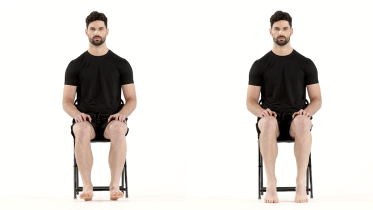 Ankle pumps
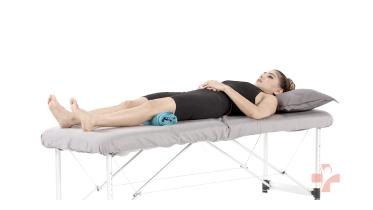 Quad sets (towel under knee)
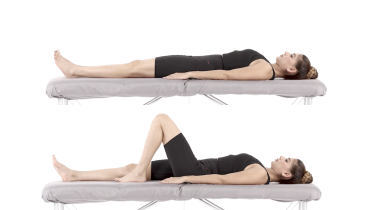 Heel slides
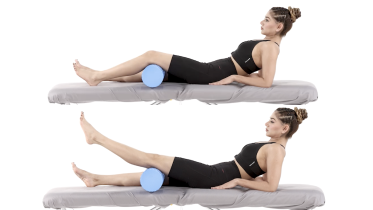 Short arc quads
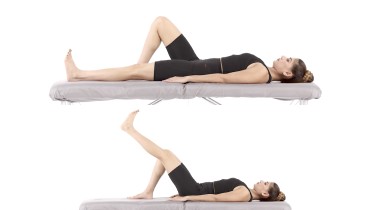 Straight leg raise
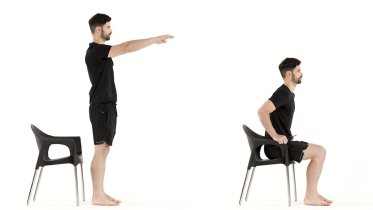 Sit to stand using armrests
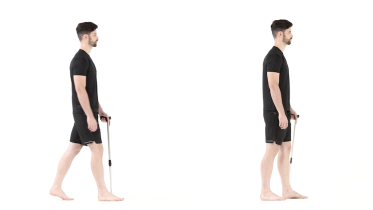 Walking with a cane
Related exercise programs
Warning signs
Get emergency help now
- Emergency: if chest pain, pressure or tightness does not ease quickly when you rest, spreads to your arm, neck, jaw, stomach or back, or comes with sweating, feeling sick, feeling light-headed or being short of breath, call emergency services straight away, as this can be a heart attack. If it eases quickly and none of these happen, get medical advice the same day, and do not exercise again until you have been checked.
- Emergency: you have just fallen and cannot get up, or you think you may have hurt your head, neck, back or hip. Stay where you are, keep warm and call emergency services, or get someone to call for you. If you got up and walked without trouble and only notice pain later, use the same-day lines in this list instead.
- Emergency: you have had a fall or an injury and now have severe hip pain, or you cannot walk or put weight on the leg. Call emergency services or go to an emergency department. This can be a sign of a broken hip (hip fracture).
- Emergency: tingling or loss of feeling in the hip or leg after a fall or injury. Call emergency services or go to an emergency department.
Get help today
- Same day: severe hip pain that came on suddenly without a fall, or pain that is getting worse quickly over a few days. Get medical advice the same day.
- Same day: new hip or groin pain after a fall, even a small one, if you are older, have low bone density (osteoporosis) or have taken steroid tablets for a long time, even if you can still walk. Get medical advice the same day. A broken hip is not always obvious at first.
- Same day: the hip is hot and swollen, or the skin over it has changed color, or you have hip pain with a high temperature or feel hot, cold or shivery. Get medical help the same day, and go to an emergency department if you feel very unwell. A joint infection needs treatment quickly. If you have a very high or very low temperature, shivering you cannot control, you are breathing very fast or finding it hard to breathe, you are confused or your speech is slurred, your skin, lips or tongue look blue, gray, pale or blotchy (on brown or black skin this can be easier to see on the palms of the hands or soles of the feet), or you have a rash that does not fade when you press it, call emergency services, as this can be sepsis.
- Same day: with an operation date coming up, you develop a cold, a cough, a high temperature or any other illness, or a cut, scratch, graze, rash or insect bite anywhere on the leg being operated on, or a dental problem such as toothache or a sore gum. Tell your surgical team the same day. Any break in the skin raises the risk of infection, and an infection means the operation is cancelled, so they need to hear about it while there is still time to act rather than on the morning of surgery. Keep taking your prescribed medicines as instructed; never stop or change one on your own.
- Same day: a calf or thigh that is newly swollen or getting more swollen, warm, tender, red or darker than usual, has swollen veins that are sore to touch, or has a throbbing or cramping pain that does not fit your injury or condition, or that feels different from normal muscle soreness after exercise. This can be a sign of a blood clot (deep vein thrombosis), especially after surgery, an injury, time in a cast or boot, a long trip or a spell of being much less mobile than usual. Get medical advice the same day. If you are also short of breath or have chest pain, call emergency services.
- Same day: dizziness or feeling faint during or after exercise, without any of the emergency signs above. Stop the exercises and get medical advice the same day. If you faint, it does not settle within a few minutes of sitting still, or you cannot stand or walk steadily, call emergency services.
- Same day: a leg or foot that is getting weaker, for example your foot drags, catches on the ground or slaps down when you walk (foot drop). Get medical advice the same day. If the weakness is getting worse by the hour, go to an emergency department.
- Same day: hip or groin pain that is worse at night or does not ease with rest, and keeps getting worse. If you are being treated for cancer now, contact your cancer team the same day.
Book an appointment
- Within a day or two: hip or groin pain that is worse at night or does not ease with rest, and keeps getting worse. If you have had cancer, now or in the past, or are losing weight without trying, see your doctor sooner, within a day or two, and mention it. This applies even if the pain is not getting worse.
- Within a few days: hip or groin pain that is worse at night or does not ease with rest, and keeps getting worse. See your doctor within a few days.
- Within a few days: you have had a fall, even if you were not hurt, or you keep tripping, stumbling or feeling that your legs might give way. Book an appointment with your doctor within a few days and ask about a falls assessment. Tell them about every fall, even the ones where you were not hurt.
- Within a few days: new groin or hip pain and you take steroid tablets long term, or have in the past, or you regularly drink a lot of alcohol. This can be a sign of a problem with the blood supply to the top of the thighbone (avascular necrosis). Book an appointment with your doctor within a few days and mention the steroids or alcohol.
Common questions
What exercises should I do before hip replacement surgery?
Learn the stage 1 exercises you will be given after the operation, because they are the ones you will be asked for on day one and the first days are a poor time to meet anything new. That means ankle pumps, quad sets, heel slides, short arc quads and standing up from a chair using the armrests, with straight leg raises only if your own hospital program uses them. Alongside those, OrthoInfo asks people having a hip or knee replacement to strengthen the upper body, because the arms are what make crutches, a walking frame or walker manageable afterward. How far the hip may bend, now and later, is your surgical team's answer rather than ours.
Does prehab actually make the recovery faster?
Nobody can honestly promise you that, and the hip evidence is thinner than the knee evidence. The largest hip-only review pooled 21 trials in 1,061 people and reported gains in function, pain and quality of life from Tai Chi, mixed exercise programs and leg strength work, but those were measured before the operation, and its confidence in the findings was mostly low to very low (van der Vorst and colleagues, 2026). An overview of reviews that looked at both operations found prehabilitation favorable for complication rates, strength, measured function, quality of life and patients' own ratings of function, with the effects generally confined to the first 6 months and the underlying evidence rated from critically low to moderate quality; its hip side came to 19 trials in 1,110 people (Keogh and colleagues, 2025). A third review found too few hip trials to say anything (Adebero and colleagues, 2024). So the direction is encouraging and the certainty is poor, which is a reason to do it and not a reason to expect it to change your discharge day.
What if my hip hurts too much to exercise?
Then the exercise changes and the week stays. OrthoInfo names isometric work, where the muscle tightens while the joint barely travels, as a way to hold on to leg strength before surgery, and quad sets are the plainest example of it. Beyond that: take the movement through the part of the range that does not complain and stop there, do seated versions of what you were doing standing, and break one session into three short ones across the day. If every version of everything hurts, ring your physio or the pre-admission team rather than quietly stopping, because the other leg, the arms and your general fitness are all still trainable while the hip is not.
How long before surgery should I start?
There is no tested number, and knowing that is better than being handed a confident one. The hip review compared types of prehabilitation against each other, not schedules, so it cannot tell you how many weeks to allow or how often to train (van der Vorst and colleagues, 2026). The practical answer comes from the NHS instead, which asks you to get on with these things while you wait precisely because waiting lists can be long. Start when you are told you need the operation, not when the date lands. Each exercise page gives a starting dose, and your physio will adjust this.
Should I keep walking while I wait?
Yes, unless your team has told you otherwise, and split it up if one long walk sets the hip off. The hip osteoarthritis program is the fuller plan to follow while you wait, and it covers walking, walking aids and load. If the hip is deteriorating while you wait, that is worth telling your surgical team about rather than pushing harder through it, because your pain relief, your walking aid and how urgent your date is are all theirs to review.
How do I prepare mentally for a hip replacement?
This is the question with the least evidence behind it, and the research gives you less than you would hope. The hip review included education as one of the ten things it tested, and education on its own did not produce a statistically significant benefit on the outcomes measured (van der Vorst and colleagues, 2026). What is practical is in the NICE guideline: people doing rehabilitation on their own should have clear goals and a point of contact for advice and support (NICE NG157, recommendation 1.10.4). Ask who that person is at the pre-admission clinic, write the number down, and take whoever will be helping you at home to the appointment with you. Knowing who to call takes more weight off than reading more about the operation does.
References
- van der Vorst MAT, Dijkman R, Hannink G, van Hove RP, Olde Rikkert MGM, Peeters G. Effectiveness of prehabilitation modalities before total hip arthroplasty: a systematic review and network meta-analysis. Annals of Physical and Rehabilitation Medicine. 2026;69(4):102114. https://doi.org/10.1016/j.rehab.2026.102114
- Keogh JAJ, Keng I, Dhillon DS, Bourgeault-Gagnon Y, Simunovic N, Ayeni OR. The effects of structured prehabilitation on postoperative outcomes following total hip and total knee arthroplasty: an overview of systematic reviews and meta-analyses of randomized controlled trials. Journal of Orthopaedic and Sports Physical Therapy. 2025;55(5):344-365. https://doi.org/10.2519/jospt.2025.13075
- Adebero T, Omana H, Somerville L, Lanting B, Hunter SW. Effectiveness of prehabilitation on outcomes following total knee and hip arthroplasty for osteoarthritis: a systematic review and meta-analysis of randomized controlled trials. Disability and Rehabilitation. 2024;46(24):5771-5790. https://doi.org/10.1080/09638288.2024.2313128
- Punnoose A, Claydon-Mueller LS, Weiss O, Zhang J, Rushton A, Khanduja V. Prehabilitation for patients undergoing orthopedic surgery: a systematic review and meta-analysis. JAMA Network Open. 2023;6(4):e238050. https://doi.org/10.1001/jamanetworkopen.2023.8050
- National Institute for Health and Care Excellence. Joint replacement (primary): hip, knee and shoulder. NICE guideline NG157, recommendations 1.10.1, 1.10.4 and 1.10.5. Published 4 June 2020. https://www.nice.org.uk/guidance/ng157
- National Institute for Health and Care Excellence. Surgical site infections: prevention and treatment. NICE guideline NG125, recommendations 1.2.4 and 1.2.5. https://www.nice.org.uk/guidance/ng125/chapter/Recommendations
- NHS. Preparing for a hip replacement. Page last reviewed 6 March 2024. https://www.nhs.uk/tests-and-treatments/hip-replacement/preparing-for-a-hip-replacement/
- NHS. Having an operation (surgery): before surgery. Page last reviewed 9 July 2024. https://www.nhs.uk/tests-and-treatments/having-surgery/preparation/
- NHS. Falls. Page last reviewed 6 March 2025. https://www.nhs.uk/conditions/falls/
- American Academy of Orthopaedic Surgeons. Preparing for joint replacement surgery. OrthoInfo. https://www.orthoinfo.org/en/treatment/preparing-for-joint-replacement-surgery/
Written and checked by the PocketPhysio editorial team. Last updated 2026-10-17.
This page is general education, not a diagnosis or a personal treatment plan. See a physiotherapist or doctor for advice about your own situation.