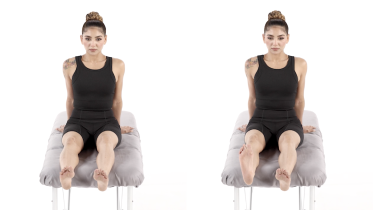
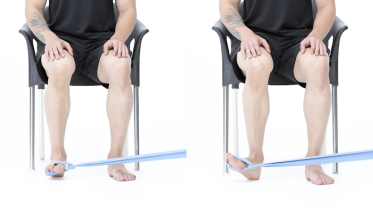
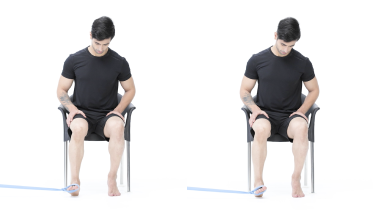
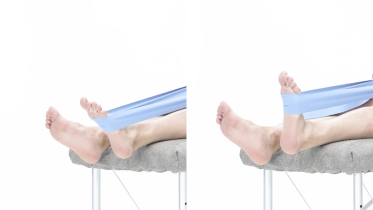
Seated ankle circles with the foot on the floor
Seated ankle circles with the foot on the floor move the ankle in every direction while the foot stays in contact with the ground. You sit on a chair with your toes and the ball of your foot on the floor, and slowly move the heel and knee in a circle, so the ankle moves up, down and side to side. Because the foot stays down, some body weight goes through it, which physios call a closed chain movement. It is often used for a stiff ankle after a sprain or once a cast or boot comes off, as a step between circles in the air and exercises in standing.
How to do the seated ankle circles with the foot on the floor
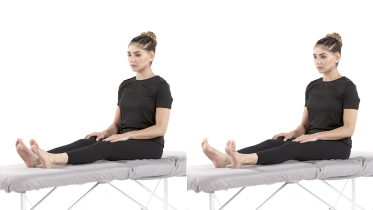
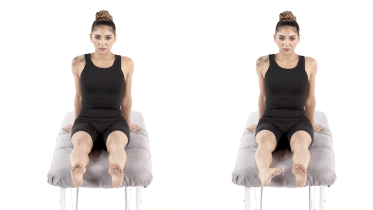
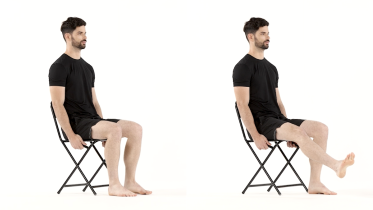
- Sit on a firm chair with both feet flat on the floor, about hip width apart, and rest your hands on your thighs.
- Choose the foot you are working. It stays on the floor for the whole exercise, while the other foot rests.
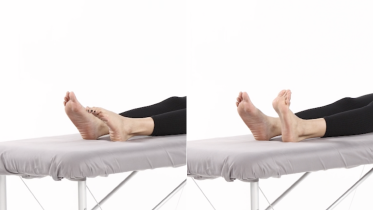
- Keep your toes and the ball of that foot on the floor. Slowly lift the heel, roll the weight out toward the little toe side, lower the heel back to the floor, then roll across toward the big toe side. Your knee and shin trace a small circle above the foot as you go, as in the video.
- Keep the movement smooth and go only as far in each direction as is comfortable. Do your set of circles one way, then the same number the other way.
- Change to the other foot if your program includes both.
What you should feel
Easy movement all around the ankle and a light stretch at the end of each direction. Some work in the shin and calf too, since part of your weight goes through the foot.
Common mistakes
- Lifting the toes or sliding the foot across the floor instead of keeping the front of the foot in one place.
- Swinging the knee in big circles while the ankle hardly moves.
- Leaning your body over the foot to push more weight through it.
- Going quickly, so the circle turns into a wobble.
How often
A common routine is 10 slow circles in each direction with each foot, done 2 or 3 times a day. Your physio will adjust this.
Stop and check with your physio if
- Sharp pain in the ankle or foot, or the ankle feels as if it might give way.
- Numbness, burning or pins and needles in the foot that starts or gets worse as you go. If it stays after you stop, or keeps getting worse, get medical advice the same day.
- Your calf or thigh is getting more swollen, or becomes warm, tender, red or darker than usual, or has a new throbbing or cramping pain. This can be a blood clot, especially after an operation, an injury, time in a cast, boot or brace, or a spell of being much less mobile than usual, and after an operation it can also be an infection. Stop and contact your medical team or get medical advice the same day. If you are also short of breath or have chest pain, call emergency services.
- You suddenly become short of breath, get chest pain or pain in your upper back that may be worse when you breathe in, cough up blood, your heart beats very fast, or you faint. Call emergency services straight away, even if your leg looks normal, as this can be a blood clot in the lungs (pulmonary embolism).
- Since the fracture or cast, the foot or ankle is getting more painful rather than less, the skin becomes very sensitive to light touch, or the foot changes color, temperature, swelling or sweating compared with the other one, or looks shiny. See your doctor or physio as soon as you can, within a few days at most, as this can be complex regional pain syndrome (CRPS) and early treatment may help.
From the clinic
The voice guide simply asks for circles with the toes, one direction and then the other. In the video, though, the toes never leave the floor. The ankle circles because the heel lifts, rolls and lowers. Compared with ankle circles done with the foot lifted, this version is steadier and lets the foot take some weight. The ankle alphabet and ankle pumps are other seated options.
After an ankle fracture or ankle surgery, follow your surgeon's or physio's weight-bearing plan, and start this exercise only when they have cleared you. Even in sitting, some weight goes through the foot, so if you are still on crutches or only allowed part of your weight on that leg, ask whether this counts. After a sprain or a ligament repair, rolling onto the outer edge of the foot can strain the healing ligament, so keep that part of the circle small until your physio says otherwise. The ankle sprain page covers the rest of sprain recovery.
Written and checked by the PocketPhysio editorial team. Last updated 2026-09-28.
This page is general education, not a diagnosis or a personal treatment plan. If you have pain, an injury or a health condition, see a physiotherapist or doctor before starting new exercises.