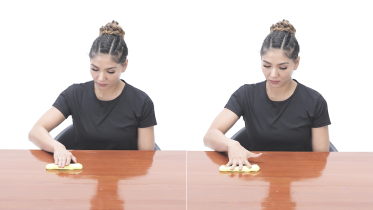
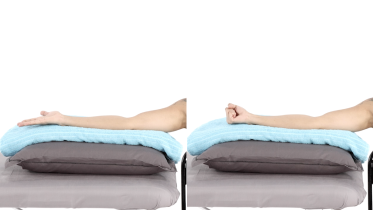
Wrist and finger range series
This series moves both wrists and all your fingers in one short routine. Sitting with your elbows bent at your sides, you make slow circles with both wrists, first one way and then the other, then spread your fingers wide and close them into a fist. It suits hands that have stiffened up from staying in one position, say after a long spell of typing or gripping. It also makes an easy warm-up before other hand exercises.
How to do the wrist and finger range series
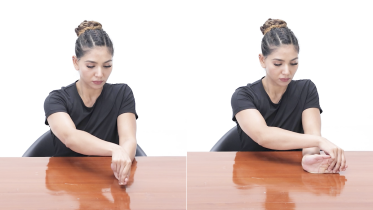
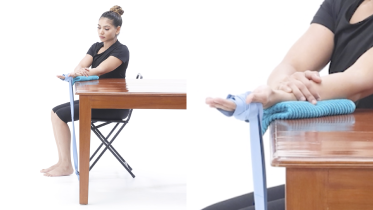
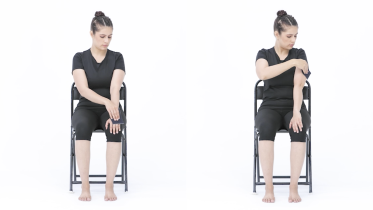
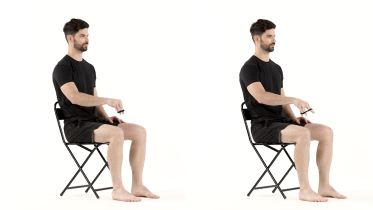
- Sit up on a chair with both feet planted on the floor. Bend both elbows to about a right angle and keep them close to your sides, with the forearms pointing forward and the hands relaxed.
- Circle both hands slowly in big circles, keeping the elbows tucked in at your sides. In the video the forearms swing out to the sides and back as the hands circle; if you want to work the wrists more, keep the forearms steadier and let the circle come from the wrists. The voice guide suggests 10 circles with the hands turning inward.
- Change direction and make the same number of circles with the hands turning outward.
- Turn both palms to face the floor. Spread all your fingers as wide apart as they will go, then close them into a full fist.
- Open and spread the fingers again, and repeat. The voice guide suggests 5 of these, and the video shows both hands working together.
What you should feel
Easy movement around the wrists, a stretch across the palms and between the fingers as they spread, and light work in the forearms as the fists close. A little stiffness in the first few circles tends to ease as you go.
Common mistakes
- Letting the elbows drift away from your sides as the hands circle.
- Making small, fast circles that skip parts of the range.
- Squeezing the fists so hard that the knuckles ache or the fingers go white.
- Shrugging the shoulders while the hands work.
How often
The voice guide suggests 10 circles each way and 5 spreads and fists, and many people run through the series 2 or 3 times a day, for example as a break from desk work. Your physio will adjust this.
Stop and check with your physio if
- Sharp pain in a wrist, or a catch or clunk that hurts as the hand circles.
- Tingling or numbness in the fingers that comes on during the series. If it stays after you stop, or keeps getting worse, get medical advice the same day. If one side of your face or body suddenly goes numb or weak, or your speech becomes slurred or muddled, call emergency services, even if it goes away.
- The wrist is hot, red and swollen, or you have wrist pain with a high temperature or feel hot, cold or shivery. Get medical advice the same day, and go to an emergency department if you feel very unwell. This can be a sign of infection in the joint, which needs treatment quickly.
- Since the fracture or cast, the hand is getting more painful rather than less, the skin becomes very sensitive to light touch, or the hand changes color, temperature, swelling or sweating compared with the other one, or looks shiny. See your doctor or physio as soon as you can, within a few days at most, as this can be complex regional pain syndrome (CRPS) and early treatment may help.
From the clinic
Slow is the whole point here. If one part of a circle catches or feels tight, ease around that spot rather than forcing the circle wider. If you have rheumatoid arthritis, keep the circles gentle and the fists loose on flare days, when your wrists or fingers are more swollen or stiffer than usual. One joint that suddenly becomes much hotter, redder or more painful than in your usual flares is different, and the stop signs on this page say what to do.
After a broken wrist, hand or forearm, or surgery on any of them such as a tendon repair, start only when your doctor, surgeon, physio or hand therapist says the bone or repair is ready for this, and follow their plan for how much to do. Each half of the series also has its own page: wrist circles for the wrist and open and close the hands for the fingers.
Hands that tingle or go numb, especially at night, are worth getting checked rather than stretched through. The carpal tunnel syndrome page explains one common cause and the warning signs to watch for.
Written and checked by the PocketPhysio editorial team. Last updated 2026-09-28.
This page is general education, not a diagnosis or a personal treatment plan. If you have pain, an injury or a health condition, see a physiotherapist or doctor before starting new exercises.