
Part of Netball injuries: what the numbers say and what to do first
Netball knee injury prevention: lowering ACL risk on court
Warning signs, and when to get help
Is netball bad for your knees?
Nobody has followed netballers and non-netballers over time to answer that, so the sport cannot be convicted or cleared. What is on record is that the knee is the expensive injury in this game. Netball Australia's coach manual, citing its own national insurance data, reports that the knee has overtaken the ankle and is now the injury Australian netballers sustain most, and estimates that as high as 25 percent of all major injuries are down to anterior cruciate ligament injury alone. England Netball states that knee trauma accounts for almost a third of all netball-related hospitalizations.
At club level the cost is measured in seasons, not weeks. Among 193 UK recreational netballers, 46 percent had sustained a knee injury in the previous five years, and those players were unable to train for 6.8 months on average, with a standard deviation of 7.0, and unable to play matches for 8.2 months, standard deviation 7.4 (Mullally and colleagues, 2023). In New Zealand, where reconstructions are tracked nationally through accident insurance, the rate of a first ACL reconstruction rose 58 percent between 2000 to 2005 and 2009 to 2016, from 36.9 to 58.2 per 100,000 person-years, and the steepest rise of any group was 120 percent in females aged 15 to 19; netball, rugby and football accounted for the highest number of injuries (Sutherland and colleagues, 2019). That study does not give a netball-only rate, so it is background rather than your personal risk.
The better question is which moment in netball is the dangerous one, because that moment is the only part you can train.
What a netball ACL injury looks like on film
Netball's ACL injury has been filmed and described twice, and this is the part of the evidence that is genuinely about netball. In the larger analysis, 17 of 21 anterior cruciate ligament injuries in elite games came from a jump-landing action and only 2 from cutting. Eleven of the 21 shared one scenario: a rapid deceleration after jumping for a high pass, a double-footed landing with a wide base of support, the deceleration taken through the injured leg with the knee straight and the foot planted, and the player often leaning too far back with the head turned away from that leg (Belcher and colleagues, 2024).
The earlier analysis of 16 injuries divided them evenly, eight indirect contact and eight non-contact, across two scenarios, and reported the knee appearing to collapse inward in most of the cases it could judge (Stuelcken and colleagues, 2016). Pulling the wider literature together, a systematic review of six studies and 11,401 players found landing was the most reported situation of knee injury at 46.6 percent, with knee collapse inward the most observed mechanism, while noting that only one of the six studies reported mechanism at all (Mullally and colleagues, 2021).
Read those together and the emphasis shifts. Most ACL prevention advice on the internet is written from football and handball research, where the change of direction is the villain. In netball the villain is the stop, with your eyes and your attention somewhere else, usually on the ball you have just taken out of the air. Netball Australia's own four principles say the same in different words: take off, landing, deceleration and change of direction, in that order.
Poor landing technique: the one risk factor rated 5 out of 5
In 2025 a group including authors affiliated with England Netball and World Netball's Medical Advisory Panel combined a systematic review with a three-round Delphi consensus of 19, 19 and 16 experts. They identified 109 candidate risk factors for injury in women's netball and reached consensus on 61 of them. Exactly one came out with a median mitigation priority of 5 out of 5: poor landing technique or mechanics. Everything else sat between 3 and 4.5 (Whitehead and colleagues, 2025).
That is as close to a priority list as this sport has, and it points at the same thing the video analyses point at. It does not mean the other 60 factors are irrelevant, and it is expert opinion built on a thin evidence base rather than a trial result. It does mean that if you only have time to change one thing, the experts in your own sport agree on which one.
Our pages do not publish landing technique targets as numbers. The video analysis that produced them asks for a shoulder-width foot landing, enough knee bend to absorb the landing rather than a leg that stays straight, the foot slightly toe-down so you come through the forefoot rather than flat, and balance you keep. It puts a knee flexion figure in degrees on that, and a degree figure is a measurement a clinician takes while watching you land, not something you can judge mid-air, so it stays off this page. The same paper gives two instructions that are easier to use and are worth more to a player: secure the ball in a stable position above the level of your pelvis as you take it, and bring your whole body around toward your next pass as you land, instead of turning only your head to look (Belcher and colleagues, 2024). The programs below are coached for exactly that reason.
The netball knee program in three countries
There is no single netball knee program. There are three national ones, and the one a player is told about depends on which country she plays in.
Netball Australia runs the KNEE Program, an on-court routine in four sections, Warm Up, Strength, Balance and Landing, and Agility. It comes at three levels, for junior, recreational and elite players, and was designed by the Australian Netball Diamonds head physiotherapist. Its coach manual says correct technique is imperative, asks coaches to introduce the sections gradually over weeks rather than all at once, and leaves static stretching out deliberately, on the stated ground that recent evidence suggests static stretching before activity does not protect against injury.
Netball New Zealand, with its accident insurance partner, runs NetballSmart, and it treats landing as a skill with its own ladder: a Landing Skills progression published in three levels sits beside the Dynamic Warm-up rather than inside it. The warm-up itself comes in four parts, A to D, with a Power Warm-up for tournaments and versions for social netball, umpires, walking netball and school years 7 and 8.
England Netball runs Jump High Land Strong, and its guidance page says the program exists to teach the landing mechanics the sport needs and to improve those basic skills so that players lower their risk of lower limb injury. It is written for all ages and all levels, needs no equipment, and is meant to be done as part of a warm-up, ideally twice a week. It runs as two levels of five sessions each: everyone starts at level 1A and moves up only when the tasks on the card can be done with control, scored against a scorecard by a teammate or from a video of yourself. Download the real thing from the governing body in your own country rather than taking an exercise list from a page like this one, including ours. What the netball warm-up page adds is what the three have in common, what each prescribes and which parts tend to get dropped.
Does ACL injury prevention work, and has anyone tested it in netball?
The first half of that question has a good answer and the second half has an uncomfortable one. Across 18 studies and 25,166 athletes, mean age 19.3 and over 85 percent of them female, ACL prevention programs produced a risk ratio of 0.46, with a confidence interval from 0.36 to 0.57, and the effect was larger in under 18s at 0.35 than in adults at 0.50 (Watson and colleagues, 2026). Those athletes played handball, soccer, basketball or volleyball. One figure in that analysis matters more to a netballer than the headline does: pooled across female players only, the risk ratio was a more modest 0.57, closer to a reduction of two fifths than of a half. The sport-specific figures in the same analysis were 0.30 for soccer and 0.66 for handball, which tells you how much the sport matters to the answer.
Netball is not in that meta-analysis, and no netball trial fills the gap. Every netball-specific trial we could find measures a surrogate: landing technique, balance reach, joint loading, physical performance or biomechanics. Not one has an injury outcome. Who looked and when: this research was done on 6 November 2026, across two PubMed searches covering 52 records, with every title read and the most relevant abstracts read in full.
That leaves the numbers on other pages needing a label. Netball Australia's manual states that there is a considerable volume of evidence that injury prevention programs improve dynamic knee control and may reduce ACL injury risk by 30 to 70 percent, and its own reference list for that sentence is soccer, handball and mixed female-athlete studies. The same manual says the program has the potential to reduce ACL incidence by up to 70 percent, which is an aim for the program rather than a measured result. A figure of 40 to 70 percent circulates on clinic blogs attributed to Netball Australia; it does not appear anywhere in the coach manual we read. So the honest summary is this: programs like these roughly halve ACL injury rates in jumping and landing sports where they have been tested, netball shares the demands of those sports, and nobody has counted netball injuries in a trial.
Why almost nobody does the program
This is the part that decides the outcome, and it is missing from most pages on the subject. An observational study watched 67 community netball training sessions across four clubs and found no team performed the recommended number of activities without modification. Across the three age groups the shares delivered as intended were 12 percent, 18 percent and 14 percent. The sections held up unevenly: warm-up and footwork reached a median of 30 percent, and strength, balance and landing, and agility each sat at a median of zero. Feedback was required in 65 percent of activities and not provided in 56 percent (Saad and colleagues, 2021).
Look at which sections survive and which disappear. The parts that get done are the parts that feel like a warm-up. The parts that get dropped are the strength, balance and landing work, which is where the evidence in other sports actually sits. If your club does the first ten minutes of a program and skips the rest, it is doing the easy half.
A survey of Welsh senior and under-21 netball found only 2 of 28 players, 7 percent, and 6 of 29 coaches, 21 percent, using any ACL prevention program, while over 90 percent of respondents identified netball as a high risk sport and over 90 percent said they would use a program if it were explained and demonstrated to them (Abdul and colleagues, 2024). The coach response rate there was 13 percent, so read the coach figures carefully. The barrier that survey describes is not motivation. Nobody has shown them how.
If your ACL is already torn, this is the wrong page
Everything above is about a knee that has not been injured. If yours has, the program you want is ACL reconstruction rehab, and the decisions in front of you belong to your surgeon and your treating physiotherapist, not to a prevention page. The question of whether you need an operation at all is answered at an ACL tear without surgery.
If you have already had a reconstruction and want to protect both knees, that is secondary prevention, which is a different subject with its own figures, and it has its own page at preventing a second ACL injury. Going back to netball after a reconstruction is a criteria-based decision covered at return to sport testing and in our return to sport test battery guide.
Two other knees get mistaken for an ACL problem. A knee that aches at the front after repeated landings and shooting practice is more often patellar tendinopathy, and a kneecap that slips sideways and then goes back has its own program at patellar dislocation. The ankle that rolls in the same landing is covered at the netball ankle, and the whole injury picture for the sport sits on the netball hub.
Exercises that can help
These five are not the KNEE Program or NetballSmart, and nothing here replaces them: they are the building blocks those programs use, with a video and a dose on each page, so you can learn the movement before you take it to a court session. The single leg hop and hold often starts at 2 to 3 sets of 6 to 10 hops, counting both legs, on 2 or 3 days a week, skater hops at 2 to 3 sets of 10 to 20 hops counting each landing or 20 to 30 seconds of work with a day between sessions, the split squat at 2 to 3 sets of 8 to 12 on each leg a few times a week, the single leg deadlift at 2 to 3 sets of 6 to 10 on each leg a few days a week, and the eccentric hamstring exercise at 2 to 3 sets of 6 to 10 slow lowers on each leg with a rest day between sessions. Where this paragraph and an exercise page differ, the exercise page wins. Your physio will adjust this.
The exercises below carry their own stop signs and precautions. Open the line under an exercise and read them before you try it.
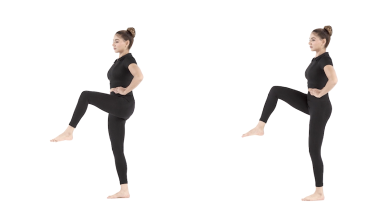 Single leg hop and hold
Stop signs and precautions for the single leg hop and hold
Before you start
- After a knee fracture or knee surgery, including a knee replacement, follow your surgeon's or physio's plan, and start this exercise only when they have cleared you. After an ankle fracture or ankle surgery, follow your surgeon's or physio's weight-bearing plan, and start this exercise only when they have cleared you. If you have had a hip or knee replacement, get the go-ahead from your surgeon before you try the single leg hop and hold. Many surgeons advise against jumping and hopping after a joint replacement for good, not just for the first months, because each landing sends high impact through the new joint.
- After a broken bone or a stress fracture in the foot, or surgery on the foot or toes, wait until your surgeon or physio clears you to hop.
- Ask your doctor or physio before you start if you have thin bones (osteoporosis) or have fallen in the past year.
- If you are pregnant, check with your midwife or physio before you start.
- If you have recently given birth, including by cesarean section, or you have a gap down the middle of your stomach muscles (diastasis recti), ask your physio, midwife or doctor first.
- After having a baby, postnatal guidance usually leaves jumping and hopping until at least 3 months after the birth, once a pelvic floor check shows you are ready.
- With a heart condition or high blood pressure, check with your doctor before you start.
When to stop and get help
- Sharp pain in the foot, ankle, shin or knee as you land, or later that day.
- Your landing knee buckles or your ankle turns over.
- A sudden pop or snap at the back of your ankle or heel, a feeling that someone kicked you there, or sudden pain there after which you cannot push off or rise onto your toes on that leg. Stop, take the weight off that leg carefully and go to an urgent care center or emergency department the same day, even if you can still walk, as this can be a torn Achilles tendon.
- Urine leaks as you land, or your pelvis feels heavy or as if something is dragging down.
- You feel dizzy, lightheaded, faint or sick, or the room seems to spin. Stop, sit down and get medical advice the same day before you exercise again. If you faint, it does not settle within a few minutes of sitting still, your vision suddenly blurs or goes double, or you cannot stand or walk steadily, call emergency services.
- Chest pain or pressure, dizziness or feeling faint, a racing or irregular heartbeat, or being far more out of breath than the effort should cause.
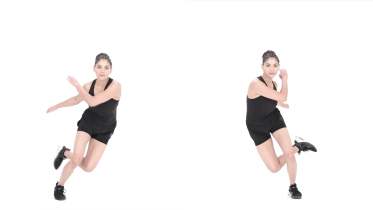 Skater hops
Stop signs and precautions for the skater hops
Before you start
- If you have had a hip or knee replacement, get the go-ahead from your surgeon before you try skater hops. Many surgeons advise against jumping and hopping after a joint replacement for good, not just for the first months, because each landing sends high impact through the new joint. After any other hip, knee or ankle surgery, such as a ligament repair, ask your surgical team or physio before doing any hopping. After a broken bone or a stress fracture in the foot, or surgery on the foot or toes, wait until your surgeon or physio clears you to hop.
- Check with your physio or doctor before you start if you leak urine when you cough, sneeze or exercise, have osteoporosis, or have fallen in the past year.
- Pregnant, or had a baby in the past months? Talk to your midwife or physio first.
- After having a baby, postnatal guidance usually leaves jumping and hopping until at least 3 months after the birth, once a pelvic floor check shows you are ready.
- With a heart condition or high blood pressure, get your doctor's advice before you start.
When to stop and get help
- Chest pain or pressure, dizziness or feeling faint, a racing or irregular heartbeat, or being far more out of breath than the effort should cause.
- Sharp pain in the hip, knee or ankle, a knee that gives way, or an ankle that rolls.
- Leaking urine, or a feeling of pressure or heaviness low in the pelvis.
- A sudden pop or snap at the back of your ankle or heel, a feeling that someone kicked you there, or sudden pain there after which you cannot push off or rise onto your toes on that leg. Stop, take the weight off that leg carefully and go to an urgent care center or emergency department the same day, even if you can still walk, as this can be a torn Achilles tendon.
- You feel dizzy, lightheaded, faint or sick, or the room seems to spin. Stop, sit down and get medical advice the same day before you exercise again. If you faint, it does not settle within a few minutes of sitting still, your vision suddenly blurs or goes double, or you cannot stand or walk steadily, call emergency services.
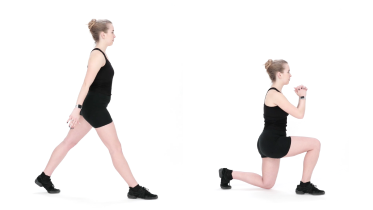 Split squat
Stop signs and precautions for the split squat
Before you start
- If you have had a hip or knee replacement, or other hip or knee surgery, get the go-ahead from your surgeon or physio before you try split squats. Some operations limit this kind of work for the first months, so the timing depends on your surgery.
- If you are pregnant, check with your midwife or physio before you start.
- With a heart condition or high blood pressure, check with your doctor before you start.
- If you have fallen in the past year, have osteoporosis or feel unsteady on your feet, set up beside a kitchen counter, a handrail or a sturdy chair back, keep one hand on it for every repetition, and ask your physio whether to start with split squats at all or to build up with both feet side by side first.
When to stop and get help
- You feel sharp pain in the knee, hip or groin, or the knee gives way.
- Knee pain builds with each rep, or is clearly worse the next morning.
- You feel dizzy, lightheaded, faint or sick, or the room seems to spin. Stop, sit down and get medical advice the same day before you exercise again. If you faint, it does not settle within a few minutes of sitting still, your vision suddenly blurs or goes double, or you cannot stand or walk steadily, call emergency services.
- Chest pain or pressure, dizziness or feeling faint, a racing or irregular heartbeat, or being far more out of breath than the effort should cause.
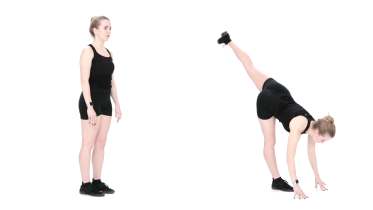 Single leg deadlift
Stop signs and precautions for the single leg deadlift
Before you start
- If you have had a hip replacement, get the go-ahead from your surgeon or physio before you try single leg deadlifts. The forward hinge bends the standing hip to a right angle or more, and many surgeons ask you to avoid that for the first months after some operations.
- If you have osteoporosis, keep the back straight and the range small, and check with your physio first, because rounding the spine forward is a position many osteoporosis programs limit.
- If you have high blood pressure or tend to feel dizzy when you bend down, come up slowly and keep breathing.
When to stop and get help
- Sharp pain in the lower back, or pain, tingling or numbness spreading down the leg.
- Sharp pain in the ankle, knee or hip you are standing on.
- You feel dizzy or lightheaded, or you lose your balance. If you faint while exercising, call emergency services, even if you feel fine again quickly.
- A sudden sharp pain, pop or snap at the back of your thigh. Stop straight away. If you then get large bruising spreading down the back of the thigh, a gap or dip you can feel, a stiff-legged walk, or clear weakness when you bend the knee, get assessed the same day at urgent care or an emergency department, as the tendon may have pulled away from the bone near the buttock.
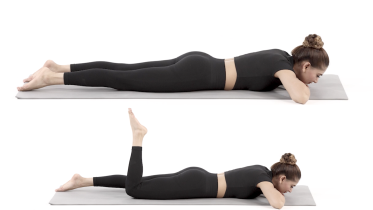 Eccentric hamstring exercise
Stop signs and precautions for the eccentric hamstring exercise
Before you start
- After a knee fracture or knee surgery, including a knee replacement, follow your surgeon's or physio's plan, and start this exercise only when they have cleared you. After a recent hamstring strain begin this only when your physio or surgeon says the muscle is ready for it, and keep to the slow lower until they clear you for the quick drop. The same applies after any ligament reconstruction that used a hamstring tendon as the graft, not only an ACL reconstruction: the tendon taken is usually the semitendinosus, sometimes with the gracilis, and the same tendons are used for MCL, PCL, posterolateral corner and kneecap ligament reconstructions, so your operation notes are what tell you whether this applies to you. Ask which leg the graft was taken from as well, because some surgeons take it from the uninjured leg, and it is that leg this applies to.
- If you are still growing, or you are a coach or parent setting this for somebody who is, ask a physiotherapist or a qualified strength coach to set it up and to look at the young person first. The hamstring attaches at a growth area at the bone you sit on, and the dose on this page is an adult figure that has not been tested in growing athletes.
- If you have had recent heart or chest surgery, do not lie face down on a healing chest wound. The weight of your chest presses on the wound for as long as you are down there, and pushing up through your arms to get off the bed pulls across the breastbone. Ask your surgeon or surgical team when lying on your front is allowed, and until then ask your physio for another way to do this while you lie on your side, sit or stand. If the breastbone clicks, grinds, shifts or feels as if it is moving while you do it, stop, and contact your surgical team the same day.
When to stop and get help
- A sudden sharp pain, pop or snap at the back of your thigh. Stop straight away. If you then get large bruising spreading down the back of the thigh, a gap or dip you can feel, a stiff-legged walk, or clear weakness when you bend the knee, get assessed the same day at urgent care or an emergency department, as the tendon may have pulled away from the bone near the buttock.
- Pain that catches behind the knee or up near the bone you sit on.
- Your lower back aches or pinches while you lie on your front or lower the leg.
Each exercise page carries its own precautions and stop signs, and those come before anything here. Three of these five are impact work on one leg. After a knee fracture or knee surgery, including a knee replacement, follow your surgeon's or physio's plan, and start these exercises only when they have cleared you. If you have had a hip or knee replacement, get the go-ahead from your surgeon before you try the single leg hop and hold or skater hops, because many surgeons advise against jumping and hopping after a joint replacement for good, not just for the first months, and each landing sends high impact through the new joint. After any other hip, knee or ankle surgery, such as a ligament repair, ask your surgical team or physio before doing any hopping, and after a broken bone or a stress fracture in the foot, or surgery on the foot or toes, wait until your surgeon or physio clears you to hop.
Check with your physio or doctor before you start the hopping if you leak urine when you cough, sneeze or exercise, have osteoporosis, or have fallen in the past year. If you are pregnant or had a baby in the past months, talk to your midwife or physio first, and if you have a gap down the middle of your stomach muscles (diastasis recti), ask your physio, midwife or doctor. After having a baby, postnatal guidance usually leaves jumping and hopping until at least 3 months after the birth, once a pelvic floor check shows you are ready. Stop the hopping and speak to your physio if urine leaks while you are doing it, or if you feel pressure or heaviness low in your pelvis.
The eccentric hamstring exercise has two limits of its own. After a recent hamstring strain, or an ACL reconstruction that used a hamstring graft, begin it only when your physio or surgeon says the muscle is ready, and keep to the slow lower until they clear you for the quick drop. If you have had recent heart or chest surgery, do not lie face down on a healing chest wound, and ask your surgical team when lying on your front is allowed.
For the single leg deadlift, if you have had a hip replacement get the go-ahead from your surgeon or physio first, because the forward hinge bends the standing hip to a right angle or more and many surgeons ask you to avoid that for the first months after some operations. With osteoporosis, keep the back straight and the range small, and check with your physio first. Keep fingertips on a counter for it until your balance is steady. With a heart condition or high blood pressure, get your doctor's advice before you start any of the impact work, and breathe steadily through every repetition rather than holding your breath.
When to see a physio
Book when something keeps happening rather than when something hurts. A knee that has given way once, a landing that has started to feel different on one side, or a session of repeated jumping that leaves one knee sore for three days are all worth an appointment, and none of them is an emergency.
What a physiotherapist adds that a downloaded program cannot is the coaching the implementation research says is missing. Someone watches you land, tells you what your knee actually did rather than what you felt it do, and changes one thing at a time. That is the difference between performing the activity and performing it as intended, and the community netball data suggests it is where most of the benefit is being lost. Read the warning list below before you start, and follow the timing each line sets.
Related exercise programs
Warning signs
Get emergency help now
- Emergency: if chest pain, pressure or tightness does not ease quickly when you rest, spreads to your arm, neck, jaw, stomach or back, or comes with sweating, feeling sick, feeling light-headed or being short of breath, call emergency services straight away, as this can be a heart attack. If it eases quickly and none of these happen, get medical advice the same day, and do not exercise again until you have been checked.
- Emergency: if you faint while exercising, call emergency services, even if you feel fine again quickly.
- Emergency: the knee became very swollen very quickly, within a few hours of a twist, fall or blow, or you felt a pop or snap. Go to an emergency department straight away. Do not drive yourself: ask someone to drive you or call an ambulance. A knee that fills up that fast has usually bled inside the joint, which can come from a torn ligament, a kneecap that slipped out or a break, so it needs checking before you play again.
- Emergency: the ankle or foot looks deformed or out of place, you heard a crack when you were injured, or the foot is numb, tingling, cold, pale or blue. Go to an emergency department straight away, and do not drive yourself.
- Emergency: you are still growing, you have pain that wakes you at night, pain at rest that keeps getting worse, or a lump or swelling around the knee or thigh that keeps growing, and you also have a rash that does not fade when you press a glass on it. Call emergency services or go to an emergency department straight away. Without the rash, follow the line on the same symptoms further down this list, which gives you a day or two.
Get help today
- Same day: a sudden pop or snap at the back of your ankle or heel, a feeling that someone kicked you there, or sudden pain there after which you cannot push off or rise onto your toes on that leg. Stop, take the weight off that leg carefully and go to an urgent care center or emergency department the same day, even if you can still walk, as this can be a torn Achilles tendon.
- Same day: you felt the kneecap slip out of place and it went back by itself. Get assessed the same day.
- Same day: you cannot walk or put weight on the leg, whether or not there was a fall or injury, or you have very bad knee pain after a fall or injury, or very bad knee pain that came on suddenly with no injury at all. Get medical advice the same day.
- Same day: the knee locks and you cannot straighten it, or it keeps giving way under you. Get medical advice the same day. Until it has been checked, leave out the exercises you do standing on one leg, hold the rail on stairs and take care on uneven ground, because a knee that gives way without warning is how people fall.
- Same day: a sudden sharp pain, pop or snap at the back of your thigh. Stop straight away. If you then get large bruising spreading down the back of the thigh, a gap or dip you can feel, a stiff-legged walk, or clear weakness when you bend the knee, get assessed the same day at urgent care or an emergency department, as the tendon may have pulled away from the bone near the buttock.
- Same day: a calf or thigh that is newly swollen or getting more swollen, warm, tender, red or darker than usual, has swollen veins that are sore to touch, or has a throbbing or cramping pain that does not fit your injury or condition, or that feels different from normal muscle soreness after exercise. This can be a sign of a blood clot (deep vein thrombosis), especially after surgery, an injury, time in a cast or boot, a long trip or a spell of being much less mobile than usual. Get medical advice the same day. If you are also short of breath or have chest pain, call emergency services.
- Same day: you are a teenager who is still growing and you have a limp, or pain in the hip, groin or thigh as well as the knee. Get an urgent appointment with a doctor the same day, and stay off sport and these exercises until you have been checked. If you cannot put weight on the leg, have a high temperature or feel very unwell, go to an emergency department. Some hip problems in growing teenagers, such as a slipped growth plate at the top of the thigh bone (slipped capital femoral epiphysis), are felt in the knee and need checking quickly.
Book an appointment
- Within a day or two: you are still growing and have pain that wakes you at night, pain at rest that keeps getting worse, or a lump or swelling around the knee or thigh that keeps growing. See a doctor within a day or two. Ask for an urgent appointment rather than the next routine one, and say what the pain does at night and whether a lump is getting bigger. Do the same if the pain comes with looking pale, unusual tiredness, fevers with no clear cause, bruising or bleeding easily, or weight loss. Bone pain that is worse at night, or a new lump, needs checking to rule out rarer causes such as a bone tumor or a blood cancer (leukemia).
- Within a few days: the pain sits at one small spot on a bone that you can point to with a finger, such as the shinbone or a bone in the foot, the bone aches at rest or at night, or hopping on that leg hurts at that one spot. Stop running, jumping and any exercise that hurts at that spot, and see a doctor within a few days, as this can be a stress fracture. This matters even more if the spot is on the front of the shinbone, the top of the foot in the middle, just in front of the ankle (the navicular bone), or the outer edge of the foot at the base of the little toe bone, because doctors treat stress fractures at those three sites as high risk: they heal slowly and unpredictably and they are the ones most likely to need fixing. Keep your weight off that leg as much as you can until it has been looked at. If walking hurts or makes you limp, get it checked the same day. An X-ray can look normal for the first 2 to 3 weeks, so a normal early X-ray does not rule it out.
Common questions
Does the KNEE Program work?
Nobody can answer that with an injury count, because the trial has not been done. The two netball trials that exist measured something else: a randomized controlled trial put two Netball NSW Premier League teams on either the KNEE Program or a traditional warm-up and measured reach distances on the modified Star Excursion Balance Test at 8 weeks and 5 months, and it found improvement in the posteromedial direction only and no group effect on the cumulative score (Grayson and colleagues, 2024). A cluster trial of 77 New Zealand school players compared two versions of the NetballSmart Dynamic Warm-up over 12 weeks and found both improved every landing technique measure, with only the Landing Error Scoring System favoring one of them (Belcher and colleagues, 2021). Better balance reach and better landing scores are not the same thing as fewer torn ligaments, and a surrogate improvement is not a null result either. What is fair to say is that programs of this kind roughly halve ACL injury rates in the jumping and landing sports where they have been tested, which are handball, soccer, basketball and volleyball, and that netball is not among them (Watson and colleagues, 2026).
How often do you need to do the KNEE Program?
Netball Australia publishes two answers and they do not match, so here are both as written. The KNEE Program coach manual says that for maximum effectiveness the program must be completed 2 to 3 times per week and must be continued for the effect to be maintained. The program's own website puts the floor lower, at least twice a week for maximum effectiveness, and says the benefit only holds while the program is kept up. The stricter reading is the manual's, and outside netball the one thing the warm-up literature is clear about is duration, not frequency: a systematic review of nine neuromuscular warm-up studies concluded that the effective programs were applied consistently for longer than three consecutive months (Herman and colleagues, 2012). A fortnight before a tournament is not a program.
Do women really tear their ACL more often than men?
Both netball governing bodies say so, and neither shows its working. Netball Australia's coach manual states that females are 4 to 6 times more likely than males to rupture the ACL, and England Netball puts a woman's risk of a non-contact ACL tear as much as six times that of a man. Neither document carries a citation for its figure, so we quote them as statements by those bodies and not as evidence we have checked. We have not read the underlying sex-difference research, so this page will not tell you why the difference exists or how big it is. What we can say is that it does not change what you do about it: landing technique sits at the top of the risk factor list for women's netball whatever the comparison with men turns out to be (Whitehead and colleagues, 2025).
Is it cutting or landing that tears an ACL in netball?
Landing, which is the opposite emphasis to the football research most prevention advice is copied from. In the larger of the two video analyses, 17 of 21 anterior cruciate ligament injuries in elite netball came from jump-landing actions and 2 from cutting, and 11 of the 21 shared a single scenario: a rapid deceleration after jumping for a high pass, landing on two feet with a wide base, taking the deceleration through the injured leg with the knee straight and the foot planted, often leaning too far back with the head turned away from the leg (Belcher and colleagues, 2024). The earlier analysis of 16 injuries split them evenly between indirect contact and non-contact, with the knee appearing to collapse inward in most of the cases it could assess (Stuelcken and colleagues, 2016). A systematic review across six studies and 11,401 players put landing at 46.6 percent of knee injuries, the single most reported situation (Mullally and colleagues, 2021).
References
- Belcher S, Whatman C, Brughelli M. A systematic video analysis of 21 anterior cruciate ligament injuries in elite netball players during games. Sports Biomechanics. 2024;23(12):2546-2563. https://doi.org/10.1080/14763141.2022.2034928
- Stuelcken MC, Mellifont DB, Gorman AD, Sayers MG. Mechanisms of anterior cruciate ligament injuries in elite women's netball: a systematic video analysis. Journal of Sports Sciences. 2016;34(16):1516-1522. https://doi.org/10.1080/02640414.2015.1121285
- Mullally EM, Atack AC, Glaister M, Clark NC. Situations and mechanisms of non-contact knee injury in adult netball: A systematic review. Physical Therapy in Sport. 2021;47:193-200. https://doi.org/10.1016/j.ptsp.2020.12.004
- Whitehead S, Mackay L, Jones B, Heyward O, Fox AS, Chesson LJ, Scantlebury S, Janse van Rensburg DCC. Injury risk factors and their priority for mitigation in women's netball: a systematic review and Delphi consensus. British Journal of Sports Medicine. 2025;59(5):294-305. https://doi.org/10.1136/bjsports-2024-108756
- Watson SL, Gohal C, Owen MM, Bajaj PM, Plantz MA, Tjong VK. A Systematic Review and Meta-analysis of Anterior Cruciate Ligament Injury Prevention Programs: Training to Stay in the Game. American Journal of Sports Medicine. 2026;54(3):733-740. https://doi.org/10.1177/03635465251376670
- Herman K, Barton C, Malliaras P, Morrissey D. The effectiveness of neuromuscular warm-up strategies, that require no additional equipment, for preventing lower limb injuries during sports participation: a systematic review. BMC Medicine. 2012;10:75. https://doi.org/10.1186/1741-7015-10-75
- Grayson J, Hillard D, Antcliff A, Chan C, Nightingale E, Pappas E. The effect of the KNEE program for Netball players on the modified Star Excursion Balance Test: a randomized controlled trial. Physical Therapy in Sport. 2024;67:83-89. https://doi.org/10.1016/j.ptsp.2024.03.004
- Belcher S, Whatman C, Brughelli M, Borotkanics R. Short and long versions of a 12-week netball specific neuromuscular warm-up improves landing technique in youth netballers. Physical Therapy in Sport. 2021;49:31-36. https://doi.org/10.1016/j.ptsp.2021.01.016
- Saad T, Davies L, Smith M. Implementation of an injury prevention programme in community netball: An observational study. Journal of Sports Sciences. 2021;39(19):2180-2188. https://doi.org/10.1080/02640414.2021.1923932
- Abdul W, Moore I, Robertson A. Anterior Cruciate Ligament Injury Prevention Programs in Welsh Netball: A Survey of Knowledge, Implementation and Barriers Amongst Players and Coaches. Cureus. 2024;16(5):e60405. https://doi.org/10.7759/cureus.60405
- Sutherland K, Clatworthy M, Fulcher M, Chang K, Young SW. Marked increase in the incidence of anterior cruciate ligament reconstructions in young females in New Zealand. ANZ Journal of Surgery. 2019;89(9):1151-1155. https://doi.org/10.1111/ans.15404
- Downs C, Snodgrass SJ, Weerasekara I, Valkenborghs SR, Callister R. Injuries in Netball: A Systematic Review. Sports Medicine Open. 2021;7(1):3. https://doi.org/10.1186/s40798-020-00290-7
- Netball Australia. Netball KNEE Program: About Us. Accessed 6 November 2026. https://knee.netball.com.au/about-us
- Netball Australia. KNEE Program Coach Manual. Accessed 6 November 2026. https://knee.netball.com.au/sites/knee/files/2025-12/NET5359_Netball_Aus_Knee_Coach_Manual_07.pdf
- Netball Australia. Netball KNEE Program: Resources. Accessed 6 November 2026. https://knee.netball.com.au/resources
- Netball New Zealand. NetballSmart Dynamic Warm-up. Accessed 6 November 2026. https://netballnz.co.nz/netball-smart/dynamic-warm-up.html
- Netball New Zealand. NetballSmart Landing Skills. Accessed 6 November 2026. https://netballnz.co.nz/netball-smart/landing-skills.html
- England Netball. NETBALLHer: Common netball injuries. Accessed 6 November 2026. https://netballher.co.uk/injury/common-netball-injuries/
- England Netball. Jump High Land Strong Guidance. Read 6 November 2026 from the Internet Archive snapshot of 22 June 2025, because the live page returns HTTP 429. https://www.englandnetball.co.uk/the-roses-development-framework/pillars-of-development/jump-high-land-strong-guidance/
- Patel DS, Roth M, Kapil N. Stress fractures: diagnosis, treatment, and prevention. American Family Physician. 2011;83(1):39-46. https://www.aafp.org/pubs/afp/issues/2011/0101/p39.html
- American Academy of Orthopaedic Surgeons. Slipped Capital Femoral Epiphysis. OrthoInfo. https://www.orthoinfo.org/en/diseases--conditions/slipped-capital-femoral-epiphysis-scfe
- National Institute for Health and Care Excellence. Suspected cancer: recognition and referral (NG12). Published 23 June 2015, last updated 15 April 2026. https://www.nice.org.uk/guidance/ng12
- NHS. Chest pain. Page last reviewed 8 August 2023. https://www.nhs.uk/symptoms/chest-pain/
- NHS. Fainting. Page last reviewed 17 August 2026. https://www.nhs.uk/symptoms/fainting/
- NHS. Knee pain. Page last reviewed 21 December 2023. https://www.nhs.uk/symptoms/knee-pain/
- NHS. Dislocated kneecap. Page last reviewed 10 March 2026. https://www.nhs.uk/conditions/dislocated-kneecap/
- NHS. Tendonitis. Page last reviewed 9 June 2023. https://www.nhs.uk/conditions/tendonitis/
- NHS. DVT (deep vein thrombosis). Page last reviewed 30 April 2026. https://www.nhs.uk/conditions/deep-vein-thrombosis-dvt/
- NHS. Sprains and strains. Page last reviewed 23 April 2024. https://www.nhs.uk/conditions/sprains-and-strains/
Written and checked by the PocketPhysio editorial team. Last updated 2026-11-06.
This page is general education, not a diagnosis or a personal treatment plan. See a physiotherapist or doctor for advice about your own situation.