
Part of Netball injuries: what the numbers say and what to do first
Netball ankle injury: the sprain, the recovery and getting back on court
Warning signs, and when to get help
How a netball ankle rolls
The moment is almost always the same. You come down from a jump, the foot lands on its outside edge or on somebody else's foot, the sole turns inward, and the ligaments on the outer side of the ankle take a load they were never built for. The systematic review of netball injury names landings, collisions and falls as the main circumstances in the sport, and in a survey of 193 UK recreational players, 46 percent of lower limb injuries happened in a landing (Downs and colleagues, 2021; Mullally and colleagues, 2023).
Two features of netball make that moment more likely than it is in most sports. The game sends several players up for the same ball, so you often land where another foot already is. And the landing is not the end of the action: you have to stop, hold your ground and pass, so the ankle is loaded while the rest of you is still moving.
Netball Australia makes the same point from its own data, saying most injuries in the sport happen to knees and ankles when landing. The knee and the ankle are usually hurt in the same instant, which is why this page and netball knee injury prevention keep handing readers to each other.
How common is a netball ankle sprain, really?
Common enough to be the sport's signature injury, and less common than the figure you will see quoted. The scoping review of ankle sprain practice in netball opens by saying ankle sprains are the most commonly reported injury in the sport, and it states that approximately four in five netball athletes will sustain one (Rowe and colleagues, 2021). We followed that to its source. It rests on a single cross-sectional study of 96 female netball players at one Australian university setting, 42 club and 54 inter-district, mean age 24.1. Their own abstract reports that 69 of the 96 had previously sprained an ankle, which is 72 percent, and that 47 percent had sprained one repeatedly (Attenborough and colleagues, 2016).
So the defensible sentence is this: in one Australian cohort of 96 club and inter-district players, roughly seven in ten had sprained an ankle at least once and nearly half had done it more than once. That is still a lot of sprained ankles. It is not four in five netball players everywhere, and the difference matters because a rounded-up number repeated often enough becomes a fact nobody checks.
One oddity is worth naming, because it affects what a UK player has probably been told. England Netball's own common netball injuries article, on its NETBALLHer platform, does not mention the ankle at all. Counted in the whole article on 6 November 2026, the word ankle appears zero times, while concussion appears 22 times and the ACL nine. The most frequently reported injury in the sport is absent from the governing body's own list of common ones, which is a measured hole rather than a criticism of the rest of the page.
For the sport as a whole, use the range. The netball systematic review found the ankle and the knee to be the most common injury sites in 19 of its studies, and reported that the figures varied considerably between them, the ankle running from 13 to 84 percent of injuries (Downs and colleagues, 2021). Different studies defined injury differently and watched different levels of player, which is why the range is that wide, and a scoping review of 65 netball injury studies found only two had used ongoing systematic surveillance (Horne and colleagues, 2024).
Separate figures exist at the top of the game. Ankle injuries were 20.9 percent of medical attention injuries over three professional Australian seasons (Toohey and colleagues, 2022). Across one elite UK season, acute ankle ligament sprains in matches cost 350 days between them, which was the heaviest match time-loss burden of any diagnosis that season, at 411.7 days lost per 1000 match player hours (Horne and colleagues, 2025). That last number is a rate for a squad's worth of match hours rather than a count of days, which is the sort of figure that gets quoted as if it were one.
Does the ankle you shrug off become the chronic one?
That is the direction the netball evidence points, even though the individual figures are thin. The scoping review reports that up to half of netballers go on to sustain recurrent sprains after a first one (Rowe and colleagues, 2021). The instability figure we can verify at source comes from the same cohort of 96: of the 69 players with a previous sprain, 64 percent had moderate to severe perceived instability in that ankle (Attenborough and colleagues, 2016).
Note what that percentage is a percentage of. It describes players who have already sprained an ankle, not netballers in general, and we have not read the full text of the study behind the wider nine-in-ten instability claim, so this page does not repeat that one.
In New Zealand, where netball injury claims are counted nationally, the number of ankle claims among 10 to 14 year olds rose 84 percent over a decade, and that age group's risk of an ankle injury roughly doubled across the same period (incident rate ratio 2.0). The highest mean rate across those ten years was in the 20 to 24 age group, at 77.8 ankle injuries per 1000 players (Belcher and colleagues, 2020). The authors linked spikes to intense periods of team trials and tournament play, which fits what clinics see: three games in a weekend after a quiet month.
The practical reading is not dramatic. A first sprain that is rehabilitated properly is a first sprain. A first sprain that gets taped over and played on is the one that turns into the ankle that keeps going over, and that ankle has its own program at chronic ankle instability.
Should you tape or wear a brace for netball?
This is the one question on this page with strong evidence behind it, and the answer is that either is fine. The scoping review states that there is strong evidence taping and bracing reduce the rate of ankle sprains, and that because both forms of external support are effective, netballers may choose between them (Rowe and colleagues, 2021). Choose on cost, comfort, fit inside your shoe and whether you can apply tape reliably yourself.
Two findings around that sit awkwardly together. The same review notes that external ankle support is not currently endorsed by the netball-specific injury prevention programs, and that of the 44 ankle injuries recorded at one three-day tournament, 68 percent of those players were not wearing any support when they were hurt (Rowe and colleagues, 2021). That second figure is 44 injuries at one tournament, not the sport, but the shape of it is clear enough: the thing with the strongest evidence in netball is the thing the national programs leave out.
Self-taping is a skill worth having. In a randomized trial of 53 pre-elite netball athletes, tape applied by the athlete improved the sense of ankle position as much as tape applied by a physiotherapist, and the effect held through a netball session (Smyth and colleagues, 2021). That is a proprioception measure, not an injury count, so treat it as permission to learn to tape yourself rather than proof that tape alone will keep you out of trouble.
Support does not replace the balance work either, and the ankle sprain program sets out how the two fit together. Tape and a brace are for playing. The balance exercises are there to train the ankle without external support, so once you can stand safely on that leg, do them with the tape off.
Do netball shoes help?
Not in any way anyone has demonstrated. The scoping review says plainly that there is currently a lack of evidence that netball-specific footwear reduces the risk of ankle sprains (Rowe and colleagues, 2021). That is an absence of evidence, not proof that shoes do nothing. Nobody has run the trial.
Buy shoes that fit, grip the court you actually play on and feel stable when you land sideways, and spend the rest of the money on tape, a brace or a few physiotherapy sessions. Netball New Zealand publishes a netball shoes sheet among its NetballSmart resources, which is a sensible place to look for practical guidance from a governing body.
How do you know it is not broken?
This is the question most worth getting right on a page whose general message is that most sprains settle. An undisplaced fracture can walk, and a netballer who has been told sprains are nothing is exactly the person who will play on one.
Emergency departments use the Ottawa ankle rules to decide who needs an X-ray. The ankle part asks two things: whether you could take four steps straight after the injury and can take them now, and whether the bone at the back edge or the tip of either ankle bone is tender when pressed. The foot part asks about tenderness at two specific bony landmarks in the midfoot, the bump halfway along the outer edge and the bump on the inner side. A systematic review of 27 studies and 15,581 patients found the rules are close to perfect at ruling a fracture out and could cut unnecessary X-rays by 30 to 40 percent, in children as well as adults (Stiell and colleagues, 1993; Bachmann and colleagues, 2003).
Read what that does and does not give you. These are rules a clinician uses to decide whether to send you for an X-ray, not a test you can use on yourself to decide a bone is intact. Even in the hands of the people who validated them, when the rules came out negative the chance of a fracture being there anyway was small but not nothing, under about 1.4 in 100 where roughly 15 in 100 of the ankles assessed turn out to be broken, and pressing your own ankle bones through swelling is not the same examination. So the signs below are a reason to go, never a reason to stay home: if any of them is there, get it checked the same day, and if the ankle is not clearly settling over the following week, get it checked anyway.
Those signs are written out as warning lines on this page, with the action and the timing, and the fuller explanation sits on the ankle sprain program. An ankle that looks deformed, a crack heard at the moment of injury, or a foot that goes numb, cold or pale is a different matter again: that is an emergency department straight away, without driving yourself. If the ankle does turn out to be broken, the rehabilitation program is at ankle fracture rehab. Pain felt higher up, between the two shin bones above the ankle, after a hard twist is often high ankle sprain, which recovers more slowly than the ordinary kind and is worth identifying early.
When can you play netball again?
Almost nobody is told. In an international survey of 1592 non-elite netballers in Australia, the UK and New Zealand, three in five sought health care after an ankle sprain. Of those who did, 76 percent saw a physiotherapist, 81 percent were given strengthening exercises, 70 percent balance exercises and 67 percent taping. Only 362 of the 1592, which is 23 percent, received return-to-play clearance from anyone (Rowe and colleagues, 2023).
If you play in the UK, that gap is wider for you than for the others. UK netballers in that survey were the lowest of the three countries on every measure: 53 percent sought care against 60 percent in Australia and 68 percent in New Zealand, 63 percent saw a physiotherapist against 79 and 87, 39 percent got taping against 74 and 82, and 10 percent received return-to-play clearance against 28 and 28 (Rowe and colleagues, 2023).
The answer to what she was not told is published by her own health service. The musculoskeletal physiotherapy team at Swansea Bay University Health Board publishes a six-stage return to play netball pathway, and the mechanism is the useful part: you work through the stages in order and move on only when the tasks in that stage leave no pain or swelling in the 24 hours afterward. Stage 1 is being pain free, stage 2 is basic function such as 20 seconds of balance on one leg and 10 hops on it, stage 3 is basic fitness including a pain-free 3 km jog, repeated court sprints, hopping and passing work, stage 4 is full non-contact training plus a triple hop test within 5 percent of the other leg, stage 5 is two full contact sessions, and stage 6 is matches.
No source we could read gives a netball-specific number of weeks, so anyone who hands you one has made it up. Criteria are better than weeks anyway, because they take account of which ankle you have rather than which calendar.
How do you prevent ankle sprains in netball?
Three things, in order of how well they are supported. Taping or bracing has strong evidence in this sport, as above. Balance and coordination training comes next: the same review reports that trunk and lower limb strengthening and proprioceptive exercise significantly reduce injury rates, ankle injuries in particular (Rowe and colleagues, 2021). That is why the exercises below are balance first and landing second, and why the ankle sprain program keeps the balance work going after the ankle feels fine. Netball-specific footwear has nothing behind it yet.
The fourth thing is the one nobody sells. Compliance is the barrier the scoping review names, and it applies to all of the above: poor implementation is why support and programs that work in a study do nothing in a club (Rowe and colleagues, 2021). A brace in your bag is not a brace on your ankle, and two weeks of balance work is not a program. The netball warm-up page covers the warm-up side of this, and the whole sport's injury picture sits on the netball hub.
Exercises that can help
Four steps in the order a physio usually builds them, from standing on one leg to landing on it. Single leg stance often starts at 5 to 10 lifts on each leg, holding each for a few seconds, the eyes-closed version at short holds of 5 to 10 seconds building toward 30 seconds, 3 to 5 times on each leg once a day, single leg heel raises at 2 to 3 sets of 8 to 15 on each leg a few days a week, and hops over a line at 1 to 3 sets of 5 to 10 hops forward and back on each leg a few times a week. Keep a counter or a sturdy chair within reach for all of them. Where this paragraph and an exercise page differ, the exercise page wins. Your physio will adjust this.
The exercises below carry their own stop signs and precautions. Open the line under an exercise and read them before you try it.
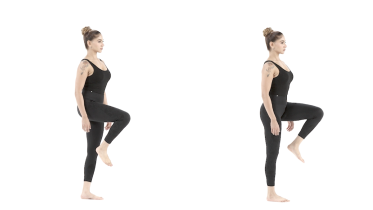 Single leg stance
Stop signs and precautions for the single leg stance
Before you start
- If you have had a hip or knee replacement, or other hip or knee surgery, get the go-ahead from your surgeon or physio before you try single leg stance. Standing on the operated leg alone comes at a set stage of rehab, and some hip operations limit how high the knee can lift in the first months after surgery.
When to stop and get help
- You feel dizzy, lightheaded, faint or sick, or the room seems to spin. Hold your support, sit down and get medical advice the same day before you practice again. If you faint, it does not settle within a few minutes of sitting still, your vision suddenly blurs or goes double, or you cannot stand or walk steadily, call emergency services.
- You lose your balance and cannot steady yourself with your support.
- Sharp pain in the hip, knee or ankle of the standing leg.
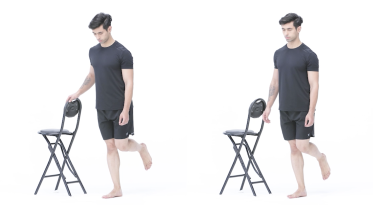 Single leg balance with eyes closed
Stop signs and precautions for the single leg balance with eyes closed
Before you start
- After a hip or knee replacement, standing on the operated leg alone comes at a set stage of rehab, so wait until your surgical team or physio says it is time.
When to stop and get help
- You feel dizzy, lightheaded, faint or sick, or the room seems to spin. Hold your support, sit down and get medical advice the same day before you practice again. If you faint, it does not settle within a few minutes of sitting still, your vision suddenly blurs or goes double, or you cannot stand or walk steadily, call emergency services.
- You lose your balance and have to grab the chair hard to stay up.
- New pain in the ankle, knee or hip of the standing leg.
- Your feet feel newly numb or tingly, or your balance has been slipping over recent weeks. Get medical advice within a few days, and leave out eyes-closed work until you have been checked. If the numbness or tingling spreads quickly up your legs or into your hands, get medical advice the same day. If your legs also feel stiff, heavy or weak, walking suddenly becomes hard, you have trouble breathing or swallowing, or you have trouble controlling your bladder or bowels, call emergency services.
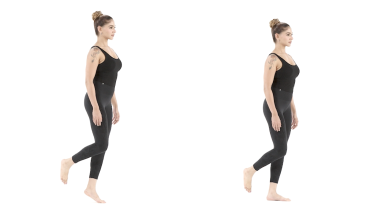 Single leg heel raise
Stop signs and precautions for the single leg heel raise
Before you start
- After an Achilles tendon repair or ankle surgery, calf raises usually come in at a set stage of your surgeon's protocol, often on both feet before one, so a single leg rise comes later still. Rising onto one foot puts more load through that tendon than the same movement on two, so check with your physio before you start.
- After surgery on the big toe joint, or a break or a stress fracture in the bones behind it, ask your surgeon or physio when to start. If that joint was fused it cannot bend upward, so pushing through the big toe side does not apply to you: keep your weight spread across the ball of the foot instead, without rolling onto the outer edge.
- Wait until your surgeon's protocol and your physio both say you are ready.
When to stop and get help
- Sharp pain in the calf, Achilles tendon or ankle, or pain that keeps building through the set.
- A sudden pop or snap at the back of your ankle or heel, a feeling that someone kicked you there, or sudden pain there after which you cannot push off or rise onto your toes on that leg. Stop, take the weight off that leg carefully and go to an urgent care center or emergency department the same day, even if you can still walk, as this can be a torn Achilles tendon.
- You lose your balance or the ankle gives way.
- The Achilles tendon or calf is clearly more painful or stiff the next morning. Check with your physio before the next session.
- You feel dizzy, lightheaded, faint or sick, or the room seems to spin. Hold your support, sit down and get medical advice the same day before you practice again. If you faint, it does not settle within a few minutes of sitting still, your vision suddenly blurs or goes double, or you cannot stand or walk steadily, call emergency services.
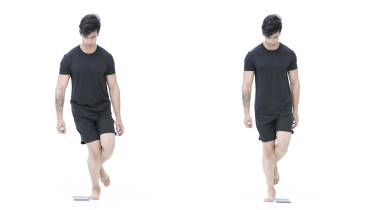 Single leg hops over a line
Stop signs and precautions for the single leg hops over a line
Before you start
- If you have had a hip or knee replacement, get the go-ahead from your surgeon before you try single leg hops over a line. Many surgeons advise against jumping and hopping after a joint replacement for good, not just for the first months, because each landing sends high impact through the new joint.
- After a knee ligament injury, knee surgery or an ankle sprain, wait until your physio clears you to hop.
- If you have osteoporosis or have fallen in the past year, ask your physio or doctor before you do any hopping.
- If you are pregnant, check with your midwife or physio before you start.
- If you have recently given birth, including by cesarean section, or you have a gap down the middle of your stomach muscles (diastasis recti), ask your physio, midwife or doctor first.
- After having a baby, postnatal guidance usually leaves jumping and hopping until at least 3 months after the birth, once a pelvic floor check shows you are ready.
- With a heart condition or high blood pressure, check with your doctor before you start.
When to stop and get help
- Sharp pain in the knee, ankle, foot or shin, on landing or afterward.
- The knee gives way or the ankle rolls.
- Swelling in the knee or ankle later that day or the next morning.
- A sudden pop or snap at the back of your ankle or heel, a feeling that someone kicked you there, or sudden pain there after which you cannot push off or rise onto your toes on that leg. Stop, take the weight off that leg carefully and go to an urgent care center or emergency department the same day, even if you can still walk, as this can be a torn Achilles tendon.
- You feel dizzy, lightheaded, faint or sick, or the room seems to spin. Stop, sit down and get medical advice the same day before you exercise again. If you faint, it does not settle within a few minutes of sitting still, your vision suddenly blurs or goes double, or you cannot stand or walk steadily, call emergency services.
- Chest pain or pressure, dizziness or feeling faint, a racing or irregular heartbeat, or being far more out of breath than the effort should cause.
Every exercise page carries its own precautions and stop signs, and those come first. If you have had a hip or knee replacement, or other hip or knee surgery, get the go-ahead from your surgeon or physio before you try single leg stance or the eyes-closed version, because standing on the operated leg alone comes at a set stage of rehab. After an ankle fracture or ankle surgery, follow your surgeon's or physio's weight-bearing plan, and start these exercises only when they have cleared you. Single leg heel raises come in at a set stage after an Achilles tendon repair or ankle surgery, often on both feet long before one leg, so check with your physio first.
Stand side on to a sturdy chair or a kitchen counter with a hand on it, on a firm non-slip floor, in flat shoes that fit and grip rather than socks or bare feet. Find your balance with your eyes open before you close them, and keep the hand on the support or hovering just above it the whole time. If you have thin bones (osteoporosis), have fallen in the past year, or often feel unsteady, keep a hand on the support and ask your physio before you let go.
The hops over a line are impact work and come last for a reason. After a knee ligament injury, knee surgery or an ankle sprain, wait until your physio clears you to hop, and if you have had a hip or knee replacement, get the go-ahead from your surgeon first, because many surgeons advise against jumping and hopping after a joint replacement for good, not just for the first months. If you are pregnant, check with your midwife or physio, and if you have recently given birth, including by cesarean section, or you have a gap down the middle of your stomach muscles (diastasis recti), ask your physio, midwife or doctor first. After having a baby, postnatal guidance usually leaves jumping and hopping until at least 3 months after the birth, once a pelvic floor check shows you are ready. Stop the hopping and speak to your physio if urine leaks while you are doing it, or if you feel pressure or heaviness low in your pelvis.
With a heart condition or high blood pressure, check with your doctor before you start the hopping, and breathe steadily through every repetition rather than holding your breath.
When to see a physio
Go after the first sprain rather than the third. The survey evidence says most netballers who seek care get the right things: exercises, balance work, taping. Almost none get told when it is safe to go back. So ask that at your first appointment, and ask what you have to be able to do rather than how many weeks it takes.
Come sooner than you were planning to if the ankle has given way twice, if it swells after every game, or if you have quietly started avoiding the jump for a high ball. A physiotherapist will test the ankle against the other side, look at how you land, and work out whether the limit is the ligament, the calf, the balance or the confidence, which are four different problems with four different programs. Read the warning list below first, and follow the timing on each line.
Related exercise programs
- Ankle sprain
- Chronic ankle instability
- High ankle sprain
- Ankle fracture rehab
- Peroneal tendinopathy
- Achilles tendinopathy
Warning signs
Get emergency help now
- Emergency: if chest pain, pressure or tightness does not ease quickly when you rest, spreads to your arm, neck, jaw, stomach or back, or comes with sweating, feeling sick, feeling light-headed or being short of breath, call emergency services straight away, as this can be a heart attack. If it eases quickly and none of these happen, get medical advice the same day, and do not exercise again until you have been checked.
- Emergency: if you faint while exercising, call emergency services, even if you feel fine again quickly.
- Emergency: the ankle or foot looks deformed or out of place, you heard a crack when you were injured, or the foot is numb, tingling, cold, pale or blue. Go to an emergency department straight away, and do not drive yourself.
- Emergency: the knee became very swollen very quickly, within a few hours of a twist, fall or blow, or you felt a pop or snap. Go to an emergency department straight away. Do not drive yourself: ask someone to drive you or call an ambulance. A knee that fills up that fast has usually bled inside the joint, which can come from a torn ligament, a kneecap that slipped out or a break, so it needs checking before you play again.
Get help today
- Same day: you could not take 4 steps right after the injury and still cannot, or the back edge or tip of either ankle bone is tender to press. Keep your weight off that foot as much as you can, leave the exercises out, and get it checked for a fracture the same day. These are part of the Ottawa ankle rules, explained on this page.
- Same day: the pain is in the middle of your foot, and the bony bump halfway along the outer edge of the foot or the bony bump on the inner side of the midfoot is tender to press. Keep your weight off that foot as much as you can, leave the exercises out, and get it checked for a fracture the same day, even if you can still walk on it.
- Same day: a sudden pop or snap at the back of your ankle or heel, a feeling that someone kicked you there, or sudden pain there after which you cannot push off or rise onto your toes on that leg. Stop, take the weight off that leg carefully and go to an urgent care center or emergency department the same day, even if you can still walk, as this can be a torn Achilles tendon.
- Same day: the pain is severe and getting worse, or the swelling or bruising is very large. Get medical advice the same day.
- Same day: the ankle or foot is hot, red and swollen, or you have a fever or feel unwell. Get medical help the same day, and go to an emergency department if you feel very unwell. If you have a very high or very low temperature, shivering you cannot control, you are breathing very fast or finding it hard to breathe, you are confused or your speech is slurred, your skin, lips or tongue look blue, gray, pale or blotchy (on brown or black skin this can be easier to see on the palms of the hands or soles of the feet), or you have a rash that does not fade when you press it, call emergency services, as this can be sepsis.
- Same day: a calf or thigh that is newly swollen or getting more swollen, warm, tender, red or darker than usual, has swollen veins that are sore to touch, or has a throbbing or cramping pain that does not fit your injury or condition, or that feels different from normal muscle soreness after exercise. This can be a sign of a blood clot (deep vein thrombosis), especially after surgery, an injury, time in a cast or boot, a long trip or a spell of being much less mobile than usual. Get medical advice the same day. If you are also short of breath or have chest pain, call emergency services.
Book an appointment
- Within a few days: your feet feel newly numb or tingly, or your balance has been slipping over recent weeks. Get medical advice within a few days, and leave out eyes-closed work until you have been checked. If the numbness or tingling spreads quickly up your legs or into your hands, get medical advice the same day. If your legs also feel stiff, heavy or weak, walking suddenly becomes hard, you have trouble breathing or swallowing, or you have trouble controlling your bladder or bowels, call emergency services.
- Within a few days: the pain sits at one small spot on a bone that you can point to with a finger, such as the shinbone or a bone in the foot, the bone aches at rest or at night, or hopping on that leg hurts at that one spot. Stop running, jumping and any exercise that hurts at that spot, and see a doctor within a few days, as this can be a stress fracture. This matters even more if the spot is on the front of the shinbone, the top of the foot in the middle, just in front of the ankle (the navicular bone), or the outer edge of the foot at the base of the little toe bone, because doctors treat stress fractures at those three sites as high risk: they heal slowly and unpredictably and they are the ones most likely to need fixing. Keep your weight off that leg as much as you can until it has been looked at. If walking hurts or makes you limp, get it checked the same day. An X-ray can look normal for the first 2 to 3 weeks, so a normal early X-ray does not rule it out.
- Within a week or two: the ankle keeps giving way or rolling over, even on flat ground, weeks or months after the sprain. This is not an emergency, but book an assessment with a physio or doctor in the next week or two.
Common questions
Can I play on a rolled ankle?
Plenty of netballers do, and that is the problem rather than the reassurance: about three in four went straight back on in two netball tournaments, from 14 ankle sprains in 103 state under-17 and under-19 players at one and 8 sprains in 192 international players at the other, while across a 14-week community season 38.5 percent went back for the following game (Rowe and colleagues, 2021). Going back on is what the players around you will expect, and it is not what the ligament needs. Before you weigh it up at all, rule out a break, and the next two signs are the ones that mean the ankle has to be checked. You could not take 4 steps right after the injury and still cannot, or the back edge or tip of either ankle bone is tender to press. Keep your weight off that foot as much as you can, leave the exercises out, and get it checked for a fracture the same day. These are part of the Ottawa ankle rules, explained on this page. If those signs are absent, the sensible answer is to come off, because an ankle that has just been sprained has lost the sense of position that stops it going over again, and the next roll is usually worse than the first.
How long until I can play netball again after an ankle sprain?
No netball-specific timeframe is published in any source we could read, and the week numbers you find on coaching forums have nothing behind them. The best document for this is a criteria-based protocol, not a calendar: the musculoskeletal physiotherapy service at Swansea Bay University Health Board publishes a six-stage return to play netball pathway that moves you on only when you can manage that stage's tasks without pain or swelling in the 24 hours afterward. Stage 2 asks for 20 seconds of balance on one leg and 10 hops on it, stage 3 adds a pain-free 3 km jog, court sprint repeats, hopping and passing work, stage 4 asks for full non-contact training plus a triple hop test within 5 percent of your other leg, stage 5 for two full contact sessions, and stage 6 is matches. Your own physiotherapist sets your criteria, and for general timescales after a sprain the ankle sprain program carries what the NHS and the guidelines say.
Why do my ankles hurt after netball?
If it is both ankles and it arrives the day after a hard session, that is usually load rather than damage, and our page on muscle soreness after exercise or injury separates the ordinary kind from the kind to act on. Soreness that sits in one spot, or on the outer edge of the ankle and foot in someone who has rolled it before, is worth more attention, and peroneal tendinopathy is one of the common answers. Stiffness and pain at the back of the heel that is worst in the first steps of the morning points toward Achilles tendinopathy instead, although in a player who is still growing that pain is often an irritated growth plate rather than the tendon, which is one of the commonest causes of heel pain in growing children and has its own page at Sever's disease, so a growing player's heel is worth getting checked rather than working through an adult tendon program. An ankle that aches after walking rather than after sport has its own page at ankle pain after walking. If the ache came with a new giving-way feeling, read the next answer.
Does taping your own ankles work as well as having a physio do it?
On the measure that trial used, yes. A randomized controlled trial of 53 pre-elite netball athletes at the Australian Institute of Sport compared tape applied by the athlete with tape applied by a physiotherapist, and found the sense of ankle position improved on application in both and held through a netball session, with no significant difference between the two (Smyth and colleagues, 2021). That is a proprioception outcome, not an injury count, so it tells you self-taping is a reasonable skill to learn rather than that it prevents sprains on its own. Learn the technique from someone who can watch you do it, and check that it has not loosened at half time.
References
- Rowe PL, Bryant AL, Paterson KL. Current ankle sprain prevention and management strategies of netball athletes: a scoping review of the literature and comparison with best-practice recommendations. BMC Sports Science, Medicine and Rehabilitation. 2021;13(1):113. https://doi.org/10.1186/s13102-021-00342-9
- Rowe PL, Hinman RS, Bryant AL, Paterson KL. Health-seeking behaviors, management practices, and return to play decisions after an ankle sprain in netball: An international cross-sectional survey of 1592 non-elite netballers. Journal of Science and Medicine in Sport. 2023;26(8):415-420. https://doi.org/10.1016/j.jsams.2023.06.004
- Attenborough AS, Sinclair PJ, Sharp T, Greene A, Stuelcken M, Smith RM, Hiller CE. A snapshot of chronic ankle instability in a cohort of netball players. Journal of Science and Medicine in Sport. 2016;19(5):379-383. https://doi.org/10.1016/j.jsams.2015.04.010
- Downs C, Snodgrass SJ, Weerasekara I, Valkenborghs SR, Callister R. Injuries in Netball: A Systematic Review. Sports Medicine Open. 2021;7(1):3. https://doi.org/10.1186/s40798-020-00290-7
- Horne S, Shaheen AF, Baltzopoulos B, Hills L. The netball injury evidence base: a scoping review of methodologies and recommendations for future approaches. Systematic Reviews. 2024;13(1):203. https://doi.org/10.1186/s13643-024-02629-7
- Mullally EM, Atack AC, Glaister M, Clark NC, Brown N. A cross-sectional retrospective survey of injury situation and prevalence in female recreational netball players with a focus on knee injuries. Physical Therapy in Sport. 2023;60:70-74. https://doi.org/10.1016/j.ptsp.2023.01.003
- Toohey LA, Antcliff A, Drew MK, Wells F, Saunders N, Piromalli LE, West S, White S, Fox AS. Epidemiology of injuries sustained in professional Australian netball: A three season cohort study. Journal of Science and Medicine in Sport. 2022;25(4):294-299. https://doi.org/10.1016/j.jsams.2021.12.004
- Horne S, Shaheen AF, Baltzopoulos B, Hills L. Match and training injury epidemiology in elite UK netball: a prospective cohort study over one season. BMJ Open Sport and Exercise Medicine. 2025;11(1):e002324. https://doi.org/10.1136/bmjsem-2024-002324
- Belcher S, Whatman C, Brughelli M, Borotkanics R. Ten-year nationwide review of netball ankle and knee injuries in New Zealand. Journal of Science and Medicine in Sport. 2020;23(10):937-942. https://doi.org/10.1016/j.jsams.2020.04.004
- Smyth E, Waddington G, Witchalls J, Newman P, Weissensteiner J, Hughes S, Niyonsenga T, Drew M. Does ankle tape improve proprioception acuity immediately after application and following a netball session? A randomised controlled trial. Physical Therapy in Sport. 2021;48:20-25. https://doi.org/10.1016/j.ptsp.2020.12.010
- Swansea Bay University Health Board, NHS Wales. Return to play netball. Accessed 6 November 2026. https://sbuhb.nhs.wales/hospitals/a-z-services/physiotherapy/musculoskeletal-physiotherapy/return-to-sport1/return-to-play-netball/
- Netball New Zealand. NetballSmart Resources. Accessed 6 November 2026. https://netballnz.co.nz/netball-smart/resources.html
- England Netball. NETBALLHer: Common netball injuries. Accessed 6 November 2026. https://netballher.co.uk/injury/common-netball-injuries/
- Stiell IG, Greenberg GH, McKnight RD, et al. Decision rules for the use of radiography in acute ankle injuries. Refinement and prospective validation. JAMA. 1993;269(9):1127-1132. https://doi.org/10.1001/jama.269.9.1127
- Bachmann LM, Kolb E, Koller MT, Steurer J, ter Riet G. Accuracy of Ottawa ankle rules to exclude fractures of the ankle and mid-foot: systematic review. BMJ. 2003;326(7386):417. https://doi.org/10.1136/bmj.326.7386.417
- Patel DS, Roth M, Kapil N. Stress fractures: diagnosis, treatment, and prevention. American Family Physician. 2011;83(1):39-46. https://www.aafp.org/pubs/afp/issues/2011/0101/p39.html
- American Academy of Orthopaedic Surgeons. Sever's Disease. OrthoInfo. Accessed 6 November 2026. https://www.orthoinfo.org/en/diseases--conditions/severs-disease/
- NHS. Chest pain. Page last reviewed 8 August 2023. https://www.nhs.uk/symptoms/chest-pain/
- NHS. Fainting. Page last reviewed 17 August 2026. https://www.nhs.uk/symptoms/fainting/
- NHS. Sprains and strains. Page last reviewed 23 April 2024. https://www.nhs.uk/conditions/sprains-and-strains/
- NHS. Tendonitis. Page last reviewed 9 June 2023. https://www.nhs.uk/conditions/tendonitis/
- NHS. Knee pain. Page last reviewed 21 December 2023. https://www.nhs.uk/symptoms/knee-pain/
- NHS. DVT (deep vein thrombosis). Page last reviewed 30 April 2026. https://www.nhs.uk/conditions/deep-vein-thrombosis-dvt/
Written and checked by the PocketPhysio editorial team. Last updated 2026-11-06.
This page is general education, not a diagnosis or a personal treatment plan. See a physiotherapist or doctor for advice about your own situation.