
Part of Netball injuries: what the numbers say and what to do first
Netball warm-up programs: what they contain and how often to do them
Warning signs, and when to get help
Two different things called a warm-up
Search for a netball warm-up and you get two answers that have almost nothing in common. One is a library of games and drills for coaches who need to fill the first ten minutes of a session. The other is a structured program from a national governing body, designed to change how a player lands and to lower her injury risk. This page is about the second kind, because the first kind is already well served and nobody has ever claimed it prevents anything.
The difference is content, not length or enthusiasm. Raising your temperature and getting a squad moving is worth doing, but it changes nothing about how a knee behaves when you come down from a jump. The national programs add strength, balance and landing work for that reason, and the netball evidence points at landing above everything else: a Delphi consensus of netball experts rated poor landing technique the only factor out of 61 with a top mitigation priority of 5 out of 5 (Whitehead and colleagues, 2025).
So a warm-up in the sense this page means is really a short training session that happens to come first. Read it that way and both the dose and the dropout problem further down make sense.
What the three national programs contain
Netball Australia's KNEE Program is an on-court routine in four sections: Warm Up, Strength, Balance and Landing, and Agility. It is published at three levels, junior, recreational and elite, it names Netball Australia's own Diamonds head physiotherapist as its designer, and it is built around four principles, take off, landing, deceleration and change of direction. Its coach manual asks coaches to introduce the sections gradually across weeks rather than all at once, and says correct technique is imperative rather than desirable.
Netball New Zealand's NetballSmart Dynamic Warm-up runs in four parts, A to D, and sits inside a bigger set of free resources: a Power Warm-up for tournaments, versions for social netball, umpires, walking netball and school years 7 and 8, a landing skills booklet with a three-level progression, a strength resource, and five sheets on the ankle. It was developed with New Zealand's accident insurance body, which is why it is free to anyone who plays there.
England Netball runs Jump High Land Strong, which it describes on its own NETBALLHer platform as conditioning movements performed as part of a warm up to lower injury risk. Its guidance page says the program teaches the landing mechanics netball needs, is written for every age and every level, and needs no equipment. The dose it gives is twice a week as part of your warm-up, and it calls that a minimum for whichever level you are on rather than a target. It is built as two levels of five sessions, starting at level 1A, and you move up a level only when you can do the tasks on that card with control, which you check against a scorecard scored by a teammate or from a video of yourself rather than by feel. If you play in England, go to England Netball for the sessions and the scorecard themselves.
What none of these pages will do, including this one, is reproduce a program's exercise list. They are the governing bodies' own resources, they come with coaching notes for a reason, and a list lifted out of its program is the version that gets done wrong.
How long should a netball warm-up be?
Neither the KNEE Program coach manual nor the NetballSmart pages we read puts a number of minutes on it, so anyone quoting you one has invented it. What is published is a structure, which is a better guide: you have finished when all four sections have been done, not when the clock says so.
In practice the limiting factor is the court booking. If your session is an hour and the hall is busy, the realistic answer is to protect the sections that matter rather than to shorten everything equally, and the implementation research below says exactly which ones get sacrificed when time runs short.
One thing to add for a cold hall in February. Give it more minutes, not more effort: lengthen the easy movement at the start, keep a layer on until you are properly warm, and take the on-court rehearsal slower than feels necessary before the first whistle.
Does a netball warm-up actually prevent injury?
Two trials have tested these warm-ups in netballers. Neither counted injuries. A cluster trial randomized 12 teams from 6 schools, 77 New Zealand players with a mean age of 15.8, to the NetballSmart Dynamic Warm-up or the Power Warm-up, three times a week for 12 weeks, and both groups improved every landing technique measure, with only the Landing Error Scoring System favoring one of them (Belcher and colleagues, 2021). A randomized controlled trial put two Netball NSW Premier League teams on the KNEE Program or a traditional warm-up and measured balance reach at 8 weeks and 5 months, and found improvement in one direction only and no group effect on the cumulative score (Grayson and colleagues, 2024).
Better landing scores are not fewer torn ligaments, and a surrogate result is not a null result either. Who looked and when: on 6 November 2026 we searched for netball trials with injury outcomes and found none, after reading 52 records across two PubMed searches.
Outside netball the evidence is real and it was measured in other sports. In 18 studies pooling 25,166 athletes, mostly female with a mean age of 19.3, ACL prevention programs produced a risk ratio of 0.46, and the athletes in those studies played handball, soccer, basketball or volleyball (Watson and colleagues, 2026). Pooled across the female players alone, which is the comparison closest to netball, it was a more modest 0.57.
An earlier systematic review of nine equipment-free warm-up studies reported reductions in lower limb and knee injuries in young amateur female footballers and in female football and basketball players, and a reduction in anterior knee pain in military recruits (Herman and colleagues, 2012). Netball shares the jumping, landing and stopping that those sports are built on, which is a reasonable basis for borrowing the method. It is not a basis for borrowing a percentage, and the netball knee page goes through where every figure you will see quoted was actually measured.
How often, and for how long?
Netball Australia publishes two doses for the same program, so both go here as written rather than averaged into one. The coach manual says that for maximum effectiveness the program must be completed 2 to 3 times per week and must be continued for the effect to be maintained. The program website puts the floor lower, at least twice a week for maximum effectiveness, and says the benefit only holds while the program is kept up. The stricter of the two is the manual's, and that is the one to work to until the governing body reconciles them. One line on the same website takes some of the sting out of the mismatch: it recommends the program is completed before every court work or match play session, so the twice a week is a floor rather than a target.
Duration is the part everyone underestimates. The netball trial that changed landing technique ran three times a week for 12 weeks. The systematic review outside netball concluded that the programs that worked were applied consistently for longer than three consecutive months (Herman and colleagues, 2012). A fortnight of landing drills before finals is not what any of this evidence describes.
Two or three times a week also means training sessions, not match days. Most clubs train once and play once, which is the practical obstacle nobody mentions: hitting the published dose usually means doing part of it at home. The exercises below are there for that.
The parts that get dropped
An observational study watched 67 community netball training sessions across four clubs, and its findings should change how a coach plans a session. No team performed the recommended number of activities without modification. By age group, 12, 18 and 14 percent of the recommended activities were performed as intended. Warm-up and footwork activities ran at a median of 30 percent of what was asked, while strength, balance and landing, and agility all ran at a median of zero. Feedback was required in 65 percent of activities and was not provided in 56 percent (Saad and colleagues, 2021).
Read the last two numbers again, because they are the heart of this page. The sections that survive contact with a real training night are the ones that feel like a warm-up. The sections that disappear are the ones carrying the evidence. A club that does the jogging and the footwork and skips the strength and landing work has kept the packaging.
Coaching is the other half. In a survey of Welsh senior and under-21 netball, only 2 of 28 players and 6 of 29 coaches used any ACL prevention program, while more than 90 percent of respondents said they would if someone explained and demonstrated it to them (Abdul and colleagues, 2024). The coach response rate there was 13 percent, so weigh the coach numbers accordingly. The barrier there is not willingness.
Should you stretch before netball?
Not as the main event, and not held long. The KNEE Program deliberately contains no static stretching, and its manual gives the reason in its own words: recent evidence suggests static stretching before activity does not have a protective effect against injury. That is Netball Australia's stated position and it is the one its program is built on. The same manual then says regular stretching away from training may be appropriate as required, and prints a list of suggested stretches for that, so the position is about when you stretch rather than about stretching.
Netball New Zealand files its stretches sheets the same way. On the NetballSmart resources index, NetballSmart Stretches and NetballSmart Stretches and Roller Recovery sit under Recovery, alongside the roller and hydration sheets, while the warm-up sheets sit under Dynamic Warm-up. So the two governing bodies are not contradicting each other. Keep the long holds for after the last game or for a session of their own, and put the moving work before you play.
Stiffness that lasts the first half hour of every morning in a hip, knee or ankle is a different problem, and no amount of warming up will fix it. Soreness that turns up a day later and fades is ordinary, and our page on muscle soreness after exercise or injury separates that from the kind to act on.
If you are coming back from an injury
A warm-up program is not a rehabilitation program, and the order matters. If your ankle is still swelling after games, work through the staged ankle sprain program first, and if it keeps rolling months later, chronic ankle instability is the page you want. Pain at the front of the knee after repeated landing and shooting practice usually belongs with patellar tendinopathy, and a heel and tendon that stiffen overnight with Achilles tendinopathy.
Coming back from an ACL reconstruction is a criteria-based decision with testing behind it, covered at return to sport testing, and your surgeon and treating physiotherapist set the limits rather than a warm-up page. A warm-up is also not the way back from a head knock: after a concussion the return runs through a staged protocol, with a minimum standdown of 21 days from the injury before competitive contact sport in the UK, Australia and New Zealand, and the last steps back to contact need a clinician's sign off rather than a calendar. That process is set out at concussion recovery and return to play. The ankle side of prevention, including the taping and bracing evidence, is on the netball ankle page, and the whole picture for the sport sits on the netball hub. If you also play another court sport, the padel warm-up and the pickleball warm-up are built the same way for those games.
Exercises that can help
Six movements that teach what the national programs are made of, in the order a session usually runs: raise your temperature, open the ranges netball uses, then rehearse the landing. Jogging on the spot often runs at 2 to 4 rounds of 30 seconds to 2 minutes at an easy pace, the grapevine at 2 to 4 rounds of 20 to 30 seconds traveling both ways, the lateral lunge at 2 to 3 sets of 8 to 12 on each side, the lunge with twist at 2 to 3 sets of 6 to 10 on each leg on 2 or 3 days a week, skater hops at 2 to 3 sets of 10 to 20 hops counting each landing or 20 to 30 seconds of work, and pogo hops at 2 to 3 sets of 10 to 20 low hops or about 15 to 20 seconds. On court you will do fewer of each and move on faster. Where this paragraph and an exercise page differ, the exercise page wins. Your physio will adjust this.
The exercises below carry their own stop signs and precautions. Open the line under an exercise and read them before you try it.
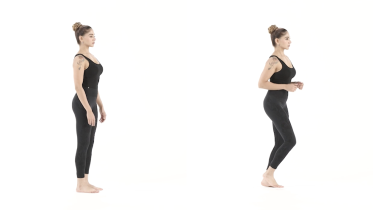 Jogging on the spot
Stop signs and precautions for the jogging on the spot
Before you start
- If you have had a hip or knee replacement, get the go-ahead from your surgeon before you try jogging on the spot. Many surgeons advise against running and jogging after a joint replacement for good, not just for the first months, because each step sends impact through the new joint.
- Every step is a small impact, and your heart works harder the faster you go. Ask your doctor or physio before you start if you have a heart or lung condition, high blood pressure or osteoporosis, or are coming back from a leg injury or operation.
- The same applies if you are pregnant or notice urine leaking when you jog or jump.
- If you have recently given birth, including by cesarean section, or you have a gap down the middle of your stomach muscles (diastasis recti), ask your physio, midwife or doctor first.
- After having a baby, postnatal guidance usually leaves running and jogging until at least 3 months after the birth, once a pelvic floor check shows you are ready.
When to stop and get help
- Chest pain or pressure, dizziness or feeling faint, a racing or irregular heartbeat, or being far more out of breath than the effort should cause.
- You feel dizzy, lightheaded, faint or sick, or the room seems to spin. Stop, sit down and get medical advice the same day before you exercise again. If you faint, it does not settle within a few minutes of sitting still, your vision suddenly blurs or goes double, or you cannot stand or walk steadily, call emergency services.
- Sharp pain in the foot, shin, knee or hip, or pain that makes you limp.
- Shin or foot pain that is clearly worse the next morning.
- Urine leaks as you jog, or you notice heaviness or dragging low in your pelvis.
- A sudden pop or snap at the back of your ankle or heel, a feeling that someone kicked you there, or sudden pain there after which you cannot push off or rise onto your toes on that leg. Stop, take the weight off that leg carefully and go to an urgent care center or emergency department the same day, even if you can still walk, as this can be a torn Achilles tendon.
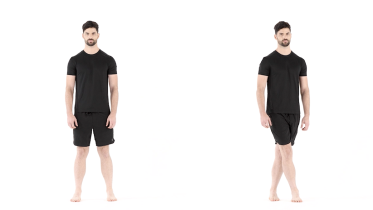 Grapevine drill
Stop signs and precautions for the grapevine drill
Before you start
- If you have had a hip replacement or other hip surgery, get the go-ahead from your surgeon or physio before you try the grapevine. Crossing one leg in front of or behind the other takes that leg across the middle of your body, and many surgeons ask you to avoid that for the first months after some operations.
- If you have osteoporosis or have fallen in the past year, practice only when someone else is at home, and ask your doctor or physio about a falls check.
When to stop and get help
- You feel dizzy, lightheaded, faint or sick, or the room seems to spin. Hold your support, sit down and get medical advice the same day before you practice again. If you faint, it does not settle within a few minutes of sitting still, your vision suddenly blurs or goes double, or you cannot stand or walk steadily, call emergency services.
- You trip on your own feet or feel close to falling.
- Sharp pain in the hip, groin, knee or ankle, or an ankle that feels like it could roll.
- Chest pain or pressure, dizziness or feeling faint, a racing or irregular heartbeat, or being far more out of breath than the effort should cause.
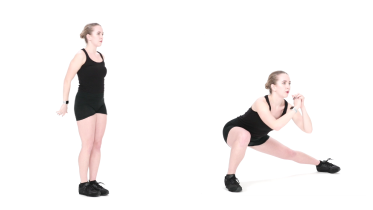 Lateral lunge
Stop signs and precautions for the lateral lunge
When to stop and get help
- Sharp or pulling pain in the groin or inner thigh.
- Sharp pain in the knee or hip, or the knee feels unstable.
- You feel dizzy, lightheaded, faint or sick, or the room seems to spin. Stop, sit down and get medical advice the same day before you exercise again. If you faint, it does not settle within a few minutes of sitting still, your vision suddenly blurs or goes double, or you cannot stand or walk steadily, call emergency services.
- Chest pain or pressure, dizziness or feeling faint, a racing or irregular heartbeat, or being far more out of breath than the effort should cause.
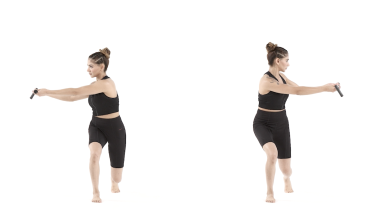 Lunge with twist
Stop signs and precautions for the lunge with twist
Before you start
- If you have had a hip replacement, get the go-ahead from your surgeon or physio before you try the lunge with twist. Some operations limit this kind of work for the first months, so the timing depends on your surgery.
- With low bone density (osteoporosis) or a past fracture in the spine, check with your physio before you add the twist, and ask how far to turn.
When to stop and get help
- Sharp pain in your knee, hip or back, or pain that shoots down a leg.
- Your knee gives way, or you lose your balance and have to grab something to stay up.
- You feel dizzy or lightheaded as you turn. If you faint while exercising, call emergency services, even if you feel fine again quickly.
- Chest pain or pressure, dizziness or feeling faint, a racing or irregular heartbeat, or being far more out of breath than the effort should cause.
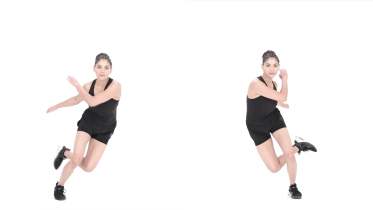 Skater hops
Stop signs and precautions for the skater hops
Before you start
- If you have had a hip or knee replacement, get the go-ahead from your surgeon before you try skater hops. Many surgeons advise against jumping and hopping after a joint replacement for good, not just for the first months, because each landing sends high impact through the new joint. After any other hip, knee or ankle surgery, such as a ligament repair, ask your surgical team or physio before doing any hopping. After a broken bone or a stress fracture in the foot, or surgery on the foot or toes, wait until your surgeon or physio clears you to hop.
- Check with your physio or doctor before you start if you leak urine when you cough, sneeze or exercise, have osteoporosis, or have fallen in the past year.
- Pregnant, or had a baby in the past months? Talk to your midwife or physio first.
- After having a baby, postnatal guidance usually leaves jumping and hopping until at least 3 months after the birth, once a pelvic floor check shows you are ready.
- With a heart condition or high blood pressure, get your doctor's advice before you start.
When to stop and get help
- Chest pain or pressure, dizziness or feeling faint, a racing or irregular heartbeat, or being far more out of breath than the effort should cause.
- Sharp pain in the hip, knee or ankle, a knee that gives way, or an ankle that rolls.
- Leaking urine, or a feeling of pressure or heaviness low in the pelvis.
- A sudden pop or snap at the back of your ankle or heel, a feeling that someone kicked you there, or sudden pain there after which you cannot push off or rise onto your toes on that leg. Stop, take the weight off that leg carefully and go to an urgent care center or emergency department the same day, even if you can still walk, as this can be a torn Achilles tendon.
- You feel dizzy, lightheaded, faint or sick, or the room seems to spin. Stop, sit down and get medical advice the same day before you exercise again. If you faint, it does not settle within a few minutes of sitting still, your vision suddenly blurs or goes double, or you cannot stand or walk steadily, call emergency services.
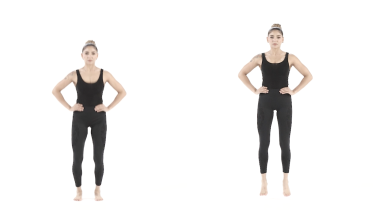 Pogo hops
Stop signs and precautions for the pogo hops
Before you start
- If you have had a hip or knee replacement, get the go-ahead from your surgeon before you try pogo hops. Many surgeons advise against jumping and hopping after a joint replacement for good, not just for the first months, because each landing sends high impact through the new joint.
- After an Achilles tendon injury, a calf tear, a stress fracture in the shin or the foot, or ankle or foot surgery, wait until your physio clears you to hop.
- If you have osteoporosis, a heart condition or high blood pressure, are pregnant, have fallen in the past year, or notice urine leaking when you hop, ask your physio or doctor before you start.
- If you have recently given birth, including by cesarean section, or you have a gap down the middle of your stomach muscles (diastasis recti), ask your physio, midwife or doctor first.
- After having a baby, postnatal guidance usually leaves jumping and hopping until at least 3 months after the birth, once a pelvic floor check shows you are ready.
When to stop and get help
- Sharp pain in the Achilles tendon, heel, shin or knee, on landing or afterward.
- A sudden pop or snap at the back of your ankle or heel, a feeling that someone kicked you there, or sudden pain there after which you cannot push off or rise onto your toes on that leg. Stop, take the weight off that leg carefully and go to an urgent care center or emergency department the same day, even if you can still walk, as this can be a torn Achilles tendon.
- Achilles or shin pain that is clearly worse the next morning, or new swelling in the ankle or knee.
- You feel dizzy, lightheaded, faint or sick, or the room seems to spin. Stop, sit down and get medical advice the same day before you exercise again. If you faint, it does not settle within a few minutes of sitting still, your vision suddenly blurs or goes double, or you cannot stand or walk steadily, call emergency services.
- Chest pain or pressure, dizziness or feeling faint, a racing or irregular heartbeat, or being far more out of breath than the effort should cause.
- Urine leaks as you hop, or you feel heaviness or dragging low in your pelvis.
Some precautions first, and the stop signs on each exercise page come before anything here. Wear flat shoes that fit well and grip the floor, not socks, tights or bare feet, and have a fence post, a rail or a sturdy chair beside you for the grapevine, the lunge with twist and the hopping. If you have low bone density (osteoporosis), have fallen in the past year, or often feel unsteady, keep a hand on that support, ask your doctor or physio about a falls check, and practice the footwork drills with someone else at home first.
Jogging on the spot, skater hops and pogo hops are impact work. Ask your doctor or physio before you start if you have a heart or lung condition, high blood pressure or osteoporosis, or are coming back from a leg injury or operation. The same applies if you notice urine leaking when you jog or hop.
If you are pregnant or had a baby in the past months, talk to your midwife or physio first, and if you have a gap down the middle of your stomach muscles (diastasis recti), ask your physio, midwife or doctor. After having a baby, postnatal guidance usually leaves jumping and hopping until at least 3 months after the birth, once a pelvic floor check shows you are ready. Stop the hopping and speak to your physio if urine leaks while you are doing it, or if you feel pressure or heaviness low in your pelvis.
If you have had a hip or knee replacement, get the go-ahead from your surgeon or physio before you try jogging on the spot, skater hops and pogo hops. Many surgeons advise against running, jogging, jumping and hopping after a joint replacement for good, not just for the first months, because each step and each landing sends impact through the new joint. After any other hip, knee or ankle surgery, such as a ligament repair, ask your surgical team or physio before doing any hopping, and after an Achilles tendon injury, a calf tear, a stress fracture in the shin or the foot, or ankle or foot surgery, wait until your physio clears you to hop.
If you have had a hip replacement or other hip surgery, get the go-ahead from your surgeon or physio before you try the grapevine and the lunge with twist. Crossing one leg in front of or behind the other takes that leg across the middle of your body, and many surgeons ask you to avoid that for the first months after some operations. The lunge with twist is a question of load as well as position, and some operations limit this kind of work for the first months. With low bone density or a past fracture in the spine, check with your physio before you add the twist, and ask how far to turn.
With the lateral lunge, start with a short step and a shallow bend if your groin has been sore, and go wider and lower only once that feels steady. If you have high blood pressure, breathe steadily through every repetition and never hold your breath, and with a heart condition or high blood pressure, check with your doctor before you start.
When to see a physio
See someone when the warm-up stops feeling like a formality. Needing twenty minutes before a hip will bend, a calf that tightens in the first quarter of every game, a knee that aches for two days after a session of landing practice: none of those is a warm-up problem and none of them improves by warming up harder.
The other reason to book is the one the implementation research keeps pointing at. A physiotherapist can watch you land, tell you what your knee actually did, and correct one thing at a time, which is the feedback that was missing from more than half the activities observed in community netball. Bring your week with you, because a flare usually belongs to the fortnight before it rather than to the session it appeared in. Read the warning list below first, and follow the timing each line gives.
Related exercise programs
Warning signs
Get emergency help now
- Emergency: if chest pain, pressure or tightness does not ease quickly when you rest, spreads to your arm, neck, jaw, stomach or back, or comes with sweating, feeling sick, feeling light-headed or being short of breath, call emergency services straight away, as this can be a heart attack. If it eases quickly and none of these happen, get medical advice the same day, and do not exercise again until you have been checked.
- Emergency: if you faint while exercising, call emergency services, even if you feel fine again quickly.
- Emergency: any sign of a stroke, even if it goes away. That means a face that droops on one side, an arm you cannot lift or keep up, slurred or muddled speech, weakness or numbness on one side of your body or face, sudden blurred vision, double vision or loss of sight, trouble swallowing, sudden dizziness with unsteadiness or falling over, a sudden severe headache, or a sudden fall where your legs give way but you do not black out (a drop attack). Call emergency services straight away.
- Emergency: after a ball, a collision or a fall to the face, any change to your sight, severe pain in the eye, a headache or finding light hard to bear, feeling sick or being sick, an eye you cannot move or keep open, or blood or pus coming from the eye. The same applies if something has pierced the eye or hit it at high speed, or if a strong chemical has gone into it. Go to an emergency department or call emergency services straight away, and do not drive yourself.
- Emergency: after a knock to the head, being very drowsy or finding it hard to keep your eyes open, confusion, a fit (seizure), new weakness or numbness anywhere in your body, new trouble understanding, speaking, walking or keeping your balance, new problems seeing or hearing, clear fluid coming from your ears or nose, bleeding from your ears or bruising behind them, a black eye when your eye was not hit, a dent in your head or a wound with something stuck in it, or a change in behavior. Call emergency services straight away. These can be signs of an injury to the brain.
- Emergency: a knock to the head in a high-energy accident, even if you feel completely well. That means a fall from a height of more than 1 meter (about 3 feet) or more than 5 stairs, a crash at high speed, a car that rolled over, being thrown from a vehicle, being hit by a vehicle while walking or cycling, a bike crash, an accident on a quad bike or similar motorized vehicle, a fall from a horse, a diving accident, or any other heavy, fast impact to the head. Call emergency services straight away, without waiting to see how you feel. A high-energy head injury is a reason for emergency assessment on its own, with no symptoms needed.
- Emergency: after a knock to the head, you were knocked out, even for a moment, you cannot remember what happened just before or after, you have had a headache ever since, or you are being sick (vomiting). The same applies, even if you feel fine, if you take medicine that thins your blood, other than aspirin on its own, have a bleeding or clotting condition, have had brain surgery in the past, or had been drinking alcohol or taking drugs when it happened. Go to an emergency department straight away, and do not drive yourself.
- Emergency: severe neck pain after a knock to the head, whatever the fall or the knock was like. Keep still and call emergency services, and do not let anyone move you until someone trained has checked your neck. If the neck pain only starts later and nobody has checked your neck since, go to an emergency department straight away, and do not drive yourself.
- Emergency: after a knock to the head, swelling, a deep cut or severe pain at the exact spot that was hit. Call emergency services or go to an emergency department straight away, and do not drive yourself. These can be signs of a broken skull.
- Emergency: you have had a fall or an injury and now have severe hip pain, or you cannot walk or put weight on the leg. Call emergency services or go to an emergency department. This can be a sign of a broken hip (hip fracture).
- Emergency: the knee became very swollen very quickly, within a few hours of a twist, fall or blow, or you felt a pop or snap. Go to an emergency department straight away. Do not drive yourself: ask someone to drive you or call an ambulance. A knee that fills up that fast has usually bled inside the joint, which can come from a torn ligament, a kneecap that slipped out or a break, so it needs checking before you play again.
- Emergency: the ankle or foot looks deformed or out of place, you heard a crack when you were injured, or the foot is numb, tingling, cold, pale or blue. Go to an emergency department straight away, and do not drive yourself.
- Emergency: you are still growing, you have pain that wakes you at night, pain at rest that keeps getting worse, or a lump or swelling around the knee or thigh that keeps growing, and you also have a rash that does not fade when you press a glass on it. Call emergency services or go to an emergency department straight away. Without the rash, follow the line on the same symptoms further down this list, which gives you a day or two.
Get help today
- Same day: a sudden pop or snap at the back of your ankle or heel, a feeling that someone kicked you there, or sudden pain there after which you cannot push off or rise onto your toes on that leg. Stop, take the weight off that leg carefully and go to an urgent care center or emergency department the same day, even if you can still walk, as this can be a torn Achilles tendon.
- Same day: you felt the kneecap slip out of place and it went back by itself. Get assessed the same day.
- Same day: sudden new dizziness, or feeling faint or unsteady, without any of the stroke signs above. Stop, sit down and get medical advice the same day. If you faint, it does not settle within a few minutes of sitting still, or you cannot stand or walk steadily, call emergency services.
- Same day: you blacked out or fainted, even for a moment. Get medical advice the same day. Call emergency services instead if the person is not breathing, cannot be woken within 1 minute, has not fully recovered or has trouble speaking or moving, has chest pain or a pounding, fluttering or irregular heartbeat, fainted while exercising or lying down, is shaking or jerking, or was badly hurt.
- Same day: a calf or thigh that is newly swollen or getting more swollen, warm, tender, red or darker than usual, has swollen veins that are sore to touch, or has a throbbing or cramping pain that does not fit your injury or condition, or that feels different from normal muscle soreness after exercise. This can be a sign of a blood clot (deep vein thrombosis), especially after surgery, an injury, time in a cast or boot, a long trip or a spell of being much less mobile than usual. Get medical advice the same day. If you are also short of breath or have chest pain, call emergency services.
- Same day: you are a teenager who is still growing and you have a limp, or pain in the hip, groin or thigh as well as the knee. Get an urgent appointment with a doctor the same day, and stay off sport and these exercises until you have been checked. If you cannot put weight on the leg, have a high temperature or feel very unwell, go to an emergency department. Some hip problems in growing teenagers, such as a slipped growth plate at the top of the thigh bone (slipped capital femoral epiphysis), are felt in the knee and need checking quickly.
- Same day: you have had a knock to the head and you take aspirin on its own, without any of the emergency signs above. Get medical advice the same day. Aspirin on its own is the only blood thinning medicine left out of the emergency line above, and the NHS still asks anybody taking a medicine that thins the blood to get urgent advice after a head injury.
Book an appointment
- Within a day or two: you are still growing and have pain that wakes you at night, pain at rest that keeps getting worse, or a lump or swelling around the knee or thigh that keeps growing. See a doctor within a day or two. Ask for an urgent appointment rather than the next routine one, and say what the pain does at night and whether a lump is getting bigger. Do the same if the pain comes with looking pale, unusual tiredness, fevers with no clear cause, bruising or bleeding easily, or weight loss. Bone pain that is worse at night, or a new lump, needs checking to rule out rarer causes such as a bone tumor or a blood cancer (leukemia).
- Within a few days: the pain sits at one small spot on a bone that you can point to with a finger, such as the shinbone or a bone in the foot, the bone aches at rest or at night, or hopping on that leg hurts at that one spot. Stop running, jumping and any exercise that hurts at that spot, and see a doctor within a few days, as this can be a stress fracture. This matters even more if the spot is on the front of the shinbone, the top of the foot in the middle, just in front of the ankle (the navicular bone), or the outer edge of the foot at the base of the little toe bone, because doctors treat stress fractures at those three sites as high risk: they heal slowly and unpredictably and they are the ones most likely to need fixing. Keep your weight off that leg as much as you can until it has been looked at. If walking hurts or makes you limp, get it checked the same day. An X-ray can look normal for the first 2 to 3 weeks, so a normal early X-ray does not rule it out.
Common questions
What is a good netball warm-up?
One that includes the parts nobody enjoys, and all three national programs are built the same way round: get warm, then do strength, balance and landing work, then move at game speed. Netball Australia's KNEE Program has four sections, Warm Up, Strength, Balance and Landing, and Agility, published at junior, recreational and elite levels. Netball New Zealand's NetballSmart Dynamic Warm-up runs in four parts, A to D, with a separate Power Warm-up for tournaments and its own landing skills progression in three levels. England Netball's Jump High Land Strong is two levels of five sessions aimed at landing mechanics, done as part of a warm up twice a week, with a scorecard you have to pass before you move up a level. Get the real document from your own governing body, because a list copied onto a page like this one loses the coaching that makes it work.
What is NetballSmart?
It is Netball New Zealand's injury prevention program, developed with the country's accident insurance body, and it is more than a warm-up. Its own page describes the Dynamic Warm-up as netball specific preparation for every game and training, meant to prepare a player for the movement demands of the game, improve her movement skill, warm her up and help lower injury risk. The resources index lists the pieces around it: a Power Warm-up for tournaments, versions for social netball, umpires, walking netball and school years 7 and 8, a landing skills booklet, a strength resource, and five sheets on the ankle covering sprains, managing a sprain, netball shoes, prevention tips, and taping and bracing. If you play in New Zealand this is the program you have access to. If you do not, it is still the clearest free description of what a netball-specific warm-up is supposed to contain.
Do netball warm-up games count as a warm-up?
They count as the first part of one. A relay or a possession game raises temperature and gets the group moving, which is worth having, and it is where almost every junior session stops. What it does not do is rehearse a controlled landing or load the muscles that hold a knee in line, and those are the sections that carry whatever benefit these programs have in other sports. The observational study of community netball makes the point in numbers: warm-up and footwork activities were performed at a median of 30 percent of what the program asked, and strength, balance and landing and agility at a median of zero (Saad and colleagues, 2021). So play the game if your squad enjoys it, then do the landing work afterward rather than instead.
How often do I need to do a netball warm-up program?
More often than before matches, and for longer than a season. Netball Australia's coach manual says the program must be completed 2 to 3 times per week and must be continued for the effect to be maintained; the program's website says at least twice a week for maximum effectiveness, and the stricter of the two is the manual. The New Zealand trial that improved landing technique ran its warm-up three times a week for 12 weeks (Belcher and colleagues, 2021). Outside netball, a systematic review of neuromuscular warm-up programs concluded that the effective ones were applied consistently for longer than three consecutive months (Herman and colleagues, 2012). Read those together and the honest answer is two or three sessions a week, every week, for months rather than weeks.
References
- Netball Australia. KNEE Program Coach Manual. Accessed 6 November 2026. https://knee.netball.com.au/sites/knee/files/2025-12/NET5359_Netball_Aus_Knee_Coach_Manual_07.pdf
- Netball Australia. Netball KNEE Program: About Us. Accessed 6 November 2026. https://knee.netball.com.au/about-us
- Netball Australia. Netball KNEE Program: Resources. Accessed 6 November 2026. https://knee.netball.com.au/resources
- Netball New Zealand. NetballSmart Dynamic Warm-up. Accessed 6 November 2026. https://netballnz.co.nz/netball-smart/dynamic-warm-up.html
- Netball New Zealand. NetballSmart Resources. Accessed 6 November 2026. https://netballnz.co.nz/netball-smart/resources.html
- Netball New Zealand. NetballSmart Landing Skills. Accessed 6 November 2026. https://netballnz.co.nz/netball-smart/landing-skills.html
- England Netball. NETBALLHer: Ten ways to avoid injury. Accessed 6 November 2026. https://netballher.co.uk/injury/ten-ways-to-avoid-injury/
- England Netball. Jump High Land Strong Guidance. Read 6 November 2026 from the Internet Archive snapshot of 22 June 2025, because the live page returns HTTP 429. https://www.englandnetball.co.uk/the-roses-development-framework/pillars-of-development/jump-high-land-strong-guidance/
- Belcher S, Whatman C, Brughelli M, Borotkanics R. Short and long versions of a 12-week netball specific neuromuscular warm-up improves landing technique in youth netballers. Physical Therapy in Sport. 2021;49:31-36. https://doi.org/10.1016/j.ptsp.2021.01.016
- Grayson J, Hillard D, Antcliff A, Chan C, Nightingale E, Pappas E. The effect of the KNEE program for Netball players on the modified Star Excursion Balance Test: a randomized controlled trial. Physical Therapy in Sport. 2024;67:83-89. https://doi.org/10.1016/j.ptsp.2024.03.004
- Herman K, Barton C, Malliaras P, Morrissey D. The effectiveness of neuromuscular warm-up strategies, that require no additional equipment, for preventing lower limb injuries during sports participation: a systematic review. BMC Medicine. 2012;10:75. https://doi.org/10.1186/1741-7015-10-75
- Watson SL, Gohal C, Owen MM, Bajaj PM, Plantz MA, Tjong VK. A Systematic Review and Meta-analysis of Anterior Cruciate Ligament Injury Prevention Programs: Training to Stay in the Game. American Journal of Sports Medicine. 2026;54(3):733-740. https://doi.org/10.1177/03635465251376670
- Saad T, Davies L, Smith M. Implementation of an injury prevention programme in community netball: An observational study. Journal of Sports Sciences. 2021;39(19):2180-2188. https://doi.org/10.1080/02640414.2021.1923932
- Abdul W, Moore I, Robertson A. Anterior Cruciate Ligament Injury Prevention Programs in Welsh Netball: A Survey of Knowledge, Implementation and Barriers Amongst Players and Coaches. Cureus. 2024;16(5):e60405. https://doi.org/10.7759/cureus.60405
- Downs C, Snodgrass SJ, Weerasekara I, Valkenborghs SR, Callister R. Injuries in Netball: A Systematic Review. Sports Medicine Open. 2021;7(1):3. https://doi.org/10.1186/s40798-020-00290-7
- Whitehead S, Mackay L, Jones B, Heyward O, Fox AS, Chesson LJ, Scantlebury S, Janse van Rensburg DCC. Injury risk factors and their priority for mitigation in women's netball: a systematic review and Delphi consensus. British Journal of Sports Medicine. 2025;59(5):294-305. https://doi.org/10.1136/bjsports-2024-108756
- Belcher S, Whatman C, Brughelli M, Borotkanics R. Ten-year nationwide review of netball ankle and knee injuries in New Zealand. Journal of Science and Medicine in Sport. 2020;23(10):937-942. https://doi.org/10.1016/j.jsams.2020.04.004
- Patel DS, Roth M, Kapil N. Stress fractures: diagnosis, treatment, and prevention. American Family Physician. 2011;83(1):39-46. https://www.aafp.org/pubs/afp/issues/2011/0101/p39.html
- American Academy of Orthopaedic Surgeons. Slipped Capital Femoral Epiphysis. OrthoInfo. https://www.orthoinfo.org/en/diseases--conditions/slipped-capital-femoral-epiphysis-scfe
- National Institute for Health and Care Excellence. Suspected cancer: recognition and referral (NG12). Published 23 June 2015, last updated 15 April 2026. https://www.nice.org.uk/guidance/ng12
- NHS. Chest pain. Page last reviewed 8 August 2023. https://www.nhs.uk/symptoms/chest-pain/
- NHS. Fainting. Page last reviewed 17 August 2026. https://www.nhs.uk/symptoms/fainting/
- NHS. Falls. Page last reviewed 6 March 2025. https://www.nhs.uk/conditions/falls/
- NHS. Symptoms of a stroke. Page last reviewed 12 September 2024. https://www.nhs.uk/conditions/stroke/symptoms/
- NHS. Eye injuries. Page last reviewed 12 March 2026. https://www.nhs.uk/conditions/eye-injuries/
- NHS. Head injury and concussion. Page last reviewed 29 May 2025. https://www.nhs.uk/conditions/head-injury-and-concussion/
- NHS. Knee pain. Page last reviewed 21 December 2023. https://www.nhs.uk/symptoms/knee-pain/
- NHS. Dislocated kneecap. Page last reviewed 10 March 2026. https://www.nhs.uk/conditions/dislocated-kneecap/
- NHS. Tendonitis. Page last reviewed 9 June 2023. https://www.nhs.uk/conditions/tendonitis/
- NHS. DVT (deep vein thrombosis). Page last reviewed 30 April 2026. https://www.nhs.uk/conditions/deep-vein-thrombosis-dvt/
- NHS. Sprains and strains. Page last reviewed 23 April 2024. https://www.nhs.uk/conditions/sprains-and-strains/
- Sport and Recreation Alliance and UK Government. UK concussion guidelines for non-elite (grassroots) sport. Published 2023, updated November 2024. https://sportandrecreation.org.uk/campaigns-and-policy/concussion/concussion-guidelines-for-grassroots-sport-html-version
Written and checked by the PocketPhysio editorial team. Last updated 2026-11-06.
This page is general education, not a diagnosis or a personal treatment plan. See a physiotherapist or doctor for advice about your own situation.