
Netball injuries: what the numbers say and what to do first
Warning signs, and when to get help
What netball asks of a body
Everything on this page follows from one sequence: you jump to take a ball, you land, you stop, and then you have to go again. The landing is where the sport does its damage, and the sources that have looked hardest at it agree. Netball Australia says on its own KNEE Program site that most netball injuries happen to knees and ankles when landing, and the four principles its program is built around are take off, landing, deceleration and change of direction.
Contact is part of it too, and it tends to take the top half of you. Among 193 adult women playing recreational netball in the UK, lower limb injuries came mostly from landings, at 46 percent, while upper limb injuries came mostly from colliding with an opponent, at 27 percent (Mullally and colleagues, 2023). The systematic review of netball injuries names landings, collisions and falls as the main circumstances across its 46 studies (Downs and colleagues, 2021). So an ankle or a knee is usually your own body failing to absorb a landing, and a shoulder or a hand is usually somebody else arriving.
Age changes the pattern. In ten years of national insurance claims in New Zealand, children aged 10 to 14 showed the biggest increase in injury counts, with ankle claims up 84 percent and knee claims up 133 percent, while players aged 20 to 24 carried the highest mean rate over the decade, 77.8 ankle and 71.6 knee injuries per 1000 players (Belcher and colleagues, 2020). The same review noted that spikes in injury are likely linked to intense periods of selection trials and tournament play. That is a useful thing to know in the week your club has selections.
What are the most common netball injuries?
The ankle and the knee, in that order on most counts, and a long way clear of everything else. The honest numbers are ranges, not single figures. The systematic review found the ankle and the knee to be the most common sites in 19 of its studies, and said the figures varied considerably between those studies, the ankle running from 13 to 84 percent of injuries and the knee from 8 to 50 percent (Downs and colleagues, 2021). A range that wide is not sloppy research. Those studies defined injury differently, watched different levels of player and collected their data in different ways.
Underneath those two, the picture depends on who was counted. In Australia's professional league over three seasons, 866 injuries needing medical attention fell out as ankle 20.9 percent, knee 15.7 percent and foot 11.3 percent (Toohey and colleagues, 2022). England Netball's own platform groups the common ones as the anterior cruciate ligament, general pain, finger and hand injuries, and concussion, and states that between 57 and 86 percent of all netball injuries are in the lower limbs.
Children break the pattern in one specific way. The systematic review found that children sustained more upper limb injuries, fractures among them, while adults sustained more lower limb injuries (Downs and colleagues, 2021). A junior who jams a hand catching a pass is in the commonest group for her age, not an unlucky exception.
How often do netball players get hurt?
Often enough that a recreational club will see it every season, and the best figure for a club player comes from a club population. Of 193 female adult recreational players surveyed in the UK, 61 percent reported a lower limb injury in the previous 12 months and 27 percent an upper limb injury (Mullally and colleagues, 2023). It is a survey, so people were remembering a whole year. That catches the slow aches a clinic never sees, and it also means memory is doing the work.
Rates per hour exist only at the top. One 14-month elite UK season produced 70 injuries in 39 of 90 players, at 41.12 injuries per 1000 player hours in matches against 1.10 in training (Horne and colleagues, 2025). Nobody has produced the equivalent for a Thursday night league, so if a page quotes you a netball injury rate per hour and you play socially, it is not about you.
The cost, when it goes wrong at club level, is measured in months rather than weeks. The 46 percent of those UK recreational players who had sustained a knee injury in the previous five years were unable to train for 6.8 months on average, with a standard deviation of 7.0, and unable to play matches for 8.2 months, standard deviation 7.4 (Mullally and colleagues, 2023). Hold that next to the time a proper netball warm-up takes.
Why two trustworthy sources disagree about the knee and the ankle
You will find netball described as an ankle sport on one page and a knee sport on the next, and both pages can cite something real. Netball Australia's coach manual, drawing on national insurance data, reports that among Australian netballers the knee has overtaken the ankle to become the commonest injury of all. The scoping review of ankle sprain practice in netball opens by saying ankle sprains are the most commonly reported injury in the sport (Rowe and colleagues, 2021). In Australia's professional league, the ankle came out ahead of the knee, 20.9 percent against 15.7 percent (Toohey and colleagues, 2022).
These three are counting three different things. Insurance claims are weighted toward injuries serious and expensive enough to claim for, reported injuries across 30 studies are weighted toward whatever each study asked about, and medical attention injuries in one league are weighted toward whatever a team physiotherapist saw that week. The defensible summary is the one that keeps both: the ankle happens more often, the knee costs more when it happens. Picking a winner would mean throwing away one of the two true statements.
The wider evidence base is thinner than its confidence suggests, and that is worth knowing before you trust any number on any netball page. A scoping review of 65 netball injury studies found only two had used ongoing systematic injury surveillance, only two had assessed injury mechanisms properly using video, and 76 percent took a simplistic view of causality (Horne and colleagues, 2024). So this page gives you the best answer available and says how thin the evidence under it is.
What does not wait until Monday
Chest pain comes first on every sport page on this site, and for the same reason: a netball game is repeated hard effort, and stopping the point is cheap compared with the alternative. Pain, pressure or tightness in the chest means you come off and sit down, then follow the first line in the warning list below. Fainting during exercise is in the same bracket and needs emergency services even if you feel fine two minutes later.
A knee that swells inside a few hours of a twist, a landing or a blow is the second. That speed of swelling usually means blood inside the joint, and the warning list below sends it to an emergency department straight away rather than to a physio on Tuesday. A pop or a snap with it makes the case stronger, not weaker, and so does being able to walk, because people walk off torn ligaments all the time.
Third is the head, and netball puts several players at speed into the same piece of court, reaching for the same ball. England Netball gives concussion more space than any other injury on its own common injuries page, and names the 2023 UK Government guidelines on recognizing concussion and returning players safely to work and sport. Our warning list below carries the full set of head injury signs, including the ones that mean an emergency department even when the player insists she is fine, and the rule that severe neck pain after a knock to the head is not something to drive yourself about.
Once the emergency signs have been ruled out, a knock to the head still has a route, and it is not a judgment call for the coach or the player. The UK grassroots guidance takes the player off immediately and keeps her out of competition, training and PE for at least 24 hours, and it asks for every suspected concussion to be assessed inside that 24 hours, by a healthcare professional on site or by calling NHS 111. After that the return runs through a staged protocol, which in the UK, Australia and New Zealand also carries a minimum standdown of 21 days from the injury before competitive contact sport. Read the 21 days as a floor rather than a countdown: the last steps back to contact need a clinician's sign off as well.
The whole process, including how the standdown differs in the USA and Canada and how children are handled, is set out at concussion recovery and return to play. This page gives no shortcut version of it, because a shortened protocol is the one thing a head injury page must not publish.
A rolled ankle that looks deformed or out of place, a crack heard at the moment of injury, or a foot that goes numb, tingling, cold, pale or blue is the fourth, and the last one here. Go to an emergency department straight away, and do not drive yourself. The warning list below gives the full set of signs, and every other line in it carries its own timing.
Where to start if something already hurts
Most netball complaints already have a staged program here. A rolled ankle goes to ankle sprain, an ankle that keeps going over months later goes to chronic ankle instability, and pain high between the shin bones after a hard twist belongs with high ankle sprain, which is a different injury with a slower recovery. Pain along the outer edge of the ankle and foot in a player who rolls it repeatedly often turns out to be peroneal tendinopathy.
For knees, an ache at the front of the kneecap after a session of repeated landings usually sits with knee pain when squatting and patellar tendinopathy, the jumper's knee of the shooting circle. A kneecap that has slipped sideways has its own program at patellar dislocation. A knee that has actually torn its anterior cruciate ligament goes to ACL reconstruction rehab, which is the page for a knee that is already injured. If your knee is intact and you want it to stay that way, the page you want is netball knee injury prevention instead.
Shoulders that come out of place in a collision go to shoulder dislocation. Hands are the other half of this sport, and England Netball warns players about the finger they dismiss with "I have only jarred it", naming fractures, dislocations and torn ligaments and tendons as what gets missed. A fingertip that droops and will not straighten after a jammed catch has its own page at mallet finger, a thumb bent back away from the hand at skier's thumb, and a wrist taken on a fall at wrist sprain. An ankle that aches the day after rather than giving way is often ankle pain after walking, and a body that is simply sore after three games in a weekend belongs with muscle soreness after exercise or injury, which separates ordinary stiffness from the kind to act on. The two deeper netball pages are the netball ankle and netball knee injury prevention, and if you have come here from another court sport, the padel hub and the pickleball hub are built the same way.
Exercises that can help
Four exercises for the parts of you netball leans on hardest: the landing, the sideways step, the calf that holds an ankle up, and balance on one leg while something else occupies your attention. The single leg hop and hold often starts at 2 to 3 sets of 6 to 10 hops, counting both legs, on 2 or 3 days a week, the lateral lunge at 2 to 3 sets of 8 to 12 on each side, single leg heel raises at 2 to 3 sets of 8 to 15 on each leg a few days a week, and the ball pass at 2 to 3 rounds of about 20 to 30 seconds on each leg. Where this paragraph and an exercise page differ, the exercise page wins. Your physio will adjust this.
The exercises below carry their own stop signs and precautions. Open the line under an exercise and read them before you try it.
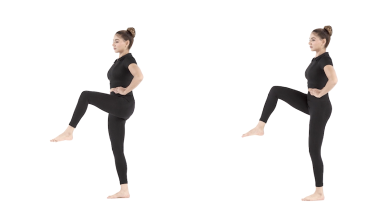 Single leg hop and hold
Stop signs and precautions for the single leg hop and hold
Before you start
- After a knee fracture or knee surgery, including a knee replacement, follow your surgeon's or physio's plan, and start this exercise only when they have cleared you. After an ankle fracture or ankle surgery, follow your surgeon's or physio's weight-bearing plan, and start this exercise only when they have cleared you. If you have had a hip or knee replacement, get the go-ahead from your surgeon before you try the single leg hop and hold. Many surgeons advise against jumping and hopping after a joint replacement for good, not just for the first months, because each landing sends high impact through the new joint.
- After a broken bone or a stress fracture in the foot, or surgery on the foot or toes, wait until your surgeon or physio clears you to hop.
- Ask your doctor or physio before you start if you have thin bones (osteoporosis) or have fallen in the past year.
- If you are pregnant, check with your midwife or physio before you start.
- If you have recently given birth, including by cesarean section, or you have a gap down the middle of your stomach muscles (diastasis recti), ask your physio, midwife or doctor first.
- After having a baby, postnatal guidance usually leaves jumping and hopping until at least 3 months after the birth, once a pelvic floor check shows you are ready.
- With a heart condition or high blood pressure, check with your doctor before you start.
When to stop and get help
- Sharp pain in the foot, ankle, shin or knee as you land, or later that day.
- Your landing knee buckles or your ankle turns over.
- A sudden pop or snap at the back of your ankle or heel, a feeling that someone kicked you there, or sudden pain there after which you cannot push off or rise onto your toes on that leg. Stop, take the weight off that leg carefully and go to an urgent care center or emergency department the same day, even if you can still walk, as this can be a torn Achilles tendon.
- Urine leaks as you land, or your pelvis feels heavy or as if something is dragging down.
- You feel dizzy, lightheaded, faint or sick, or the room seems to spin. Stop, sit down and get medical advice the same day before you exercise again. If you faint, it does not settle within a few minutes of sitting still, your vision suddenly blurs or goes double, or you cannot stand or walk steadily, call emergency services.
- Chest pain or pressure, dizziness or feeling faint, a racing or irregular heartbeat, or being far more out of breath than the effort should cause.
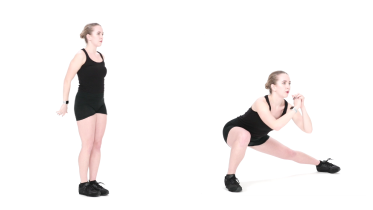 Lateral lunge
Stop signs and precautions for the lateral lunge
When to stop and get help
- Sharp or pulling pain in the groin or inner thigh.
- Sharp pain in the knee or hip, or the knee feels unstable.
- You feel dizzy, lightheaded, faint or sick, or the room seems to spin. Stop, sit down and get medical advice the same day before you exercise again. If you faint, it does not settle within a few minutes of sitting still, your vision suddenly blurs or goes double, or you cannot stand or walk steadily, call emergency services.
- Chest pain or pressure, dizziness or feeling faint, a racing or irregular heartbeat, or being far more out of breath than the effort should cause.
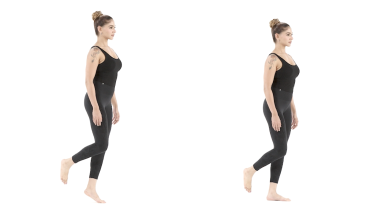 Single leg heel raise
Stop signs and precautions for the single leg heel raise
Before you start
- After an Achilles tendon repair or ankle surgery, calf raises usually come in at a set stage of your surgeon's protocol, often on both feet before one, so a single leg rise comes later still. Rising onto one foot puts more load through that tendon than the same movement on two, so check with your physio before you start.
- After surgery on the big toe joint, or a break or a stress fracture in the bones behind it, ask your surgeon or physio when to start. If that joint was fused it cannot bend upward, so pushing through the big toe side does not apply to you: keep your weight spread across the ball of the foot instead, without rolling onto the outer edge.
- Wait until your surgeon's protocol and your physio both say you are ready.
When to stop and get help
- Sharp pain in the calf, Achilles tendon or ankle, or pain that keeps building through the set.
- A sudden pop or snap at the back of your ankle or heel, a feeling that someone kicked you there, or sudden pain there after which you cannot push off or rise onto your toes on that leg. Stop, take the weight off that leg carefully and go to an urgent care center or emergency department the same day, even if you can still walk, as this can be a torn Achilles tendon.
- You lose your balance or the ankle gives way.
- The Achilles tendon or calf is clearly more painful or stiff the next morning. Check with your physio before the next session.
- You feel dizzy, lightheaded, faint or sick, or the room seems to spin. Hold your support, sit down and get medical advice the same day before you practice again. If you faint, it does not settle within a few minutes of sitting still, your vision suddenly blurs or goes double, or you cannot stand or walk steadily, call emergency services.
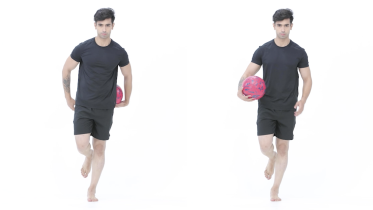 Single leg balance with ball pass
Stop signs and precautions for the single leg balance with ball pass
Before you start
- If you have injured a knee in the past, ask your physio before you add a wobble board: in the trial this training rests on, overuse knee injuries went up among the players who had injured a knee before (Verhagen and colleagues, 2004).
When to stop and get help
- You feel dizzy, lightheaded, faint or sick, or the room seems to spin. Hold your support, sit down and get medical advice the same day before you practice again. If you faint, it does not settle within a few minutes of sitting still, your vision suddenly blurs or goes double, or you cannot stand or walk steadily, call emergency services.
- You nearly fall, or have to grab the counter to stay on your feet.
- Sharp pain in the standing ankle or knee, or the ankle gives way.
Every exercise page carries its own precautions and stop signs, and those come before anything in this paragraph. The single leg hop and hold is impact work on one leg, so it comes late rather than early. After a knee fracture or knee surgery, including a knee replacement, follow your surgeon's or physio's plan, and start these exercises only when they have cleared you. After an ankle fracture or ankle surgery, follow your surgeon's or physio's weight-bearing plan, and start these exercises only when they have cleared you. If you have had a hip or knee replacement, get the go-ahead from your surgeon before you try the single leg hop and hold, because many surgeons advise against jumping and hopping after a joint replacement for good, not just for the first months, and each landing sends high impact through the new joint.
Ask your doctor or physio before you start the hopping if you have thin bones (osteoporosis) or have fallen in the past year. If you are pregnant, check with your midwife or physio before you start, and if you have recently given birth, including by cesarean section, or you have a gap down the middle of your stomach muscles (diastasis recti), ask your physio, midwife or doctor first. After having a baby, postnatal guidance usually leaves jumping and hopping until at least 3 months after the birth, once a pelvic floor check shows you are ready. Stop the hopping and speak to your physio if urine leaks while you are doing it, or if you feel pressure or heaviness low in your pelvis.
Keep a counter or a sturdy chair within reach for the heel raises and the ball pass, and keep a hand on it throughout if your balance is poor or you have had falls. Single leg heel raises come at a set stage after an Achilles tendon repair or ankle surgery, often on both feet long before one, so wait until your surgeon's protocol and your physio both say you are ready. With the lateral lunge, start with a short step and a shallow bend if your groin has been sore, and go wider and lower only once that feels steady. With a heart condition or high blood pressure, check with your doctor before you start any of this, and if you have high blood pressure, breathe steadily through every repetition and never hold your breath.
When to see a physio
Two weeks of the same soreness is the usual trigger. So is an ankle that has gone over twice, a knee that has given way once, or the quiet realization that you have stopped driving to the post you used to drive to. Netball players tend to wait for a season to end, and the knee figures from recreational clubs are an argument against that: once a knee injury happens at club level, the time out is counted in months.
A first appointment is mostly watching you move. A physiotherapist will look at how you land from a jump, whether the knee drifts inward as you stop, how far the ankle bends, and whether the hip can hold the pelvis level on one leg, then build the program around whichever of those is furthest behind. Bring an honest account of your last fortnight of court time, because a flare usually belongs to the two weeks before it rather than to the session it showed up in. Read the warning list below first, and follow the timing each line gives.
In this topic
- Netball knee injury prevention: lowering ACL risk on court
Netball knee injury prevention, honestly: how ACL tears happen on court, what the KNEE Program and NetballSmart ask of you, and what the evidence covers.
- Netball ankle injury: the sprain, the recovery and getting back on court
A netball ankle injury, from the inside: how the sprain happens, what the netball recurrence figures say, whether to tape or brace, and when to play.
- Netball warm-up programs: what they contain and how often to do them
What a netball warm-up should contain, what the KNEE Program and NetballSmart prescribe, how often to do it, and which parts clubs keep dropping.
Related exercise programs
- Ankle sprain
- Chronic ankle instability
- ACL reconstruction rehab
- Patellar tendinopathy
- Patellar dislocation
- Shoulder dislocation
- Concussion recovery and return to activity
- Mallet finger
Warning signs
Get emergency help now
- Emergency: if chest pain, pressure or tightness does not ease quickly when you rest, spreads to your arm, neck, jaw, stomach or back, or comes with sweating, feeling sick, feeling light-headed or being short of breath, call emergency services straight away, as this can be a heart attack. If it eases quickly and none of these happen, get medical advice the same day, and do not exercise again until you have been checked.
- Emergency: if you faint while exercising, call emergency services, even if you feel fine again quickly.
- Emergency: any sign of a stroke, even if it goes away. That means a face that droops on one side, an arm you cannot lift or keep up, slurred or muddled speech, weakness or numbness on one side of your body or face, sudden blurred vision, double vision or loss of sight, trouble swallowing, sudden dizziness with unsteadiness or falling over, a sudden severe headache, or a sudden fall where your legs give way but you do not black out (a drop attack). Call emergency services straight away.
- Emergency: after a ball, a collision or a fall to the face, any change to your sight, severe pain in the eye, a headache or finding light hard to bear, feeling sick or being sick, an eye you cannot move or keep open, or blood or pus coming from the eye. The same applies if something has pierced the eye or hit it at high speed, or if a strong chemical has gone into it. Go to an emergency department or call emergency services straight away, and do not drive yourself.
- Emergency: after a knock to the head, being very drowsy or finding it hard to keep your eyes open, confusion, a fit (seizure), new weakness or numbness anywhere in your body, new trouble understanding, speaking, walking or keeping your balance, new problems seeing or hearing, clear fluid coming from your ears or nose, bleeding from your ears or bruising behind them, a black eye when your eye was not hit, a dent in your head or a wound with something stuck in it, or a change in behavior. Call emergency services straight away. These can be signs of an injury to the brain.
- Emergency: a knock to the head in a high-energy accident, even if you feel completely well. That means a fall from a height of more than 1 meter (about 3 feet) or more than 5 stairs, a crash at high speed, a car that rolled over, being thrown from a vehicle, being hit by a vehicle while walking or cycling, a bike crash, an accident on a quad bike or similar motorized vehicle, a fall from a horse, a diving accident, or any other heavy, fast impact to the head. Call emergency services straight away, without waiting to see how you feel. A high-energy head injury is a reason for emergency assessment on its own, with no symptoms needed.
- Emergency: after a knock to the head, you were knocked out, even for a moment, you cannot remember what happened just before or after, you have had a headache ever since, or you are being sick (vomiting). The same applies, even if you feel fine, if you take medicine that thins your blood, other than aspirin on its own, have a bleeding or clotting condition, have had brain surgery in the past, or had been drinking alcohol or taking drugs when it happened. Go to an emergency department straight away, and do not drive yourself.
- Emergency: severe neck pain after a knock to the head, whatever the fall or the knock was like. Keep still and call emergency services, and do not let anyone move you until someone trained has checked your neck. If the neck pain only starts later and nobody has checked your neck since, go to an emergency department straight away, and do not drive yourself.
- Emergency: after a knock to the head, swelling, a deep cut or severe pain at the exact spot that was hit. Call emergency services or go to an emergency department straight away, and do not drive yourself. These can be signs of a broken skull.
- Emergency: the shoulder feels as if it has slipped out of place, looks a different shape or suddenly locks so you cannot move the arm, or the pain is severe after a fall or an injury. Go to an emergency department straight away, without driving yourself, and do not try to put the shoulder back in yourself.
- Emergency: your arm, hand or fingers turn cold, pale, blue or gray compared with the other side. Call emergency services or go to an emergency department straight away, and do not drive yourself. The blood supply to the arm may be blocked.
- Emergency: after an injury, a finger or thumb that points at an odd angle, looks blue or feels numb, or has a cut with bone showing or poking out. Go to an emergency department straight away, and do not drive yourself. The finger may be broken.
- Emergency: the knee became very swollen very quickly, within a few hours of a twist, fall or blow, or you felt a pop or snap. Go to an emergency department straight away. Do not drive yourself: ask someone to drive you or call an ambulance. A knee that fills up that fast has usually bled inside the joint, which can come from a torn ligament, a kneecap that slipped out or a break, so it needs checking before you play again.
- Emergency: the ankle or foot looks deformed or out of place, you heard a crack when you were injured, or the foot is numb, tingling, cold, pale or blue. Go to an emergency department straight away, and do not drive yourself.
- Emergency: you are still growing, you have pain that wakes you at night, pain at rest that keeps getting worse, or a lump or swelling around the knee or thigh that keeps growing, and you also have a rash that does not fade when you press a glass on it. Call emergency services or go to an emergency department straight away. Without the rash, follow the line on the same symptoms further down this list, which gives you a day or two.
Get help today
- Same day: a finger or thumb that became painful, swollen, bruised, stiff or hard to move after an injury, rather than slowly over weeks. Get medical advice the same day, and have it checked before you start these exercises.
- Same day: a sudden pop or snap at the back of your ankle or heel, a feeling that someone kicked you there, or sudden pain there after which you cannot push off or rise onto your toes on that leg. Stop, take the weight off that leg carefully and go to an urgent care center or emergency department the same day, even if you can still walk, as this can be a torn Achilles tendon.
- Same day: you felt the kneecap slip out of place and it went back by itself. Get assessed the same day.
- Same day: you cannot walk or put weight on the leg, whether or not there was a fall or injury, or you have very bad knee pain after a fall or injury, or very bad knee pain that came on suddenly with no injury at all. Get medical advice the same day.
- Same day: the knee locks and you cannot straighten it, or it keeps giving way under you. Get medical advice the same day. Until it has been checked, leave out the exercises you do standing on one leg, hold the rail on stairs and take care on uneven ground, because a knee that gives way without warning is how people fall.
- Same day: a calf or thigh that is newly swollen or getting more swollen, warm, tender, red or darker than usual, has swollen veins that are sore to touch, or has a throbbing or cramping pain that does not fit your injury or condition, or that feels different from normal muscle soreness after exercise. This can be a sign of a blood clot (deep vein thrombosis), especially after surgery, an injury, time in a cast or boot, a long trip or a spell of being much less mobile than usual. Get medical advice the same day. If you are also short of breath or have chest pain, call emergency services.
- Same day: you are a teenager who is still growing and you have a limp, or pain in the hip, groin or thigh as well as the knee. Get an urgent appointment with a doctor the same day, and stay off sport and these exercises until you have been checked. If you cannot put weight on the leg, have a high temperature or feel very unwell, go to an emergency department. Some hip problems in growing teenagers, such as a slipped growth plate at the top of the thigh bone (slipped capital femoral epiphysis), are felt in the knee and need checking quickly.
- Same day: the pain is there at night or at rest and keeps getting worse. If you are being treated for cancer now, contact your cancer team the same day.
- Same day: you have had a knock to the head and you take aspirin on its own, without any of the emergency signs above. Get medical advice the same day. Aspirin on its own is the only blood thinning medicine left out of the emergency line above, and the NHS still asks anybody taking a medicine that thins the blood to get urgent advice after a head injury.
Book an appointment
- Within a day or two: you are still growing and have pain that wakes you at night, pain at rest that keeps getting worse, or a lump or swelling around the knee or thigh that keeps growing. See a doctor within a day or two. Ask for an urgent appointment rather than the next routine one, and say what the pain does at night and whether a lump is getting bigger. Do the same if the pain comes with looking pale, unusual tiredness, fevers with no clear cause, bruising or bleeding easily, or weight loss. Bone pain that is worse at night, or a new lump, needs checking to rule out rarer causes such as a bone tumor or a blood cancer (leukemia).
- Within a day or two: the pain is there at night or at rest and keeps getting worse. If you have had cancer, now or in the past, or are losing weight without trying, see your doctor sooner, within a day or two, and mention it. This applies even if the pain is not getting worse.
- Within a few days: the pain sits at one small spot on a bone that you can point to with a finger, such as the shinbone or a bone in the foot, the bone aches at rest or at night, or hopping on that leg hurts at that one spot. Stop running, jumping and any exercise that hurts at that spot, and see a doctor within a few days, as this can be a stress fracture. This matters even more if the spot is on the front of the shinbone, the top of the foot in the middle, just in front of the ankle (the navicular bone), or the outer edge of the foot at the base of the little toe bone, because doctors treat stress fractures at those three sites as high risk: they heal slowly and unpredictably and they are the ones most likely to need fixing. Keep your weight off that leg as much as you can until it has been looked at. If walking hurts or makes you limp, get it checked the same day. An X-ray can look normal for the first 2 to 3 weeks, so a normal early X-ray does not rule it out.
- Within a few days: the pain is there at night or at rest and keeps getting worse. See your doctor within a few days.
Common questions
Why is netball so hard on knees and ankles?
Because the game keeps asking you to stop in the air and then stop again on the floor, which is where most netball injuries start. Netball Australia puts it plainly on its own KNEE Program site: most injuries in netball happen to knees and ankles when landing. The filmed evidence agrees: a video analysis of 21 anterior cruciate ligament injuries in elite netball found 17 came from a jump-landing action and only 2 from cutting, with 11 of them sharing one scenario, a rapid deceleration after jumping for a high pass (Belcher and colleagues, 2024). A systematic review of non-contact knee injury in adult netball, covering six studies and 11,401 players, found landing was the most reported situation at 46.6 percent of knee injuries, with the knee collapsing inward the most observed mechanism (Mullally and colleagues, 2021). Ankles roll in the same moment, which is why the netball knee page and the netball ankle page keep pointing at each other.
What is the worst injury you can get playing netball?
By time lost rather than by frequency, the knee. Netball Australia's coach manual, citing its own national insurance data, estimates that as high as 25 percent of all major injuries in Australian netball are attributed to anterior cruciate ligament injury alone, and England Netball states that knee trauma accounts for almost a third of all netball-related hospitalizations. In the UK Superleague season that was tracked prospectively, anterior cruciate ligament injuries were infrequent and expensive: there were two of them, one in a match and one in training, and between those two players they accounted for 496 days out, 208 and 288. Knee joint injuries carried the heaviest in-season burden in Australia's professional league, at 44.9 days of absence per 365 player contract days (Horne and colleagues, 2025; Toohey and colleagues, 2022). The recreational figure is the one that should worry a club player most: of 193 UK recreational netballers, the 46 percent who had hurt a knee in the previous five years were out of training for 6.8 months on average, with a standard deviation of 7.0, and out of matches for 8.2 months, standard deviation 7.4 (Mullally and colleagues, 2023).
How often do netball players get hurt in a match compared with training?
Match play is where almost all of it happens. Over one 14-month season, 90 players in the UK Vitality Netball Superleague produced 70 injuries in 39 players, at 41.12 injuries per 1000 player hours in matches against 1.10 per 1000 player hours in training (Horne and colleagues, 2025). Those are elite players with elite exposure, so do not read the rate as yours. The shape of it still holds for a club night: the risky hours are the competitive ones, which is an argument for preparing properly rather than for training less.
Which netball position gets injured most?
In the one UK elite cohort that reported it, the centre. Players in the centre position sustained 41 percent of all injuries recorded across that season (Horne and colleagues, 2025). One season in one league is thin evidence, nobody has repeated it at club level, and a position count cannot separate the demands of the position from the hours the person played or who happened to be in the squad. Treat it as a reason to pay attention to the engine room of your team rather than as a ranking of danger.
References
- Downs C, Snodgrass SJ, Weerasekara I, Valkenborghs SR, Callister R. Injuries in Netball: A Systematic Review. Sports Medicine Open. 2021;7(1):3. https://doi.org/10.1186/s40798-020-00290-7
- Horne S, Shaheen AF, Baltzopoulos B, Hills L. The netball injury evidence base: a scoping review of methodologies and recommendations for future approaches. Systematic Reviews. 2024;13(1):203. https://doi.org/10.1186/s13643-024-02629-7
- Horne S, Shaheen AF, Baltzopoulos B, Hills L. Match and training injury epidemiology in elite UK netball: a prospective cohort study over one season. BMJ Open Sport and Exercise Medicine. 2025;11(1):e002324. https://doi.org/10.1136/bmjsem-2024-002324
- Mullally EM, Atack AC, Glaister M, Clark NC, Brown N. A cross-sectional retrospective survey of injury situation and prevalence in female recreational netball players with a focus on knee injuries. Physical Therapy in Sport. 2023;60:70-74. https://doi.org/10.1016/j.ptsp.2023.01.003
- Mullally EM, Atack AC, Glaister M, Clark NC. Situations and mechanisms of non-contact knee injury in adult netball: A systematic review. Physical Therapy in Sport. 2021;47:193-200. https://doi.org/10.1016/j.ptsp.2020.12.004
- Toohey LA, Antcliff A, Drew MK, Wells F, Saunders N, Piromalli LE, West S, White S, Fox AS. Epidemiology of injuries sustained in professional Australian netball: A three season cohort study. Journal of Science and Medicine in Sport. 2022;25(4):294-299. https://doi.org/10.1016/j.jsams.2021.12.004
- Belcher S, Whatman C, Brughelli M, Borotkanics R. Ten-year nationwide review of netball ankle and knee injuries in New Zealand. Journal of Science and Medicine in Sport. 2020;23(10):937-942. https://doi.org/10.1016/j.jsams.2020.04.004
- Belcher S, Whatman C, Brughelli M. A systematic video analysis of 21 anterior cruciate ligament injuries in elite netball players during games. Sports Biomechanics. 2024;23(12):2546-2563. https://doi.org/10.1080/14763141.2022.2034928
- Rowe PL, Bryant AL, Paterson KL. Current ankle sprain prevention and management strategies of netball athletes: a scoping review of the literature and comparison with best-practice recommendations. BMC Sports Science, Medicine and Rehabilitation. 2021;13(1):113. https://doi.org/10.1186/s13102-021-00342-9
- Netball Australia. Netball KNEE Program: About Us. Accessed 6 November 2026. https://knee.netball.com.au/about-us
- Netball Australia. KNEE Program Coach Manual. Accessed 6 November 2026. https://knee.netball.com.au/sites/knee/files/2025-12/NET5359_Netball_Aus_Knee_Coach_Manual_07.pdf
- England Netball. NETBALLHer: Common netball injuries. Accessed 6 November 2026. https://netballher.co.uk/injury/common-netball-injuries/
- Patel DS, Roth M, Kapil N. Stress fractures: diagnosis, treatment, and prevention. American Family Physician. 2011;83(1):39-46. https://www.aafp.org/pubs/afp/issues/2011/0101/p39.html
- American Academy of Orthopaedic Surgeons. Slipped Capital Femoral Epiphysis. OrthoInfo. https://www.orthoinfo.org/en/diseases--conditions/slipped-capital-femoral-epiphysis-scfe
- National Institute for Health and Care Excellence. Suspected cancer: recognition and referral (NG12). Published 23 June 2015, last updated 15 April 2026. https://www.nice.org.uk/guidance/ng12
- NHS. Chest pain. Page last reviewed 8 August 2023. https://www.nhs.uk/symptoms/chest-pain/
- NHS. Fainting. Page last reviewed 17 August 2026. https://www.nhs.uk/symptoms/fainting/
- NHS. Symptoms of a stroke. Page last reviewed 12 September 2024. https://www.nhs.uk/conditions/stroke/symptoms/
- NHS. Eye injuries. Page last reviewed 12 March 2026. https://www.nhs.uk/conditions/eye-injuries/
- NHS. Head injury and concussion. Page last reviewed 29 May 2025. https://www.nhs.uk/conditions/head-injury-and-concussion/
- NHS. Dislocated shoulder. Page last reviewed 16 September 2026. https://www.nhs.uk/conditions/dislocated-shoulder/
- NHS. Broken finger or thumb. Page last reviewed 20 November 2025. https://www.nhs.uk/conditions/broken-finger/
- NHS. Knee pain. Page last reviewed 21 December 2023. https://www.nhs.uk/symptoms/knee-pain/
- NHS. Dislocated kneecap. Page last reviewed 10 March 2026. https://www.nhs.uk/conditions/dislocated-kneecap/
- NHS. Tendonitis. Page last reviewed 9 June 2023. https://www.nhs.uk/conditions/tendonitis/
- NHS. DVT (deep vein thrombosis). Page last reviewed 30 April 2026. https://www.nhs.uk/conditions/deep-vein-thrombosis-dvt/
- NHS. Sprains and strains. Page last reviewed 23 April 2024. https://www.nhs.uk/conditions/sprains-and-strains/
- Sport and Recreation Alliance and UK Government. UK concussion guidelines for non-elite (grassroots) sport. Published 2023, updated November 2024. https://sportandrecreation.org.uk/campaigns-and-policy/concussion/concussion-guidelines-for-grassroots-sport-html-version
Written and checked by the PocketPhysio editorial team. Last updated 2026-11-06.
This page is general education, not a diagnosis or a personal treatment plan. See a physiotherapist or doctor for advice about your own situation.