
Partial knee replacement recovery: a staged program
Warning signs, and when to get help
How long does partial knee replacement recovery take?
One figure on this page was written for this operation instead of being borrowed from the bigger one, and it is OrthoInfo's. By 6 weeks after the operation, it says, you will most likely have all of your usual daily activities back. Daily living is the limit of that figure, and work, driving and sport have dates of their own further down this page. Before that point it says you begin putting weight on the knee immediately after surgery, and that you may need a walker, cane or crutches for the first several days or weeks. The NHS adds the comparison in one line, that recovery after a partial should be shorter than after a total, and the caution that full recovery from a knee replacement may take several months or longer.
Swelling outlasts the walking. Knowing that in advance saves a lot of worry. The unicompartmental leaflets put it at three months or more (Royal Berkshire) and up to six months to settle completely (King's College Hospital), so a knee that is still puffy in the evening months after the operation is ordinary. The direction matters more than whether it is there at all: swelling that increases from day to day instead of settling belongs in the warning signs at the foot of this page, and swelling that is slowly fading does not.
What the leaflets do about it is unglamorous. Rest with the operated leg up, ideally with the ankle higher than the hip, and support the lower leg on pillows or a stool rather than putting anything under the knee itself, which is the same mistake as the pillow. Keep the ankle pumps going, and use an ice pack wrapped in a damp tea towel instead of straight onto the skin. On how long to leave it on they disagree, from no more than 10 minutes with 20 minutes between applications (Royal Berkshire) to 15 to 20 minutes every two hours (King's College Hospital), so start at the shorter end and use your own team's version if they gave you one. Check that you have full feeling in the leg and no numbness before you use ice at all, because a numb leg cannot tell you it is being burned, and look at the skin before, during and after.
Hospital is short or skipped altogether. OrthoInfo says you will either go home after your surgery or be admitted for an overnight stay, and that people having this operation usually spend little or no time in hospital. The leaflets written for the partial say the same thing without hedging it. The Royal Berkshire's tells you plainly that you can get up and mobilise on the day of the surgery, and lists what you have to manage before you go home: getting from bed to chair and toilet on your own, walking with crutches, the stairs, and your own personal care with little or no help. King's College Hospital's has you standing as soon as the feeling and strength in your legs have come back enough, and says you could be discharged any time up to 8pm the same day. One Scottish trust's physiotherapy page for this operation puts the aim as being up and walking on the day of the operation or the next morning, in wording that covers knee replacement in general (NHS Greater Glasgow and Clyde). That pace is much of the point of the operation, and it is also why people get home before they have properly understood the plan.
Now the part that matters more than any of those numbers. If your team told you to keep the foot off the floor, to put only part of your weight through the leg, or not to bend past a set angle, that instruction governs and nothing here overrides it. Surgeons give those instructions for reasons specific to what they found and what they did, and OrthoInfo's sentence about weight going on immediately describes the usual partial knee replacement, not yours. It is not a permission.
The leaflets for this operation make the same point from both directions. Chelsea and Westminster's says that unless you are advised otherwise you are allowed to put full weight through the operated leg. King's College Hospital's leaves a blank line on its front page for your weight bearing status, and tells anyone who has been put on partial or touch weight bearing to keep the walking aid until that period is up or they are told otherwise. Two leaflets for one operation, and the instruction is still written for the person rather than for the procedure. If what you were told is stricter than what you read on this page, follow what you were told, and ask your team when it changes.
One reason for that sits inside the knee, not in the paperwork. A partial can be fixed to the bone with cement or without it, and the early risks are not identical. In a Danish national study covering 22,080 partial replacements, a break in the shin bone under the implant inside the first 4 months happened after 0.7% of the uncemented operations against 0.2% of the cemented ones, and the risk was concentrated in women, in people aged 70 or over, and in people who are shorter or heavier (Risager and colleagues, 2025). The risk is small either way. It does explain how two people who had the same named operation can go home with different instructions, which is one more reason to follow yours and not a page. If that list of groups describes you, the useful question at your next appointment is whether your implant was cemented and whether that is why they want you on the crutches for as long as they do. None of this is a reason to come off your feet. It is a reason not to hand the sticks back early on the strength of something you read.
What does a unicompartmental knee replacement actually replace?
A knee has three separate compartments that can wear out: the inside, the outside, and the surface behind the kneecap. A partial replacement resurfaces one of them and goes nowhere near the other two. OrthoInfo's sentence on what is left behind is the one to hold on to: the healthy cartilage and bone, as well as all of the ligaments, are preserved. Some units and some patients call it a half knee replacement, and unicompartmental knee replacement is the clinical name for the same operation.
That is why this page exists separately. Your remaining cartilage still has to tolerate load, your own ligaments still have to do their job, and both of those make the early advice a different conversation from the one after a total. Who gets offered which operation, and how the two compare on further surgery and complications, is a bigger question than a rehab page should try to answer in passing, so it has its own page: partial vs total knee replacement.
Where a partial changes the rehab, and where it does not
Three jobs make up the early work after any knee operation. Get the knee straight. Get it to bend. Get the thigh strong enough to control the leg going down a step. A partial does not change that list, and anyone who tells you the rehab is a different discipline is overselling it.
What does change is the pace and the paperwork of restrictions. Weight through the leg usually starts at once instead of being built up. The stay is hours or a night, not days. And the dates on the do-not list are set by your team, not by the published total knee timelines, because some of those dates exist for a knee where the whole joint surface and sometimes the kneecap have been replaced.
Keep one habit from the total knee pathway whichever operation you had. Judge a session by the next morning, not by how it felt at the time. Swelling and soreness arrive late, so the morning after is the honest reading. Two of the unicompartmental leaflets draw the line in almost the same words, and they are worth borrowing: a moderate ache that settles quickly is acceptable, and severe pain that takes hours to settle is not (Royal Berkshire). Chelsea and Westminster's adds swelling to the second half of that, and the test that it gets in the way of your exercises. Sharp pain is a different signal from either, and the Royal Berkshire's asks you to stop the activity straight away if you get it, and to get advice if it does not settle. What that rule cannot tell you apart is an overdone session from an infection around the new joint, because both show up as a knee that is more swollen and more sore. A knee that is also hot or red, a pain that keeps building while you rest, or a temperature puts you outside the training question and into the warning signs at the foot of this page.
If your operation is still ahead of you, the waiting weeks are the cheapest strength you will ever buy. The prehab before joint replacement program is written for them, and so is the knee osteoarthritis program if your team is happy for you to use it while you wait.
What the published evidence on partial knee rehab actually says
Very little, and saying so is more useful than tidying it up. A systematic review looked specifically at early physiotherapy after a first partial knee replacement and found eleven studies with 1,293 people between them, three of them randomized trials and eight observational. What it found was that the dose and content of post-operative physiotherapy was highly variable, with a recent move to minimal physiotherapy input alongside faster discharge (Jenkins and colleagues, 2023). So there is no settled protocol for this operation to hand you, and a page claiming one would be making it up.
The nearest thing to an answer on how much supervision you need comes from a single trial. Fifty-two people were randomly allocated after a partial knee replacement to 6 weeks of outpatient physical therapy or to an unsupervised home program, and the change in range of motion at 6 weeks came out the same in both groups, as did the other measures recorded (Fillingham and colleagues, 2018). The authors put it as self-directed exercise probably suiting most people after this operation, while a subset still benefits from formal therapy. Two of the people who switched from the home program to formal therapy inside 2 weeks later needed the knee freed up under anesthetic, which is the shape of that subset: the knees that were not moving were the ones that needed hands on them.
Hospitals still have to write something down, and three NHS trusts have. The leaflets from Chelsea and Westminster, the Royal Berkshire and King's College Hospital each set out a staged program for this operation with repetitions, frequencies and return-to-activity dates, and they are quoted throughout this page because they are the only material written for the partial and not for the total. They also disagree with each other, on the exercises, on the doses and on several of the dates, which is the variability Jenkins and colleagues measured showing up in public.
So the stages below are not a protocol derived from trials of this operation, because that evidence does not exist. They follow the three leaflets, the other published patient sources named on this page and ordinary physiotherapy practice, and your team's plan still comes first.
How to use this program
Start only with the exercises your team has given you or cleared, and work in the order below. Stage 1 is the first weeks. Move to stage 2 when stage 1 feels manageable and your team is happy with how you are walking, and to stage 3 when you walk steadily and stage 2 feels easy. Those signs come from common practice and are a guide, not a test you pass on a date. Moving on means moving, not adding. A later stage takes over from most of the one before it rather than sitting on top of it, which is how all three leaflets are built: King's College Hospital's moves you from its basic exercises to its intermediate ones rather than asking for both, Chelsea and Westminster's gives its later phase a separate list of its own, and the Royal Berkshire's finishes by asking you to carry on with the exercises you find most beneficial. So let a stage 1 or stage 2 exercise drop away once a harder one has taken its job over, and keep only the bending and the straightening going the whole way through, because those two go backward if you stop. If you find yourself doing every exercise on this page in one day, that is several times what any of these leaflets asks. And if you are months past the operation and an early stage still feels hard, that is a reason to ask for a physiotherapist rather than to push through the stage. The stages are not a test, and being at stage 1 in your third month is not a failure.
Each exercise page gives a typical starting dose. Three NHS leaflets written for this operation give numbers with the right label on them. The Royal Berkshire's starts the day after surgery with a minimum of 5 of each exercise, once or twice a day, holding each for a slow count of 5 to 10, and moves up to 10 of each 3 or 4 times a day if that brings no increase in pain or swelling. King's College Hospital's asks for three sessions a day, starting at 5 repetitions of each and building to 10 to 15. Chelsea and Westminster's spreads the early work through the day rather than stacking it, with about 10 repetitions of the thigh exercises 5 times a day, ankle pumps 20 times every waking hour, and the later standing strength work at 3 to 4 sessions a week.
Two things about those numbers. They are somebody else's starting points rather than your prescription, and your physio will adjust them to your knee and to the plan you were sent home with. And two of the three attach their frequency to the session rather than to the exercise, which is where a program quietly doubles. The Royal Berkshire's asks for a minimum of 5 of each exercise once or twice a day, and King's for three sessions a day, meaning the whole set three times and not each exercise three times. Chelsea and Westminster's works the other way round, with its own frequency written beside each exercise, which is why its numbers look so small: 6 heel slides five times a day, 6 standing knee bends twice a day. A reader who gives every exercise below its own three or four sessions a day ends up doing several times what any of the three asks for. Deliberately, there are no week numbers attached to the stages here. The readable sources for this operation do not support them, and an invented week number is the thing most likely to make a normal recovery look like a failing one.
Breathe normally through every repetition rather than holding your breath, especially if you have high blood pressure. Check with your doctor before you start if you have a heart or lung condition, or blood pressure that is not under control. If you have fallen in the past year, feel unsteady on your feet, or take medicines that make you dizzy, keep a hand on a kitchen counter, a handrail or a sturdy chair back for the whole of the standing exercises, practice only when someone else is at home, and ask your doctor or physio about a falls check. If you live alone, that needs a workable version rather than being dropped. Work beside a handrail, a kitchen counter deep enough to take both hands, or a sturdy chair back, whichever is where the exercise happens, keep your phone in a pocket rather than on the worktop, do the standing and balance work at a time of day when somebody could reach you, and tell someone you are about to do it. Leave the first attempt at anything new, and anything done on one leg, for a day when there is someone in the house.
NICE's joint replacement guideline asks a physiotherapist or occupational therapist to get rehabilitation started on the day of the operation where that is possible, and within 24 hours of it at the latest, for anyone who has had a primary hip, knee or shoulder replacement. It says that rehabilitation should take in advice on daily activities, a home exercise program and getting you moving (NICE NG157, recommendation 1.10.1). The guideline nowhere uses the word unicompartmental, and that recommendation does not separate the two knee operations; its knee section recommends offering a choice of partial or total replacement to people whose arthritis sits in the inner compartment alone, so a partial is inside what it means by a knee replacement. The same guideline asks for advice on self-directed rehabilitation before you leave hospital, and that anyone doing it be left with clear goals and a point of contact for advice and support. If nobody has told you what your home program is or who to contact about it, that is worth a phone call rather than a wait.
One last thing before you start. Each exercise below opens a box of its own stop signs and precautions, and those are to read before the first attempt rather than after it. Some of the lines in them are written for the other injuries that use the same exercise, a cast, a broken ankle, a pregnancy, so you will meet advice that has nothing to do with you. That is not a mistake and it does not mean the exercise is wrong for you. Read the knee, leg, chest and dizziness lines in each box, and treat the warning signs at the foot of this page as the list that is yours.
The exercise program
The exercises below carry their own stop signs and precautions. Open the line under an exercise and read them before you try it.
Stage 1: Straighten, bend and wake the thigh up
For the first weeks, and only with the exercises your team has given you or cleared. Ankle pumps keep the blood moving in the calf, and in the two leaflets that prescribe them they are the exercise wanted most often, with Chelsea and Westminster's asking for 20 every waking hour and King's starting them on the ward (the Royal Berkshire's leaflet does not include them, and asks instead for the leg to be kept up as much as possible for the first 3 to 4 days). Quad sets, short arc quads and straight leg raises ask the thigh to work with no weight through the leg. Heel slides, the seated knee bend and the assisted seated knee bend work on bending, and the assisted one lets your other leg nudge the knee a little further. Chelsea and Westminster's leaflet holds the heel slides back until after day 3, and the Royal Berkshire's prescribes the assisted push with the good leg crossed over the operated one, which is worth saying because it crosses the ankles for the push only and is not the same thing as sitting with your legs crossed. The knee extension stretch and the seated heel prop let the knee sink straight, and straightening is the half people quietly drop. They are one job done in two positions, so pick one of them and leave the other out rather than doing both. Both exercise pages build the hold toward about 10 minutes, 3 or 4 times a day, and that is a dose for a knee that will not straighten rather than a daily quota for every knee. The only leaflet written for this operation that has this exercise at all gives it for a knee that does not straighten fully because the muscles behind it are tight, asks you to hold it for as long as you can tolerate, and puts no number of minutes and no number of times a day on it (Royal Berkshire). So treat it as a job with an end rather than a target. Lie or sit out straight while the operated knee is still short of the other one, keep the whole day's total under about half an hour instead of the 40 minutes the top of that range adds up to, and stop adding time once both knees straighten the same, after which the quad sets and the short arc quads carry the straightening on. Short holds spread through the day beat one long session in the morning. Get up, walk about and keep the ankle pumps going between them, because Chelsea and Westminster's leaflet asks you to bring your clot risk down by keeping mobile and doing your exercises regularly, and a long spell lying still is the opposite of that. If the knee bends as you try to lift the leg straight, stay with quad sets and short arc quads for now and tell your physio.
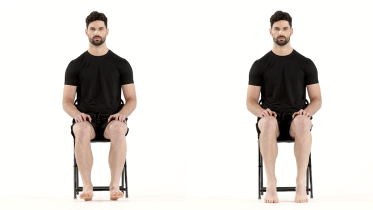 Ankle pumps
Stop signs and precautions for the ankle pumps
Before you start
- Had surgery on your foot or ankle, or wearing a cast or boot? Check which movements are allowed before you start.
When to stop and get help
- Your calf or thigh is getting more swollen, or becomes warm, tender, red or darker than usual, or has a new throbbing or cramping pain. This can be a blood clot, especially after an operation, an injury, time in a cast, boot or brace, or a spell of being much less mobile than usual, and after an operation it can also be an infection. Stop and contact your medical team or get medical advice the same day. If you are also short of breath or have chest pain, call emergency services.
- You suddenly become short of breath, get chest pain or pain in your upper back that may be worse when you breathe in, cough up blood, your heart beats very fast, or you faint. Call emergency services straight away, even if your leg looks normal, as this can be a blood clot in the lungs (pulmonary embolism).
- Any sharp pain in the foot or ankle.
- Emergency: while you are in a cast or boot, your toes turn blue, white or pale, or feel cold. Do not wait to see if raising your leg helps. Go to an emergency department straight away, and do not drive yourself. The cast or boot may be cutting off the blood supply, or pressure may be building up inside the leg (compartment syndrome), and both need checking quickly.
- In a cast or boot, the pain gets worse, your toes feel numb, tingle or burn or look more swollen, or the cast or boot feels too tight. Stop, raise your foot to about hip level and no higher, keep moving your toes and contact your fracture clinic or get medical advice straight away. If you wear a boot, loosen the straps but keep it on. Do not prop the foot higher than that and do not put ice on it, because if pressure is building up inside the lower leg both of those cut down the blood reaching your foot. If you cannot move your toes, the pain is severe even after painkillers, or the numbness, tingling, burning or swelling has not settled within 30 minutes of raising your foot, go to your fracture clinic or an emergency department straight away, and do not drive yourself.
- Since the fracture or cast, the foot or ankle is getting more painful rather than less, the skin becomes very sensitive to light touch, or the foot changes color, temperature, swelling or sweating compared with the other one, or looks shiny. See your doctor or physio as soon as you can, within a few days at most, as this can be complex regional pain syndrome (CRPS) and early treatment may help.
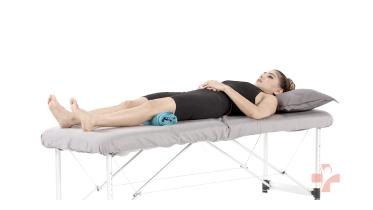 Quad sets (towel under knee)
Stop signs and precautions for the quad sets (towel under knee)
Before you start
- After a knee fracture or knee surgery, including a knee replacement, follow your surgeon's or physio's plan, and start this exercise only when they have cleared you.
When to stop and get help
- Your knee pain goes up sharply.
- Your calf or thigh is getting more swollen, or becomes warm, tender, red or darker than usual, or has a new throbbing or cramping pain. This can be a blood clot, especially after an operation, an injury, time in a cast, boot or brace, or a spell of being much less mobile than usual, and after an operation it can also be an infection. Stop and contact your medical team or get medical advice the same day. If you are also short of breath or have chest pain, call emergency services.
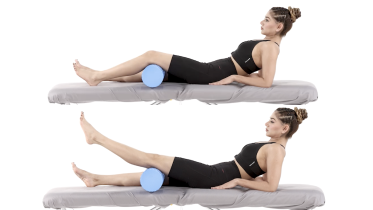 Short arc quads
Stop signs and precautions for the short arc quads
Before you start
- After a knee fracture or knee surgery, including a knee replacement, follow your surgeon's or physio's plan, and start this exercise only when they have cleared you.
When to stop and get help
- Knee pain increases sharply during the set.
- Your calf or thigh is getting more swollen, or becomes warm, tender, red or darker than usual, or has a new throbbing or cramping pain. This can be a blood clot, especially after an operation, an injury, time in a cast, boot or brace, or a spell of being much less mobile than usual, and after an operation it can also be an infection. Stop and contact your medical team or get medical advice the same day. If you are also short of breath or have chest pain, call emergency services.
- Your wound becomes more red, hot, swollen or painful, or starts to leak. Contact your medical team the same day.
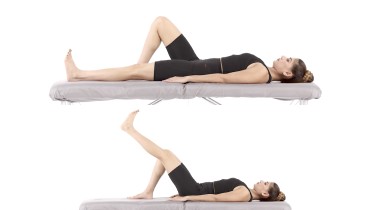 Straight leg raise
Stop signs and precautions for the straight leg raise
Before you start
- After a knee fracture or knee surgery, including a knee replacement, follow your surgeon's or physio's plan, and start this exercise only when they have cleared you.
- If you have had a hip replacement or other hip surgery, get the go-ahead from your surgeon or physio before you try this exercise. Some operations limit this kind of work for the first months, so the timing depends on your surgery. Lifting a straight leg is the heaviest way to use the muscles at the front of the hip, and after a periacetabular osteotomy a North American physiotherapy consensus panel asks for this exact movement, a straight leg lift while you are on your back, to be left out for 8 to 12 weeks.
- If you are pregnant and past the first three months, check with your physio before exercising flat on your back.
When to stop and get help
- Your lower back hurts.
- Knee pain increases during the set.
- You feel sharp pain in the front of the hip or groin.
- Your calf or thigh is getting more swollen, or becomes warm, tender, red or darker than usual, or has a new throbbing or cramping pain. This can be a blood clot, especially after an operation, an injury, time in a cast, boot or brace, or a spell of being much less mobile than usual, and after an operation it can also be an infection. Stop and contact your medical team or get medical advice the same day. If you are also short of breath or have chest pain, call emergency services.
- Your wound becomes more red, hot, swollen or painful, or starts to leak. Contact your medical team the same day.
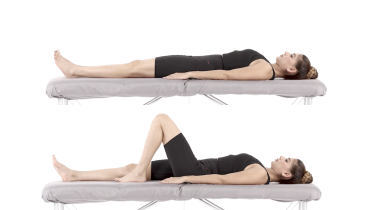 Heel slides
Stop signs and precautions for the heel slides
Before you start
- After a knee fracture or knee surgery, including a knee replacement, follow your surgeon's or physio's plan, and start this exercise only when they have cleared you.
- If you have had a hip replacement or other hip surgery, get the go-ahead from your surgeon or physio before you try heel slides. Sliding the heel toward you bends the hip, and many surgeons set a limit on how far it can bend for the first months after some operations, so find out what yours is.
- If you are pregnant and past the first three months, check with your physio before exercising flat on your back.
When to stop and get help
- Pain in the knee or hip becomes sharp or keeps increasing with each rep.
- Your calf or thigh is getting more swollen, or becomes warm, tender, red or darker than usual, or has a new throbbing or cramping pain. This can be a blood clot, especially after an operation, an injury, time in a cast, boot or brace, or a spell of being much less mobile than usual, and after an operation it can also be an infection. Stop and contact your medical team or get medical advice the same day. If you are also short of breath or have chest pain, call emergency services.
- Your wound becomes more red, hot, swollen or painful, or starts to leak. Contact your medical team the same day.
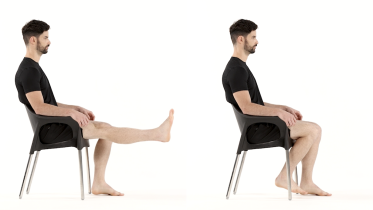 Seated knee bend
Stop signs and precautions for the seated knee bend
Before you start
- After a knee fracture or knee surgery, including a knee replacement, follow your surgeon's or physio's plan, and start this exercise only when they have cleared you. After a meniscus repair and some other operations, the knee may only bend to a set angle for a while, so ask what your limit is before you slide the foot all the way back.
When to stop and get help
- Sharp or catching pain in the knee, the knee locks, or it swells and stays more painful into the next day.
- Your calf or thigh is getting more swollen, or becomes warm, tender, red or darker than usual, or has a new throbbing or cramping pain. This can be a blood clot, especially after an operation, an injury, time in a cast, boot or brace, or a spell of being much less mobile than usual, and after an operation it can also be an infection. Stop and contact your medical team or get medical advice the same day. If you are also short of breath or have chest pain, call emergency services.
- Your wound becomes more red, hot, swollen or painful, or starts to leak. Contact your medical team the same day.
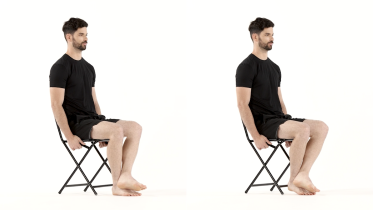 Assisted seated knee bend
Stop signs and precautions for the assisted seated knee bend
Before you start
- After knee surgery, follow the range your surgeon and physio have set. Some operations, such as a meniscus repair, come with a limit on how far the knee may bend in the first weeks. If you have had a hip replacement, get the go-ahead from your surgeon or physio before you try this exercise. Crossing your legs takes one leg across the middle of your body, even when only the ankles cross, and many surgeons ask you to avoid that for the first months after some operations. Until they say yes, skip this exercise.
When to stop and get help
- Sharp or stabbing pain in the knee, or pain that stays much worse for hours afterward.
- The knee becomes more swollen, hot or red, or it locks or catches.
- Your calf or thigh is getting more swollen, or becomes warm, tender, red or darker than usual, or has a new throbbing or cramping pain. This can be a blood clot, especially after an operation, an injury, time in a cast, boot or brace, or a spell of being much less mobile than usual, and after an operation it can also be an infection. Stop and contact your medical team or get medical advice the same day. If you are also short of breath or have chest pain, call emergency services.
- Your wound becomes more red, hot, swollen or painful, or starts to leak. Contact your medical team the same day.
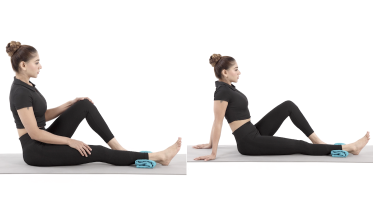 Knee extension stretch
Stop signs and precautions for the knee extension stretch
Before you start
- After a knee fracture or knee surgery, including a knee replacement, follow your surgeon's or physio's plan, and start this exercise only when they have cleared you.
- If you rest an ice pack on the knee during the hold, check first that you have normal feeling in the leg and no numbness, and look at the skin before, during and after. Numb skin cannot tell you it is being burned, and feeling can still be coming back for a while after an operation or a nerve block.
When to stop and get help
- Pain that is sharp or keeps building the longer you hold.
- Your calf or thigh becomes swollen, warm, tender, red or darker than usual, or has a throbbing or cramping pain that feels different from normal muscle ache. Stop and get medical advice the same day, as this can be a blood clot. If you are also short of breath or have chest pain, call emergency services.
- Numbness or tingling in the foot.
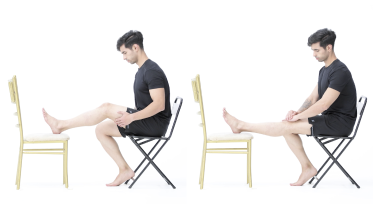 Seated heel prop
Stop signs and precautions for the seated heel prop
Before you start
- After a knee fracture or knee surgery, including a knee replacement, follow your surgeon's or physio's plan, and start this exercise only when they have cleared you.
When to stop and get help
- Sharp knee pain, or an ache that grows stronger through the hold instead of settling.
- Numbness, tingling or pins and needles in your foot or lower leg.
- Your calf or thigh becomes swollen, warm, tender, red or darker than usual, or has a throbbing or cramping pain that feels different from normal muscle ache. Stop and get medical advice the same day, as this can be a blood clot. If you are also short of breath or have chest pain, call emergency services.
- Your wound becomes more red, hot, swollen or painful, or starts to leak. Contact your medical team the same day.
Stage 2: Take your weight and walk without thinking about it
When stage 1 feels manageable and your team is happy with how you are walking. Seated knee extension and terminal knee extension build the thigh further. The glute bridge and side stepping bring the hip into it, which all three unicompartmental leaflets ask for alongside the thigh work, and which is what keeps the knee from drifting inward as you come down a step. The bridge needs the knee bent to about 90 degrees, so leave it out and tell your physio if your team set you a bend limit below that. It also puts you flat on your back, so use a firm bed rather than the floor until you are sure you can get down to the floor and back up again, because that part is riskier than the lift itself. The two weight shifts teach the leg to carry you again, and sit to stand using armrests, the mini squat and calf raises are the first real standing work, done at a kitchen counter with a hand on it. Walking with a cane is for when your team moves you from crutches to one stick, and the leaflets for this operation set the same test either way: keep two crutches or sticks until you can walk without a limp. If you have fallen in the past year, feel unsteady on your feet, or take medicines that make you dizzy, keep a hand on the counter, a wall or a sturdy chair back for the whole of the standing exercises and practice only when someone else is at home. Go no deeper in the mini squat than your team allows, and no deeper than feels controlled. On how often, each exercise page gives a general starting dose and several of these say once or twice a day. Take the lower end here: the leaflet written for this operation puts this phase of standing strength work at 3 to 4 sessions a week (Chelsea and Westminster), and ten exercises done daily at the top of every range is far more than any of the three leaflets asks of you. Two numbers to carry with you when you open those pages, because what you read there is written for general use and not for a knee a few weeks past this operation. The frequency is 3 or 4 sessions a week rather than daily. And where a page offers you 2 or 3 sets, do one of them: in the leaflets written for this operation every exercise at this stage is a single set of 5 to 15 repetitions and never two or three sets (Royal Berkshire, King's College Hospital). One set of about 10, three or four times a week, is the shape of it, and your physio is the one who moves it.
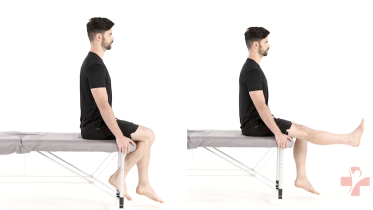 Seated knee extension
Stop signs and precautions for the seated knee extension
Before you start
- After knee ligament surgery, such as an ACL reconstruction, get the go-ahead from your surgeon or physio before you do this one. Many protocols limit how far the knee may straighten against resistance in sitting during the early stage.
- After a knee fracture or knee surgery, including a knee replacement, follow your surgeon's or physio's plan, and start this exercise only when they have cleared you. Ask again before you add an ankle weight.
When to stop and get help
- You feel sharp pain at the front of the knee or under the kneecap.
- The knee swells up or is clearly more painful later that day or the next morning.
- Chest pain or pressure, dizziness or feeling faint, a racing or irregular heartbeat, or being far more out of breath than the effort should cause.
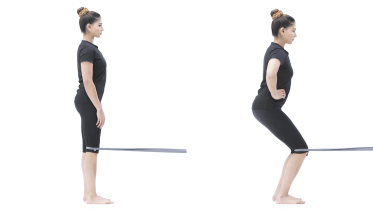 Terminal knee extension with band
Stop signs and precautions for the terminal knee extension with band
Before you start
- After a knee fracture or knee surgery, including a knee replacement, follow your surgeon's or physio's plan, and start this exercise only when they have cleared you.
When to stop and get help
- Pain at the front of the knee or behind the kneecap that builds during the set.
- The knee gives way, locks or catches.
- The knee is more swollen after the session than before it.
- You feel dizzy, lightheaded, faint or sick, or the room seems to spin. Stop, sit down and get medical advice the same day before you exercise again. If you faint, it does not settle within a few minutes of sitting still, your vision suddenly blurs or goes double, or you cannot stand or walk steadily, call emergency services.
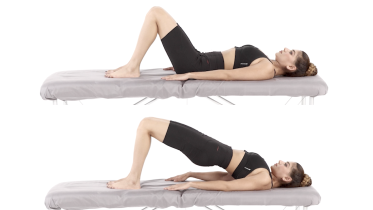 Glute bridge
Stop signs and precautions for the glute bridge
Before you start
- After hip, knee or back surgery, your surgeon's protocol decides when you can start bridges. Once you are past the first three months of pregnancy, check with your physio before exercising flat on your back.
- A bridge needs the knee bent to about 90 degrees before you lift, so if you have had knee surgery and been given a limit on how far the knee may bend, leave this one out and ask your surgeon or physio whether the bend it needs is allowed yet.
When to stop and get help
- You feel back pain rather than buttock work, even when you lift a little lower.
- Pain spreads down the leg or you get numbness or tingling.
- Your hamstrings (the back of the thighs) cramp. This is a common complaint with bridges, and bringing your feet a little closer to your bottom often eases it.
- Pain in the knee itself, or a knee that swells or is clearly more painful the next morning. The position holds the knee bent throughout, so after knee surgery stop and check with your surgeon or physio before you try it again.
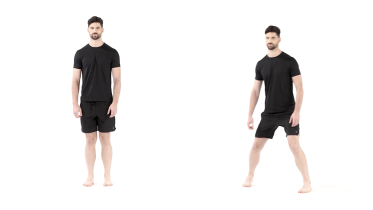 Side stepping
Stop signs and precautions for the side stepping
Before you start
- If you have had a hip replacement or other hip surgery, get the go-ahead from your surgeon or physio before you try side stepping. Some operations limit this kind of work for the first months, so the timing depends on your surgery. If the operation was done through the side of the hip (a lateral approach), the muscles at the side of the hip were detached and repaired. Exercises that make them work hard, like this one, are then often held back for around the first 6 weeks. After knee surgery or a knee replacement, wait until your surgeon or physio clears you for weight bearing work from side to side.
When to stop and get help
- You feel dizzy, lightheaded, faint or sick, or the room seems to spin. Hold your support, sit down and get medical advice the same day before you practice again. If you faint, it does not settle within a few minutes of sitting still, your vision suddenly blurs or goes double, or you cannot stand or walk steadily, call emergency services.
- You start to lose your balance.
- Sharp pain in the hip, groin or knee.
- Pain running down the leg, or the leg going numb or tingly.
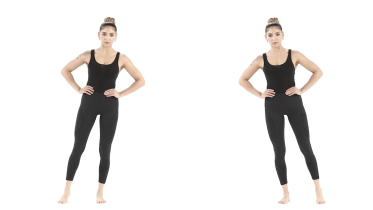 Side to side weight shift
Stop signs and precautions for the side to side weight shift
Before you start
- If you have had a hip or knee replacement, or other hip or knee surgery, get the go-ahead from your surgeon or physio before you try side to side weight shifts. Some operations limit this kind of work for the first months, so the timing depends on your surgery. Ask them how much weight you are allowed to put through the operated leg before you shift fully onto it.
When to stop and get help
- You feel dizzy, lightheaded, faint or sick, or the room seems to spin. Hold your support, sit down and get medical advice the same day before you practice again. If you faint, it does not settle within a few minutes of sitting still, your vision suddenly blurs or goes double, or you cannot stand or walk steadily, call emergency services.
- You start to lose your balance and need to grab your support to stay up.
- Sharp pain in the hip, knee or ankle.
- Since the fracture or cast, the foot or ankle is getting more painful rather than less, the skin becomes very sensitive to light touch, or the foot changes color, temperature, swelling or sweating compared with the other one, or looks shiny. See your doctor or physio as soon as you can, within a few days at most, as this can be complex regional pain syndrome (CRPS) and early treatment may help.
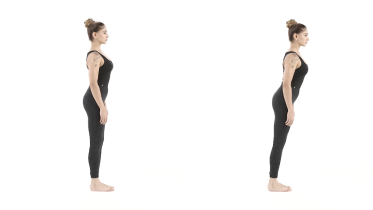 Forward and backward weight shift
Stop signs and precautions for the forward and backward weight shift
Before you start
- After an ankle fracture or ankle surgery, follow your surgeon's or physio's weight-bearing plan, and start this exercise only when they have cleared you.
- If you have had a hip or knee replacement, or other hip or knee surgery, get the go-ahead from your surgeon or physio before you try forward and backward weight shifts, and ask how much weight you are allowed to put through the operated leg first.
When to stop and get help
- You feel dizzy, lightheaded, faint or sick, or the room seems to spin. Hold your support, sit down and get medical advice the same day before you practice again. If you faint, it does not settle within a few minutes of sitting still, your vision suddenly blurs or goes double, or you cannot stand or walk steadily, call emergency services.
- Your calf or thigh becomes swollen, warm, tender, red or darker than usual, or has a throbbing or cramping pain that feels different from normal muscle ache. Stop and get medical advice the same day, as this can be a blood clot. If you are also short of breath or have chest pain, call emergency services.
- Sharp pain in your ankle or foot as your weight moves onto your toes or heels.
- Since the fracture or cast, the foot or ankle is getting more painful rather than less, the skin becomes very sensitive to light touch, or the foot changes color, temperature, swelling or sweating compared with the other one, or looks shiny. See your doctor or physio as soon as you can, within a few days at most, as this can be complex regional pain syndrome (CRPS) and early treatment may help.
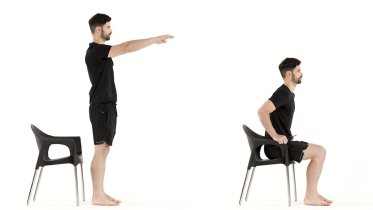 Sit to stand using armrests
Stop signs and precautions for the sit to stand using armrests
Before you start
- If you have had a hip replacement or other hip surgery, get the go-ahead from your surgeon or physio before you try sit to stand using armrests. Lowering into a chair and rising from it takes the hip beyond a right angle when the seat is low, and many surgeons ask you to avoid that for the first months after some operations.
- If knee pain builds as you go, or you have had knee surgery, check with your physio what seat height to use.
- If balance is a worry or you have fallen before, have someone nearby and place the chair next to a counter or wall you can reach once upright. If you have osteoporosis, set the chair up the same way, next to a counter or wall, though thin bones on their own are not a reason to wait until someone is at home before you stand up out of a chair. Wear flat shoes that fit well and grip the floor, not socks, tights or bare feet.
When to stop and get help
- You feel dizzy, lightheaded or faint as you get up. Sit back down and wait for it to pass. If it does not pass within a minute or two, or it keeps happening, get medical advice the same day before you practice again. If you faint, or it does not settle within a few minutes of keeping still, call emergency services. A drop in blood pressure on standing, or a side effect of a medicine, can cause this, so mention your medicines when you get advice.
- Your knee, hip or back hurts sharply, or a wrist or shoulder hurts as you push on the armrests.
- A leg buckles, or you feel close to falling.
- Chest pain or pressure, dizziness or feeling faint, a racing or irregular heartbeat, or being far more out of breath than the effort should cause.
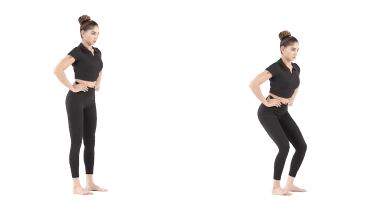 Mini squat
Stop signs and precautions for the mini squat
Before you start
- If you have had a hip replacement or other hip surgery, get the go-ahead from your surgeon or physio before you try mini squats. Some operations limit this kind of work for the first months, so the timing depends on your surgery.
- After a knee replacement, including a partial one, or other knee surgery, get the go-ahead from your surgeon or physio and ask how deep you may go. A squat bends the knee and loads it at the same time, so if you have been given a limit on how far the knee may bend, this is the exercise it applies to first. Keep it shallow and controlled until they say otherwise.
When to stop and get help
- Knee pain is sharp or keeps getting worse through the set.
- The knee swells, gives way or feels unstable afterwards.
- You feel dizzy, lightheaded, faint or sick, or the room seems to spin. Hold your support, sit down and get medical advice the same day before you practice again. If you faint, it does not settle within a few minutes of sitting still, your vision suddenly blurs or goes double, or you cannot stand or walk steadily, call emergency services.
- You feel unsteady enough that you might fall. Hold on to something firm and sit down.
- Your calf or thigh is getting more swollen, or becomes warm, tender, red or darker than usual, or has a new throbbing or cramping pain. This can be a blood clot, especially after an operation, an injury, time in a cast, boot or brace, or a spell of being much less mobile than usual, and after an operation it can also be an infection. Stop and contact your medical team or get medical advice the same day. If you are also short of breath or have chest pain, call emergency services.
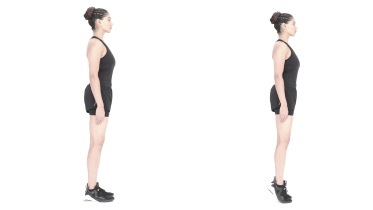 Calf raises
Stop signs and precautions for the calf raises
Before you start
- After an Achilles tendon repair or ankle surgery, calf raises usually come in at a set stage of your surgeon's protocol, often on both feet before one. Check with your physio before you start.
- After a knee or hip replacement, or other leg surgery, follow your surgeon's or physio's plan, and hold a counter or a sturdy chair back for the whole set. Rising onto your toes puts your weight forward onto a smaller base, which is where the balance goes.
When to stop and get help
- Sharp pain in the Achilles tendon, heel or arch.
- A sudden pop or snap at the back of your ankle or heel, a feeling that someone kicked you there, or sudden pain there after which you cannot push off or rise onto your toes on that leg. Stop, take the weight off that leg carefully and go to an urgent care center or emergency department the same day, even if you can still walk, as this can be a torn Achilles tendon.
- Achilles or heel pain that is clearly worse the next morning. Ease off and check with your physio.
- Your calf or thigh becomes swollen, warm, tender, red or darker than usual, or has a throbbing or cramping pain that feels different from normal muscle ache. Stop and get medical advice the same day, as this can be a blood clot. If you are also short of breath or have chest pain, call emergency services.
- Your ankle gives way, or you lose your balance.
- Since the fracture or cast, the foot or ankle is getting more painful rather than less, the skin becomes very sensitive to light touch, or the foot changes color, temperature, swelling or sweating compared with the other one, or looks shiny. See your doctor or physio as soon as you can, within a few days at most, as this can be complex regional pain syndrome (CRPS) and early treatment may help.
- You feel dizzy, lightheaded, faint or sick, or the room seems to spin. Stop, sit down and get medical advice the same day before you exercise again. If you faint, it does not settle within a few minutes of sitting still, your vision suddenly blurs or goes double, or you cannot stand or walk steadily, call emergency services.
- Chest pain or pressure, dizziness or feeling faint, a racing or irregular heartbeat, or being far more out of breath than the effort should cause.
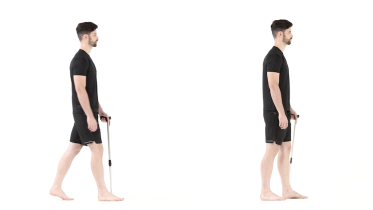 Walking with a cane
Stop signs and precautions for the walking with a cane
Before you start
- If you have broken a bone in your leg or had an operation on it, follow the weight-bearing plan your surgeon or physio gave you. Do not swap crutches or a frame for a single cane until they tell you that you are ready.
When to stop and get help
- You feel dizzy, lightheaded, faint or sick, or the room seems to spin. Hold your support, sit down and get medical advice the same day before you practice again. If you faint, it does not settle within a few minutes of sitting still, your vision suddenly blurs or goes double, or you cannot stand or walk steadily, call emergency services.
- You stumble, your leg gives way, or you have to grab something to stay upright. Stop and sit down.
- Your calf or thigh becomes swollen, warm, tender, red or darker than usual, or has a throbbing or cramping pain that feels different from normal muscle ache. Stop and get medical advice the same day, as this can be a blood clot. If you are also short of breath or have chest pain, call emergency services.
- New or much worse pain in your hip, knee or ankle that changes the way you walk.
- Since the fracture or cast, the foot or ankle is getting more painful rather than less, the skin becomes very sensitive to light touch, or the foot changes color, temperature, swelling or sweating compared with the other one, or looks shiny. See your doctor or physio as soon as you can, within a few days at most, as this can be complex regional pain syndrome (CRPS) and early treatment may help.
- You have had a fall or an injury and now have severe hip pain, or you cannot walk or put weight on the leg. Call emergency services or go to an emergency department. This can be a sign of a broken hip (hip fracture).
- Chest pain or pressure, dizziness or feeling faint, a racing or irregular heartbeat, or being far more out of breath than the effort should cause.
Stage 3: Stairs, balance and the strength you came for
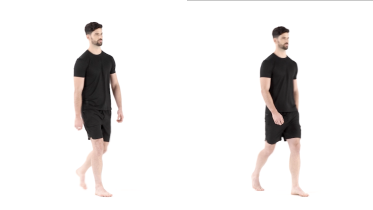
For when you walk steadily, often with one stick or none, and stage 2 feels easy. Sit to stand without your hands, step ups and stair practice build what stairs actually ask of the thigh, starting on the bottom step of your own stairs with a rail to hold. Single leg stance and standing balance at a chair train the control that keeps a stumble from becoming a fall, with a counter or sturdy chair in reach. Brisk walking is the simplest way to get your general fitness back, in the amounts your knee settles from. Ask your surgical team how far you may bend and whether there is anything they want left out. How often is the same answer as stage 2, and this is the stage where it matters most: 3 or 4 sessions a week with a day in between rather than every day, one set of each, and the step ups and the stairs are the two to leave a gap after, because they load the thigh harder than anything else here. Walking and the balance holds can be daily. If an exercise leaves the knee more swollen or more painful the next morning, that session was too long, and the number of repetitions comes down before the exercise comes out. If you have fallen in the last 12 months or feel unsteady, keep a hand on a handrail, a kitchen counter or a sturdy chair back throughout the balance work and for every repetition of the step ups and the stairs, and practice only when someone else is at home, because a fall onto a new knee can damage it.
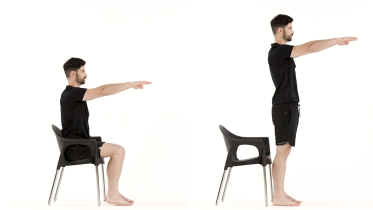 Sit to stand
Stop signs and precautions for the sit to stand
Before you start
- After a knee fracture or knee surgery, including a knee replacement, follow your surgeon's or physio's plan, and start this exercise only when they have cleared you.
- If you have had a hip replacement or other hip surgery, get the go-ahead from your surgeon or physio before you try sit to stand. Standing up from a low seat bends the hip past a right angle, and many surgeons ask you to avoid that for the first months after some operations. Ask them how high your seat should be. If you are pregnant, check with your midwife or physio before you start.
- Set up before the first stand: use a chair that will not slide, ideally with its back against a wall, and have someone nearby, or set the chair beside a kitchen counter you can reach, if you are not sure of your balance or you have fallen in the past year. Wear flat shoes that fit well and grip the floor, not socks, tights or bare feet.
When to stop and get help
- You feel dizzy, lightheaded or faint as you get up. Sit back down and wait for it to pass. If it does not pass within a minute or two, or it keeps happening, get medical advice the same day before you practice again. If you faint, or it does not settle within a few minutes of keeping still, call emergency services.
- Sharp pain in the knee, hip or lower back.
- Your knee gives way or you feel you might fall.
- Chest pain or pressure, dizziness or feeling faint, a racing or irregular heartbeat, or being far more out of breath than the effort should cause.
- You are pregnant and notice bleeding or fluid leaking from your vagina, regular painful tightenings, tummy pain that does not settle when you rest or comes with lower back pain, or a change in your baby's usual movements, such as moving less than usual. Stop and contact your midwife or maternity unit straight away. Do the same for a severe headache, problems with your vision such as blurring or flashing lights, pain just below your ribs, or sudden swelling of your face, hands or feet, which can be signs of pre-eclampsia. Call emergency services if the bleeding is heavy, the tummy pain is severe, bleeding or tummy pain comes with pain in your shoulder or feeling sick, faint or dizzy, or a headache comes on suddenly and is very severe.
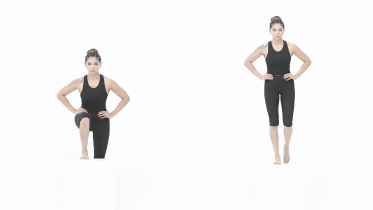 Step up
Stop signs and precautions for the step up
Before you start
- If you have had a hip or knee replacement, or other hip or knee surgery, get the go-ahead from your surgeon or physio before you try step ups. Some operations limit this kind of work for the first months, so the timing depends on your surgery. Your surgeon or physio will also tell you what step height is right for you.
- With a heart condition or high blood pressure, check with your doctor before you start.
- If you have fallen in the past year, have osteoporosis or feel unsteady on your feet, set the step beside a handrail, a kitchen counter or a sturdy chair back, keep one hand on it for every repetition, and ask your physio whether to start with step ups at all or to build up on a single stair first.
When to stop and get help
- You feel sharp pain in the knee or the knee gives way.
- Pain at the front of the knee builds with each rep.
- You feel dizzy, lightheaded, faint or sick, or the room seems to spin. Hold your support, sit down and get medical advice the same day before you practice again. If you faint, it does not settle within a few minutes of sitting still, your vision suddenly blurs or goes double, or you cannot stand or walk steadily, call emergency services.
- You feel unsteady enough that you might fall. Stop and sit down.
- Chest pain or pressure, dizziness or feeling faint, a racing or irregular heartbeat, or being far more out of breath than the effort should cause.
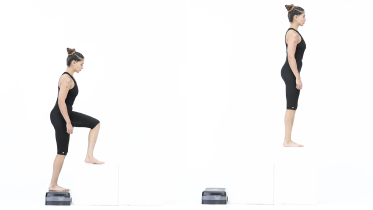 Stair climbing
Stop signs and precautions for the stair climbing
Before you start
- If you have had a hip or knee replacement, or other hip or knee surgery, get the go-ahead from your surgeon or physio before you try stair climbing. Some operations limit this kind of work for the first months, so the timing depends on your surgery.
- With a heart condition or high blood pressure, check with your doctor before you start.
- If you have fallen in the past year, have osteoporosis or feel unsteady on your feet, have someone with you for the first sessions and ask your physio whether to start on a single step.
When to stop and get help
- A sharp pain in your knee or hip, or a knee that gives way.
- The knee or hip is more swollen, or clearly more painful, the next morning. Stairs load the thigh harder than anything else in a home program, so cut the number of trips rather than pushing on, and after knee or hip surgery check with your physio before you build it up again.
- You feel unsteady or catch your foot on a step. Hold the rail, stop, and sit down on a step until you feel settled.
- Chest pain or pressure, dizziness or feeling faint, a racing or irregular heartbeat, or being far more out of breath than the effort should cause.
- You feel dizzy, lightheaded, faint or sick, or the room seems to spin. Hold your support, sit down and get medical advice the same day before you practice again. If you faint, it does not settle within a few minutes of sitting still, your vision suddenly blurs or goes double, or you cannot stand or walk steadily, call emergency services.
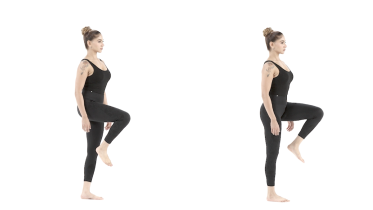 Single leg stance
Stop signs and precautions for the single leg stance
Before you start
- If you have had a hip or knee replacement, or other hip or knee surgery, get the go-ahead from your surgeon or physio before you try single leg stance. Standing on the operated leg alone comes at a set stage of rehab, and some hip operations limit how high the knee can lift in the first months after surgery.
When to stop and get help
- You feel dizzy, lightheaded, faint or sick, or the room seems to spin. Hold your support, sit down and get medical advice the same day before you practice again. If you faint, it does not settle within a few minutes of sitting still, your vision suddenly blurs or goes double, or you cannot stand or walk steadily, call emergency services.
- You lose your balance and cannot steady yourself with your support.
- Sharp pain in the hip, knee or ankle of the standing leg.
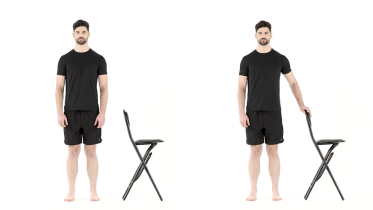 Standing balance at a chair
Stop signs and precautions for the standing balance at a chair
Before you start
- After a knee replacement or other knee surgery, a hip replacement, or a broken hip or leg fixed with screws, a nail or a plate, follow your surgeon's or physio's weight-bearing plan, and start this exercise only when they have cleared you. Taking your hand off the chair puts your full body weight through both legs, so if you have been told to put only part of your weight through that leg, or none of it, or to keep using a frame or crutches for now, this exercise is not yours yet, whatever the leg feels able to do. Keep the hand on the chair until they tell you it can come off.
When to stop and get help
- You feel dizzy, lightheaded, faint or sick, or the room seems to spin. Hold your support, sit down and get medical advice the same day before you practice again. If you faint, it does not settle within a few minutes of sitting still, your vision suddenly blurs or goes double, or you cannot stand or walk steadily, call emergency services.
- You start to tip and need the chair to catch yourself. Put your hand back on it, rest, then try a shorter hold.
 Brisk walking
Stop signs and precautions for the brisk walking
Before you start
- With a heart or lung condition, high blood pressure, or after a recent operation, ask your doctor or physio how much to walk and how fast before you start. If you are pregnant, check with your midwife or physio before you start.
When to stop and get help
- Chest pain or pressure, dizziness or feeling faint, a racing or irregular heartbeat, or being far more out of breath than the effort should cause.
- You feel dizzy, lightheaded, faint or sick, or the room seems to spin. Stop, sit down and get medical advice the same day before you exercise again. If you faint, it does not settle within a few minutes of sitting still, your vision suddenly blurs or goes double, or you cannot stand or walk steadily, call emergency services.
- A sharp pain in a foot, ankle, knee or hip that changes the way you walk.
- Aching, cramping or tightness in a calf, thigh or buttock that comes on at about the same walking distance every time and clears within a few minutes of standing still, and a doctor has not checked it yet. Keep the walk gentle and book an appointment with your doctor before you build up any further, as narrowed arteries in the legs (peripheral arterial disease) can cause this and are managed differently. If leg pain carries on while you are resting or in bed, or wakes you at night, get medical advice the same day. If a foot or leg suddenly turns cold, pale or blue, or suddenly becomes very painful, numb or weak, call emergency services and do not drive yourself, because the blood supply to the leg may be blocked and a leg that has gone numb or weak with it can be impossible to save if it is not treated within about six hours.
- Your calf or thigh becomes swollen, warm, tender, red or darker than usual, or has a throbbing or cramping pain that feels different from normal muscle ache. Stop and get medical advice the same day, as this can be a blood clot. If you are also short of breath or have chest pain, call emergency services.
- You feel unsteady on your feet or close to falling.
- You are pregnant and notice bleeding or fluid leaking from your vagina, regular painful tightenings, tummy pain that does not settle when you rest or comes with lower back pain, or a change in your baby's usual movements, such as moving less than usual. Stop and contact your midwife or maternity unit straight away. Do the same for a severe headache, problems with your vision such as blurring or flashing lights, pain just below your ribs, or sudden swelling of your face, hands or feet, which can be signs of pre-eclampsia. Call emergency services if the bleeding is heavy, the tummy pain is severe, bleeding or tummy pain comes with pain in your shoulder or feeling sick, faint or dizzy, or a headache comes on suddenly and is very severe.
Getting these exercises to work at home
The straightening work is what gets skipped. It is also the half that decides how the leg feels on stairs months later. The knee extension stretch and the seated heel prop achieve nothing while the thigh is still guarding, so rest your hands on the thigh and not on the kneecap, leave the calf unsupported, and allow the leg's own weight to do the work. Both are slow and boring on purpose, which makes them the two to pair with something you were going to watch anyway.
For quad sets, watch the kneecap instead of trusting what the leg reports. It travels a short distance toward your hip as the muscle genuinely switches on, and a roll about as thick as a folded hand towel gives the knee something to press into. A pillow holds it too bent for any of that to happen. In short arc quads the top of the movement is the whole exercise, so reaching properly straight matters more than the count.
Heel slides stick on a bare sheet; a sock on the foot fixes it. For the assisted seated knee bend, choose a seat with room underneath it, and keep an eye on your hips: the moment they travel forward along the seat, the knee has stopped bending and you are stretching nothing.
Seat height decides whether half of stage 2 is even possible. A firm dining chair beats a sofa, and a cushion on top of it can turn an impossible set into a manageable one. Begin at whatever height you can rise from without dragging on your arms, and take it down a little every week or two. For walking with a cane, two details change how it feels: it is held in the hand on your unoperated side and swings forward at the same time as the operated leg, and the handle wants to reach your wrist crease with the arm hanging loose.
What should you not do after a partial knee replacement?
This question gets asked constantly and answered, almost everywhere, with the total knee replacement list. Here is the honest version.
The NHS recovery page names a partial twice, for the shorter recovery and for the shorter driving wait, and gives the rest of its advice for knee replacement without separating the two operations: do not kneel on the new knee until your doctor says you can, do not sit with your legs crossed for the first 6 weeks, avoid twisting the knee, bending down and reaching up as much as possible, and leave household tasks that involve lifting or moving anything heavy for the first 3 months. Healthdirect Australia, writing for the same two operations together, says to avoid activities that involve jumping or twisting while you are recovering.
The three NHS leaflets written for the partial do have a short list of their own, and it is worth more to you than the general one. Do not put a pillow under the knee while you sit or sleep, because it holds the knee bent and keeps it stiff (Chelsea and Westminster, King's College Hospital). Avoid jarring and twisting jobs for 6 to 8 weeks, shopping trolleys and vacuuming included (Royal Berkshire). Leave the bath until the wound is fully healed and you can get out of it again, which is unlikely before 6 weeks, and shower or strip wash until then (Royal Berkshire, King's College Hospital). Do not stop your pain medication abruptly; come off it slowly (Chelsea and Westminster). And do not take up running, jumping or contact sport, which has its own section below.
Treat the general advice as a sensible default rather than as a rule written for your knee. After a partial your own team may lift some of them earlier, and they are the ones who know which compartments they left alone. What is not a default, and does not wait for anybody, is this short list. Do not push on through a knee that is hot, or that is more swollen and more painful every morning rather than settling. Do not give the walking aid back before your team says to; the afternoon that catches people out has a wet pavement, a curb and a supermarket in it. And do not treat a week of no progress in bending or straightening as something to try harder at, because that is the week to make the phone call.
Kneeling, twisting and deep bending
Kneeling first, because it is the one people ask about. The NHS line is that you do not kneel on the new knee until your doctor says you can, and Arthritis UK, formerly Versus Arthritis, says you can try kneeling on a soft surface from about 3 months after the operation and that it may never feel completely comfortable. Neither of those is written for a partial. One of the three unicompartmental leaflets is. The Royal Berkshire's says that kneeling on the new knee will do the replacement no harm, that some people can kneel within a few weeks of surgery and some never find it comfortable, and that the way in is to start on something soft such as a bed once the scar is comfortable, then try a firmer surface with a cushion or a kneeling pad. That is a good deal earlier than 3 months, which is a reason to ask the team that operated rather than to pick whichever of the two figures suits you.
Whenever you get the go-ahead, kneel on a folded towel or a pad and not on rough ground, because breaking the skin over a new joint is a way in for bacteria, and get down and up using your hands and something solid. Kneeling after a knee replacement carries the research.
Twisting does come with a timeframe once you read the leaflets for this operation. The Royal Berkshire's asks you to avoid jarring and twisting activities for 6 to 8 weeks and names the two everybody meets first, pushing a shopping trolley and vacuuming. King's College Hospital's says you may need help with heavier jobs such as vacuuming for up to 12 weeks, and the NHS leaves lifting or moving anything heavy for 3 months. None of them attaches a reason to the twisting itself, so take the instruction and do not let anyone sell you a mechanism for it, including us. What makes it workable is a habit rather than an explanation: pick your feet up and take several small steps to turn, instead of pivoting on the operated leg. Practice that in the kitchen and at the bathroom sink, which are the two places everybody forgets.
Deep bending has a clearer answer than you might expect. The answer is a negative result, not a gap. Three NHS physiotherapy leaflets written for this operation, from Chelsea and Westminster, the Royal Berkshire and King's College Hospital, set no maximum bend anywhere in them. They push the other way. The Royal Berkshire's says the scar tissue tightens over the first 6 weeks, that stretching early is what gets you the most movement you are going to get, and that after 3 months it becomes very difficult to improve flexibility. Both of the angle figures in those leaflets ask for bend rather than cap it: a bridge with the knees bent to at least 90 degrees, and a supported lunge taken to knees close to 90 degrees, the lunge being in the King's booklet rather than in the stages on this page. On where you end up, the Royal Berkshire's says you usually regain the movement you had before the operation and sometimes a little more, and that it may not let you fully squat or sit back on your heels.
So a bend limit after a partial is an instruction somebody has written for your knee, not a general rule of the operation. If your team gave you one, that is your limit, in every standing exercise above and in the bridge. If they gave you none, work the bend daily in the sitting and lying exercises, which is where those leaflets put the stretching, and still keep the mini squat shallow and controlled until you have asked, because the squat is the one that loads the new surface at the same time as bending it.
Driving, work and getting back to activity
Driving has a figure of its own for the partial operation. It is the one most readers come for. The NHS says to wait at least 6 weeks after a total knee replacement, or 3 weeks after a partial one, and to check with your doctor that you are fit to drive. Three weeks is a floor and not a date in your diary, and the hospital leaflets for this operation sit well above it: the Royal Berkshire's tells you not to drive until you can do an emergency stop and puts that at about 6 to 8 weeks, and Chelsea and Westminster's gives 6 to 8 weeks as a rough guide and asks you to tell your insurer about the operation. So 3 weeks is the earliest anybody allows rather than the usual point, and a longer wait from your own unit is the one to follow. Arthritis UK sets the test as being able to control the car safely and perform an emergency stop, and it adds that your insurer is worth a call about cover during recovery. Driving after a knee replacement goes through the braking test and the insurance question.
Long journeys as a passenger are a separate question. The answer there is about clots, not about the knee. The Royal Berkshire's leaflet advises against flying within 6 weeks of a joint replacement and against long haul flights for 3 months, and King's College Hospital's says not to fly for the three months after surgery and to avoid long car journeys for at least 6 to 8 weeks, stopping to move your legs on any that cannot be put off. Ask your own team before you book, and read the clot warning signs at the foot of this page before you travel.
Work does have figures written for this operation, and they are tighter than the general ones. Chelsea and Westminster's table puts sedentary work at 4 weeks and manual jobs at 5 to 6 weeks depending on the job, while its own opening page says office work or work without significant physical activity can start after six weeks. The Royal Berkshire's gives around 4 to 8 weeks for a sedentary job and up to 3 months where the job involves prolonged walking or standing or heavy lifting, and asks you to check the date with the surgeon. The NHS gives about 6 to 12 weeks depending on the job for knee replacement generally. Those overlap without agreeing, including inside one leaflet, which is where it actually stands: the range is real and the date is your surgeon's. What helps an employer is not a date anyway. It is which parts of the job this advice actually touches: kneeling, ladders, driving, lifting, and how long you can stand in one place.
Sport and higher-impact activity need your surgeon. The published picture is genuinely mixed. A review pooling thirteen studies and 1,675 people after a partial replacement found that most were playing sport again afterward, and that high-impact sport made up a bigger share of what they played afterward than the records showed beforehand, 21.1% against 6.3% (Cerasoli and colleagues, 2026). Read it with its own limits in view, because they are substantial. Its headline return rate differs between its abstract and its results, 87.97% and 87.2%. Four of its thirteen studies took their partial replacement group out of mixed groups that also included total replacements. It did not report how long the return took. And the before-and-after comparison is not a measured change: the review says many of the studies it pooled lacked detailed pre-operative sport data, which limits the ability to quantify net changes in sport participation, and that more sports were recorded after surgery than before, so some of that rise is better record keeping rather than more sport. In the same tables, intermediate-impact participation did not rise at all, 22.9% before and 20.4% after. So it tells you that going back to sport after this operation is usual. It does not tell you when, for whom, or how much of the impact figure is real.
Against that sits the registry finding that partial replacements are revised more often than total ones by 10 years, and something more pointed than general surgical caution. Two of the three NHS leaflets written for this exact operation advise against impact, and neither of them puts a date on when the advice stops. The Royal Berkshire's says a unicompartmental replacement is not made for high impact activities such as running and jumping, that walking and swimming are encouraged while sports calling for jogging, jumping or contact are not, and it repeats the same thing in its 3 to 6 month section. King's College Hospital's gives the reason: your new joint is designed for day-to-day living and not for high-impact sport, because that raises the risk it wears out sooner, loosens or breaks. Both also ask you to talk to your surgeon or physiotherapist before you take up anything more demanding.
The caution below is not borrowed from the total knee pages. Here the instruction to follow is the cautious one. If you have had a hip or knee replacement, get the go-ahead from your surgeon before you try running or jogging. Many surgeons advise against running and jogging after a joint replacement for good, not just for the first months, because each step sends impact through the new joint. The same question goes to your surgeon before any jumping or hopping. Many surgeons advise against jumping and hopping after a joint replacement for good, not just for the first months, because each landing sends high impact through the new joint. What the same leaflets allow is a good deal more than walking, and that part gets left out of most impact warnings. The Royal Berkshire's puts golf at 8 to 12 weeks, starting with chipping and putting before you play 9 or 18 holes, and leaves the driving range for up to 3 months because the repetitive twisting aggravates the knee. In its 3 to 6 month section it expects you to be back to sports such as golf, gentle tennis or badminton, and to bowls, gardening and dancing. It asks you to consult your surgeon or physiotherapist before you return to any sport, which is the step to take instead of reading a date off this page. If none of that is what you want the knee for, you are not behind anybody. Most people have this operation for the stairs, the shops and a night's sleep, and the stage 3 work is what buys those; the dates above matter only if you are heading for a particular sport. Cycling and swimming are the usual ways back to general fitness in the meantime, and neither replaces the strength work. Both carry a date in the leaflets for this operation, and the swimming one is about your wound rather than your knee. Wait until the wound is fully healed before you get into a pool, which Chelsea and Westminster's puts at 6 weeks, and it asks for a straight kick rather than breaststroke. It gives a static bike from 4 weeks, a cross trainer or rowing machine from 6 weeks and road cycling from 3 months, and the Royal Berkshire's also starts a static bike at week 4, pedaling or rocking for 5 to 10 minutes.
What if your recovery is not faster than a total?
Plenty of people land here two to six weeks out, holding a total knee timeline they found online and worried by it. Start with why the comparison is slippery. A partial is only possible when the wear sits in one compartment, so the group having one starts with less damaged knees on average. Some of the faster recovery belongs to the operation and some belongs to the knee, which means the sentence "a partial recovers faster" is partly a sentence about who gets a partial. It is not a promise made to you.
Several ordinary things slow a recovery down without anything being wrong. A knee that was very stiff before the operation. A long wait, with the thigh getting weaker through it. The other knee, the back or a hip taking a share of the work. Being less fit going in. None of those is a complication and all of them lengthen the weeks.
The finish line is also further out than most people are told, and the leaflets for this operation say so. Chelsea and Westminster's has improvements carrying on for up to 24 months as the muscles get stronger and the tissues heal. The Royal Berkshire's says joint line pain or tenderness can persist for up to two years after the surgery and that some people are left with some of it. King's College Hospital's puts a full recovery at up to a year. A knee that is still improving at eight months is doing what these sources say it does.
So use markers, not dates. Putting a sock on with nobody helping. Getting into the back of a car. Sleeping through to the morning. Reaching the end of your street and coming home again without having planned where to stop. On an ordinary bad day, drop back a step instead of stopping, and keep the bending and straightening going even when the standing work is left for tomorrow, because a day of nothing costs more than an easy day. A knee that is hot, or more swollen and more painful every morning instead of settling, is not an ordinary bad day and is not one to train through at any level: that one is a phone call.
Two patterns are not a slow recovery and should not be waited out. A knee that is no further on in bending or straightening from one week to the next, or that is getting stiffer, needs your physio or surgical team inside a few days rather than at the next routine appointment, because stiffness is easier to deal with early than late. Pain is the other, and the two year figures above are not a reason to sit with it. Pain that is climbing week by week rather than easing, pain that is there while you rest or that wakes you and is getting worse, or a knee that turns hot, red or more swollen, all go to your surgical team the same day, and the warning signs at the foot of this page say why and what they are looking for. Pain that had settled months or years ago and has come back, or that is creeping up month by month rather than week by week, is a review rather than a same-day call, and that line is down there too. The difference is direction, not speed: slow and still improving is a recovery, and going backward is a question for your team whatever week you are in. For what the sources say about the related worries, stiffness and bending after a knee replacement and how long swelling lasts were written for the total operation, and the general points in them hold.
When to see a physio or doctor
Get help the same day for anything in the warning signs below, and that list is the part of this page to read before you need it. Problems after a knee replacement sets the same signs out by how fast to act and adds who to call and what to have ready. If you cannot get hold of your surgical team on the day, do not let that turn into waiting for your next appointment. Use whatever urgent medical advice there is where you live, an out of hours service, an urgent care center or an emergency department, and tell them you have had a knee replacement and how long ago. The wound, the clot and the infection lines below are the ones that do not keep until morning.
Short of that, contact your physiotherapist or physical therapist, or your surgical team, if your bend or your straightening has not moved for a week or two, if you are still limping once the walking aid has gone, if you cannot get up from a chair without pulling on your arms by the time stage 2 should feel easy, or if you are not confident you are doing this safely on your own. Those are the same grounds NICE gives for being offered supervised rehabilitation rather than doing it alone: difficulty with daily activities, ongoing loss of function, or self-directed rehabilitation that is not getting you to your goals (NG157, recommendation 1.10.5). Asking is not a sign that something has gone wrong. Raise it at your follow-up appointment too if the knee will not straighten fully or bend far enough for stairs and for getting in and out of a car.
If you are older, have fallen before or feel unsteady, the balance and falls prevention program builds on stage 3, and a fall onto a new knee is worth the trouble of preventing. The total knee replacement rehab program and the week by week pages with it were written for a first total knee replacement, so use them for background and follow the plan from the team that did your partial.
For physiotherapists
This page is a general framework after a primary unicompartmental knee replacement and defers to the surgical protocol throughout, including on weight bearing and any flexion ceiling. It deliberately carries no week numbers on its stages. Jenkins and colleagues (2023) reviewed early post-operative physiotherapy after primary unilateral unicompartmental knee replacement and included eleven studies with 1,293 participants, three randomized trials and eight observational studies, reporting that the dose and content of post-operative physiotherapy was highly variable, with a recent move to minimal physiotherapy input alongside rapid recovery and same-day discharge pathways. No included study was at low risk of bias. There is no protocol in that literature to reproduce, and attaching total knee replacement milestones to a unicompartmental knee would misdescribe the operation.
Fillingham and colleagues (2018) randomized 52 patients after unicompartmental knee arthroplasty to 6 weeks of outpatient physical therapy or an unsupervised home exercise program; 25 received outpatient therapy and 22 the home program, and neither the change in range of motion nor the total arc of motion differed significantly at 6 weeks, with no significant difference in the Knee Society Score, KOOS Jr, Lower Extremity Functional Scale or VR-12. Two patients who crossed over from home exercise to formal therapy within 2 weeks subsequently required manipulation under anesthesia, which is the clinically useful part of a small trial: triage on range of motion trajectory rather than on pathway.
Screen as you would after any arthroplasty, for venous thromboembolism, wound and periprosthetic joint infection, a new extensor lag, progressive stiffness and peroneal nerve symptoms, and after any fall for periprosthetic fracture. Fitch and colleagues (2022) is the reason the fracture warning sign also covers the untraumatized knee: their eight periprosthetic tibial plateau fractures after unicompartmental arthroplasty presented at a median of 14 days, range 5 to 52, all as a vertical shear pattern exiting at the metadiaphyseal junction. The trigger on that line is weight-bearing pain rather than a reported injury, and the window is now open-ended with the first 3 months named as the pressing part. Fitch's abstract reports no mechanism either way, so the eight cases cannot be called atraumatic from it, but the wider literature can be. Burger and colleagues (2022) systematically reviewed 81 studies of periprosthetic tibial fracture after unicompartmental arthroplasty and classified 127 fractures by timing and 113 by mechanism: 23 intraoperative, 68 within 3 months, 19 between 4 and 12 months and 17 after 1 year, with 95 of 113 non-traumatic. Thoreau and colleagues (2022) state that the first 3 months are critical because of transient post-operative osteoporosis and local biomechanical change, and that pain on weight bearing signals bone-load imbalance and should be a trigger for unloading, which is the surgical basis for the page telling the reader to stop, unload and ask for an X-ray rather than to watch it. Because 28% of the dated fractures in Burger's series presented after 3 months, the line carries no closing date, which also keeps it consistent with the page's undated same-day line for sudden inability to weight bear.
Four dose points for anyone adjusting the stages. The two extension holds in stage 1 do one job in two positions and their library doses would stack to over an hour a day at the top of both ranges, so the stage text asks for one at a time, and it also caps the day's total at about half an hour and ties the exercise to an extension deficit: the only unicompartmental leaflet carrying it prescribes it for a knee that does not straighten fully because the posterior structures are tight, holding for as long as tolerated, with no duration and no frequency attached (Royal Berkshire), and the 10 minutes 3 to 4 times a day in our library is low-load prolonged stretch dosing for a fixed flexion contracture rather than a routine post-unicompartmental dose. The stage 2 standing strength work follows Chelsea and Westminster's 3 to 4 sessions a week rather than the once or twice daily that several of the individual exercise pages give for general use, because ten exercises at daily top-of-range is about 426 repetitions, counted 2026-11-02, and exceeds anything in the three leaflets. Stage 3 now carries the same frequency with a day between sessions, because it is the same phase in Chelsea and Westminster's terms and is the heaviest work on the page. And the stages are explicitly not additive: all three leaflets progress by replacing or selecting rather than accumulating, and stacking all 25 exercises at top of range comes to roughly 808 repetitions a day before the holds, the stairs and the walking.
Three sourcing notes for reviewers. The numeric dose, the return-to-activity timings and the absence of a flexion ceiling all come from three NHS trust unicompartmental leaflets read in full rather than from total knee material: Chelsea and Westminster (March 2024), the Royal Berkshire (reviewed October 2025) and King's College Hospital (April 2026). None of the three sets a maximum flexion angle; the only angles in them are an inner range prescription, a bridge at or past 90 degrees and a supported lunge near 90 degrees, and the Royal Berkshire's actively pushes early range on the grounds that flexibility is hard to gain after 3 months. Note that the King's booklet carries residual hip wording in several sections, including its driving paragraph, so it is cited here only where the text is knee-specific or generic.
The manipulation timing quoted in the stiffness warning sign comes from Hosanee and colleagues (2026), a total knee arthroplasty paper. The sentence is kept whole as recorded house wording, and the qualifying lines after it now carry Rako and colleagues (2026), the first unicompartmental series on this: 140 manipulations in 41,220 Medicare unicompartmental arthroplasties (0.34%) within one year, median 2.02 months, IQR 1.61 to 2.78, which falls inside the 6 to 12 week window without testing whether earlier is better. Incidence is lower than the total knee literature; the timing is concordant.
On return to activity, Cerasoli and colleagues (2026) pooled thirteen studies and 1,675 patients and reported a weighted mean return to sport rate given as 87.97% in the abstract and 87.2% in the results, with high-impact activity making up 6.3% of the sports reported preoperatively against 21.1% postoperatively; four of the included studies drew their unicompartmental arm from mixed cohorts, and time to return was not reported. Those percentages are shares of the sports recorded in each period and not proportions of patients, which is a further reason not to read them as a measured change in behavior. The pre to post comparison should not be read as a measured increase. The authors state that detailed preoperative sport data was missing from many of the studies they included, so a net change in sport participation cannot be quantified from them, and that substantially more sports were reported postoperatively than preoperatively, which may have underrepresented preoperative participation; intermediate-impact participation was 22.9% against 20.4%. The abstract's wording, increased participation in intermediate and high-impact activities, is not supported by the intermediate figures in the results, so this page follows the results. That is participation data in any case, and not a recommendation. The impact caution on this page is now sourced to the unicompartmental leaflets themselves, two of which advise against running, jumping and contact sport with no end date, rather than to OrthoInfo's total knee activity page, and it stands alongside the higher 10-year revision rate in the matched registry analysis (Mohammad and colleagues, 2022). The open-ended wording stands as the page's general advice, on grounds re-derived from the leaflets themselves. The Royal Berkshire's states in its introduction, with no phase and no date attached, that these replacements are not made for high impact activities such as running and jumping, which is a statement about the implant rather than about a stage of recovery, and it repeats the avoidance in its 3 to 6 month section. Correction to an earlier note on this page: that 3 to 6 month section is not the last point at which the leaflet speaks. It has a 6 months to 1 year section after it, which says you should be well enough to continue with your life normally and that joint line pain can persist for up to two years, and which neither repeats nor lifts the impact advice. So the argument is not silence after a date; it is that the prohibition was never dated in the first place and is never withdrawn. King's adds a mechanism, wear, loosening and breakage, that does not expire with a date, and OrthoInfo's activity page for the total operation independently asks readers to avoid high-impact activities such as jumping, jogging or skiing with no end point. Whether it should be lifelong for an individual knee remains that surgeon's call, and the page says so.
Note on the King's booklet, confirmed on surgical review. It is a unicompartmental knee booklet built on a hip template, and the residual hip wording is not confined to the driving paragraph and the discharge checklist. Counted on 2026-11-02 by searching the full text for the string "hip": 15 occurrences, 14 of them hip wording or a cross-reference to hip material and 1 anatomical, which is the instruction to rest the ankle higher than the hip. The 14 sit in 12 separate places: the enhanced recovery paragraph and its NHS cross-reference, the spinal anaesthetic paragraph and its Royal College of Anaesthetists cross-reference, the discharge checklist asking whether you have had a hip X-ray, the outpatient consultant clinic paragraph, the physiotherapy referral sentence about a hip class, the 12 month sentence about a hip feeling more natural, the driving paragraph, the car transfer instruction, the weight advice about pressure on your new hip, and one an earlier note did not name, the "stepping up your exercises" section, which sends readers to online videos of intermediate and advanced exercises for total hip replacements.
The ruling is that the booklet stays as a source and is quoted only where the sentence is knee-specific or carries no body part, never where a figure could have come down the hip template, and never for an exercise it links out to. Every citation to King's on this page was then checked against its own sentence: knee-specific (swelling to six months, the ice regimen applied to the knee, the pillow, the dose sentence, which sits under a heading saying these exercises help you recover after knee surgery, and the supported lunge) or carrying no body part (same-day discharge up to 8pm, standing once feeling and strength in the legs return, full recovery up to a year, no routine onward physiotherapy referral). The trap was the recovery horizon: the booklet's generic "it may take up to a year for you to make a full recovery" is the sentence used, and the hip one about 12 months sits a few paragraphs later. Its driving figure of six weeks is not used, because that sentence names a hip.
Warning signs
Get emergency help now
- Emergency: since your operation, you suddenly become short of breath, you get chest pain or pain in your upper back that may be worse when you breathe in, you cough up blood, your heart is beating very fast, or you faint. Call emergency services straight away, even if your leg looks normal. These can be signs of a blood clot in the lungs (pulmonary embolism).
- Emergency: after a fall or a knock, you cannot put weight on the leg, your knee or thigh is very painful, or the leg looks out of shape or shorter than the other. Go to an emergency department straight away, and do not drive yourself. If you cannot get up, call emergency services. A broken bone around a knee replacement is rare, but it needs treatment in hospital. If a smaller fall or knock leaves the knee newly painful, swollen or bruised, even if you can still walk on it and the leg looks normal, stop the exercises, go back to your crutches or sticks and keep your full weight off that leg, and get it checked by your surgical team the same day. Ask whether you need an X-ray: a break in the bone around a new knee is not always obvious at first, an X-ray is what shows it, and walking normally on one can move the broken ends apart. After a partial, treat new pain that stops you putting your weight through the leg the same way whenever it starts, even if nothing happened to it. Breaks in the shin bone under a partial implant are rare, and of the ones reported in the published literature most happened with no injury at all, 95 of the 113 where the mechanism was recorded, and most appeared either during the operation itself or inside the first 3 months, 91 of 127, which is the stretch a review of this complication calls the critical one (Burger and colleagues, 2022; Thoreau and colleagues, 2022). It is not only an early problem. In those same 127, 19 appeared between 4 and 12 months and 17 after a year, so there is no date at which this stops being worth a phone call. In one series of eight the fractures came at a median of 14 days, spread from 5 to 52 days (Fitch and colleagues, 2022). Taking the weight off the leg and getting the knee X-rayed is what those reviews ask for, so this goes to your surgical team the same day, not to your next appointment.
- Emergency: your foot became weak or numb at the moment of a new injury to the operated leg, for example a fall, a twist, or the knee giving way or shifting out of place, so that your foot drags, catches on the ground or slaps down when you walk (foot drop), you cannot pull your foot or toes upward, or the top of your foot has lost feeling. Go to an emergency department straight away, and do not drive yourself: ask someone to drive you, or call emergency services if you cannot get up or the leg looks out of shape. This is a different situation from a foot that has been weak since your operation itself, which goes to your surgical team the same day, and it is not one to watch at home overnight to see whether it gets worse. A fall or a twist forceful enough to leave your foot weak from that moment can have injured the nerve that runs round the outer side of your knee, and the same force can injure the blood vessels behind the knee, so both have to be checked on the day and a hospital is the only place that can check them.
Get help today
- Same day: a calf or thigh that is newly swollen or getting more swollen, warm, tender, red or darker than usual, has swollen veins that are sore to touch, or has a throbbing or cramping pain that does not fit your injury or condition, or that feels different from normal muscle soreness after exercise. This can be a sign of a blood clot (deep vein thrombosis), especially after surgery, an injury, time in a cast or boot, a long trip or a spell of being much less mobile than usual. Get medical advice the same day. If you are also short of breath or have chest pain, call emergency services.
- Same day: swelling in the operated leg that is increasing from day to day instead of settling, including swelling spreading into your calf, ankle or foot, pain in your leg or calf away from the wound, increasing pain in your calf, or tenderness or redness above or below your knee. Get medical advice the same day. Swelling is expected after this operation, and it can be moderate to severe in the first days or weeks, but OrthoInfo asks you to tell your doctor about new or severe swelling because it can be the warning sign of a blood clot, and increasing swelling of the calf, ankle and foot, increasing calf pain, and tenderness or redness above or below the knee are all on its list of clot signs. Your clot risk does not end on the day your tablets or injections do. If you are also short of breath or have chest pain, call emergency services.
- Same day: you are taking tablets or having injections to lower your risk of a blood clot and you notice blood in your urine, black or bloody stools, bleeding gums, a nosebleed that goes on and on, bruising far beyond what the knock would explain, or you are being sick or coughing up blood. Get medical advice the same day, and do not stop the medicine on your own. Bleeding more easily is the known trade-off of these medicines (NHS), and the dose or the type may need looking at. Go to an emergency department if the bleeding will not stop, you feel faint, or you bang your head while you are taking it, even if you feel fine, because the NHS advises getting urgent advice after a head injury on medicine that thins your blood and only a hospital can scan for a bleed inside the head.
- Same day: your wound becomes more red, hot, swollen or painful, starts to leak or ooze, is still leaking in the second week or has never stopped, has pus coming out of it or its edges start to come apart, or you have a high temperature or feel hot, cold or shivery. Contact your surgical team or get medical advice the same day. Redness can be harder to see on brown or black skin. If you feel very unwell, go to an emergency department. If you have a very high or very low temperature, shivering you cannot control, you are breathing very fast or finding it hard to breathe, you are confused or your speech is slurred, your skin, lips or tongue look blue, gray, pale or blotchy (on brown or black skin this can be easier to see on the palms of the hands or soles of the feet), or you have a rash that does not fade when you press it, call emergency services, as this can be sepsis.
- Same day: in the days or weeks after your operation you are getting more and more tired, breathless doing everyday things such as walking to the toilet or getting dressed, dizzy or lightheaded, your heart is racing, or your skin looks paler than usual. Contact your surgical team or get medical advice the same day. Tiredness and breathlessness that build up like this are not part of the usual recovery. Blood loss during and after a knee replacement can leave you short of red blood cells (anemia), which is treatable, and a slow bleed or an infection can show up the same way. If breathlessness comes on suddenly, or you get chest pain, call emergency services, as the emergency line above explains.
- Same day: since your operation, the redness, warmth, swelling or pain in your knee is not getting better or is getting worse, for example the knee pain keeps building both when you move and when you rest. Contact your surgical team or get medical advice the same day, as this can be a sign of infection around the new joint. If you feel very unwell, go to an emergency department.
- Same day: at any time after your operation, even years later, new pain in your new knee along with a high temperature or feeling hot, cold or shivery, or a knee that becomes hot, red or swollen, which counts on its own, with or without pain and with or without a temperature. Contact your surgical team or get medical advice the same day. A new joint can become infected long after the operation, and that needs treating quickly. A normal temperature is not an all clear: OrthoInfo says fever is no longer considered a sign of an infection after a joint replacement, that the signs can be as little as mild redness and swelling and sometimes there are none at all, and that increased pain or stiffness in a joint that had been working well is one of them. So do not wait for a temperature before you report new or increasing pain in your new knee to your surgical team.
- Same day: in a knee that has been replaced, at any time after the operation, pain that keeps building while you rest as well as when you move, or night pain that is climbing week by week instead of easing, or pain that does not change with what you do, even with no fever, no redness and nothing to see. Contact your surgical team or get medical advice the same day, and say you want the knee checked for infection. OrthoInfo lists increasing pain both at rest and with activity among the signs of a knee replacement infection to report, and pain that does not change with activity among the symptoms of an infection around a new joint. A knee that has simply been overdone usually quiets down by the next morning and an infected one does not, so a knee that is worse again in the morning is the one to call about.
- Same day: you suddenly cannot straighten your knee or lift your leg straight when you could before, often after a pop, a tearing feeling or a stumble, or you notice a dip just above or below your kneecap, or you suddenly cannot put weight on the leg, even without a fall. Keep your weight off it and contact your surgical team the same day. If you cannot reach them that day, go to an emergency department. A tendon at the front of the knee may have torn, and a repair works better when it is done soon.
- Same day: a leg or foot that is getting weaker, for example your foot drags, catches on the ground or slaps down when you walk (foot drop). Get medical advice the same day. Until it has been checked, use your walking aid, hold a rail on stairs and keep off uneven ground, because a foot that catches trips you and a fall onto a new knee can damage it. If the weakness is getting worse by the hour, go to an emergency department.
- Same day: new numbness, tingling or burning in your lower leg or foot, beyond the numb patch of skin around your scar. Contact your surgical team or get medical advice the same day. If it started after a fall or an injury, or your foot or toes turn cold, pale, blue or gray, call emergency services or go to an emergency department straight away, and do not drive yourself.
- Same day: dizziness, lightheadedness, blurred vision or feeling faint when you stand up that is new for you, does not pass within a minute or two, keeps happening, or has made you fall. Sit or lie down, and get medical advice the same day. This can be a drop in blood pressure on standing (postural hypotension), a type of low blood pressure, which the NHS lists among the causes of falls, and your doctor can check it. Tell them about your medicines, because some can cause it. If it does not settle within a few minutes of sitting or lying still, call emergency services. If you faint, call emergency services, even if you come round quickly, because the NHS says to call them when someone faints while exercising or is badly hurt, and a fall onto a new knee can damage it.
- Same day: dizziness or feeling faint during or after exercise, other than the brief lightheadedness as you stand up covered in the line above, without any of the emergency signs above. Stop the exercises and get medical advice the same day. If you faint, it does not settle within a few minutes of sitting still, or you cannot stand or walk steadily, call emergency services.
Book an appointment
- Within a few days: your knee is not bending or straightening any further from week to week, is getting stiffer, or feels unstable or gives way when you stand or walk. This is not an emergency, but contact your physio or surgical team within the next few days rather than waiting for your next routine appointment, and keep using your walking aid until they have checked it. That applies to a knee that has not got its movement back yet. A knee that had been working well and has since started to stiffen, particularly with new pain, belongs with the same-day warnings on this page instead, because infection, a loose or badly positioned implant and an unstable knee all have to be ruled out before stiffness is put down to scar tissue (Hosanee and colleagues, 2026). A stiff knee is easier to free up early than late: where it has to be freed up under anesthetic, doing that earlier, generally within about 6 to 12 weeks of the operation, is associated with regaining more movement than doing it later, although how much any one knee gains also depends on how stiff it was to begin with, on who is suitable and on the rehabilitation afterward. So the date you raise it matters (Hosanee and colleagues, 2026). That timing was worked out in research on total knee replacement. After a partial it is needed far less often, and when it is needed it lands in the same stretch of the calendar: in 41,220 partial replacements, 140 knees, or 0.34%, were freed up under anesthetic within a year, at a median of 2 months after the operation (Rako and colleagues, 2026). That study counted when it happened and did not test whether earlier was better, so the early months still matter here and the thresholds and dates for your knee come from your own surgical team. If the knee has given way and let you fall, or it gives way on stairs, hold a rail and use your walking aid every time, and stay off stairs on your own until you have been seen.
- Within a few days: you have had a fall, even if you were not hurt, or you keep tripping, stumbling or feeling that your legs might give way. Book an appointment with your doctor within a few days and ask about a falls assessment. Tell them about every fall, even the ones where you were not hurt.
- Routine: pain in your new knee that had settled and has come back, or pain that is getting worse month by month, for example pain that starts as soon as you stand up and begin to walk. This is not an emergency, but ask your surgical team for a review, as the parts of a new joint can loosen or wear over the years. Get medical advice the same day instead, not a routine appointment, if the knee also becomes hot, red or swollen, or you have a high temperature or feel hot, cold or shivery, or the pain is building week by week rather than month by month. A new joint can become infected years after the operation, and the two can feel similar at first.
Common questions
How long does it take to recover from a partial knee replacement?
The figure most readers are looking for is OrthoInfo's, and it is specific to the partial operation: 6 weeks, by which point it says you will most likely have your ordinary daily activities back, all of them. Daily living is what that covers. Before that, it says you begin putting weight on the knee immediately after surgery and may need a walker, cane or crutches for the first several days or weeks. The NHS says recovery after a partial should be shorter than after a total, and that full recovery from a knee replacement may take several months or longer. Healthdirect Australia puts full recovery from a knee replacement at about one year, which is a figure for knee replacement in general rather than for a partial. None of those is a forecast for your knee. Your own team knows what they found, what they did and how your knee was beforehand, so their numbers beat all of these. One thing no timeline covers: a knee that is going backward rather than slowly forward, getting stiffer week to week, more painful week by week, or turning hot, red or more swollen, is not a slow recovery and does not belong on any of these clocks. That goes to your surgical team, and the warning signs on this page say which parts of it need the same day.
What should you not do after a partial knee replacement?
Start with the honest part: most of the do-not lists you will find are written for knee replacement in general, not for a partial, although three NHS physiotherapy leaflets for this operation do give a few items of their own. Those are no pillow under the knee, no jarring or twisting jobs such as a shopping trolley or the vacuum for 6 to 8 weeks, no bath until the wound is healed and you can get out again, which is unlikely before 6 weeks, no abrupt stop to the pain medication, and no running, jumping or contact sport. On the NHS recovery page the only two things said about a partial are the shorter recovery and the 3 week driving wait. Its other advice, which is not to kneel on the new knee until your doctor says you can, not to sit with your legs crossed for the first 6 weeks, to avoid twisting the knee and bending down and reaching up as much as possible, and to leave household tasks involving lifting or moving anything heavy for the first 3 months, is given for knee replacement without separating the two operations. Healthdirect Australia likewise says to avoid activities that involve jumping or twisting while you are recovering. Those are reasonable defaults, and after a partial your own team may set them differently, because the compartments they left alone and the ligaments they preserved are your own. So the usable answer is a short one. Do not work through a knee that is hot, or more swollen and more painful each morning, do not hand the walking aid back before your team says so, and for everything with a date on it, ask the team that operated what your date is.
How long do partial knee replacements last?
Most are still in place at 10 years, and more of them have needed further surgery by then than total replacements have. In the largest matched registry analysis we have read, drawing on the National Joint Registry, 12% of partial replacements had been revised by 10 years, against 5% of total replacements, with further surgery of any kind in 25% against 21% (Mohammad and colleagues, 2022). UK patient information puts the same thing in round numbers, saying about one person in ten needs more surgery after 10 years (Arthritis UK). Two cautions come with those figures. They describe people who had their operations years ago, and nobody in a registry was allocated at random, so some of the difference belongs to the knees each operation was chosen for. Partial vs total knee replacement sets the registry figures against the randomized trial that put the question to chance, which is the fuller answer.
Is recovery from a partial knee replacement really faster than a total?
On average yes, and the averages hide something worth knowing. The NHS says recovery after a partial should be shorter than after a total, and OrthoInfo lists a quicker recovery among the advantages of the partial operation. The catch is that the two operations go to different knees: a surgeon can only use a partial where the worn area sits in a single compartment, so the people who get one usually start from a less damaged knee than the people who have a total. Part of the difference belongs to the operation and part belongs to the knee, and no published average can tell you which part is yours. If your own recovery is not running faster than the total knee timelines you have read, that is not evidence something has gone wrong, as long as the knee is still slowly moving forward. A knee going the other way is a different question: no further bend or straightening from week to week, pain that is climbing rather than easing, or a knee that turns hot, red or more swollen goes to your surgical team rather than onto a timeline, and the same day for the last two of those. The section on it above says what to do and when to raise it.
Do I need physical therapy after a partial knee replacement, or can I do the exercises myself?
Many people do most of it themselves, and that is a finding rather than a cost-saving. In a randomized trial, 52 people were allocated after a partial knee replacement to 6 weeks of outpatient physical therapy or to an unsupervised home exercise program, and the change in range of motion at 6 weeks did not differ between the groups, nor did the other measures the trial recorded (Fillingham and colleagues, 2018). The authors suggest self-directed exercise may suit most people after this operation, and they also say a subset benefits from formal therapy. Read the trial's own small detail before you decide you are in the first group: two people who moved from the home program to formal therapy within 2 weeks went on to need the knee freed up under anesthetic. It was a single trial of 52 people, so treat it as a reason to ask rather than an answer. King's College Hospital's unicompartmental booklet is what that looks like in a hospital: it tells patients they will not be routinely referred for ongoing physiotherapy. NICE names who should be, and the list is worth knowing, because supervised outpatient rehabilitation is to be offered to anyone having difficulty with everyday activities, left with ongoing loss of function, or finding that self-directed rehabilitation is not meeting their goals (NG157, recommendation 1.10.5). So a physiotherapist or physical therapist is worth asking for if your bend or your straightening is not moving week to week, if you are limping once the walking aid is gone, or if you are not sure you are doing this safely.
Can I kneel after a partial knee replacement?
Your doctor's go-ahead comes first, and the NHS puts it exactly that way: do not kneel on your new knee until your doctor says you can. Arthritis UK, formerly Versus Arthritis, says you can try kneeling on a soft surface from about 3 months after the operation, and that it may never feel completely comfortable. Neither of those is written for a partial, and one unicompartmental leaflet is less strict: the Royal Berkshire's says kneeling will not harm the knee replacement, that some people manage it within a few weeks and some never find it comfortable, and that you start on something soft such as a bed once the scar is comfortable. A few weeks and 3 months are a long way apart, which is why the date is one to get from the team that operated rather than from a page. Two practical points hold whichever knee you have. Put something soft under the knee, a folded towel or a kneeling pad, and keep off rough or uneven ground, because a graze over a new joint gives bacteria a route in. And get down and back up using your hands and something solid to hold, since the floor is where the fall risk sits. Kneeling after a knee replacement has the research behind it.
References
- American Academy of Orthopaedic Surgeons. Unicompartmental (partial) knee replacement. OrthoInfo. https://www.orthoinfo.org/en/treatment/unicompartmental-knee-replacement/
- American Academy of Orthopaedic Surgeons. Total knee replacement. OrthoInfo. https://www.orthoinfo.org/en/treatment/total-knee-replacement/
- American Academy of Orthopaedic Surgeons. Activities after total knee replacement. OrthoInfo. https://www.orthoinfo.org/en/recovery/activities-after-knee-replacement/
- American Academy of Orthopaedic Surgeons. Infection after joint replacement. OrthoInfo. https://www.orthoinfo.org/en/diseases--conditions/joint-replacement-infection/
- NHS. Recovering from a knee replacement. Page last reviewed 9 September 2026. https://www.nhs.uk/tests-and-treatments/knee-replacement/recovery/
- Healthdirect Australia. Knee replacement. https://www.healthdirect.gov.au/knee-replacement
- Arthritis UK. Knee replacement surgery. https://www.arthritis-uk.org/information-and-support/understanding-arthritis/arthritis-treatments/surgery/knee-replacement-surgery/
- NHS Greater Glasgow and Clyde. Unicompartmental knee replacement. https://www.nhsggc.scot/?p=75915
- Chelsea and Westminster Hospital NHS Foundation Trust. Unicompartmental (partial) knee replacement: advice and exercise following your operation. March 2024 update. https://www.chelwest.nhs.uk/your-visit/patient-leaflets/advice-and-exercise-following-ukr-march-2024.pdf
- Royal Berkshire NHS Foundation Trust. Uni-compartmental knee replacement (UCA) advice and exercises. Reviewed October 2025. https://www.royalberkshire.nhs.uk/leaflets/uni-compartmental-knee-replacement-advice-and-exercises
- King's College Hospital NHS Foundation Trust. Uni-compartmental knee replacement. April 2026. https://www.kch.nhs.uk/document/uni-compartmental-knee-replacement/
- Jenkins C, Minns Lowe C, Barker KL. Early post-operative physiotherapy rehabilitation after primary unilateral unicompartmental knee replacement: a systematic review. Physiotherapy. 2023;118:39-53. https://doi.org/10.1016/j.physio.2022.05.003
- Fillingham YA, Darrith B, Lonner JH, Culvern C, Crizer M, Della Valle CJ. Formal physical therapy may not be necessary after unicompartmental knee arthroplasty: a randomized clinical trial. Journal of Arthroplasty. 2018;33(7S):S93-S99.e3. https://doi.org/10.1016/j.arth.2018.02.049
- Mohammad HR, Liddle AD, Judge A, Murray DW. A matched comparison of long-term outcomes of total and unicompartmental knee replacements in different ages based on national databases. Journal of Arthroplasty. 2022;37(2):243-251. https://doi.org/10.1016/j.arth.2021.09.018
- Cerasoli T, Favero A, Coliva F, Fogacci A, Pasquini A, Zaffagnini S, Marcheggiani Muccioli GM. Sport participation after unicompartmental knee arthroplasty: high return rates independent of implant design or technique, a systematic review and meta-analysis. Journal of Experimental Orthopaedics. 2026;13(1):e70514. https://doi.org/10.1002/jeo2.70514
- Hosanee S, Elebo N, Sikhauli N, Pietrzak JRT. Reluctant knee: understanding and managing stiffness after total knee arthroplasty. International Orthopaedics. 2026;50(9):2337-2346. https://doi.org/10.1007/s00264-026-06905-0
- Rako K, Park J, Barbera J, Kumar A, Zubizarreta N, Poeran J, Hayden BL. Manipulation under anesthesia after unicompartmental knee arthroplasty: incidence and risk factors. The Knee. 2026;60:104408. https://doi.org/10.1016/j.knee.2026.104408
- Fitch AA, Terhune EB, Cohn MR, Wright-Chisem J, Weatherford BM, Williams JC. Periprosthetic tibial plateau fractures after unicompartmental knee arthroplasty are successfully treated with open reduction and internal fixation. Orthopedics. 2022;45(5):287-292. https://doi.org/10.3928/01477447-20220425-04
- Burger JA, Jager T, Dooley MS, Zuiderbaan HA, Kerkhoffs GMMJ, Pearle AD. Comparable incidence of periprosthetic tibial fractures in cementless and cemented unicompartmental knee arthroplasty: a systematic review and meta-analysis. Knee Surgery, Sports Traumatology, Arthroscopy. 2022;30(3):852-874. https://doi.org/10.1007/s00167-021-06449-3
- Thoreau L, Morcillo Marfil D, Thienpont E. Periprosthetic fractures after medial unicompartmental knee arthroplasty: a narrative review. Archives of Orthopaedic and Trauma Surgery. 2022;142(8):2039-2048. https://doi.org/10.1007/s00402-021-04063-z
- Risager S, Troelsen A, Viberg B, Henkel C, Lindberg-Larsen M. Risk of early periprosthetic tibial fracture after medial unicompartmental knee arthroplasty with cemented versus cementless fixation: a nationwide cohort study. Journal of Bone and Joint Surgery (American). 2025;107(15):1670-1679. https://doi.org/10.2106/JBJS.24.01538
- Chartered Society of Physiotherapy. NICE recommends rehab on same day as surgery for joint replacement patients. 10 June 2020. https://www.csp.org.uk/news/2020-06-10-nice-recommends-rehab-same-day-surgery-joint-replacement-patients
- National Institute for Health and Care Excellence. Joint replacement (primary): hip, knee and shoulder. NICE guideline NG157. Published 4 June 2020. https://www.nice.org.uk/guidance/ng157
- NHS. Deep vein thrombosis (DVT). Page last reviewed 30 April 2026. https://www.nhs.uk/conditions/deep-vein-thrombosis-dvt/
- NHS. Pulmonary embolism. Page last reviewed 15 October 2026. https://www.nhs.uk/conditions/pulmonary-embolism/
- NHS. Sepsis. Page last reviewed 14 May 2026. https://www.nhs.uk/conditions/sepsis/
- NHS. Anticoagulant medicines. Page last reviewed 9 September 2024. https://www.nhs.uk/conditions/anticoagulant-medicines/
- NHS. Low blood pressure (hypotension). Page last reviewed 11 July 2023. https://www.nhs.uk/conditions/low-blood-pressure-hypotension/
- NHS. Falls. https://www.nhs.uk/conditions/falls/
Written and checked by the PocketPhysio editorial team. Last updated 2026-11-02.
This page is general education, not a diagnosis or a personal treatment plan. See a physiotherapist or doctor for advice about your own situation.